What Co-op Means in PIONER
PIONER is built to let you tackle content alone or in a group, and it repeatedly frames group play as a core way to experience the archipelago: long journeys to dangerous places, raids into closed dungeons, anomaly hunting, faction conflict, and special missions where “there’s enough work for everyone.” That’s important because it tells you how to build a winning squad mindset:
- You’re not forming a party just to “fight better.”
- You’re forming a party to move faster, survive longer, and extract more value per trip.
When co-op is done right, three things happen automatically:
- Travel gets safer, so you die less to surprises.
- Objectives stack better, so you complete more missions per hour.
- Loot conversion becomes smoother, so money and upgrades arrive faster.
The fastest squads aren’t the ones who take every fight. They’re the ones who finish objectives, win the right fights quickly, and leave with the loot.
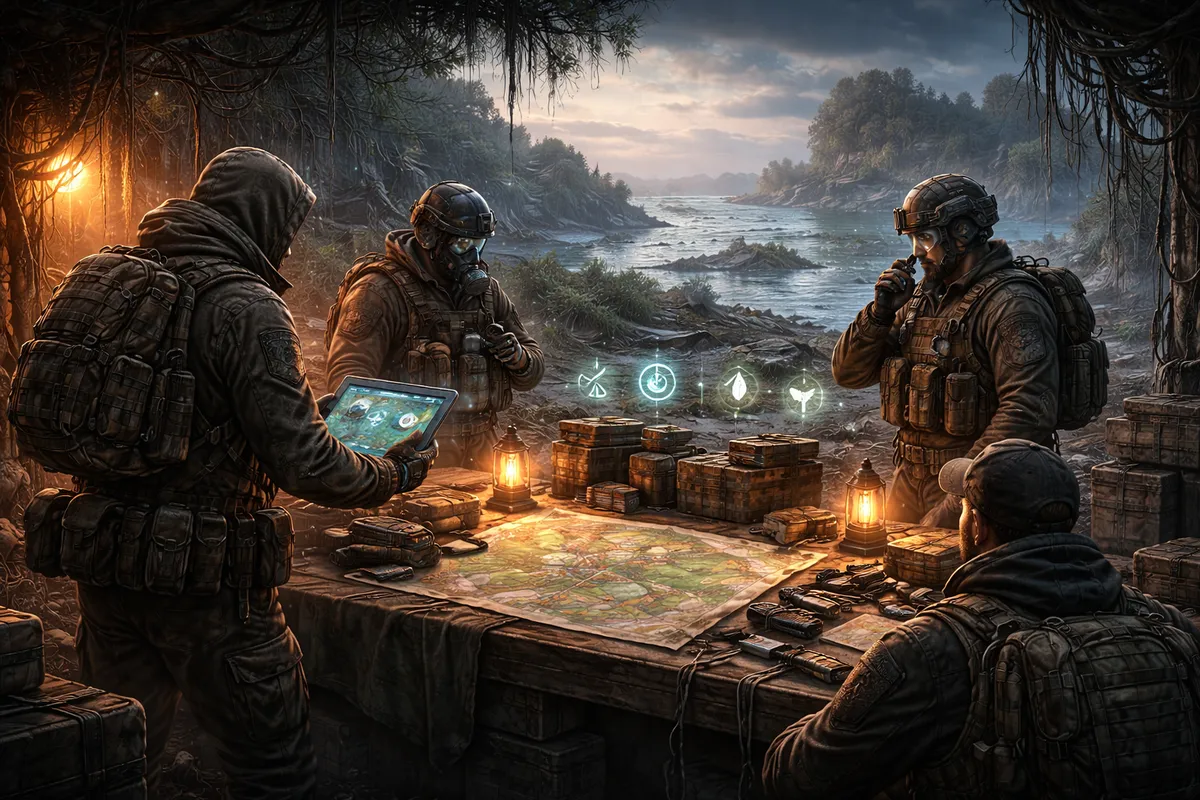
The Big Rule: PIONER Doesn’t Force Classic Roles—So You Create Practical Roles
PIONER’s developers have been clear about one crucial detail: there are no classic MMO combat roles (no locked-in “tank/healer/DPS”). However, players can upgrade and build their characters to imitate certain roles in everyday gameplay, and skill still matters most.
That’s perfect news for co-op, because it means:
- You don’t need a “healer class” to be the support player.
- You don’t need a “tank class” to be the frontline anchor.
- You can swap roles between runs depending on the mission, the zone, and the loot goal.
So when this guide talks about “roles,” it means jobs, not classes:
- Who scouts?
- Who anchors?
- Who interacts with objectives?
- Who controls loot pace?
- Who calls extracts?
If your squad answers those questions, you’ll feel organized instantly—even before you improve aim.
Squad Role Templates That Actually Work
Use these role templates as plug-and-play. You can run them as a duo, trio, or full group. Swap roles based on who’s best at what.
Point / Scout (the eyes)
Job: spot threats early, choose lanes, prevent ambushes.
Habits:
- moves first but never too far ahead
- checks angles before the squad enters
- calls “hold” and “rotate” early
- Loadout priorities:
- reliable mid-range control
- stamina/sustain-friendly supplies
- utility that helps disengage or reposition
Anchor / Stabilizer (the spine)
Job: keep fights controlled, prevent flanks, stop panic.
Habits:
- plays cover and holds the “safe” angle
- doesn’t chase kills
- protects resets (heals, reloads, looting windows)
- Loadout priorities:
- consistent weapon handling
- extra ammo and sustain
- tools that punish pushes
Objective Runner (the hands)
Job: interacts with mission items, triggers steps, handles timed tasks.
Habits:
- stays alive more than they chase kills
- communicates clearly when interacting (“cover me,” “starting,” “done”)
- keeps inventory space for quest items
- Loadout priorities:
- fast handling
- survivability and mobility
- a secondary that saves them in close contact
Flank / Pressure (the finisher)
Job: ends fights quickly so the squad can loot and leave.
Habits:
- moves only when the anchor is stable
- takes short, decisive angles
- backs off fast if timing is wrong
- Loadout priorities:
- close-to-mid pressure weapon behavior
- strong secondary swap
- limited but impactful utility
Quartermaster / Loot Lead (the wallet)
Job: controls loot pace, calls extract thresholds, prevents stash chaos.
Habits:
- sets “profit threshold” before the run
- calls “30-second loot” after fights
- tracks consumable burn and repair risk
- Loadout priorities:
- efficient ammo use
- inventory space discipline
- tools to escape when the bag gets valuable
In a duo, the simplest setup is:
- Player A: Point + Objective Runner
- Player B: Anchor + Quartermaster
In a trio:
- Player A: Point
- Player B: Anchor
- Player C: Flank + Objective Runner
- (Quartermaster job can rotate.)
Loadout Synergy: How to Build Kits That Help the Team
Because PIONER doesn’t lock you into classes, your “team comp” is mostly about range coverage, reset speed, and fight endings.
A strong squad loadout does three things:
- Covers close, mid, and “across the area” distances.
- Allows at least one player to reset safely while others cover.
- Ends fights fast enough to avoid a second wave (PvE swarms, third parties, extra patrols).
Range coverage rule (simple and effective):
- At least one player specializes in mid-range control (anchor).
- At least one player is comfortable close-range (flank/finisher).
- The point player is flexible and prioritizes survivability.
Utility coverage rule:
- Don’t stack the same utility on everyone.
- One player brings disengage-focused utility; another brings fight-ending utility.
- Overlap only on essentials (basic sustain).
Sustain rule:
- If everyone runs “just enough” healing, the squad collapses on long objectives.
- If everyone runs “too much,” you sacrifice loot space and profits.
- Pick one player (often the anchor) to carry the small extra buffer.
Comms That Win: A Simple Language Your Squad Can Copy
Most squads don’t lose because they didn’t see danger. They lose because comms were messy. PIONER co-op becomes dramatically easier when you use a structured callout style.
The 5-word contact report (say this first):
“Contact / Where / Distance / Count / Intent.”
Examples:
- “Contact, left ridge, mid, two, holding.”
- “Contact, building ahead, close, one, pushing.”
- “Contact, behind us, mid, unknown, rotate.”
Then add only one helpful sentence:
- “I’m anchoring this angle.”
- “I’m flanking right.”
- “I’m doing objective—cover.”
The three comm levels
- Macro comms: route, objective order, extraction timing.
- Micro comms: contact reports, angle calls, “reload/heal/cover.”
- Economy comms: loot threshold, repair risk, “one more objective or extract.”
Most squads talk only micro comms. Rich squads talk all three.
The no-blame rule
Never say: “Why did you do that?” during a fight.
Say: “Reset,” “Rotate,” “Hold,” “Cover,” “Extract.”
Review mistakes after you’re safe. In PIONER, mid-fight blame is just delayed panic.
Map Discipline: Marks, Routes, and Simple Planning
A squad without a route is a squad that bleeds time and resources.
PIONER’s UI and controls support navigation habits (map access, marking, and a social menu), and patches have included stability fixes for chat and larger player capacity changes across different locations. That implies a living world where density varies—so route planning is not optional.
Route planning basics
- Pick one anchor objective (main quest step, dungeon entrance, world event).
- Add 1–3 stackable side objectives along the same direction.
- Identify two exits: primary extract and backup extract.
Marking discipline
- Mark the next waypoint, not the entire journey.
- Use marks for:
- entry point
- “reset spot” (safe cover cluster)
- extraction direction
- danger zones you heard fights from
A mark is not decoration. It’s a shared brain.
The Stacked Objective Method for Co-op PvE Missions
PIONER emphasizes quests, errands, events, and factions—and it’s built so tasks can be done alone or in a group. That means co-op PvE becomes a speed game: how many rewards can you collect per trip without turning it into a marathon?
The stacked objective method (team version)
- Choose one anchor mission.
- Each player grabs 1–2 side missions that overlap location or enemy type.
- Agree on one “leave condition” before you start:
- bag value threshold
- consumable threshold (ammo/heals)
- objective completion threshold (anchor done = leave)
- Run the route, loot lightly, and extract.
Why this works
- Less travel time.
- Less random fighting.
- More predictable resource use.
- Better mission chaining, which accelerates workbench progression and upgrades.
If your squad is always broke, you’re usually doing the opposite: one mission, too much wandering, too many fights, and a late extract.
Open World Safety: Movement Formations That Reduce Surprise Losses
Co-op is not only about firepower. It’s about being harder to ambush.
Use these formations depending on terrain:
Column (tight paths, interiors)
- Point leads
- Objective runner stays second
- Anchor covers rear/side
- Rules:
- never sprint through doorways blind
- pause at corners for a half-second scan
- let the anchor “own” the rear angle
Wedge (open terrain)
- Point in front
- Anchor slightly behind, centered
- Flank slightly wide to one side
- Rules:
- keep spacing so one surprise doesn’t hit everyone
- move cover-to-cover, not shortest path
- stop together, not one by one
Box (high-threat zones)
- Assign four angles:
- front (point)
- left (flank)
- right (objective runner or flex)
- rear (anchor)
- Rules:
- rotate angles when changing direction
- announce when you swap lanes
Most co-op deaths happen during travel, not during planned fights. Formations fix that.
Team Loot Rules: The Fastest Way to Stay Friends and Stay Rich
Loot problems break squads faster than bosses do. Solve it with rules before you leave the hub.
The “one sentence” loot agreement
Choose one:
- “Need before greed for upgrades.”
- “Equal split on big drops.”
- “Quartermaster assigns based on roles.”
- “Everyone keeps their own loot—trade later.”
Then add one rule for rare pieces:
- “If it’s a direct upgrade for someone’s main kit, they get first claim.”
- Or:
- “We roll/rotate claims—no arguments.”
The 30-second loot rule
After any fight:
- Loot essentials first (ammo/heals/compact value).
- Don’t sort in the open.
- Move to cover, then decide.
- Leave the fight location quickly.
PIONER’s world rewards survival and extraction. Looting slowly is how you turn wins into losses.
Team Economy: How to Fund the Squad Without Burnout
A great squad isn’t just stronger—it’s more sustainable.
PIONER patches have repeatedly touched economy systems, trader behavior, resource stacking, conversions, and durability changes. The message is clear: money is part of the loop, and smart teams manage it.
Squad economy rules
- Run two kit tiers:
- Farm kit for missions and materials
- Push kit for raids, hard objectives, high-risk zones
- Don’t bring push kits into farm loops “because it feels safer.” Repairs will eat you alive.
- Convert runs into upgrades immediately:
- sell surplus
- craft the next meaningful step
- restock essentials
- stop shopping emotionally
The “squad restock list”
Agree on a standard restock so nobody is always underprepared:
- ammo baseline
- healing baseline
- food/rest baseline
- one emergency tool category
Consistency reduces avoidable wipes, and fewer wipes means fewer grind sessions.
World Events as Co-op Content: Arrive Ready, Leave Rich
PIONER’s updates have added and refined world events, including named events, and even added fast travel points to world event locations. That’s a giant hint: world events are meant to be a repeatable group loop.
World event squad plan
- Arrive with at least 30–40% free inventory space.
- Assign roles on arrival:
- point watches entry lanes
- anchor holds the stable angle
- objective runner focuses on event steps
- quartermaster watches bag value and calls extract timing
- Decide your exit plan before the event ends:
- where you regroup
- where you rotate out
- what counts as “enough”
The biggest event mistake
Winning the event, then staying too long because everyone is excited.
Events attract attention. Your job is to convert the win into loot at home.
Global Quests and World Boss Moments: How Squads Handle Chaos
Global quests and world boss encounters are built to create big moments, which usually means:
- multiple threats
- unpredictable third parties
- high resource drain if your squad panics
The calm squad rules
- Anchor calls tempo: “hold,” “reset,” “rotate.”
- Point calls threats early, not loudly.
- Flank only moves when the anchor says the fight is stable.
- Quartermaster calls “leave condition” the moment it’s met.
Chaos punishes squads who freestyle. Structure turns chaos into profit.
Raids 101: Why Raids Reward Coordination (Not Just Damage)
PIONER’s raid content has been framed as large-scale PvE designed to test coordination, skill, and firepower—exactly what co-op squads are built for.
If your squad struggles in raids, it’s usually not because you lack damage. It’s because you lack:
- stable roles
- clean comms
- reset discipline
- inventory discipline (showing up full, overpacked, or underprepared)
Raid success formula
- clear roles
- short callouts
- consistent positioning
- planned “reset windows” (heal/reload/loot discipline)
- one person calling the pace
Make one person the raid caller (often the anchor). Too many leaders is slower than one good leader.
Crash Site Training Raid: Turn It Into a Squad Skill Builder
Training raids exist for a reason: they let you build team habits in a less punishing environment before you push harder content.
Use Crash Site as practice for:
- contact reports and short callouts
- “cover me while I interact” discipline
- spacing and formation
- reset habits (heal/reload behind cover)
- loot discipline after fights
A simple rule that upgrades your team instantly
After every room/encounter, do a 10-second regroup:
- “Ammo check.”
- “Heal check.”
- “Inventory space check.”
- Then move.
Those checks prevent 80% of “stupid wipes.”
Manufacture Raid: The Squad Rules That Make Attempts Cleaner
Manufacture has been presented as a raid built to test coordination and firepower. Even without memorizing mechanics, your squad can massively improve attempt quality with universal raid rules.
The three-lane rule
Split attention into lanes:
- front lane (point)
- side lane (flank)
- rear/reset lane (anchor)
- Objective runner moves only when lanes are stable.
The reset window rule
When someone says “reset,” everyone does:
- stop chasing
- return to cover
- heal/reload
- re-establish lanes
- Then re-engage.
The “no solo hero” rule
If one person runs ahead for “one more kill,” you risk splitting spawns, splitting aggro, or splitting attention. Raids punish that.
Bastion and Havenari Manufactory: Preparing for Harder Difficulty
Patches have highlighted raid fixes and referenced harder versions (including “hardcore” access fixes and even “extreme-difficulty” encouragement in update notes). The main lesson is that harder raids demand more discipline, not just better gear.
Hard-raid preparation checklist
- Upgrade one reliable main weapon path first (consistency > flashy power).
- Repair only the committed kit you’ll run in the raid.
- Bring controlled consumables:
- enough for one full attempt + buffer
- not so much you lose loot space
- Decide failure protocol:
- when you reset
- when you extract
- when you stop for the day
Most squads lose hard raids because they keep chaining attempts while tilted and understocked. Discipline keeps attempts high quality.
Crab Island Raid Quest: Planning Attempts Without Wasting a Night
Updates have clarified access requirements for the Crab Island raid: entry conditions were adjusted so it becomes available only after an initial encounter and from a specific hub route.
That means Crab Island should be treated like a planned operation:
- don’t show up “just to see” if you can enter
- don’t start it with half a kit
- don’t arrive with a full inventory
Crab Island attempt blueprint
- Start at the correct hub route with clear roles already assigned.
- Do a quick warm-up run first if your squad hasn’t played together that day.
- Set the attempt limit:
- “Two attempts, then convert and stop.”
- This prevents the fatigue spiral where your comms get sloppy and you burn your economy.
Shadowlands With Friends: How Co-op Changes PvP Zones
PIONER highlights special PvP areas like the Shadowlands, where you can go alone or with a group for player loot and rare equipment opportunities. Co-op changes everything there because:
- you can control angles
- you can cover looting
- you can rotate safely
- you reduce the “random wipe” variance
Shadowlands team rules
- Never loot without overwatch. One person loots, one person covers.
- End fights fast or disengage. Long fights attract more players.
- After any win, rotate away before sorting inventory.
- Use a strict extraction threshold. When the bag is valuable, the squad becomes conservative.
A disciplined duo often outperforms a noisy squad. If your group is larger, make sure your comms and movement are even tighter.
Clan Play: Wars, Outposts, Resource Points, and Profit
PIONER frames clan activity as more than social: joining clans can be “more fun (and profitable),” clans can declare wars, fight for outposts or map spots, and conquer resource points to earn money. That’s important because it means co-op strategy isn’t only “combat tactics”—it’s also objective strategy.
Best clan habits for small squads
- Start as a reliable strike team:
- capture/hold small objectives
- escort resource runs
- defend map spots during conflict windows
- Run consistent schedules:
- same nights, same roles
- short sessions with clear goals
- Focus on economic outcomes:
- resource point control
- safe extraction of valuable items
- reliable conversion into upgrades
Clans reward the squad that shows up organized, not the squad that shows up loud.
Structured PvP Practice: 6v6 Brawl and Deathmatch as Skill Accelerators
PIONER has featured structured PvP like Deathmatch and 6v6 Brawl (with maps like Dawn added in updates). Even if your main goal is co-op PvE, structured PvP is the fastest way to train:
- aim under pressure
- short callouts
- spacing and peeking discipline
- fast target switching
- “reset” timing
Use structured PvP like practice
- Don’t judge your squad by win/loss at first.
- Judge by:
- cleaner comms
- fewer double-peeks
- better spacing
- faster regroup after mistakes
Then bring those habits back to raids and Shadowlands.
The 30-Minute Squad Training Routine
If your team wants fast improvement without grinding forever, do this routine before a big run:
10 minutes: comms drills
- One person calls routes.
- Everyone uses the 5-word contact report.
- Practice “reset” calls.
10 minutes: movement discipline
- Run a short mission area focusing on formations:
- column indoors
- wedge outdoors
- Goal: nobody gets caught alone.
10 minutes: loot discipline
- Practice the 30-second loot rule.
- Quartermaster calls extract threshold once.
- Everyone extracts on time.
This routine isn’t glamorous. It’s how squads become consistent.
Common Co-op Mistakes (and Fast Fixes)
Mistake: Everyone talks at once
Fix: one raid caller, one point caller, everyone else short callouts.
Mistake: Everyone loots at the same time
Fix: overwatch rule—someone always watches.
Mistake: No leave condition
Fix: set a profit/consumable/objective threshold before you start.
Mistake: Chasing fights during missions
Fix: fight only for route control or objective completion.
Mistake: Overpacking consumables
Fix: use a standardized restock list and stop shopping emotionally.
Mistake: Trying to force classic tank/healer roles
Fix: use practical roles (point/anchor/runner/quartermaster) and build kits that support those jobs.
Mistake: Turning raids into endless attempts
Fix: set attempt limits and convert loot between attempts.
BoostRoom
If you want your co-op squad to feel organized fast—without weeks of trial-and-error—BoostRoom helps you build real team structure in PIONER.
BoostRoom can help your group with:
- practical squad roles that fit PIONER’s “no classic roles” design
- comms templates that keep fights short, calm, and winnable
- route planning for missions, events, raids, and Shadowlands runs
- loot rules that prevent drama and increase profit per session
- raid prep habits that reduce wipes and wasted attempts
- progression planning so your team gets stronger together instead of drifting apart
The goal is simple: fewer messy runs, more clean extracts, and a squad that feels like a unit.
FAQ
Can you do most PIONER content in co-op?
Yes. PIONER frames tasks and activities as doable either in a group or alone, and it explicitly encourages grouping for journeys, PvP areas, and dungeons/raids.
Does PIONER have tank/healer roles?
Not in the classic MMO sense. Instead, you can build and upgrade your character to imitate practical roles, but player skill and teamwork matter most.
What are the best squad roles for beginners?
Point/Scout, Anchor, and Objective Runner are the easiest to start with. Add a Quartermaster mindset for loot and extraction timing.
How do we stop wiping during travel between objectives?
Use simple formations (column indoors, wedge outdoors), keep spacing, and have the anchor protect the rear/reset lane while the point calls danger early.
How do we avoid loot arguments?
Agree on one loot rule before you leave (need-before-greed, equal split, quartermaster assigns, or keep-your-own then trade). Then use the 30-second loot rule after fights.
What’s the biggest communication upgrade a squad can make?
Use a short contact report: “Where / Distance / Count / Intent,” then one sentence about your action (“anchoring,” “flanking,” “doing objective”).
How should a squad practice for raids?
Treat the training raid (Crash Site) as a teamwork drill: roles, comms, resets, and loot discipline. Then apply the same structure to larger raids.
Why do we feel slow even when we win fights?
Because your squad likely lacks macro planning: stacked objectives, leave conditions, and post-run conversion. Winning fights isn’t progress unless you extract and convert rewards into upgrades.



