Online Video Games Economy 101: The Big Picture
An online video game economy is simply the system that creates, distributes, and values digital items. These items might be cosmetic (skins, outfits, emotes), functional (weapons, power-ups), or collectible (limited editions, event exclusives). Even when items don’t affect gameplay, they can still become valuable because players care about:
- Identity (how you look in-game)
- Status (rare items feel prestigious)
- Belonging (matching a friend group or community style)
- Memories (event items tied to a season or milestone)
- Creativity (customization and self-expression)
- Convenience (in some games, items save time or unlock features)
Economies exist whether trading is allowed or not. The difference is:
- Closed economy: items are bought from the game and stay on your account (no player-to-player trade)
- Open economy: items can move between players (trading/reselling), creating a real marketplace behavior
A healthy mindset: this is an entertainment economy, not a guaranteed way to “make money.” Prices can move fast, rules can change, and the safest approach is to treat spending like you would treat buying a movie ticket: pay for enjoyment, not profit.
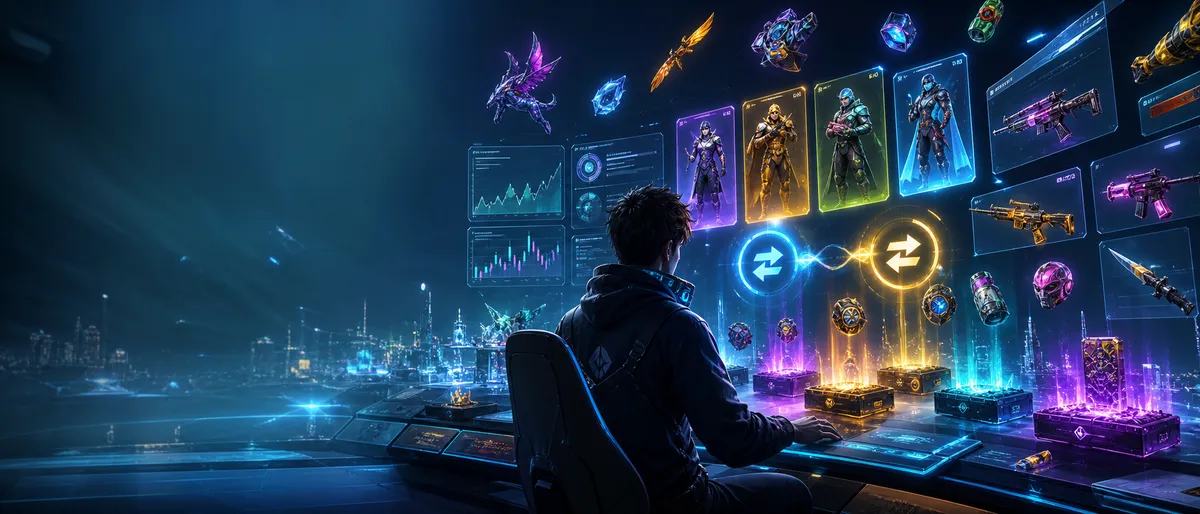
Skins and Cosmetics: Why People Pay for “Looks”
Skins are digital cosmetics that change how something looks—your character, weapon, vehicle, ability effects, banners, and more. They don’t have to affect gameplay to be valuable, because cosmetic value is driven by human psychology and social play:
- Visibility: If you see your character or weapon constantly, cosmetics feel more “worth it.”
- Social proof: Rare cosmetics signal experience, time invested, or event participation.
- Aesthetic preference: Some designs are simply more popular.
- Community culture: A skin can become iconic because streamers, esports, or memes made it famous.
- Attachment: Players get emotionally tied to items they used during “good seasons.”
Cosmetics also feel safer than pay-to-win purchases because they don’t directly change competitive results. Many players accept cosmetics as fair monetization—especially when prices are transparent and optional.
Types of Digital Items: Tradable, Account-Bound, and Everything Between
Before you think about value, you need to know what kind of item you’re dealing with. Most games use some combination of these categories:
- Account-bound (non-tradable): Once you buy or earn it, it stays on your account. Value is personal (how much you like it), not market-based.
- Tradable: The item can be exchanged directly between players or resold in a marketplace.
- Limited tradable: Tradable, but only under certain conditions (subscription required, region restrictions, holding periods, age rules, etc.).
- Time-limited availability: Not tradable, but only obtainable during a season/event. These items gain “social rarity” even without a market.
- Crafting materials / currencies: Often non-tradable, but they influence how quickly items can be created.
- Creator-made items: Some platforms allow creators to sell cosmetics; demand becomes tied to creator reputation and trends.
The biggest “beginner surprise” is this: not all rarity is tradable rarity. An item can be rare because it was available for one weekend, but if it can’t be traded, the value is mostly emotional and personal.
Rarity: How Games Create Scarcity
Rarity is a design tool. Games create scarcity through controlled supply, limited time, or difficulty. Here are the most common scarcity methods:
- Limited supply: Only a set number of copies exist.
- Limited time: Available only during an event or season.
- Progression gates: Requires completing a long grind or high difficulty challenge.
- Skill gates: Requires winning tournaments, ranked milestones, or hard achievements.
- Randomized acquisition: You might not get the item even after many tries (this is where “random items” systems create risk).
- Rotating shops: Items appear and disappear on a schedule.
- Creator drops: Creator-made items may have limited availability or limited mint quantity depending on platform rules.
Important: rarity alone doesn’t guarantee value. Many rare items are unpopular. Value usually happens when scarcity meets high demand.
Supply and Demand: The Actual Engine of Value
If you remember one concept, remember this:
Market value = how many people want it vs how many copies are available.
Value rises when:
- demand increases (more people want the item)
- supply decreases (fewer items available)
- both happen at the same time
Value falls when:
- a re-release increases supply
- the game’s popularity declines
- new cosmetics replace the “meta look”
- the platform changes rules (fees, trading limits, eligibility)
This is why prices in some game economies can change quickly after:
- a new season drops
- a big update changes visuals
- a platform changes trading rules
- creator trends shift
- certain items become “fashionable” again
For most players, the best approach is: buy items you truly enjoy, and if trading exists, treat resale as a bonus—not a plan.
What Makes One Skin Worth More Than Another
Players often assume the most expensive item is the “rarest.” Sometimes that’s true, but value is usually a stack of multiple factors:
- Visual appeal: Clean design, strong color combos, iconic theme
- Popularity: Items tied to famous moments, esports, stream culture
- Scarcity type: Limited supply beats “common but old”
- Condition/variant: Some items have condition grades or hidden attributes
- Compatibility: Works across many characters/weapons (more usable = more demand)
- Status signaling: People recognize it instantly
- Trust and safety: Items that are easily traded on official systems feel safer (more buyers)
Value can also be influenced by “collector logic”:
- completing a set
- owning a specific series
- chasing a rare version (pattern, number, special effect)
Collectors can raise demand even if the item is not widely used in gameplay.
Condition, Variants, and Hidden Attributes
Some online games use item attributes that change value even when two items look “the same” at first glance. Common examples include:
- Wear/condition levels: The item can be “new” or “worn,” changing how it appears.
- Pattern variations: The texture pattern might generate differently, creating rare looks.
- Serial numbers: Limited items may have serial IDs; lower numbers can be more desirable.
- Special counters: Some items track stats or kills, which some buyers prefer.
- Event tags: Items tied to specific events or seasons can be more collectible.
- Edition differences: Same theme, different release wave or version.
These systems create “micro-rarity” inside a broader rarity tier—meaning the economy becomes more detailed than a simple “rare vs common” label.
A key safety point: if you’re new, don’t let micro-details pressure you. Micro-rarity is where people overpay because they don’t understand what they’re buying.
Trading and Marketplaces: How Trades Usually Work
Trading systems come in a few major formats:
- Direct trades: You and another player exchange items directly (sometimes with confirmation steps).
- Central marketplace: You list an item, someone buys it, and the platform handles delivery.
- Auction-style listings: Items can have bids, asks, or timed auctions.
- Resale marketplaces: You purchase an item and later re-list it (if platform rules allow).
Official marketplaces tend to be safer because they:
- record transactions
- enforce platform rules
- reduce fake “middleman” scams
- include account protections like trade confirmations
Unofficial, DM-based trading tends to be riskier because:
- there is less protection
- scammers use pressure and fake proof
- disputes are harder to resolve
If you’re a teen, the safest approach is to use official marketplace features and avoid DM deals that require trust in a stranger.
Fees, Holds, and Limits: Why Your “Value” Isn’t Always What You Receive
Most marketplaces charge fees. That matters because the sticker price isn’t always what the seller receives.
Common fee patterns:
- Platform transaction fee: The marketplace takes a percentage.
- Publisher/game fee: Some ecosystems add an extra game-specific cut.
- Minimum fee rules: Small transactions may have minimum fees.
- Creator revenue splits: Creator-made platforms may split revenue between creator and platform.
These fees affect value in two ways:
- Resale pricing: Sellers price higher to account for fees.
- Buyer cost: Buyers pay more than the seller receives.
Holding periods and trade holds also matter. Many platforms use holds to reduce fraud:
- new accounts may be restricted
- newly purchased items may be “locked” for a period
- newly enabled security features may have a waiting period before holds disappear
This is not only annoyance—it’s a safety mechanism. Economies without friction become scam playgrounds.
Real Examples of How Modern Game Economies Work
To keep this guide practical, here are examples of real rule types you’ll see in major ecosystems. Treat these as examples of “how platforms think,” not as instructions to chase profit.
Example: marketplace transaction fees
Some well-known marketplaces use a base fee (like a platform cut) and may also apply an additional game/publisher fee for certain game economies. This is why the buyer’s price and seller’s received amount can differ.
Example: trade holds to prevent theft
Some systems impose a holding period when account security changes, such as adding an authenticator or changing login protections. The idea is to stop instant theft: if an attacker takes over an account, the hold creates time to recover it.
Example: subscription-gated trading
Some platforms require a paid subscription tier to enable trading or resale. That reduces spam accounts and adds friction to mass scamming.
Example: holding periods after purchase
Some resale systems prevent immediate flipping by locking newly acquired limited items for a period (days to weeks). That reduces abuse and creates more stable markets.
The key takeaway: every big marketplace is trying to balance three things:
- fun collecting
- fair monetization
- fraud prevention
Rarity Tiers: How “Common to Legendary” Labels Actually Function
Many games use rarity tiers (common, rare, epic, legendary, etc.). These labels can mean different things depending on the game:
- In some games, rarity tiers are purely cosmetic labels that match color themes.
- In others, rarity tiers correspond to drop rates or limited-time availability.
- In tradable economies, rarity tiers can affect supply and set baseline price expectations.
But rarity tiers are not the full story. Two items in the same tier can have wildly different prices because:
- one is popular and looks better
- one is part of a beloved set
- one has a rare variant/condition
- one is newer and trending
- one is old but forgotten
So treat rarity as a starting clue, not a final answer.
Price Signals: How to Read a Marketplace Without Getting Tricked
If you want to understand value (without turning it into stress), learn how marketplaces signal price.
Important signals:
- Floor price: the cheapest available listing at the moment
- Recent sales: what people actually paid (more reliable than listings)
- Volume: how many sales happen per day/week (high volume = more stable pricing)
- Spread: the gap between buyer offers and seller asks (wide spread = more uncertainty)
- Listing depth: how many items exist near the floor (thin depth = easier to spike)
Beginner-friendly rule:
Recent sales matter more than listings.
Listings can be wishful thinking. Sales are reality.
Safety rule:
If a price “looks too good,” assume there’s a catch:
- wrong item variant
- wrong condition
- fake trade attempt
- scam link
- region restriction
- hidden fees
The Value Traps: FOMO, Random Rewards, and “It’ll Never Return”
The fastest way players overspend is not greed—it’s panic.
Common value traps:
- FOMO timers: “limited time only”
- Rotating shops: “it might not come back”
- Bundle pressure: “best value” bundles that include things you don’t want
- Currency fog: buying “gems/coins” makes prices feel less real
- Progress bars: “just a few more tiers”
- Social pressure: “everyone has this skin”
The safest mindset:
If an item makes you feel anxious, pause.
Waiting 24 hours prevents most regret buys.
Random Items and Loot-Style Systems: What Parents and Teens Should Know
Some online video games sell randomized items—where you pay and don’t know exactly what you’ll receive. These systems can feel exciting, but they can also lead to overspending because the reward is uncertain.
Important safety points:
- Random rewards are not a “plan.” They are a gamble with your money.
- If you’re under 18, randomized purchases should be treated with extra caution and family spending rules.
- Many regions and regulators push for clearer disclosure around randomized paid items and the real cost of multi-currency systems.
Beginner rule:
If you care about value, buy what you can see (direct purchase cosmetics) rather than chasing random outcomes.
Scams in Trading Economies: The Most Common Patterns
Trading economies attract scammers because people get excited and move fast. Here are the scams that show up again and again:
- Phishing links: “log in to confirm the trade”
- Fake support messages: “your item is flagged”
- Verification code scams: “send me the code to prove it’s you”
- Fake middleman scams: “use my trusted middleman”
- Look-alike item swaps: item name/icon looks similar but is not the same variant
- Pressure tactics: “deal ends in 5 minutes”
- Off-platform payment scams: pushing gift cards/crypto or methods with no protection
If you learn these patterns, you avoid most losses automatically.
The Safe Trading Rules (Non-Negotiable)
These rules are simple, but they stop the majority of marketplace disasters:
- Never share passwords or one-time codes.
- Never log in through links from DMs.
- Don’t trade in a rush—double-check the item variant and what you’re receiving.
- Prefer official marketplaces and in-app trading systems.
- Avoid deals that require “trusting a stranger” outside platform protections.
- Don’t use irreversible payment methods for strangers.
- Use strong account security (2FA/passkeys) and keep recovery info updated.
- If a deal makes you feel pressured, walk away.
Walking away is a skill. In digital economies, patience is safety.
A Teen-Friendly Spending System for Cosmetics
If you’re a teen (or a parent reading this), here’s a simple system that keeps spending safe and drama-free:
- Set a monthly limit before browsing the shop (even if it’s $0).
- Use approval tools if a family payment method is connected.
- Use the 24-hour rule for any limited-time offer.
- Never spend while tilted after losing matches.
- Track total spending once a month so small purchases don’t add up silently.
- Choose one “main game” to spend on (spending on five games at once is how budgets disappear).
Cosmetics should feel fun, not stressful. A budget is what keeps it fun.
How to Think About “Value” Without Treating Skins Like Investments
It’s normal to notice that some items rise and fall in price. But treating skins as an “investment plan” can easily lead to regret because:
- game rules can change
- items can be re-released
- fees and restrictions can shift
- trends move fast
- markets are emotional
A healthier definition of value:
- Personal value: how much you enjoy it and use it
- Social value: how it fits your identity, squad vibe, or community
- Market value (when trading exists): what others are currently paying
If you focus on personal value first, you’re far less likely to feel scammed by the economy.
BoostRoom: Why Skill Often Has Better “Value” Than Cosmetics
Skins are fun, but skill is the only upgrade that works across:
- seasons
- patches
- new metas
- even entirely different games
If you’re spending money in online games and you want long-term payoff, consider a balance:
- cosmetics for fun and identity
- skill-building for better matches, less frustration, and more wins
BoostRoom is designed around skill-based services that keep you safe:
- coaching sessions that teach fundamentals and decision-making
- VOD/replay reviews that show exactly what to fix
- duo/squad training that improves teamwork and communication
- settings guidance (FPS, sensitivity, audio clarity) for consistency
A practical way to use BoostRoom:
If you’re tempted to overspend because you feel stuck or frustrated, pause and invest in improvement instead. Better skill reduces tilt, reduces “panic spending,” and makes the whole game more enjoyable—without needing risky shortcuts.
Practical Rules: Your Economy Checklist (Copy This)
Use this checklist any time you interact with an online game economy.
- I know whether the item is tradable or account-bound.
- I understand fees and holding periods that affect resale.
- I check recent sales, not just listings.
- I confirm item variant/condition before buying or trading.
- I avoid rushed deals and pressure tactics.
- I never click “login” links from DMs.
- I never share passwords or verification codes.
- I use 2FA/passkeys and keep recovery info updated.
- I set a monthly spending limit before browsing.
- I treat random paid rewards as high-risk for overspending.
- I keep cosmetics fun—not stressful.
- If I want progress, I invest in skill (practice or BoostRoom coaching) instead of chasing “quick fixes.”
FAQ
What is an online video game economy?
It’s the system that creates and prices digital items—cosmetics, collectibles, and sometimes functional items—through supply rules, demand, and platform restrictions like fees and trading limits.
Why do skins have value if they don’t affect gameplay?
Because players care about identity, aesthetics, rarity, and community status. In tradable economies, value also comes from limited supply and marketplace demand.
What does “rarity” actually mean?
Rarity can mean limited supply, limited-time availability, difficulty to earn, or low drop frequency. But rarity only becomes expensive when demand is also high.
How do marketplace fees affect value?
Fees mean the buyer’s price and the seller’s received amount can differ. Fees also influence listing prices and can reduce how much value you recover when reselling.
Why do some platforms use holding periods?
Holding periods and trade holds reduce fraud and account theft. They create time to recover accounts if someone tries to steal items quickly.
Are random paid items (loot-style systems) worth it?
They’re risky because you pay without knowing what you’ll get. If you care about value and budgets, direct purchases are usually safer than randomized outcomes.
What’s the safest way to trade or buy items?
Use official marketplace and in-game trading systems, keep account security strong, avoid DM links, and never share passwords or verification codes.
How can BoostRoom help if I’m spending a lot on games?
BoostRoom helps you improve skill and enjoyment so you’re less likely to overspend out of frustration. Coaching and VOD reviews can give lasting progress that cosmetics can’t.



