Why Communication Wins More Than Aim
In most online video games, your team doesn’t lose because everyone missed shots. Teams lose because people are doing different plans at the same time. Communication fixes that by turning five separate players into one coordinated unit.
Good comms give you:
- Earlier information (you see danger before it reaches you)
- Faster decisions (less hesitation, fewer split pushes)
- Cleaner teamwork (trades, spacing, focus fire, objective timing)
- Calmer matches (less panic, fewer tilt spirals)
- More consistent wins (especially in close games)
A simple truth: when both teams have similar skill, the team with clearer comms wins more of the close moments.
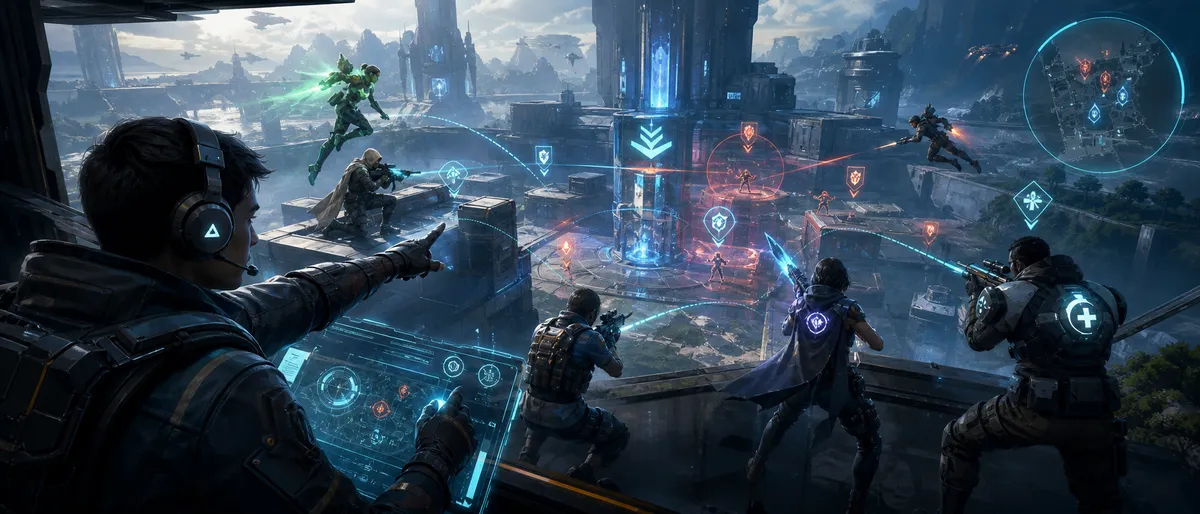
The 3-Part Communication System
Strong teams communicate in three layers. If you only use one layer, comms feel messy.
- Information: what is happening right now (enemy location, numbers, resources, timing)
- Intent: what we are going to do next (push, rotate, hold, reset, trade)
- Confirmation: everyone is aligned (“yes,” “on my way,” “holding,” “I can’t”)
Most teams fail because they spam information without intent, or they shout intent without confirming. Pros keep it simple: info → plan → execute.
The Golden Callout Formula: What, Where, How Many, What Next
If you want callouts that instantly improve your team, use this formula:
- What: enemy / objective / threat
- Where: location (short and consistent)
- How many: number of enemies (or “solo”)
- What next: your suggested action (optional but powerful)
Examples you can use in almost any game:
- “Two left side, pushing—play slow.”
- “One behind us—turn and reset.”
- “They’re rotating to objective—rotate early.”
- “Enemy support low—focus them.”
- “We’re down one—don’t fight, reset.”
This format works because it gives teammates enough context to react correctly—without a long explanation.
Callout Timing: When to Speak and When to Stay Quiet
Good comms aren’t “talk more.” They’re “talk at the right time.”
Speak when:
- You see danger your teammate doesn’t see yet
- You can prevent a teammate’s death
- You can coordinate a push, trade, or reset
- You can confirm a plan under pressure
- You have a high-impact update (enemy numbers, key resource used, objective timing)
Stay quiet when:
- You’re just venting frustration
- You’re narrating everything you do
- The team is in a clutch moment and needs focus
- Your message is not actionable
A pro habit: silence is a tool. If comms are crowded, the important callout gets lost.
Building a Shared Language: How Great Teams Name Locations
Most teams struggle because they call the same place five different names. This is how you fix that fast:
- Pick the simplest location names your squad agrees on
- Use short names (1–2 words when possible)
- Avoid complicated “storybook” descriptions mid-fight
- Stick to the same terms for a full week
If you don’t know a callout name, use:
- a landmark (“by the stairs,” “behind the truck,” “near the tower”)
- a direction (“left side,” “right side,” “top,” “bottom”)
- a reference point (“on objective,” “at our spawn,” “by the door”)
Then after the match, agree on a better name. Your goal is not perfect callouts. Your goal is consistent callouts.
The Two Rules That Make Callouts Instantly Cleaner
Rule 1: Call the enemy, not your feelings.
Bad: “Why are they everywhere?!”
Good: “Three pushing right side.”
Rule 2: Don’t call what everyone already sees.
If the entire team is staring at the same fight, repeating “he’s right there” adds noise. Call what adds value:
- a flank
- a second enemy
- a low target
- a used ultimate
- a rotation
- a reset
Roles: Why Teams Need Them Even in Casual Modes
Roles are not about being strict. Roles prevent confusion. When everyone knows their job, comms become predictable and calm.
A role answers:
- Where you should be
- What you should focus on
- What information you’re responsible for calling out
Even if your game doesn’t have official roles, your squad can still use role habits.
The Core Team Roles That Exist in Most Online Games
These roles show up across shooters, battle royale, MOBAs, co-op raids, and even sports-style games.
Shotcaller / IGL (in-game leader)
- Decides the main plan: rotate, push, reset, objective timing
- Keeps comms organized (“one plan at a time”)
- Calls when to slow down or speed up
- Best callouts:
- “Reset and regroup.”
- “Rotate early to objective.”
- “Play slow, punish mistakes.”
Entry / Initiator
- Starts fights when the team has advantage
- Creates space and forces reactions
- Needs quick confirmation from team before pushing
- Best callouts:
- “I’m going in now—trade me.”
- “I can start this—ready?”
- “I tagged one—push together.”
Support / Utility
- Stabilizes fights (heals, shields, smokes, info tools, disables, peel)
- Protects teammates during resets
- Tracks team resources (cooldowns, healing, protection tools)
- Best callouts:
- “I can heal in 3.”
- “Utility ready—use it on my mark.”
- “I’m saving peel—play near me.”
Anchor / Defender
- Holds important space so the team doesn’t get flanked
- Plays safer and protects the backline
- Provides calm information rather than chasing fights
- Best callouts:
- “Flank is clear for now.”
- “Two moving toward us.”
- “Hold—don’t overpush.”
Flex
- Fills gaps: helps weak lanes, trades, supports entry, covers flanks
- Adapts based on what the match needs
- Best callouts:
- “I’m rotating to help.”
- “I can cover that angle.”
- “I’m with you—push now.”
Objective Focus
- Keeps the team aligned with the win condition
- Calls timing: “set up now,” “don’t fight here,” “save resources for objective”
- Best callouts:
- “We win by objective—stop chasing.”
- “Set up early.”
- “Hold this space.”
Your team doesn’t need all roles every match. But it helps to assign at least:
- one shotcaller
- one flank watcher/anchor
- one entry/initiator (if the game needs it)
Role Discipline: The Habit Pros Never Break
Role discipline means you don’t abandon your job because you’re bored, angry, or chasing highlights. Most “unfair” losses happen when:
- the anchor pushes too far and the team gets flanked
- the support plays like an entry and dies first
- the entry goes in with no trade support
- everyone chases kills and nobody plays objective
A pro rule: your role is your team promise. Keep it.
The Best Callouts by Role (Copy These)
Use these as your squad’s default language. Short, clear, repeatable.
Shotcaller defaults
- “Reset.”
- “Group.”
- “Rotate early.”
- “Hold and punish.”
- “Play slow.”
Entry defaults
- “Ready to push?”
- “Going in—trade.”
- “I’m forcing them back.”
- “One weak—finish.”
Support defaults
- “I can cover you.”
- “Cooldown ready.”
- “I’m peeling—come back.”
- “Heal/utility in X.”
Anchor defaults
- “Flank watch.”
- “One backline.”
- “They’re rotating.”
- “Hold position.”
Objective defaults
- “We don’t need this fight.”
- “Set up now.”
- “Play objective.”
- “Save resources for next fight.”
When everyone knows these, comms become automatic.
Team Habits: The Difference Between Random Wins and Consistent Wins
Most teams think they need better aim. Often they need better habits.
Here are the team habits that matter most:
- Pre-round plan habit: one simple plan before action starts
- Mid-round update habit: quick updates when the plan changes
- Post-round debrief habit: one lesson, not an argument
- Reset habit: calm regroup after chaos instead of trickling in
- Trade habit: “we fight together or not at all”
- Objective habit: always know the win condition
Teams without habits rely on luck. Teams with habits create repeatable wins.
The 15-Second Pre-Round Plan
Before a round, drop, or push, your shotcaller says one sentence:
- “We rotate early and hold high ground.”
- “We play slow and punish pushes.”
- “We fight together on objective—no solo plays.”
- “We avoid fights until we have resources.”
Then teammates confirm:
- “Yes.”
- “On it.”
- “I’m watching flank.”
- “I need 10 seconds.”
- “I can’t—rotate without me.”
That’s it. One sentence. One confirmation loop. It prevents chaos.
Mid-Fight Communication: The 3 Calls That Matter Most
During action, you don’t have time for speeches. Pros focus on three call types:
- Numbers (how many, advantage or disadvantage)
- “We’re up one.”
- “We’re down one.”
- Low target / focus
- “Support low.”
- “Finish left.”
- Reset or push
- “Reset, reset.”
- “Push now, together.”
If your comms do only these three things well, your team immediately improves.
Post-Round Debrief Without Tilt
Bad debrief:
- blaming
- long arguments
- “why did you do that”
- ego fights
Pro debrief:
- one thing we did well
- one thing we fix next round
- then move on
A perfect 10-second debrief:
- “Good trade.”
- “Next time rotate earlier.”
- “Same plan, stay grouped.”
Pros keep the emotional temperature low, because emotion kills execution.
Communication in Different Game Types
Callouts and roles shift depending on genre. Here’s how to adapt without learning a new language for every game.
Communication for Team Shooters
What matters most:
- numbers (up/down)
- flanks
- focus fire
- utility timing
- objective timing
- trade distance
High-impact shooter callouts:
- “Two pushing A.”
- “Flank behind.”
- “One shot, finish.”
- “Smoke/utility used.”
- “Reset—don’t peek.”
Role focus:
- one caller
- one anchor/flank watcher
- entries coordinate timing (“go now”)
Communication for Battle Royale
What matters most:
- rotations and safe zones
- third-party risk
- team spacing
- resource economy (heals, ammo, shields)
- target focus and disengage timing
High-impact BR callouts:
- “Rotate now—zone pressure.”
- “Don’t fight, we’ll get third-partied.”
- “Team on us—back up.”
- “Cracked one—push together.”
- “Reset behind cover.”
Role focus:
- one rotation caller
- one scout/info watcher
- one stabilizer/support
- entries only push when team can follow
Communication for MOBAs and Objective Strategy Games
What matters most:
- timers and objectives
- vision/info control
- cooldown/ultimate tracking
- lane pressure and rotations
- win condition alignment
High-impact calls:
- “Objective soon—set up.”
- “No ultimate on them.”
- “We fight when cooldowns are back.”
- “Reset and defend.”
- “Group—don’t split.”
Role focus:
- one macro caller
- each role calls their cooldown state and rotation availability
Communication for Co-Op PvE and Raids
What matters most:
- mechanics timing
- assignments and roles
- hazard calls
- recovery and revive calls
High-impact calls:
- “Mechanic incoming—positions.”
- “I’ve got this role.”
- “Need help on left.”
- “Revive now / don’t revive.”
- “Reset phase.”
PvE comms are more like a checklist. Calm clarity beats hype.
Communication for Sports and Racing Online
What matters most:
- spacing and coverage
- rotations
- “who is going” decisions
- tempo (slow down, speed up)
High-impact calls:
- “I’m back.”
- “You go.”
- “Rotate out.”
- “Hold possession.”
- “Cover left.”
Simple comms win because they prevent double-commits and panic.
Voice Chat vs Pings vs Text: What to Use and When
Different tools work for different moments.
Voice chat is best for:
- fast, urgent calls
- coordination (“push now,” “reset now”)
- leadership and tempo control
Pings are best for:
- quick location marking
- silent comms when voice is messy
- cross-language teams
- “I can’t talk right now” situations
Text chat is best for:
- pre-round plan in calm moments
- quick reminders between rounds
- sharing one simple strategy
A strong habit:
- Voice for speed
- Ping for precision
- Text for planning between action
The Most Common Communication Mistakes (And the Pro Fix)
Here are the mistakes that destroy teamwork faster than anything else.
Mistake: Talking too much
- Fix: reduce to info → plan → execute. If it’s not actionable, don’t say it.
Mistake: Arguing mid-match
- Fix: no debates during action. Save feedback for after the round, keep it short.
Mistake: Blame language
- Fix: replace blame with “next plan” language.
- Instead of “You threw,” say “Next time rotate earlier.”
Mistake: Conflicting plans
- Fix: one plan caller. If two plans exist, choose one quickly and commit.
Mistake: No confirmations
- Fix: require simple confirmations:
- “ready”
- “on my way”
- “can’t”
- This prevents half-push disasters.
Mistake: Silent team
- Fix: start with one useful callout per fight. Silence is okay if the team is coordinated, but most random teams need at least basic info.
Mistake: Panic comms
- Fix: breathe, then call numbers and reset options. Calm voice changes team behavior instantly.
The “Clean Comms” Ruleset You Can Adopt Tonight
If you want a simple ruleset your whole squad can follow, use this:
- One shotcaller per match (can rotate between games)
- Call numbers every fight (up one, down one, equal)
- Call flanks immediately
- Call reset early rather than late
- No arguing mid-fight
- No blame language
- Post-round: one good thing, one fix, move on
This ruleset turns random squads into coordinated squads surprisingly fast.
Practice Drills: How to Train Communication Like a Skill
Most people never “practice” comms. They just hope it improves. Pros train it.
Drill 1: The 3-Callout Challenge
For one session, each player must do only three types of callouts:
- enemy location + number
- focus target
- reset/push
This forces clarity and removes clutter.
Drill 2: One Plan Caller
For 5 matches, only one person calls the plan. Everyone else focuses on:
- info updates
- confirmations
- No extra strategies. This builds team alignment.
Drill 3: Silent Match + Ping Only
Play one match with no voice, using pings only. Then play one match with voice. Most teams discover:
- what info they actually need
- when they overtalk
- how to make pings more useful
Drill 4: Post-Fight Debrief Timer
After each match, you get 20 seconds to debrief:
- one thing good
- one fix
- If you exceed 20 seconds, you stop. This prevents blame spirals and builds the habit of concise learning.
Solo Queue Communication: How to Be Helpful Without Becoming Annoying
In solo queue, talking too much can backfire. The goal is to be useful and calm.
Use the “3 useful messages” approach:
- One plan at the start (“Let’s play objective and rotate early.”)
- One key warning mid-game (“Two flanking, don’t overpush.”)
- One reset call when chaos hits (“Reset and group.”)
If teammates are toxic, mute and keep playing your role. Your win rate improves when you protect your focus.
Crossplay Team Communication: Making Mixed Platforms Feel Smooth
Crossplay squads often struggle with:
- voice chat quality
- push-to-talk differences
- party invite confusion
- different map callout habits
Fix it with:
- one shared callout list (simple names)
- one plan caller
- pings used heavily (pings work even when voice is messy)
- clear “ready” confirmations before big pushes
- calm reset language (“back up,” “regroup,” “play slow”)
Crossplay teams win more when they simplify comms and rely on fundamentals instead of perfect tech.
Toxicity-Proof Communication: Stay Calm and Win More
Toxic comms don’t just ruin vibes—they ruin outcomes. The best teams build “toxicity-proof” habits:
- Use calm tone even when losing
- Focus on next plan, not last mistake
- Praise good plays (“nice trade,” “good rotate”)
- Mute early if someone is distracting or abusive
- Keep disagreements short and plan-focused
A powerful mindset: Your voice is a performance tool. Calm voice = calmer team = better decisions.
Practical Rules That Make Your Team Instantly Better
Copy these rules and treat them like a squad contract:
- We call numbers in fights (up/down/equal).
- We call flanks immediately.
- We don’t take solo fights without trade support.
- We have one shotcaller per match.
- We use pings for precision and voice for timing.
- We keep comms short during action.
- We do 10-second debriefs after rounds: one good thing, one fix.
- We stop arguing mid-match.
- We reset early instead of dying one by one.
If your team does this for a week, your matches feel more controlled and your win rate usually rises.
How BoostRoom Helps You Improve Communication Faster
Communication is learnable, but many squads struggle because they don’t know what to fix first. BoostRoom helps remove the guessing.
Ways BoostRoom can help:
- Team coaching sessions: build a simple comms system (callout language, roles, reset rules)
- Duo/squad practice: train trading, spacing, and synchronized pushes
- VOD/replay reviews: identify where communication broke down (late calls, no confirmations, split decisions)
- Role training: teach each player what they should call out based on their role (IGL, support, anchor, entry)
- Consistency routines: short drills and rules your team can repeat every session
BoostRoom is most valuable when you use it to build a repeatable playbook:
- one callout format
- one role structure
- one habit system
- Then your team improves every week instead of relearning everything every night.
FAQ
What are callouts in online video games?
Callouts are short messages that share important information: enemy location, numbers, objective timing, and what the team should do next.
What makes a callout “good”?
A good callout is short, specific, and actionable. The simplest formula is: what + where + how many + what next.
How do I stop comms from becoming chaotic?
Use one plan caller, keep callouts short, and focus on three things during fights: numbers, flanks, and reset/push.
What role should be the shotcaller?
The best shotcaller is usually the calmest player with strong map awareness and objective focus—not necessarily the best aimer.
How do we communicate better in a duo or squad?
Assign simple roles (caller, entry, support, anchor), use confirmations (“ready”), and build a habit of resetting together instead of trickling in.
How can I communicate in solo queue without annoying teammates?
Use the “3 useful messages” approach: one plan early, one warning mid-game, one reset call in chaos. Avoid arguing and blame.
Does good communication really help you win more?
Yes. It improves trades, reduces throws, increases objective timing, and keeps teams calm. It’s one of the highest-impact skills for climbing.
How does BoostRoom help with communication?
BoostRoom can provide team coaching, comms-focused VOD reviews, and practice sessions that build clear callouts, roles, and team habits fast.



