What “Roadmap Watch” Means in Legend of YMIR
A roadmap watch isn’t about predicting random rumors. It’s about reading official intent and preparing in ways that stay useful even if dates shift.
In Legend of YMIR, “roadmap signals” usually come in three reliable forms:
- Valhalla Letters (high-level direction, upcoming systems, and why changes are happening)
- Notices and Patch Notes (exact timing, rule changes, event schedules, and update delivery)
- PD letters (big content teasers like new classes or brand-new systems)
Your goal isn’t to know every detail early. Your goal is to answer four questions before each big update:
- What new content is coming (season, dungeon, boss, PvP, economy)?
- What new progression layer will matter (runes, mastery, new materials, new currencies)?
- What should you save (materials, Diamonds, tickets, upgrade resources)?
- What should you avoid over-investing in right now (temporary gear, risky upgrades, endless rerolls)?
If you plan around those four questions, you stay ahead regardless of small schedule shifts.
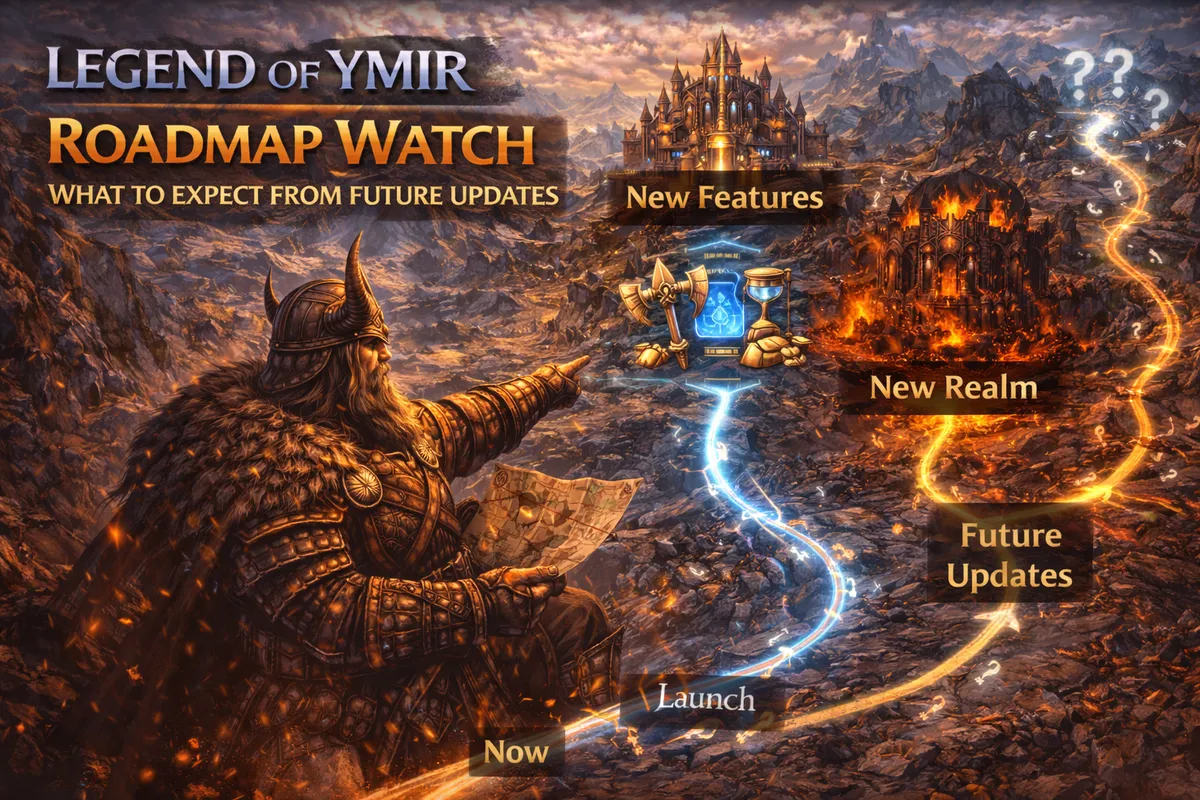
Confirmed Roadmap Highlights Through Mid-2026
Based on official roadmap statements, the upcoming update direction includes major seasonal arcs and new systems that change how you progress.
Here’s the easy “big picture” snapshot:
- Vertical progression expansion: new region(s) and higher-tier growth layers tied to Awakening and new progression paths
- Cooperation-focused season content: party-based cooperative modes, large group dungeons, and systems that reward teamwork
- Competition-focused season content: a season PvP zone, new world boss competition, and special expeditions
- New progression systems: mercenary participation across servers, rune growth, mastery growth, and new “choose-your-path” progression concepts
- Partner Server evolution: kingdom governance mechanics, diplomacy systems, prison/summon mechanics, and server identity choices
- Platform expansion: Steam expansion plans and broader player base implications
- Economy changes: shifting gWEMIX distribution from luck-based lottery emphasis toward content-based rewards, plus structured competitive prizes afterward
- New class and competitive systems: a teased new class, plus an arena-like system and a tower-like stat growth system
Instead of treating this like “future hype,” treat it as future preparation. Every item above affects what you should farm, what you should sell, and what content you should prioritize.
December Vertical Progression: New Area, New Growth Pressure
One major roadmap milestone is a new region designed as a vertical progression update. Vertical progression usually means:
- tougher hunting grounds that expect higher power and better builds
- new materials and progression drops tied to the new region
- new upgrade loops that push you beyond earlier power ceilings
What this means for you:
- If you are still early or midgame, it’s worth building a stable baseline (weapon + survivability) so you can enter new areas without “death looping.”
- If you are already endgame, start thinking in “season layers”: new region materials and new progression systems often make some older optimizations less urgent.
Practical rule: Don’t burn your best resources on temporary upgrades right before a vertical jump. Save enough to adapt fast when the new area becomes your best farm.
Awakening and New Potentials: Why Builds Matter More After the Expansion
The roadmap ties vertical progression to Awakening and new Potentials, signaling that your build planning matters more as content climbs. When systems like Awakening and Potentials become central, you’ll usually see:
- more meaningful differences between farm builds, boss builds, and PvP builds
- larger reward gaps between players who can clear efficiently and players who barely survive
How to prepare now:
- Lock in two presets minimum: Farm and Boss. If you do PvP or inter-server content, add a third preset for PvP/Wars.
- Upgrade what makes every activity faster: weapon first, then survivability baseline, then optimize.
Practical rule: Past a certain point, “more power” comes from reducing deaths and increasing uptime, not from chasing one perfect roll.
Conqueror Authority and Inter-Server Competition: Why Server Winners Matter
Roadmap content also highlights “Conqueror” style authority for winners of certain competitive modes—specifically emphasizing control over boss spawn timing and a gWEMIX tax rate in some context.
What this means for players:
- The server meta can shift quickly if winners can influence boss timing and economic settings.
- Your best strategy is to avoid being caught unprepared by these swings—especially if your routine depends on boss windows or market prices.
How to prepare:
- Keep your daily plan flexible: don’t rely on one boss window for your entire week’s progress.
- Build a Diamonds pipeline (selling tradables consistently) so price swings don’t stall you.
- If you’re in a competitive clan, coordinate: these systems reward organized groups.
Practical rule: When server-level authority exists, routine wins. You want a plan that still works if schedules shift.
Season 2: The Era of Cooperation
The roadmap describes Season 2 with a clear theme: cooperation—content that rewards players who party up, coordinate roles, and clear difficult challenges together.
What “cooperation season” usually changes:
- Solo play remains viable, but group content becomes the best reward-per-minute for certain materials and growth items.
- Party skill matters more: positioning, survivability, and resource discipline win more rewards than raw Combat Power alone.
How to prepare:
- Build your friends list intentionally: keep reliable players, not just random names.
- Join an active clan (even if you mostly play solo) so you can find groups quickly for cooperative content.
- Practice boss discipline now—dodging and uptime habits carry over into every future dungeon.
Practical rule: In cooperation seasons, your social setup becomes a power stat.
Hall of Cooperation: What to Expect and How to Prepare
Roadmap notes point toward Hall of Cooperation as party-based cooperative content. Even without knowing every mechanic early, you can predict the core success factors:
- consistent survivability
- clear roles (anchor, support, uptime, mechanics)
- stable builds and controlled cooldown usage
- clean inventory and consumable setup (so you don’t break rhythm mid-run)
Preparation checklist:
- Create a boss preset with reliable survival and controlled burst.
- Set potion auto-use in a way that prevents sudden “one mistake deaths.”
- Make sure your bag stays under safe weight thresholds before starting a long cooperative session.
Practical rule: Cooperative content punishes chaos—your job is to enter with a clean setup and avoid preventable wipes.
Hardcore Dungeon: Jarnhamash and Limited Resurrection Pressure
The roadmap specifically calls out a 15-player Hardcore Dungeon: Jarnhamash with limited resurrection attempts. That one rule alone changes your whole approach.
What limited resurrection means:
- Every death is expensive.
- Greedy damage becomes a liability.
- Teams win by staying alive and keeping uptime, not by rushing.
How to prepare now (works for any limited-revive content):
- Practice “one-dodge discipline”: don’t burn defensive resources immediately.
- Build for stability first—then damage.
- In group runs, assign responsibility: who handles adds, who watches dangerous patterns, who calls reposition.
Practical rule: Hardcore clears are won before the fight starts—through preparation and role discipline.
Tower of Mirrors: Skill-Based Progress You Can Start Training For Today
The roadmap includes Tower of Mirrors, where mirror clones based on top-ranking players create a unique challenge experience.
Why this matters for your progress:
- This kind of content rewards mechanical skill (timing, positioning, resource management).
- It also becomes a consistent way to test builds without relying on pure farming.
How to prepare:
- Build a “training routine” into your week:
- 10 minutes of controlled fights where you dodge late and punish openings
- practice standing up quickly from knockdowns and stabilizing
- learn to disengage rather than panic commit
Practical rule: If you improve your mechanics now, future “skill-based” content becomes free rewards instead of frustration.
Mercenary System: Cross-Server Participation
Season 2 roadmap mentions a Mercenary System that allows participation in battles on other servers.
What to expect as a player:
- More cross-server interaction
- More reasons to keep your PvP preset and survival discipline ready
- Potentially new reward loops tied to cross-server participation and performance
Preparation tips:
- Treat your PvP readiness as a routine, not a mood:
- keep a PvP preset saved
- keep potions and quickslots consistent
- avoid overweight penalties that ruin movement
- Practice “fight selection” now: you don’t need to take every fight to progress.
Practical rule: Cross-server systems reward players who can survive and contribute consistently, not just duelists.
Rune System: A New Long-Term Power Layer
The roadmap also describes a Rune System tied to growth through runes dropped in awakening areas—adding a new layer of character progression and strategic depth.
What runes usually change in an MMO progression loop:
- Power becomes more “account build” than “just gear.”
- Small upgrades compound over weeks and months.
- Players who manage resources carefully keep improving while others stall.
How to prepare without wasting resources:
- Don’t try to “perfect” everything early.
- Plan for steady upgrades:
- build a baseline rune set
- replace only when upgrades meaningfully match your goal (PvE, PvP, farming)
- Keep inventory clean so you don’t accidentally dismantle or ignore valuable rune drops later.
Practical rule: Rune progress is a marathon—steady improvement wins.
Season 3: The Era of Competition
Season 3 roadmap shifts the theme from cooperation to competition, introducing:
- a season PvP zone
- a new world boss
- new expeditions
- and additional growth systems that expand post-awakening progression
Competition seasons are where:
- efficiency and speed matter more
- group coordination becomes a reward multiplier
- the economy can shift (because new items become high demand)
The best way to prepare:
- Build a stable daily engine (missions, offline, market routine) so you can participate in competition content without “falling behind” on your baseline.
- Make sure you can play both safe and aggressive depending on the event.
Practical rule: Competition seasons punish players who don’t have a routine. Build the routine now.
Battlefront PvP Zone: Survive, Farm, and Don’t Feed
The roadmap highlights Battlefront as a season PvP zone with powerful monsters and exceptional EXP gains—meaning it’s likely both high reward and high risk.
Your Battlefront mindset should be:
- Treat it like a resource zone, not a duel arena.
- Your goal is to leave with rewards, not to win every fight.
Preparation that helps immediately:
- Use a PvP preset with survivability and escape tools.
- Tighten your auto-combat range and avoid wandering pulls.
- Never enter overweight—movement penalties will get you killed.
Practical rule: In PvP farm zones, your best play is controlled aggression plus reliable disengage.
World Boss: Audhumla
Season 3 roadmap introduces a new World Boss: Audhumla, framed as a major inter-server competition target.
What this means for your week:
- Boss participation will become a scheduled priority for many players and clans.
- Channels and competition can make “arrive early” and “tag quickly” more important than raw damage.
How to prepare:
- Keep a boss preset ready.
- Keep bag space ready (boss rewards and drops spike inventory).
- Don’t chase killing blow drama—consistent participation and survival is how you get repeatable value.
Practical rule: World boss rewards usually go to the prepared—arrive early, contribute safely, survive.
Season Expeditions: Laubaur and Fafnir
The roadmap describes Season Expeditions including:
- Laubaur, a defense-style expedition
- Fafnir, a 15-player expedition with exclusive accessories that drop only from Fafnir
What to expect from defense-style and large-group expeditions:
- Role discipline matters more than burst damage.
- Teams that coordinate positioning and objective play will clear faster and more consistently.
- Exclusive drops often become high demand, shifting the market and progression priorities.
Preparation:
- Build at least one “team-friendly” preset:
- survivability
- consistent damage
- tools that help control chaos (not just big numbers)
- Join a clan or maintain a friend roster so you can form stable 15-player groups more easily.
Practical rule: When exclusive drops exist, consistency becomes king—clear reliably and repeat.
Mimir’s Spring and the Mastery System
Season 3 roadmap mentions Mimir’s Spring as a choose-your-path growth concept, plus a Mastery System that enhances your character via new regional materials after Awakening.
What this signals:
- More customization in growth direction
- More materials that matter long-term
- More reasons to plan your weekly farming around future upgrade steps
How to prepare now:
- Stop spending rare resources impulsively.
- Build a “weekly power session” habit:
- farm and sell during the week
- do your big upgrade session once per week with clear goals
- Keep your inventory and market routine disciplined so you can pivot into the new materials immediately when they matter.
Practical rule: New mastery systems reward players who already know how to farm, save, and spend with intent.
Partner Server Roadmap: Kingdom Governance Gets Deeper
The roadmap describes Partner Servers as kingdoms shaped by a “King” and governance philosophy, with upcoming systems that deepen that identity.
Key Partner Server-style features mentioned include:
- prison and escape mechanics
- summon power by the ruler
- royal order decisions that shape server identity (PvP focus vs PvE focus style choices)
- exclusive mount for kings
- diplomacy systems and inter-kingdom competitions
- unity-building content like treasure hunts and defense events
If you play on a Partner Server (or plan to), treat it like a different meta:
- politics and server identity choices can shape your daily environment
- diplomacy features can change where the best rewards and fights happen
Practical rule: Partner Server life rewards social awareness—pay attention to server rules and upcoming governance changes.
Prison, Summon, and Royal Orders: How It Changes Daily Life
Features like Prison/Summon and server-wide orders mean your gameplay can be influenced by:
- the server’s chosen direction (PvP-heavy or growth-focused)
- enforced consequences for disruptive behavior
- faster organization or forced audience mechanics
How to prepare:
- Keep a flexible routine: some days the “best farm” might be too contested, and you’ll want a backup plan.
- Keep your behavior clean in governed environments—don’t create unnecessary risks for your own progress.
Practical rule: When governance is real, stability beats chaos.
Diplomacy Features: THE MATCH and Treasure Island
The roadmap mentions diplomacy and cross-kingdom competition features like:
- THE MATCH with rule-based duel formats
- Sindri’s Lost Treasure Island as a large-scale conquest-style competition
How to prepare:
- Build PvP discipline first (survival, target selection, when to disengage).
- Coordinate roles as a clan: gatherers, hunters, objective control, and defenders.
- Protect revive counts in limited-revive events—feeding deaths removes your impact.
Practical rule: Diplomacy content rewards teams who play objectives, not just fights.
Unity Features: Treasure Hunts, Gifting Power, and Ragnarok Assault
The roadmap also emphasizes server unity features like:
- a treasure-hunt style event (king hides treasures, players search)
- direct gifting power for notable contributions
- defense-style monster invasion content
What to expect:
- These features often reward participation consistency and community involvement.
- Even non-hardcore players can get value by showing up regularly.
Preparation:
- Keep bag space and quick mobility ready for sudden events.
- Don’t ignore these “community systems”—they’re often efficient reward sources.
Practical rule: When events reward participation, showing up consistently is a progression strategy.
Steam Launch Preview: What New Platform Expansion Can Change
An official Steam expansion preview indicates platform growth, which typically leads to:
- a bigger playerbase and more active markets
- more competition for bosses and contested zones
- more fresh players (which can be good for trade and group formation)
- potential stability and performance improvements pushed alongside platform launches
How to prepare:
- Strengthen your market habits now. A larger playerbase can shift prices quickly.
- Keep your inventory and Trade Station routine clean so you can capitalize on demand spikes.
- Expect more crowded content—prepare a “performance profile” (lower effects, low performance mode in crowds) so you don’t stutter during mass fights.
Practical rule: Platform expansion usually means more opportunity—and more competition.
gWEMIX Reward System Changes: What Players Should Expect
Official communication describes a shift toward rewarding effort and achievement, not just luck—by adjusting lottery event distribution and increasing content-based rewards.
What this means:
- Content participation may become a more meaningful path for earning value.
- “Playing the right content” can matter more than waiting for lucky outcomes.
- Competitive structures may redistribute rewards more regularly.
How to prepare:
- Focus on becoming a consistent clearer: stable boss preset, reliable dungeon clears, and clean daily routines.
- Don’t build your entire motivation on lottery-style outcomes. Plan around content you can control.
Practical rule: When rewards move toward content performance, consistency becomes your best currency.
YMIR League and Monthly Regional Championships
Official statements also mention structured competitive systems after major tournament periods:
- a league system
- promotion and relegation dynamics
- monthly regional championships near the end of each month (as described)
What this means for regular players:
- Competitive play becomes more scheduled and more predictable.
- There may be more reasons to join a clan and play organized content regularly.
- Meta shifts can happen faster because leagues and tiers create new incentives.
Preparation:
- Don’t wait until league launch to build your PvP preset and survivability habits.
- Start practicing now in smaller PvP environments and inter-server areas so your fundamentals are ready.
Practical rule: Competitive systems reward the players who prepared months earlier.
Server Transfer, Clan Transfer, and Class Change: Roadmap Moves That Reshape Servers
Official letters confirm systems like server transfer windows, clan transfer support, and class change—features that can reshape the population and server balance quickly.
Why this matters:
- Markets change when populations move.
- Boss competition changes when top players relocate.
- Your best farming spots can become contested overnight.
- Class change can shift PvP and dungeon meta quickly.
How to prepare:
- Keep your economy flexible: Diamonds flow helps you adapt fast.
- Avoid long-term commitments to a single “perfect routine” that only works in one server climate.
- If you plan to transfer, plan it socially (friends/clan) and economically (inventory cleanup, market timing).
Practical rule: Transfer systems are meta earthquakes—prepare your flexibility.
New Class + Arena System + Guardian Tower System: A March-Focused Tease
Official PD communication points to a new class and additional competitive and growth systems:
- a “grand new class” update window
- an Arena System described as skill-based
- a Guardian Tower System described as a stat growth system through tributes
How to prepare without wasting resources:
- Don’t pre-spend everything trying to “perfect” your current setup if you plan to try the new class.
- Keep a resource cushion:
- enhancement materials
- crafting materials
- Diamonds for real bottlenecks
- Practice mechanics now—arena-style systems reward clean play more than raw numbers.
Practical rule: New classes tempt impulsive spending. The smart move is saving flexibility, not chasing perfection.
Your 30-Day Roadmap Prep Checklist
Use this as your “update readiness” routine. It’s designed to help you profit from any future patch.
- Build two presets minimum: Farm + Boss (add PvP if you do inter-server).
- Stabilize your weapon and survivability baseline: clear faster, die less.
- Clean your inventory system:
- keep/sell/dismantle/decide-later piles
- daily cleanup before long content blocks
- Create a daily Diamonds pipeline:
- sell tradables once per day
- settle once per day
- avoid cancel/relist habits
- Save a flexible resource cushion instead of spending to zero:
- keep enough for a pivot when new systems drop
- Do one weekly “power session”:
- planned upgrades
- planned crafting
- planned optimization targets
- Follow official updates:
- roadmap letters tell direction
- patch notes tell exact timing
Do that for one month and you’ll feel the difference the moment a big update hits.
Resource Discipline Rules That Stop You From Wasting Progress
Most players don’t fall behind because they’re weak. They fall behind because they spend like they’re always “one patch away” from quitting.
Use these rules:
- Don’t gamble risky upgrades on gear you expect to replace soon.
- Don’t chase perfect option rolls daily—save that for planned weekly sessions.
- Don’t upgrade everything equally—prioritize weapon and survival baseline.
- Don’t enter new content overweight or with a messy bag.
- Don’t rely on one content type for all progress—patches change what’s best.
Roadmap watch is about discipline. The player who wastes less will always look “luckier.”
BoostRoom: Get Patch-Ready Without Guessing
If you want to stay ahead of future updates without spending hours reading every notice, BoostRoom can help you turn the roadmap into a simple plan you can actually follow.
BoostRoom can help you with:
- a roadmap-based upgrade plan (what to push now vs what to save for upcoming seasons),
- presets optimized for cooperation dungeons, competition zones, and boss content,
- a weekly routine that aligns with upcoming major systems (runes, mastery, new dungeons),
- a market routine that protects Diamonds and prepares you for demand spikes,
- and a patch-day checklist so you enter new content smoothly instead of scrambling.
The goal is simple: more rewards on day one of updates, less waste, and faster progress across every season.
FAQ
Is the roadmap guaranteed to happen exactly on the dates mentioned?
Roadmaps show intent and direction, but schedules can shift. The best approach is preparing in ways that stay useful even if timing changes (saving flexibility, building presets, keeping your economy healthy).
What’s the smartest thing to save before big updates?
Save flexibility: upgrade materials, crafting materials, and a Diamonds cushion for bottlenecks. Avoid spending everything to zero right before seasons and new systems.
How do I benefit from cooperation-focused updates if I’m mostly solo?
Join a clan or build a small reliable friends list. You don’t need to be social all day—just have access to groups for the content that pays best in cooperation seasons.
What should I do if a new class is coming and I want to switch?
Avoid heavy long-term investment in “perfecting” your current setup. Build stable power now, but keep a resource cushion so you can adapt and experiment without stalling.
How do I prepare for competition seasons without becoming a PvP addict?
Create a PvP preset and practice survival fundamentals. You don’t have to fight constantly—focus on event participation, objectives, and safe reward routes.
Will platform expansion (like Steam) affect my progress?
It can increase competition and market activity. The best preparation is having a clean market routine, strong performance settings for crowded fights, and flexible routes that don’t rely on one boss or one zone.
What’s the best “minimum routine” if I’m busy but want to stay ready for updates?
Daily Mission progress + Offline Mode setup + a short market pass (sell duplicates) + one small improvement toward your next milestone. Consistency beats long sessions.



