What “Free-to-Play” Should Mean (And What It Shouldn’t)
Free-to-play doesn’t mean “never touch the shop.” It means you’re not relying on spending to fix progress problems. Your power comes from routine value + smart upgrades + patience, not from impulse purchases.
A healthy F2P mindset looks like this:
- You accept that progress is a weekly climb, not a one-night sprint.
- You build power from systems that reset daily/weekly (missions, time-based dungeons, offline progress).
- You spend premium currency (especially Diamonds) like a budget, not like a mood.
An unhealthy “F2P but actually overspending” mindset looks like this:
- You keep buying “one more” reroll or upgrade attempt because your gear didn’t spike.
- You purchase convenience to compensate for messy routines (full bag, wasted time bars, cancelled listings).
- You chase paid shortcuts before you’ve maxed the free ones that reset every day.
If you want to progress without overspending, the goal is not to be perfect. The goal is to avoid the few expensive mistakes that drain resources and force you to spend.
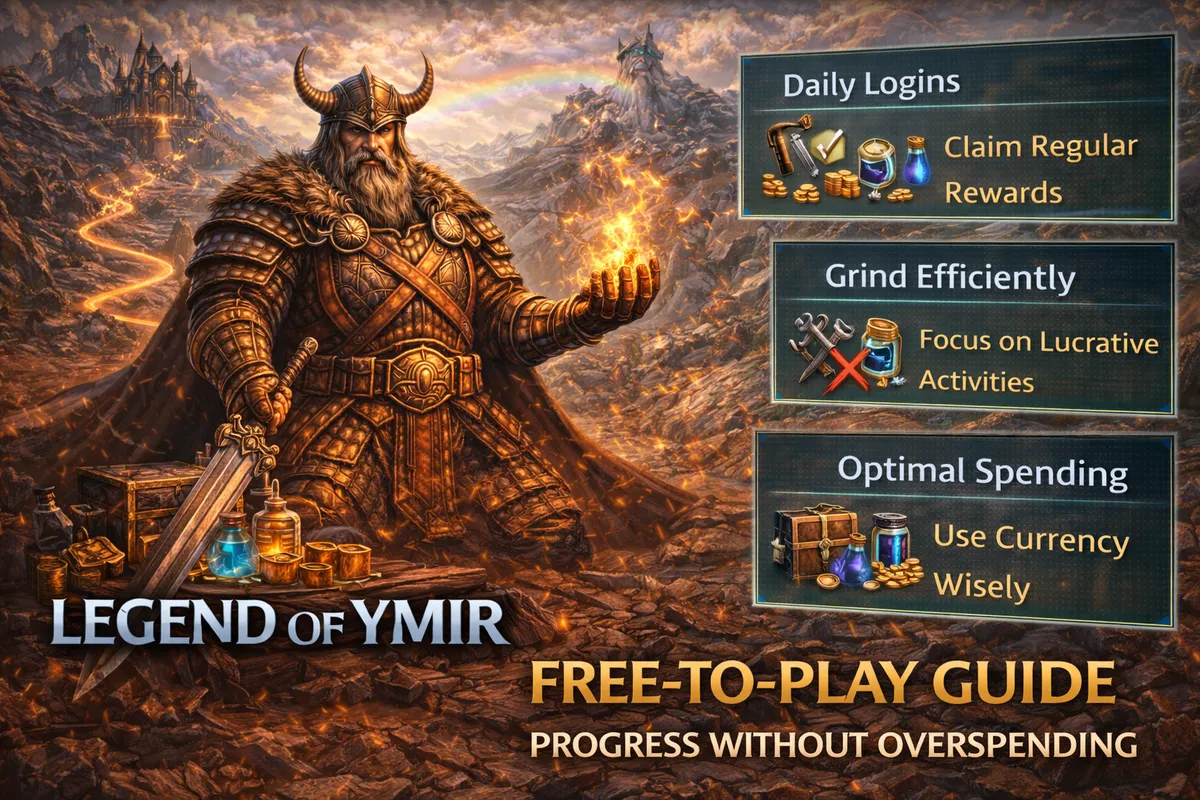
The F2P Power Pyramid: The Order That Makes You Stronger Fast
If you prioritize the wrong things, you’ll feel weak even if you play a lot. Use this power pyramid instead:
- Consistency (daily/weekly resets)
- Clear speed (weapon + main skills)
- Survivability (armor baseline + defensive habits)
- Account power (Artifacts, Collection, Story Deck, companions)
- Optimization (enchanting targets, risk enhancement, rune tuning later)
Most overspending happens when players try to skip steps 1–4 and jump straight to step 5. Don’t. Build the base first, and the game becomes dramatically easier.
The Two Reset Clocks That Decide Your F2P Growth
If you’re F2P, reset value is your main “income.” Missing it is like skipping a paycheck.
Two core clocks control most routines:
- 04:00 (Server’s Region Time): many daily systems reset (like Daily Mission and repeatable counters).
- 00:00 (Server’s Region Time): Offline Mode base time resets.
F2P rule: If you can only play briefly, log in to protect reset value (Daily Mission progress + Offline Mode setup). That single habit keeps you moving forward without grinding or spending.
F2P Currency Map: What Matters, What’s Optional, What’s Dangerous
Legend of YMIR has many currencies. You don’t need to master all of them to progress F2P. You just need to know which ones are “daily drivers” and which ones are “optional ecosystems.”
Core F2P currencies (focus here):
- Silver: your everyday upgrade fuel.
- Diamonds: your market power and bottleneck remover.
Long-term “account growth” currencies (important, but slow):
- Artifact progression resources (Artifacts unlock at level 30).
- Collection/Story Deck progress (permanent-ish account boosts).
Optional tokenomics layer (skip if you want pure F2P gameplay):
- gWEMIX / sWEMIX / WEMIX, Token Bag, Station, Deposit, PLUS benefits.
- These systems are real economy-adjacent and involve wallet linking rules, caps, and fee behavior. You can be a strong F2P player without going deep into them.
Shop currencies (use extreme caution):
- YMIR Point (recharge points)
- YMIR Cash (YMC)
- WEMIX PAY purchases
- These are where overspending happens fastest, especially if you treat non-refundable purchases like “small bets.”
If you’re a teen, the safest plan is simple: play fully F2P and avoid paid systems unless a parent/guardian explicitly approves. Even then, treat purchases as planned budgets, not impulse taps.
Your F2P Golden Rules (Follow These and You Won’t “Need” Spending)
Here are the rules that keep F2P progress smooth for months:
- Rule 1: Never spend Diamonds to fix poor habits. Fix the habit instead.
- Rule 2: Use stable upgrades first; gamble later (if ever).
- Rule 3: Two presets minimum (Farm and Boss). Entering hard content in a farm setup is the #1 hidden time and resource drain.
- Rule 4: Protect reset value daily. Daily Mission + Offline Mode are your baseline.
- Rule 5: Sell duplicates consistently. Diamonds flow = fewer bottlenecks = less temptation to spend.
- Rule 6: Don’t chase perfection early. F2P wins by consistency, not by “perfect rolls.”
If you only adopt these rules, you will progress faster than many spenders who constantly waste resources.
Daily Mission: Your F2P “Minimum Win”
Daily Mission is one of the best F2P systems because it’s built to reward consistent play and overlaps with almost everything you do. It resets daily, which means it’s free daily value.
F2P strategy:
- Start Daily Mission early in your session so you complete it naturally while playing.
- Aim for the milestone rewards (often tied to completing multiple missions in a day).
- On busy days, do Daily Mission first so you still get value.
When F2P players fall behind, it’s usually because they treat daily missions like “optional chores,” then try to grind to replace what they skipped.
Offline Mode: The F2P Progress Engine That Works While You Sleep
Offline Mode is one of the most F2P-friendly systems in the game because it converts real time into progress. The base time resets daily, and time use is limited—so treating it casually is a huge loss over weeks.
F2P strategy:
- Always set Offline Mode before logging out. Always.
- Choose the highest difficulty you can reliably meet (Combat Power requirements matter).
- Upgrade your Offline Mode target as your power grows—don’t stay in low tiers out of habit.
This single habit can carry your account through busy weeks without spending.
Valhalla: Time-Based Progress You Should Never Skip
Valhalla is a special dungeon system where usage time resets daily or weekly. That makes it extremely valuable for F2P because it’s “scheduled free value.”
F2P strategy:
- Spend default time consistently.
- Prioritize daily-reset time first if you’re short on time.
- Don’t waste time wiping; choose a floor you can clear smoothly.
- Use your Boss preset for Valhalla, not your farm preset.
F2P accounts that feel “stuck” often skipped Valhalla time repeatedly and then tried to brute-force progress with grinding or spending.
Hall of Gold and gWEMIX: F2P Perspective Without Hype
You’ll see gWEMIX mentioned as a token-related currency. The important F2P approach is clarity:
- If you want pure gameplay progression, treat token systems as optional.
- If you do participate, do it deliberately and understand caps and rules so you don’t waste time or resources.
F2P-smart approach:
- Focus first on your core growth loop: daily missions, offline mode, safe upgrades, and Diamonds economy.
- Only add token routines after your main loop is stable and you actually enjoy that system.
A strong F2P account is not built by chasing every currency. It’s built by mastering a repeatable routine.
Diamonds Without Spending: The Trade Station Pipeline
Diamonds are the most important “F2P premium currency” because they let you remove bottlenecks without opening your wallet. Your primary Diamond source is simple: sell tradable items.
F2P Trade Station routine:
- During farming, mark items with the tradable icon as “sell pile.”
- Once per day, do one market pass:
- list items realistically,
- avoid constant relisting,
- settle Diamonds in one batch.
- Use Diamonds only for bottlenecks that clearly unlock your next progress step.
The biggest Diamond leak is indecision: cancelling listings repeatedly. Make listings carefully so you don’t lose fees and time.
The F2P Spending Rule for Diamonds (A Real Budget)
Diamonds feel like “money,” but F2P players should treat them like a tool. Use a bottleneck budget:
Spend Diamonds only if at least one is true:
- It unlocks a clear upgrade milestone (weapon/armor baseline, required craft input).
- It saves hours of low-value farming for one missing component.
- It prevents a major mistake (like losing progress due to missing a required item for a planned step).
Do not spend Diamonds on:
- random rerolls with no target,
- impulse convenience items you won’t remember tomorrow,
- panic purchases when you’re stuck (fix the cause instead).
A simple practice that works: keep a “Diamond floor,” a number you refuse to drop below. That ensures you always have emergency power for real bottlenecks.
Inventory Discipline: The Most F2P-Friendly “Power Boost”
Inventory management is F2P power because it reduces time waste and prevents resource loss.
Bag weight penalty thresholds matter because they affect movement and loot:
- Under 80%: no penalty
- 80–95%: no natural HP/MP recovery
- 95–100%: movement speed reduced and mobility restricted
- Over 100%: can’t obtain items and can’t attack
F2P inventory rules:
- Never farm near 95% weight for long.
- Use short “farm blocks”:
- farm 10–20 minutes,
- quick cleanup,
- continue.
- Separate items into four mental piles:
- keep, sell, dismantle, decide later.
This prevents the classic F2P disaster: accidentally dismantling something valuable, then spending Diamonds to replace what you destroyed.
Upgrade Priorities That Work for F2P
F2P players can’t afford wasted upgrades. Use this order:
- Weapon (clear speed multiplies everything)
- Core armor baseline (survivability reduces deaths, which saves time and consumables)
- Secondary weapon (often meaningful, but after weapon + survival baseline)
- Accessories / seals (strong but easy to overspend early)
- Utility upgrades (important later, not your first power spikes)
F2P truth: Being slightly less geared but never dying is stronger than having a flashy upgrade and losing half your time to resets and wipes.
Forge for F2P: Safe Power, Not Gambling
Forge is where many players overspend (or waste) because it’s easy to chase “just one more + level.”
F2P enhancement discipline:
- Build stable power using Safe Enhancement stages first.
- Avoid gambling on gear you’ll replace soon.
- Plan your enhancement sessions instead of upgrading after every drop.
A smart F2P enhancement mindset:
- Make a “baseline target” for your current tier (for example, “safe levels on my main set”).
- Only push risky stages on long-term keeper items.
- If you feel tempted to gamble, pause and do a daily mission/market pass instead—those are guaranteed value.
Enchanting and Rerolls: The F2P Trap Zone
Option enchanting and “replacement” style systems can feel like progress
, but they are often where Diamonds disappear.
F2P enchanting rules:
- Enchant only items you expect to keep for a meaningful period.
- Start with 1–2 realistic target options—not “perfect everything.”
- Use auto systems with strict limits so you don’t burn resources endlessly.
The most expensive mistake is trying to chase “perfect rolls” early. F2P progress should prioritize stable power first, then polish later when your gear is long-term.
Presets: The F2P Shortcut Most Players Ignore
Presets let you save and apply your character setup (equipment and other key components). For F2P, presets are a time and death reducer—which means more rewards per hour.
F2P preset setup:
- Preset I: Farm
- Fast clear, efficient rotation, comfortable automation.
- Preset II: Boss/Dungeon
- Survivability, controlled skills, safer settings.
- Preset III: PvP/Inter-Server (optional)
- Survival and consistency under pressure.
Why this matters:
- You stop dying because you forgot to switch builds.
- You stop wasting consumables and time.
- Your daily routine becomes automatic and fast.
If you want to progress without spending, presets are one of the best “free upgrades” in the game.
Artifacts, Collection, and Story Deck: The F2P Compound Interest
F2P strength often comes from systems that stack over weeks rather than lucky drops.
Artifacts (level 30): a long-term growth layer that stays valuable as you replace gear.
F2P approach:
- Upgrade steadily, not impulsively.
- Treat artifacts as “slow power” that makes every other system easier.
Collection: registering items for permanent-ish effects.
F2P approach:
- Register before dismantling or selling when possible.
- Make it a 2-minute habit when you’re in town.
Story Deck: sets, duplicates, and long-term effects.
F2P approach:
- Don’t ignore duplicates—use them to build steady deck progress.
- Avoid “reroll addiction” with points; spend with a goal.
These systems are how F2P players stay competitive long-term without spending: they build account power that doesn’t disappear when you swap gear.
Co-Op and Clans: F2P Progress Multiplier Without Spending
Even if you prefer solo play, joining a good clan can be one of the best F2P decisions because it adds:
- more consistent groups for Expeditions and raids,
- more reliable clears (less wasted entries),
- access to clan reward loops and support features in many MMO designs.
F2P clan approach:
- Join a clan that matches your schedule (active but not demanding).
- Participate in one weekly group session if possible.
- Use co-op sessions for high-value content (Expeditions, scheduled boss windows) rather than routine chores.
F2P accounts often grow faster with light clan participation than with pure solo grinding, because you waste fewer runs and get more consistent rewards.
The Shop: How to Avoid Overspending and Still Feel Progress
If your goal is “progress without overspending,” the best shop advice is: don’t buy impulsively.
Important safety reality:
- Some purchases are non-refundable, and some payment methods require wallet connections.
- If you’re a minor, purchases should only happen with a legal guardian’s consent.
F2P-safe shop mindset:
- You don’t need to buy anything to progress.
- If you ever choose to spend, do it as a planned budget with guardian approval, not as a reaction to frustration.
Overspending usually starts when players buy things to fix a temporary feeling: “I’m stuck, so I need to buy something.” The correct F2P fix is almost always:
- reset value (missions/offline),
- stable upgrade baseline (weapon/armor),
- sell tradables (Diamonds),
- then return to your Main Quest or content goal.
YMIR Point and YMIR Cash: What F2P Players Should Know
These exist as shop payment methods. For F2P players, the most useful knowledge is how to avoid being pulled into impulsive purchases.
- YMIR Point can be purchased via the in-game recharge flow.
- YMIR Cash (YMC) purchases are generally treated as non-refundable and may require wallet connection and specific platform rules.
F2P rule:
- If you’re not intentionally budgeting for purchases (with guardian consent), treat these as “not part of your progression plan.” Your account can grow without them.
WEMIX PAY and Token Features: Optional, Not Required
Token-related systems can include wallet linking and additional rules (limits, caps, fees, and fixed wallet behavior). For many players, that’s unnecessary complexity—especially if your goal is simply to play and progress.
F2P recommendation:
- Progress first using normal gameplay systems and Diamonds economy.
- Only explore token features if you fully understand them and genuinely want that layer.
- Never use token features as a “replacement” for good daily routines.
A strong F2P player is not defined by token participation. They’re defined by consistent progression habits.
F2P Progression Roadmap: Early Game to Endgame
Here’s the clean, no-drama path.
Early game (start to level 30):
- Push Main Quest as your main XP and unlock engine.
- Start Daily Mission as soon as it unlocks and treat it as baseline.
- Use Offline Mode daily (even if you play a lot).
- Use Trade Station when available and start selling duplicates early.
- Build a safe gear baseline; don’t gamble upgrades.
Mid game (level 30 to Awakening range):
- Start Artifacts at level 30 and grow steadily.
- Use presets to split Farm vs Boss.
- Spend Valhalla time consistently and avoid wiping loops.
- Use Repeatable Tasks and Requests as structured gate-breakers (not random grinding).
- Build your Diamonds pipeline so bottlenecks don’t stall you.
Endgame mindset (after main progression / Awakening era):
- Your growth becomes a loop: daily engines + time-based dungeons + market + planned upgrade sessions.
- You specialize more: Boss preset and PvP preset matter a lot.
- You improve “account power” systems consistently (Artifacts, Collection, Story Deck).
- You stop chasing perfect rolls daily and move to weekly planned optimization sessions.
F2P endgame success is mostly discipline: steady improvements, fewer wasted runs, fewer resource leaks.
The F2P Daily Routine (30 Minutes)
If you want the highest progress-per-minute, run this route:
- Start Daily Mission progress immediately.
- Quick bag cleanup to stay under 80% weight.
- Spend any daily-reset time-based value you can (short session version).
- Do one structured block:
- small Repeatable Task batch, or
- 1–2 Requests, or
- a short Trial-style run if you’re blocked.
- Market pass:
- list tradables once,
- settle once.
- Set Offline Mode before logout.
This routine protects your account from falling behind even on busy days—without spending.
The F2P Weekly Routine (The “Catch-Up and Power Spike” Day)
Pick one day per week to do your “power session.” This prevents daily impulse spending.
Weekly power session:
- Spend weekly time-based dungeon value efficiently (plan a longer run).
- Do a focused Expedition session with your best available group time.
- Do one planned upgrade session:
- enhancement baseline maintenance,
- enchanting targets (only if gear is worth it),
- artifact growth steps.
- Do a bigger market cleanup:
- sell duplicates,
- turn clutter into Diamonds,
- buy only true bottlenecks.
Weekly planning is the best anti-overspending tool because it replaces impulse spending with intentional upgrades.
Common F2P Traps That Make People Overspend
Avoid these and you’ll stay comfortably F2P:
- Trap 1: Spending Diamonds because you’re impatient
- Fix: use reset value + sell duplicates + plan upgrades.
- Trap 2: Chasing perfect enchants early
- Fix: set 1–2 realistic targets and stop.
- Trap 3: Gambling enhancements on temporary gear
- Fix: safe baselines first; gamble only on keepers (if ever).
- Trap 4: Farming overweight and losing time
- Fix: farm blocks + quick cleanups.
- Trap 5: Cancelling market listings repeatedly
- Fix: list realistically once; don’t babysit the market.
- Trap 6: Buying convenience instead of fixing routines
- Fix: presets, daily checklist, stable upgrade priorities.
F2P progress is not hard. It’s just unforgiving to chaos.
BoostRoom: The F2P Shortcut to Faster Progress
If you want F2P progress that feels “solved,” BoostRoom helps you remove the trial-and-error that causes most people to overspend.
BoostRoom can help you with:
- a personalized F2P daily routine (15/30/60/120 minutes) that fits your schedule,
- a farm vs boss preset setup so you stop dying and wasting runs,
- upgrade priorities (what to enhance now, what to ignore, what to save),
- a Diamonds pipeline plan (what to sell, when to buy bottlenecks, how to avoid fee leaks),
- and a weekly power-session plan so your growth stays steady without impulse spending.
The goal is simple: progress faster, feel stronger, and stay in control of your resources—fully F2P.
FAQ
Can I reach endgame in Legend of YMIR as a free-to-play player?
Yes. F2P progress is built around daily/weekly value, safe upgrades, and a steady market routine. It may be slower than heavy spending, but it is absolutely viable with consistent habits.
What are the most important daily actions for F2P progress?
Start Daily Mission early, set Offline Mode before logout, spend time-based dungeon value when available, and do one quick market pass to sell tradables.
How do I earn Diamonds without spending money?
Sell tradable drops through the Trade Station and settle the proceeds into Diamonds. Focus on consistent selling of duplicates and avoid cancelling listings repeatedly.
What should I spend Diamonds on as F2P?
Spend only on bottlenecks that unlock your next progress step (critical materials, required components, planned upgrade milestones). Avoid impulse spending on rerolls and convenience.
Should I use token systems like gWEMIX, Station, or Deposit?
They are optional. If your goal is pure gameplay progression, you can ignore token features and still build a strong account. Use them only if you understand the rules and actually want that
ecosystem.
What upgrades give the biggest F2P power spike?
Weapon upgrades (clear speed) and a stable armor baseline (survivability) usually provide the best progress-per-resource. Presets also act like a “free power spike” by reducing deaths and wasted runs.
How do I avoid overspending if I’m tempted by the shop?
Use a weekly plan and a Diamond floor. Make upgrades in planned sessions, not during frustration. If you’re a minor, only purchase anything with a guardian’s consent and a strict budget.
Why does my progress feel slow even when I play a lot?
Usually it’s missed reset value, wasted time from inventory weight penalties, too many deaths from using the wrong preset, or scattered upgrades. Fixing routines often increases progress more than grinding longer.



