Who Are the Haranir in WoW Midnight?
The Haranir are introduced as an enigmatic, reclusive people with a deep connection to Azeroth’s hidden places — not the open world of capitals and battlefronts, but the living understructure that makes Azeroth Azeroth. In Midnight, they’re presented as:
- Ancient guardians of the rootways (their core identity and purpose)
- Led by a council of elders (suggesting tradition, collective rule, and a culture built on continuity)
- Ferocious and watchful (they aren’t passive “forest spirits” — they’re protectors with teeth)
- Devoted to a long-absent goddess (their faith and their grief are central themes)
The most important thing to understand about Haranir lore is that they’re not defined by conquest or expansion. They’re defined by custodianship.
Their culture is built around an ongoing responsibility: guarding the pathways and places where the world’s deepest roots connect — and keeping watch over wild domains tied to the being they revere. That responsibility becomes much harder (and much more urgent) when Midnight’s conflicts threaten to spill into the very foundations they protect.
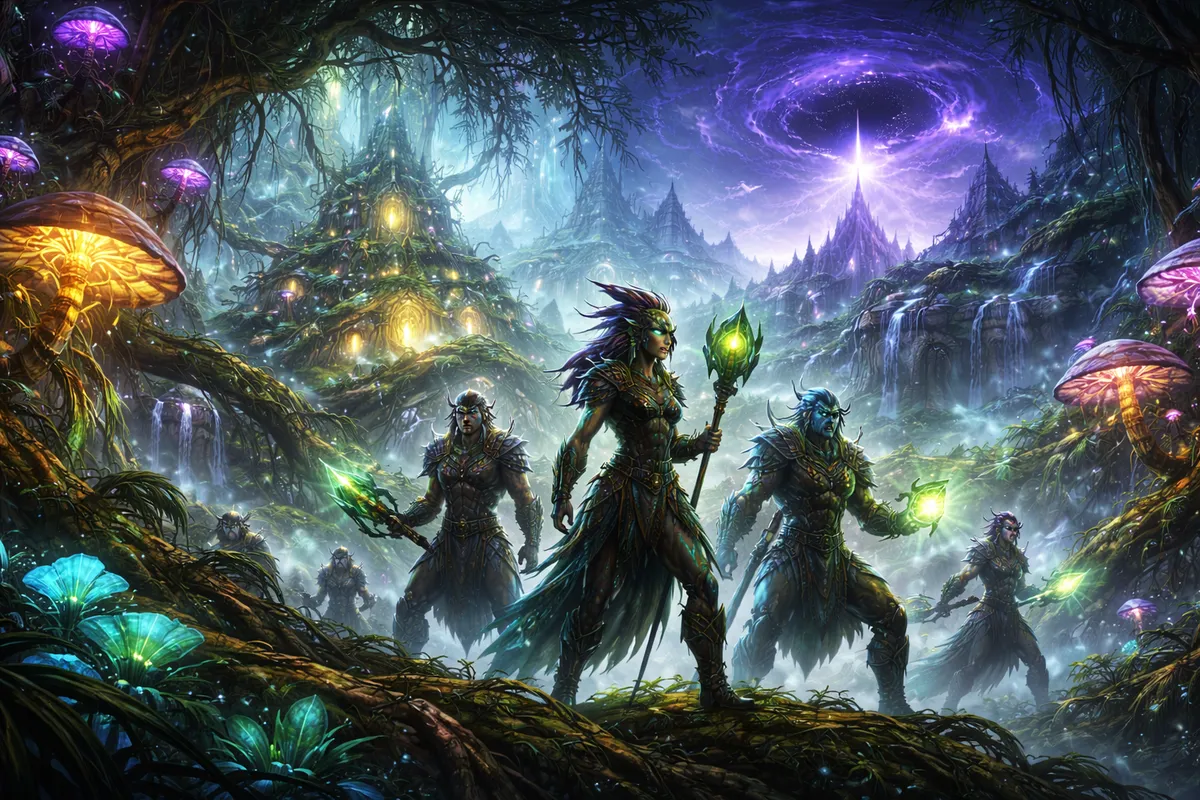
Harandar: The Bioluminescent Root-Jungle Beneath Azeroth
Harandar is the Haranir homeland — and it’s not “a jungle zone” in the normal World of Warcraft sense. It’s described as a primordial, bioluminescent fungal jungle nestled among the roots of the World Trees, and it’s positioned as a place where nature feels ancient, unfamiliar, and a little dangerous even before enemies show up.
What makes Harandar feel different (and why it matters for lore) is the way it’s framed as a crossroads:
- A zone “built around” or “found among” the roots of the World Trees
- A place where those roots converge
- A homeland that’s both alive and sacred, more like an ecosystem-temple than a kingdom
Midnight’s official descriptions and early previews lean hard into visuals that reinforce this identity: glowing fungi, living architecture, and an environment shaped by growth rather than construction. That matters because it reflects how the Haranir relate to the world: they don’t dominate it; they live inside it.
You’ll also see Harandar described with memorable details like exploring fungal towers, living murals, and the Cradle tied to a long-lost goddess. Even if you’re coming to Midnight for raids and systems, Harandar is positioned as a lore anchor — the place where Midnight’s “roots and reality” themes become tangible.
The Rootways Explained: How the Haranir Move and Watch
The rootways are one of Midnight’s most important “quiet lore concepts” — the kind of idea that sounds like flavor until you realize it can reshape the story.
In official descriptions, the Haranir use the rootways to:
- Move around the world
- Observe Azeroth in secret
- Avoid “intervening openly” in world affairs
That final point is huge. It tells you the Haranir have had access — or at least proximity — to events across Azeroth for a long time. Their choice wasn’t “we can’t help.” Their choice was “we won’t step into the light.”
So why does that change in Midnight?
Because the rootways are not just roads. They’re a lifeline. If Harandar is the junction where World Tree roots converge, then the rootways are the network that ties the world’s natural power, memory, and movement together. From a story perspective, anything that corrupts or breaks that network doesn’t just threaten a zone — it threatens how Azeroth’s living systems connect.
From a player-friendly angle, you’ll also see this idea reflected in Haranir gameplay flavor: their racial identity leans into root travel, ritual movement, and nature-bound utility. The lore and the mechanics are clearly designed to rhyme.
The Rift of Aln: When Dreams Bleed Into Reality
If the rootways explain what the Haranir protect, the Rift of Aln explains why Harandar can’t stay isolated.
In Midnight’s Harandar description, the Rift of Aln is presented as:
- A primordial wound
- A place where the barrier between dreams and reality grows thin
- A location where the echoes of the Goddess’ anguish can overwhelm minds
- A source of horrifying, half-formed creatures that threaten Harandar
In other words: this isn’t a normal “bad guy cave.” It’s a metaphysical breach — a place where inner pain, nightmares, and unreal things can become real enough to kill you.
And here’s the spicy part for long-time lore fans: “Rift of Aln” is also an established name in older Warcraft lore connected to the Emerald Dream. That doesn’t automatically mean Midnight’s Rift is the same rift in the same way — but Blizzard choosing that name for a physical/worldly manifestation in Harandar is not an accident. Midnight is clearly playing with the boundary between “dream space” and “real space,” and the Haranir are at the center of that tension.
What the Rift represents thematically:
- Uncontrolled creation
- The danger of grief
- Reality destabilizing when the world’s deeper systems are wounded
That’s also why Haranir lore is more than “new race hype.” They are positioned right on top of a story mechanism that can reshape the setting.
The Shul’ka: Warriors Who Silence Their Connection
Midnight introduces a Haranir group called the Shul’ka, and their role is one of the clearest explanations for why Haranir culture is both spiritual and brutally practical.
The Shul’ka are described as defenders against the horrors within Harandar, especially those connected to the Rift of Aln. The key detail: they are able to do this because they silence (or sever) their connection to the goddess — specifically so they can traverse the Rift’s influence without being consumed by what it echoes.
That is a deeply tragic kind of heroism.
For most fantasy cultures, stronger faith means stronger power. The Shul’ka flip that idea. Their strength comes from what they give up:
- They sacrifice a “lingering connection” to protect their people
- They face threats that would break most minds
- They become the line between “bad dreams” and “deadly reality”
If you want to understand why Haranir join the fight, start here: the Shul’ka prove that Haranir society is already under pressure. They aren’t entering Midnight from a place of comfort — they’re entering it from a place of constant vigilance, because something in their homeland is already wrong.
And Midnight escalates that “wrongness” into a global war.
Orweyna’s Role: The Haranir Who Steps Into the Surface War
Orweyna is your bridge into Haranir lore — and, narratively, she’s the reason Haranir stop being a rumor and become a people with voices, arguments, and hard choices.
What’s confirmed about Orweyna’s role:
- She was introduced during The War Within
- She’s a young Haranir with a very strong connection to her goddess
- She moves beyond Haranir seclusion traditions, even when it angers her people
- She becomes pivotal to introducing players to Haranir culture and values
This matters because it frames Haranir involvement as something that starts with internal conflict — not just external threat.
Orweyna represents a tension inside the Haranir:
- Tradition says: stay hidden, watch, do not intervene openly
- Calling/faith says: go where you’re led, even if it breaks the rules
That tension is exactly the kind of emotional “hook” Blizzard uses when a new allied race transitions from neutral to playable. It’s not just “we like you, here’s recruitment papers.” It’s “we’re changing because the world is forcing us to.”
Why the Haranir Join the Fight in Midnight
So what finally pushes a secretive root-guardian culture into the open?
Midnight stacks multiple pressures on the Haranir at the same time:
- Their homeland is inherently unstable due to the Rift of Aln
- The Rift produces threats that endanger Harandar directly
- The broader Midnight story is driven by Xal’atath’s invasion and the rising Void threat over Quel’Thalas
- Harandar is not “somewhere else” — it’s structurally tied to Azeroth through the World Tree roots
From a lore logic standpoint, the Haranir’s old stance (“observe in secret, never intervene openly”) becomes harder to maintain because:
- Isolation stops working when the threat is systemic.
- If Midnight’s conflict touches the world’s roots, you can’t hide in the roots and pretend it’s someone else’s war.
- The rootways are strategic.
- A network that connects World Tree roots isn’t just spiritually important — it’s geopolitically important. Any power seeking influence over Azeroth’s future would care about that network.
- The Rift of Aln is a pressure cooker.
- Even before the Void arrives, Harandar is dealing with a breach where dreams can become monsters. When a cosmic invasion escalates, Harandar becomes a potential weak point — and the Haranir become necessary allies.
- Orweyna breaks the pattern.
- Once a Haranir becomes a visible actor in world events, you can’t fully put the secrecy back in the box. Orweyna isn’t just a character; she’s a cultural turning point.
In short: the Haranir join the fight because Midnight turns their sacred duty into a frontline.
What Haranir Culture Looks Like in Practice
It’s easy to call the Haranir “nature people” and move on. Midnight’s official description gives more texture — and it’s worth paying attention to because it explains why Haranir feel distinct from druids you already know.
Haranir culture is described as being shaped by “the deep places of the world,” with:
- Homes and tools crafted from roots
- Glowing mushrooms
- Living bark and stone
- Bioluminescence that shows up in armor, weapons, and skin markings
That “living” emphasis is the key. Haranir don’t just build with wood; they build with things that are still part of an ecosystem. Their aesthetic isn’t “forest village.” It’s “the world is breathing.”
Other cultural pillars you can infer from what’s confirmed:
- Collective authority (council of elders)
- Protective severity (watchful guardians, reclusive posture)
- Faith mixed with grief (devotion to a long-absent goddess and the anguish echoing in the Rift)
- A taboo around intervention (they watch, but don’t act openly — until Midnight forces change)
This makes them a perfect “mirror faction” for Midnight’s themes:
- Light vs Void
- Hope vs despair
- What you protect vs what you sacrifice
What This Means for Players: Unlocks, Classes, Racials, and Flavor
Even if you’re here for lore, Haranir story and Haranir gameplay are designed to reinforce each other — and knowing the basics helps the lore land harder in your playthrough.
How Haranir are unlocked
- Haranir are an unlockable allied race earned through Midnight’s level-up campaign (by playing the story and earning their trust).
Faction availability
- Haranir can be played as Horde or Alliance, which signals they’re framed as a “world ally,” not a single-faction political recruit.
Class list
- Druid, Hunter, Mage, Monk, Priest, Rogue, Shaman, Warlock, Warrior
Customization flavor
- Bioluminescent face/body paint patterns are highlighted as a defining customization feature.
Racial ability flavor (why it matters for lore)
Some Haranir racials are extremely on-theme:
- Rootwalking evokes ritual travel and root network mastery (teleporting to the Cradle and traveling via World Tree roots in Harandar).
- Thorn Bloom is an “attack and heal” moment — aggressive protection, not gentle pacifism.
- Passive bonuses tied to gathering and critical power reinforce the vibe of a people that is both survivor and guardian.
Even if numbers change during testing, the direction is clear: Haranir are meant to feel like they are from Harandar — and that their power comes from the same systems they protect.
Harandar Content Touchpoints That Reinforce the Lore
If you want to experience Haranir lore in a way that sticks, pay attention to where Blizzard places key activities in Harandar. Early official and preview coverage consistently mentions Harandar as home to:
- A dungeon: Blinding Vale
- A delve: Den of Echoes
- A raid tie-in concept involving the Shul’ka: the Dreamrift raid is framed around a surreal hunt through nightmares and “undreamt” horrors, with the Shul’ka involved
Why that matters: your “endgame loop” isn’t separate from the story. Midnight is deliberately placing Haranir themes — growth, roots, dreams, reality fractures — into the content you’ll run repeatedly.
That’s also why Haranir are such an effective allied race concept: you aren’t just meeting them in a cutscene. You’re stepping into the ecosystem they live and bleed for.
Practical Lore Tour Checklist Before You Quest in Harandar
Want to get maximum story value out of Haranir content without drowning in theorycraft? Use this quick checklist while you level and explore.
- Read every moment that mentions the rootways (it’s the backbone of Haranir identity).
- Pay attention to how NPCs talk about seclusion and “never intervening openly.” That’s the key to understanding why Midnight changes them.
- When the Rift of Aln is mentioned, note the language: “dreams,” “reality,” “echoes,” “anguish,” “half-formed.” These are deliberate theme words.
- Watch how the Shul’ka are described. Are they honored, feared, pitied, or all three? That tells you a lot about Haranir internal values.
- Track Orweyna’s conflict: when she chooses action over tradition, ask “what does this cost her socially?”
- If you see references to “the Cradle,” treat it like a sacred site, not just a waypoint. It’s central to how Harandar is framed.
- When you run Harandar instanced content (dungeon/delve/raid tie-ins), notice how mechanics and environments mirror the lore: growth, instability, predation, dreamlike unreality.
Do that, and the Haranir won’t feel like “a cool-looking new race.” They’ll feel like a missing piece of Azeroth’s anatomy finally being revealed.
BoostRoom: Make Your Midnight Haranir Progress Smooth
Midnight is going to be loaded: a major campaign, new systems, new zones, and a brand-new allied race with its own story beats. If you want to experience the Haranir storyline without the stress spiral, BoostRoom is built for that.
With BoostRoom, you can:
- Stay on track with a weekly Midnight checklist so you don’t miss key unlock steps
- Get help pushing through the content that slows you down (whether that’s group content, repeat runs, or gearing goals)
- Keep your focus where it belongs: enjoying Harandar’s story, unlocking your Haranir, and prepping for endgame
- Lean on practical guides that translate “lore zones” into real progression decisions (what to prioritize, what to ignore for now, and how to avoid burnout)
Whether you’re returning for the Worldsoul Saga story or diving in for raids and Mythic+, BoostRoom helps you move faster — without turning Midnight into a second job.
FAQ
Can I play a Haranir on Horde or Alliance?
Yes. Haranir are available to both factions once unlocked.
How do you unlock the Haranir allied race?
By playing through Midnight’s level-up campaign and earning their trust through the story.
What is Harandar?
Harandar is the Haranir homeland — a bioluminescent fungal jungle located among the converging roots of the World Trees.
What are the rootways?
The rootways are the pathways the Haranir use to travel and observe Azeroth in secret, tied to the World Tree root network.
What is the Rift of Aln in Midnight?
It’s described as a primordial wound in Harandar where the barrier between dreams and reality grows thin, producing dangerous, half-formed creatures and echoing divine anguish.
Who are the Shul’ka?
The Shul’ka are Haranir defenders who silence their connection to the goddess so they can safely face the Rift’s horrors and protect Harandar.
Who is Orweyna and why is she important?
Orweyna is a young Haranir introduced in The War Within. She has a strong connection to her goddess and becomes a key figure guiding players into Haranir culture in Midnight.
Which classes can Haranir be?
Druid, Hunter, Mage, Monk, Priest, Rogue, Shaman, Warlock, Warrior.
Does Haranir lore connect to older Emerald Dream Rift of Aln lore?
The name “Rift of Aln” is established in older Emerald Dream lore, and Midnight also uses it for a major Harandar threat. That shared naming strongly suggests Blizzard wants you watching that connection during the Worldsoul Saga.



