Harandar in WoW Midnight: The Zone That Lives Under the Story
Midnight brings players back to the surface conflict around Quel’Thalas, the Void, and Xal’atath—but Harandar is the reminder that not every battlefield is a city wall. Some battles happen where the world is stitched together.
Blizzard’s own zone framing positions Harandar as:
- A primordial jungle built around the roots of the World Trees
- A bioluminescent fungal wilderness with a distinct “deep world” identity
- The homeland of the Haranir, an allied race you can unlock by earning their trust through story
- A zone defined by a single, ominous landmark: the Rift of Aln, where dreams and reality blur
That combination matters because Harandar isn’t just “another leveling zone.” It’s a foundation zone: a place that hints at how Azeroth’s life systems connect, how spiritual power is routed, and how a cosmic threat could poison the world from underneath instead of attacking it from above.
If Midnight is a saga chapter about Light vs Void, Harandar is one of the places where that war feels existential—because it’s happening close to the mechanisms that keep the world alive.
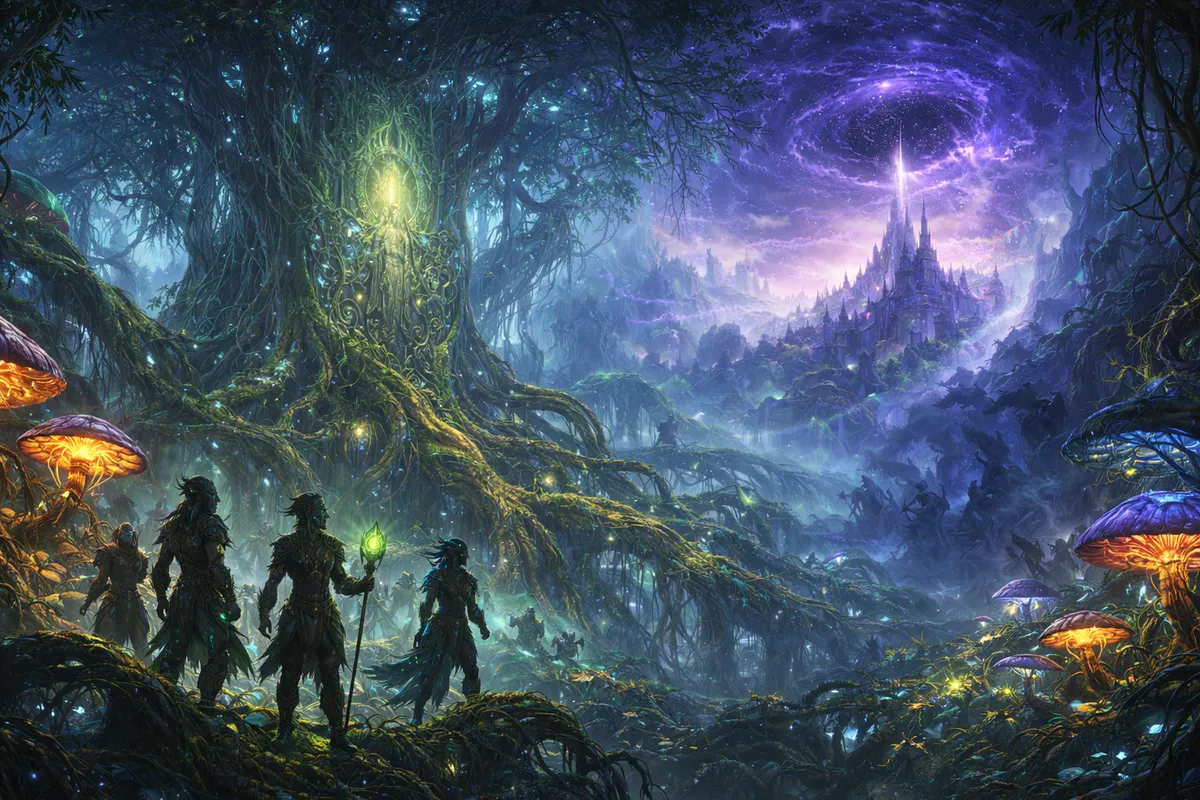
What “The Confluence of the World Trees’ Great Roots” Really Means
“World Trees’ roots converging” can sound like poetic marketing until you unpack how World Trees have worked in Warcraft lore. World Trees have historically been tied to:
- The Emerald Dream (a realm of nature and possibility)
- The distribution or containment of power
- The idea that Azeroth isn’t just land and oceans—it’s a living system with flows, valves, and safeguards
So when Blizzard says Harandar sits at the confluence of the World Trees’ great roots, it implies something more specific than “big tree roots in a cave.” It implies a junction—an underground knot where multiple world-scale root systems meet.
Think of it like this:
- A single World Tree is a massive conduit.
- Multiple World Trees create multiple conduits.
- Harandar is where those conduits braid together.
That makes Harandar a natural location for:
- hidden pathways (the rootways)
- ancient guardians (the Haranir)
- and catastrophic breaches (the Rift of Aln)
Because if the roots connect far-reaching places, then anything that corrupts the junction can spread influence in terrifying ways.
World Trees in Warcraft Lore: Why They’re More Than Giant Plants
World Trees are not just oversized scenery. In Warcraft lore, they’ve repeatedly been used to:
- spread life-giving energy
- contain or seal threats
- anchor connections to the Emerald Dream
- reshape the fate of entire civilizations
A quick, practical overview of key World Trees often referenced in lore discussions:
Nordrassil
The iconic original World Tree on Mount Hyjal, historically tied to night elf destiny, druidic access to the Emerald Dream, and life-energy spreading across the world through deep roots.
Teldrassil
A later World Tree grown in the post–Third War era (famously controversial in lore), deeply tied to night elf identity and later tragedy—an example of how World Trees can become political and emotional symbols, not just natural wonders.
Andrassil / Vordrassil
A World Tree grown in Northrend with the intention of containing the spread of saronite—an example of a World Tree used as a containment measure, but vulnerable to corruption without sufficient safeguards.
Shaladrassil
A World Tree in Val’sharah that became associated with corruption and the Emerald Nightmare—an example of how World Trees can be both guardians and victims when darker forces get a foothold.
Amirdrassil
A newer World Tree strongly tied to modern WoW storytelling and the future direction of nature-power in the setting—proof that World Trees remain a living part of Azeroth’s evolving story.
Why this matters for Harandar: Blizzard is putting Harandar at the junction of “World Tree roots” as a concept, which means Harandar inherits all the past themes World Trees represent:
- protection
- containment
- corruption risk
- Dream connections
- and world-spanning consequences
Harandar is built to feel ancient because the forces it sits on top of are ancient.
Harandar’s “Deep Places” Identity: Fungal Towers, Living Murals, and the Cradle
Harandar is described across official and media previews with specific, memorable environmental storytelling beats:
- glowing mushrooms and heavy bioluminescence
- fungal towers (vertical landmarks made of living growth rather than carved stone)
- living murals (suggesting story and memory expressed through organic surfaces)
- moss bridges and root-woven pathways
- and the Cradle of a long-lost goddess (a sacred site with massive lore implications)
This matters because it tells you what kind of storytelling Harandar is going for. Instead of “ancient ruins of a lost empire,” Harandar leans toward:
- ancient living systems
- organic memory
- sacred ecology
- and spiritual absence
When a zone includes a place called the Cradle, it’s almost never “just a cool cave.” A cradle implies:
- origin
- guardianship
- nurturing
- and loss
In Harandar, the Cradle is directly tied to a goddess described as long-lost or absent. That sets up a central mystery: what happened to the goddess, and what did her presence do to Harandar when she was here?
The Haranir and the Rootways: Secret Travel Through the World’s Foundations
Blizzard describes the Haranir as watchers who:
- travel through rootways
- observe Azeroth in secret
- and (crucially) do not intervene openly in the world’s affairs
That last point is the key to why the Haranir feel different from most allied races. Many allied races join you because they need political allies. The Haranir join because their entire approach to existence is collapsing under pressure.
The rootways imply:
- Harandar is not isolated in a simple “underground zone” way
- The Haranir can move through a network that connects root systems
- They can appear, vanish, and relocate without using conventional roads or portals
From a lore perspective, this network also makes Harandar feel like:
- a transport hub
- a surveillance hub
- and a strategic vulnerability
If the Void wants to poison the world, it doesn’t always need to conquer capitals. It can attack the arteries.
Rootwalking and “World Tree Fast Travel”: A Lore Detail That Affects How You Feel the Zone
Early previews of Haranir racials reinforce the rootways concept: the Haranir have a racial ability described as Rootwalking, a ritualistic teleport to the Cradle, and the ability to travel when near World Tree roots within Harandar.
Even if the exact mechanics shift before launch, the concept is important for lore:
- Harandar isn’t just “near some roots.”
- It’s so root-dense that “being near World Tree roots” becomes a meaningful state.
- The Cradle is so central it becomes a teleport anchor.
That’s worldbuilding through gameplay: the zone is telling you “this is how the Haranir experience Azeroth.” Not by roads. Not by ships. By moving through the living understructure.
The Rift of Aln in Warcraft History: Why This Name Hits Hard
Here’s where Harandar’s lore gets extra spicy. The name Rift of Aln already exists in older Warcraft lore as a place deep within the Emerald Dream, described as:
- a vast, deep fissure
- believed by druids to be where the Dream itself originated
- and believed to bleed into the Twisting Nether and the Great Dark Beyond
The Rift of Aln has also historically been tied to the persistence of the Emerald Nightmare in certain stories and questlines, making it a name associated with deep, primal danger—not a random label.
So when Midnight describes a Rift of Aln in Harandar as a “primordial wound where the barrier between dreams and reality grows thin,” it immediately raises a high-value mystery question:
Is this the same Rift, a reflection of it, a connected fracture, or a new wound that shares the name because it shares the nature?
Midnight doesn’t require you to answer that on day one—but it clearly wants you to feel that the Rift is not a local problem. It is a cosmology problem.
Dreams vs Reality: What It Means When the Barrier Grows Thin
In most zones, danger is physical: armies, monsters, plague, fire. In Harandar, the danger is metaphysical.
Blizzard’s Harandar description frames the Rift of Aln as a place where:
- dreams and reality leak into each other
- the “echoes” of a goddess’ anguish can drive minds toward madness
- half-formed creatures emerge—things that don’t feel fully born into reality
That’s a unique kind of threat, and it suggests Harandar’s horror isn’t “blood and gore” horror. It’s conceptual horror:
- things that shouldn’t exist, existing anyway
- emotions and memories becoming weapons
- a sacred place turning hostile not because someone built a fortress, but because reality is fraying
If you want to enjoy Harandar’s story, don’t treat the Rift as “the zone’s bad guy cave.” Treat it as a symptom: something in the world’s deep system is wrong.
The Shul’ka: Defenders Who Silence Their Connection
The Shul’ka are described as mystical warriors who stand against the horrors emerging from the Rift—and they do so by silencing their connection to the goddess so they can safely traverse the Rift.
This is one of the strongest pieces of Harandar lore because it shows:
- the goddess’ presence is not just comforting; it’s overwhelming in the Rift context
- Haranir faith is not purely empowering; it can be dangerous
- defending Harandar requires sacrificing intimacy with the divine
That tells you Harandar’s story is likely to focus on painful choices:
- keep your connection and risk being consumed
- or sever/silence it and lose something sacred in order to survive
In practical storytelling terms, the Shul’ka are a perfect “player ally archetype” for Harandar:
- they can guide you into forbidden areas
- they can show you what the Rift costs
- and they can reveal internal Haranir tension between tradition, faith, and survival tactics
The Cradle and the Long-Lost Goddess: The Mystery Thread That Could Define Harandar
Across multiple Midnight previews, Harandar is tied to “the Cradle of a long-lost goddess” or a sacred site “once ruled by a nascent goddess, now vanished.” That’s a huge lore hook because Warcraft doesn’t casually introduce god-language without building consequences around it.
What you can responsibly infer from confirmed phrasing:
- The Haranir revere a goddess connected to Harandar.
- Her absence is central (long-lost, vanished, or otherwise not present).
- The Rift’s effects include echoes of her anguish, implying pain, trauma, or loss.
- The Cradle is a sacred origin point tied to her presence or purpose.
What you should watch for in-game:
- does the story treat the goddess as a nature entity, a Dream entity, a Worldsoul-adjacent entity, or something else entirely?
- does the Cradle function as a birthplace, a prison, a sanctuary, or a scar?
- is the goddess missing because she left, because she was taken, because she’s sleeping, or because she shattered?
- are the Haranir protecting her legacy, protecting her remains, or protecting a secret connected to her disappearance?
Harandar’s “ancient mysteries” are likely to be answered not through one quest text box, but through:
- environmental details
- repeated motifs (murals, symbols, offerings)
- and the behavior of Haranir factions reacting differently to the same crisis
Harandar’s Ecology: “No Mammals, No Mercy” and What That Says About the Zone
One of the most memorable lines from early coverage is that Harandar is “a zone with no mammals, no mercy, and a whole lot of glowing mushrooms.” Whether you take it literally or as a vibe statement, it signals something important:
Harandar is meant to feel alien while still being Azeroth.
A fungal jungle built around gigantic roots suggests a biosphere that runs on:
- decomposition
- symbiosis
- spores
- bioluminescent signaling
- and predator/prey dynamics that don’t resemble a sunny forest zone
That reinforces Harandar’s story themes:
- life can be beautiful and dangerous simultaneously
- “growth” can mean shelter or suffocation
- and “nature” here doesn’t mean safe—it means ancient and indifferent
If you’re the kind of player who loves zones like Zangarmarsh or parts of the Emerald Dream, Harandar is built to hit that same “otherworldly nature” sweet spot—only darker, deeper, and more mythic.
Harandar and the Emerald Dream: The Connection You Should Keep In Mind
World Trees are historically tied to the Emerald Dream, and the Rift of Aln is famously tied to the Dream in older lore. Midnight doesn’t require a one-to-one mapping of Dream geography to Harandar, but it absolutely invites you to connect dots:
- World Tree roots
- Dream-adjacent fractures
- dream-reality permeability
- and a long-lost goddess whose anguish echoes in the wound
When you quest in Harandar, keep a mental eye on “Dream logic”:
- Are there areas that behave like memories?
- Do spaces feel like they shift when you look away?
- Do enemies feel like concepts rather than species?
- Do Haranir rituals resemble Dream-warding rather than conventional magic?
Even without spoilers, those are the kinds of cues that tell you whether Harandar is purely underground ecology—or whether it’s an interface between the physical world and Dream-space.
The Half-Formed Creatures: Why Harandar’s Enemies Should Feel Different
Blizzard’s phrasing about “horrifying, half-formed creatures” emerging from the Rift is carefully chosen. “Half-formed” suggests:
- incomplete manifestation
- unstable bodies
- creatures that might not obey normal rules
- and enemies that feel like they’re still being “decided” by reality as you fight them
From a lore standpoint, this is a terrifying idea: if the Rift is producing half-born entities, then Harandar isn’t just under attack. It’s under ontological pressure—pressure on what is allowed to exist.
This is also where Harandar can connect strongly to one of Midnight’s broader raid concepts, the Dreamrift, described as a hunt through a veil between primordial dreams and brutal reality, including “undreamt” horrors. If your story brain likes pattern recognition, Harandar is where you’ll likely learn the language of that pattern.
Ancient Mysteries to Watch For While Exploring Harandar
If you want Harandar to feel like a mystery you’re solving (instead of a checklist you’re clearing), focus on these threads while you play:
The Mystery of the Goddess
- What name(s) do the Haranir use for her?
- Is she spoken of as mother, protector, creator, judge, or victim?
- Are there taboos around saying her name?
- Do murals depict her directly, or only through symbols?
The Mystery of the Cradle
- Is it a birthplace, a sanctuary, a throne, or a tomb?
- Is it guarded, abandoned, or contested?
- Does it react to your presence through visions, whispers, or environmental changes?
The Mystery of the Rootways
- Are rootways purely physical tunnels, or do they behave like “living roads”?
- Do they connect only within Harandar, or outward to other World Tree roots?
- Do Haranir treat them as sacred, dangerous, or routine?
The Mystery of the Rift of Aln
- Is the Rift growing, shrinking, or pulsing?
- Do Haranir treat it as a wound to heal or a prison to keep sealed?
- Do different Haranir groups disagree on what should be done?
The Mystery of Silence
The Shul’ka silence their connection to the goddess to traverse the Rift safely.
- Is silence a technique, a ritual, a sacrifice, or a permanent loss?
- How does Haranir society treat those who do it? Honored heroes, tragic outcasts, or feared necessities?
The Mystery of “Why Now?”
Haranir have watched the world without intervening openly—until Midnight.
- What changed: the Rift, the Void, the goddess’ echo, or all of it?
- Is Harandar becoming a strategic target for Xal’atath’s wider plans, or is it failing on its own?
Approach Harandar with those questions and you’ll start noticing how much the zone “talks” through space design—not just dialogue.
How Harandar Fits Into the Worldsoul Saga
Midnight is explicitly the second chapter of the Worldsoul Saga, with the Void rising and Xal’atath at the center of the threat. Harandar fits this saga because it’s an “infrastructure zone.” It hints at the deeper systems that make Azeroth resilient—or fragile.
Here are the saga-level reasons Harandar matters:
- Root networks imply world connectivity. If the roots converge, then Harandar is a leverage point.
- Dream-reality permeability implies corruption vectors. If the barrier is thin, then influence can leak in both directions.
- A missing goddess implies a power vacuum. In Warcraft stories, vacuums get filled—often by something worse.
- The Haranir are new allies because they’re necessary. Midnight’s war isn’t just fought with armies; it’s fought with guardians who understand the world’s deep places.
If you’re an “AI search” type of reader who wants one sentence:
Harandar is where Midnight shows you that the war isn’t only about who holds Silvermoon—it’s about whether Azeroth’s deep systems can hold together.
A Practical Harandar Exploration Plan
You don’t need to min-max Harandar to enjoy it, but a smart plan helps you absorb story without burning out.
Step 1: Treat Harandar as a chapter, not a detour
If you rush Harandar like a side zone, you’ll miss what makes it special: the slow reveal of the Cradle, the Shul’ka’s role, and the Rift’s escalating weirdness. Plan for:
- one “story session” where you read and explore
- one “efficiency session” where you clean up side objectives after you understand the zone
Step 2: Explore vertically, not just horizontally
Harandar’s identity leans toward towers, bridges, and root-built elevation. When you see:
- fungal spires
- suspended moss bridges
- or stacked root platforms
- …treat them as more than scenery. They often signal:
- vantage points
- hidden pathways
- rare spawns
- or lore set pieces designed to be seen from above
Step 3: Revisit the Cradle at different story moments
Zones built around a “Cradle” often use it as a story barometer. As the zone conflict escalates, the Cradle may:
- change atmosphere
- unlock new areas
- reveal new murals or rituals
- or show visual signs of corruption, healing, or awakening
If your goal is lore comprehension, revisit it whenever the narrative “level” increases.
Step 4: Follow Shul’ka content as a priority
The Shul’ka are explicitly linked to traversing the Rift. If you want the zone’s core mystery to unfold clearly, prioritize:
- quests involving Shul’ka rites
- missions that take you near the Rift
- and story beats about “silence” and what it costs
Those threads are likely to be Harandar’s spine.
Step 5: Keep a “mystery notebook” mindset
You don’t need to write anything down—just keep mental flags:
- names of places
- repeated symbols
- and any line that suggests “origin,” “cradle,” “rootway,” “echo,” “silence,” or “anguish”
- In zones like Harandar, repeated words are rarely accidental.
What to Farm and What to Save for Later
Harandar’s previews strongly emphasize nature materials and gathering identity. If you’re the kind of player who likes practical wins while you explore:
- If you gather, Harandar’s theme suggests it will be a satisfying place to do it—especially if you’re into plant-based or fungus-like nodes.
- If you’re not a gatherer, focus on story and cosmetics first. Harandar looks designed for memorable transmogs, toys, and exploration achievements—things you enjoy more when you’re not exhausted.
Most importantly: don’t force Harandar to become a grind. The zone is built to feel mysterious and alive. Grind brain turns mystery into wallpaper.
BoostRoom: Enjoy Harandar’s Lore Without Falling Behind
Harandar is exactly the kind of zone that tempts you to slow down (in a good way): explore glowing caverns, chase side mysteries, and soak in the Cradle storyline. The downside is that Midnight’s endgame rhythm still exists—weekly goals, gearing lanes, and content that can feel time-sensitive.
BoostRoom helps you keep the best of both worlds:
- Clear weekly checklists so you know what actually matters this reset
- Efficient progress support for Delves, Mythic+, and raids when you want reliable completions
- Guides that keep your time focused so Harandar stays fun, not stressful
- A smoother “catch-up” path if you start late or can’t play daily
If your ideal Midnight experience is: “I want to understand the Haranir and Harandar and still be ready for endgame,” BoostRoom is the shortcut that protects your free time.
FAQ
What is Harandar in WoW Midnight?
Harandar is a new Midnight zone described as a bioluminescent, primordial fungal jungle built around the converging roots of Azeroth’s World Trees. It’s also the homeland of the Haranir.
Why are World Tree roots important in Harandar?
Harandar is positioned as a junction where World Tree root systems converge, which implies it’s tied to the deep life-systems of Azeroth and could have world-scale consequences if threatened or corrupted.
What are the rootways?
The rootways are secret pathways the Haranir use to move around the world and observe Azeroth without intervening openly—suggesting a root-network travel system tied to World Tree roots.
What is the Rift of Aln in Midnight?
In Midnight’s Harandar zone framing, the Rift of Aln is a primordial wound where the barrier between dreams and reality grows thin, allowing dangerous, half-formed creatures to emerge.
Is the Rift of Aln connected to older Emerald Dream lore?
The name “Rift of Aln” is established in older lore as a deep fissure within the Emerald Dream associated with primal Dream origins and dangerous bleed-through. Midnight uses the same name for Harandar’s wound, which strongly invites players to watch for connections.
Who are the Shul’ka?
The Shul’ka are mystical Haranir warriors who defend Harandar from Rift-born horrors by silencing their connection to the goddess so they can traverse the Rift safely.
What is the Cradle in Harandar?
Previews describe the Cradle as a sacred site tied to a long-lost or vanished goddess. It appears to be a central lore location in Harandar.
Why is Harandar described as “no mammals, no mercy”?
It’s a vivid way to communicate the zone’s harsh, alien ecology and its fungal, bioluminescent identity—Harandar is meant to feel beautiful, dangerous, and unlike a normal forest biome.
Can I unlock the Haranir by playing in Harandar?
Yes. Blizzard has stated you can earn the Haranir’s trust through story-driven quests in Harandar and unlock them as an allied race.
How do I explore Harandar without burning out?
Treat it as a story chapter, prioritize Shul’ka/Rift quests, revisit the Cradle as the narrative evolves, and do cleanup objectives in separate sessions after you’ve absorbed the lore.



