The Midnight Travel Mindset: Faster Doesn’t Mean Riskier
In older expansions, speed often meant cutting corners and pulling half the zone. In Midnight, “fast travel” is more about building reliable lanes that keep momentum and keep you alive.
Three rules that make every route better
- Route for zero resets. A 90-second “shortcut” that gets you killed is slower than a calm two-minute ridge line.
- Batch objectives by geography. Finish everything in one pocket before you cross into another pocket.
- Think in layers, not lines. Midnight zones (especially Harandar and Voidstorm) are designed with vertical travel options that are faster than ground weaving.
When you plan like this, travel stops being downtime and starts becoming progression: fewer corpse runs, fewer detours, more completed objectives per hour.
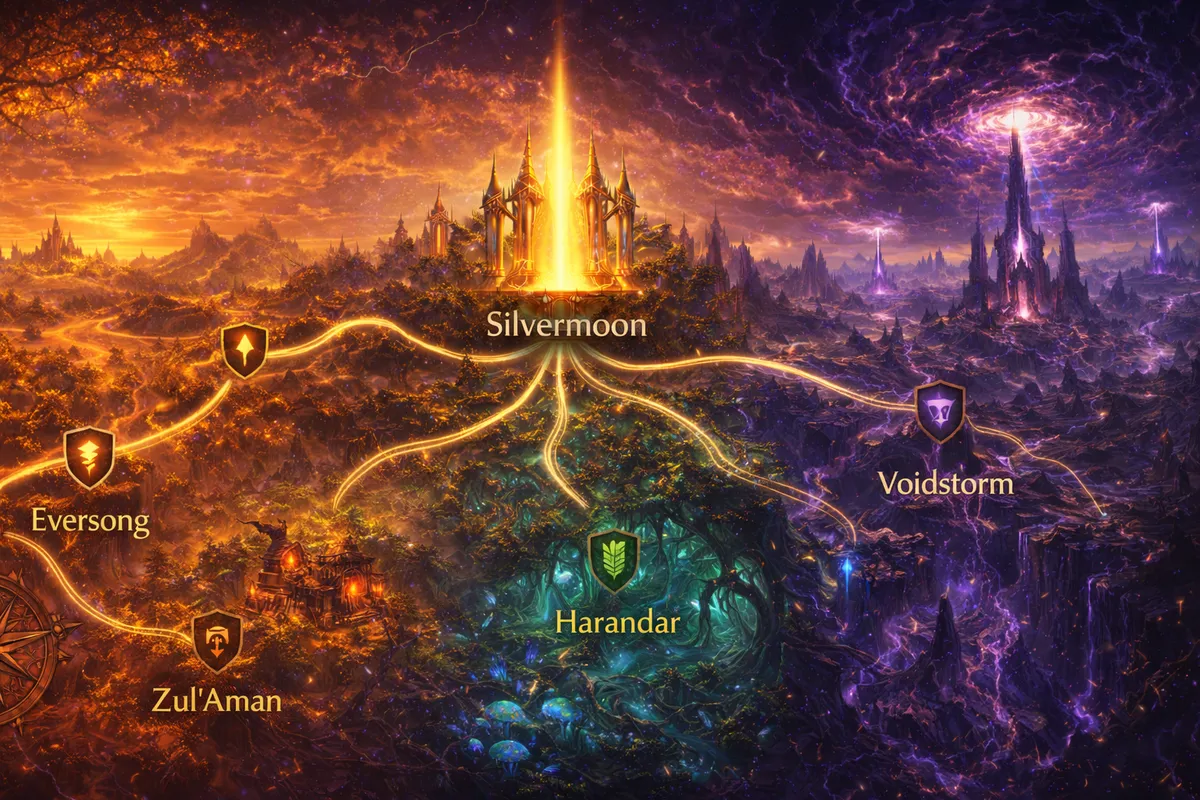
Your Core Travel Toolkit: What to Set Up Before You Start Grinding
If you do nothing else, build your travel routine around two “always available” returns and one movement system.
1) Silvermoon City as your home hub
Silvermoon is Midnight’s campaign hub for both factions, rebuilt from the ground up. The easiest efficiency win is treating it like your permanent base of operations: campaign steps, vendors, system NPCs, and your “reset loop” all live here.
2) Arcantina Key as your second anchor
The Arcantina is a cross-faction social hub you can return to using the Arcantina Key earned at the end of Arator’s Journey. The key is explicitly described as being able to return you to the Arcantina whenever you need respite. Use it as your “mental reset,” your social stop, and your safe mid-session anchor.
3) Skyride as your highway
Midnight is built for modern aerial traversal. Eversong in particular is designed so you can Skyride through the zone without loading screens. That changes everything: long-distance travel becomes an active skill, not a loading screen.
The Two-Anchor Teleport Routine: Silvermoon + Arcantina
The fastest players are consistent players. Consistency comes from anchors.
Anchor A: Silvermoon (primary hub)
Your default loop starts and ends here:
- start session → pick up tasks → leave
- return → turn in → restock → leave again
Anchor B: Arcantina (secondary hub)
Your Arcantina Key gives you a reliable “break glass” option:
- when you want a calmer intermission between chapters
- when you want a quick social/quest detour without committing to a full hub return
- when you’re tired and don’t want to keep pushing in a dangerous zone
How to use both without wasting time
- Use Silvermoon for efficiency (turn-ins, systems, restocking).
- Use Arcantina for pacing (story intermissions, short side-quests, quick “reset” moments).
- Avoid bouncing between them constantly. Pick one as your “main return” for the day and use the other only when it serves a clear purpose.
Silvermoon City: The Hub Loop That Saves You Hours
Silvermoon is designed to be a shared hub—Horde and Alliance both fortify here. But it’s not fully neutral: about one-third is Horde-exclusive, while the remaining two-thirds is accessible to both factions. That matters for travel because you want a route that works even when the city has boundaries (especially if you’re Alliance).
Your Silvermoon hub loop
- Step 1: Turn in everything you can in one sweep. Don’t turn in one quest, leave, then come back because you forgot a vendor or NPC.
- Step 2: Do your “system stop” in one pass. If you’re using Midnight systems like Prey, do it here before you head out.
- Step 3: Leave with a plan. Pick the next zone pocket you’re doing and commit to it.
Alliance efficiency tip
If you’re Alliance, build your loop around the cross-faction sections and don’t wander. Silvermoon is meant to feel like you’re a guest ally—so treat it like a workplace: in, done, out.
Prey travel tie-in
Prey is enabled in Silvermoon City by speaking with Magister Astalor Bloodsworn in Murder Row. Even if you only use Prey occasionally, it’s worth folding into your hub loop because it turns your roaming travel into “travel + progress.”
Eversong Woods: The Seamless Highway Zone
Eversong is your travel foundation because it’s explicitly described as:
- a revitalized zone combining the original Eversong Woods and Ghostlands
- slightly expanded
- connected to the Eastern Kingdoms
- Skyride-friendly without loading screens
That combination makes Eversong the best place to practice “Midnight movement” and build habits you’ll reuse everywhere else.
Eversong fast travel principles
- Use Skyride to cross the zone, not to micro-move. Skyride shines when you’re going far. For short hops, ground movement and clean paths are often faster.
- Treat the restored land as a grid. Eversong’s new seamless flow means you can create repeatable “north/south” or “east/west” lanes that you reuse all week.
- Build a “return corridor.” Pick a reliable line that always brings you back toward Silvermoon quickly. That way, even if you detour for objectives, you always know how to come home fast.
The best Eversong habit
When you arrive in a quest pocket, don’t immediately start fighting. First: climb or rise slightly and scan. Eversong’s biggest time savings come from avoiding backtracking for missed objectives.
Eversong route templates (pick one based on your goals)
- Campaign-first lane: only follow main campaign markers and do side quests that are directly on the path.
- Completionist lane: finish a full pocket before moving to the next pocket (slower per minute, better for long sessions).
- Weekly lane: prioritize anything that resets weekly (events, hunts, reputation tasks), then fill the gaps with side content.
Zul’Aman: Landmark Navigation and Mountain-Smart Shortcuts
Zul’Aman is described as forests and tall mountains with periodic rainfall, and it’s built to make you move through a region that feels like a real homeland. The trick to fast travel here is landmark routing—you don’t navigate Zul’Aman by “straight lines,” you navigate it by “temple-to-temple” and “ridge-to-valley.”
Your Zul’Aman travel anchors
Even spoiler-light, you have natural anchors: the overgrown loa temples (Akil’zon, Halazzi, Jan’alai, Nalorakk). These are perfect navigation pillars because you can build loops that always return to something recognizable.
Zul’Aman shortcut types that work
- Ridge routes: stay high when traveling long distances; drop down when you’re ready to clear.
- Valley sweeps: once you drop into a valley, finish the whole valley pocket before climbing out.
- Pass crossings: mountains create funnel points. When you find a pass that cleanly crosses a ridge, reuse it every time instead of improvising new climbs.
How to avoid the #1 Zul’Aman travel mistake
The most common time sink is “I dropped into a low pocket for one objective and now I’m climbing forever.” Fix it with one habit:
Never drop for one objective unless you have at least two more objectives nearby.
If you only have one, stay high, keep moving, and come back when you can bundle it.
Event-aware routing
Zul’Aman is tied into major open-world activities like Abundance (available across all Midnight zones). Travel efficiency here comes from staying flexible:
- if an event is active, do it first (time-boxed)
- then clear the nearest pocket while you’re already there
- then go back to your main route
This keeps you from bouncing across the zone for single tasks.
Harandar: Layer Travel, Rootways, and Safe Lines
Harandar is described as a fungal jungle where the roots of all world trees converge, glowing with bioluminescence. It contains the Rift of Aln, where the boundary between dreams and reality grows thin. Haranir travel through the rootways to move around the world.
Harandar travel is all about one concept: layers.
The three Harandar layers
- Ground layer: dense, beautiful, slow; easiest to get lost; highest chance of accidental pulls.
- Root bridge layer: the “best lane” for travel; natural bridges reduce detours.
- High spine layer: the scouting lane; best for seeing where you want to drop and for avoiding ground clutter.
The Harandar fast travel rule
Travel on roots; fight on the ground.
If you do this consistently, Harandar stops feeling confusing and starts feeling like a playground.
Rootways: how to use them without wasting time
Rootways are powerful, but they can also disorient you if you treat them like a novelty.
Rootway best practices
- Use rootways for long jumps, not short hops. They’re best when crossing sub-regions.
- Learn one connector at a time. Two reliable rootways beat ten half-remembered ones.
- Remember exits, not entrances. The time saver is knowing where you come out and what it’s good for.
Rift of Aln safety routing
The Rift is described as a place where echoes can overwhelm most haranir and half-formed creatures emerge. Even if you’re strong, travel mistakes are costlier near the Rift.
Rift travel safety habits
- keep a defensive ready while moving
- avoid narrow “root bridges over danger” when you’re tired or distracted
- if you’re undergeared, skirt Rift-adjacent pockets until you’re comfortable
Harandar rewards calm competence. Panic movement is what kills your time.
Voidstorm: Survival Travel and Gorge-Proof Shortcuts
Voidstorm is described as chaotic and violent, drenched in Void, filled with deep gorges and towering Nexus-Points devouring Void energy from the land. It’s also framed as a place where safety is not guaranteed.
Voidstorm travel is a skill check. The zone is designed to punish:
- wandering without a lane
- dropping into gorges without an exit plan
- fighting in bad terrain
Voidstorm navigation anchors
- Nexus-Points are your lighthouses. Pick one as a reference and keep it in view to maintain orientation.
- Ridges are your highways. High lines are safer and faster than ground weaving.
- Gorges are “objective pockets.” Treat gorges like places you enter intentionally to finish multiple tasks, then leave.
The two fastest shortcut styles in Voidstorm
- Ridge highways: move on high edges and plateaus, then drop into your target pocket.
- Planned drop routes: when you drop into a gorge, commit to clearing 2–5 objectives there before you climb out.
The most important Voidstorm rule
Never improvise your exit after you drop.
Before you jump down: identify where you’ll climb out or where your path continues forward. If you don’t know, stay high and keep scouting.
Survival travel habits that save time
- fight on wide terrain when possible (avoid narrow ledges)
- interrupt dangerous casts instead of “tanking through”
- use defensives early when a pull goes wrong (dying is the slowest travel)
Voidstorm becomes enjoyable when you stop trying to “shortcut the chaos” and instead build repeatable safe lines.
All-Zone Efficient Paths: The Routes That Work No Matter What You’re Doing
Now that each zone has its own logic, here are universal route plans you can use daily and weekly.
The 15-Minute Daily Fast Travel Loop
This is the “log in and immediately feel progress” routine.
- Start in Silvermoon.
- Turn in anything ready to turn in.
- Pick up your next main objectives (campaign or weekly).
- If you use Prey, activate it now (so your travel time doubles as hunt time).
- Choose one zone pocket and commit to it (don’t bounce).
- End the session back in Silvermoon if you need to reset for next time.
Why it works: it minimizes bouncing and makes every travel segment carry progress.
The 45–60 Minute “One Zone, One Goal” Route
Pick one zone and run it like a circuit:
- Eversong: a smooth Skyride sweep that clears clustered objectives and returns you quickly.
- Zul’Aman: a ridge-to-valley loop anchored by temples; drop only when bundling.
- Harandar: a root-bridge travel loop with one deliberate ground-layer clear pocket.
- Voidstorm: ridge highway travel with one planned drop route into a gorge pocket.
This route is perfect for real life schedules because it prevents the “I started 12 things and finished none” feeling.
The Weekly Cross-Zone Route (Minimal Backtracking)
Use this when you want weekly progress without turning your week into chores.
- Day 1: Campaign focus + Silvermoon setup + one event block
- Day 2: One “vertical zone” block (Zul’Aman or Harandar)
- Day 3: Voidstorm block (short, focused—don’t wander)
- Day 4+: Fill gaps: delves, dungeons, hunts, and quick objective pockets
The trick is not doing “a little of everything every day.” The trick is doing one coherent route per session.
Fast Travel and Delves: Don’t Miss the Mount Advantage
Midnight’s delves include some outdoor-staged delves where you can use ground mounts to get around more easily. Travel efficiency in delves matters because delves are repetition content: small time saves add up fast.
Delve travel tips
- treat outdoor delves like mini-zones: identify the “main lane” immediately
- mount whenever possible instead of fighting every pack on the path
- finish the pocket you’re in before crossing the map inside the delve
If you’re farming delves weekly, this alone can save hours over a season.
Fast Travel and World Activities: Plan Around Time-Boxed Content
Midnight’s open-world activities often appear on schedules (events, world PvP objectives, hunts). Your travel should respect time-boxed rewards.
Time-box rule
If something is active and valuable, do it first—then clear the pocket around it while you’re already there.
Examples of things that often reward this approach:
- Abundance-style events (cross-zone)
- PvP objective windows in contested areas
- Prey hunt opportunities while you’re already roaming
This keeps your travel from becoming “a commute” and turns it into “a chain.”
Fast Travel for Alts: Build Repeatable Lanes, Not Perfect Maps
Alt-friendly travel is about simplicity. Your main character might have a perfect route. Your alt just needs a reliable one.
Alt travel priorities
- Keep Silvermoon as the consistent hub so your muscle memory stays the same.
- Use one “safe route” per zone, even if it’s not the absolute fastest.
- Avoid deep Voidstorm drop routes on alts until you’re geared and comfortable.
The best alt habit
Don’t chase perfection. Chase consistency. Consistency is what makes alt sessions feel relaxing instead of chaotic.
Common Time-Wasters in Midnight Travel (And the Fix for Each)
Time-waster: bouncing between zones for single objectives
Fix: batch objectives by geography; finish pockets before switching zones.
Time-waster: “shortcut” drops into bad terrain (especially Voidstorm)
Fix: use ridge highways and planned drop routes with known exits.
Time-waster: ground-layer wandering in Harandar
Fix: travel on roots, fight on ground.
Time-waster: overusing Skyride for short hops
Fix: Skyride for long travel, not micro-movement.
Time-waster: returning to hub too often
Fix: one hub return per “chapter” of your session, not every time you complete one quest.
BoostRoom: Turn Efficient Travel Into Faster Progress
Fast travel is only valuable if it translates into real gains: cleaner campaign pacing, more weekly rewards, better gear progression, and less frustration. BoostRoom is built to help you turn your time into results—especially in expansions like Midnight where zones are designed with layered navigation, high-risk pockets, and systems that reward consistency.
BoostRoom can help you:
- Plan the most efficient weekly route across all zones so you hit your goals faster
- Handle difficult travel-heavy objectives (especially in Voidstorm) without death loops
- Optimize Prey and event routing so roaming time becomes meaningful progress
- Improve delve and dungeon efficiency so your power grows and outdoor travel gets easier
- Get coaching on movement and routing (Skyride lines, safe lanes, pocket batching)
BoostRoom is a third-party service and is not affiliated with Blizzard Entertainment.
FAQ
What’s the best “home hub” in WoW Midnight for travel efficiency?
Silvermoon City. It’s the campaign hub for Midnight and is designed to be your main return point for turn-ins, systems, and resets.
How do I access the Arcantina, and why does it matter for travel?
You need the Arcantina Key earned at the end of Arator’s Journey. It matters because it gives you a reliable return-to-hub option for respite and pacing without relying purely on your main hub loop.
Is Eversong Woods actually seamless in Midnight?
Eversong is described as connected to the Eastern Kingdoms, and it’s built so you can Skyride through it without loading screens, which makes it one of the smoothest travel zones in the expansion.
What’s the fastest way to move through Zul’Aman?
Use landmark routing and vertical discipline: travel on ridges, drop into valleys only when bundling multiple objectives, and reuse mountain passes instead of improvising climbs.
How do I stop getting lost in Harandar?
Stop traveling on the ground layer. Use root bridges and high roots for movement, then drop down only when you’re ready to clear an objective pocket. Learn rootways one connector at a time.
Why does Voidstorm feel so slow and dangerous to travel in?
Voidstorm is built around deep gorges and hazardous terrain. The “shortest path” often drops you into a bad pocket. Ridge highways and planned drop routes are the key to fast, safe movement.
Is Prey worth enabling if I care about travel efficiency?
Yes, if you like roaming. Prey turns travel time into progress by layering a hunt objective on top of your normal zone movement. Enable it in Silvermoon City and plan routes that give you space to handle surprise encounters.
What’s the simplest daily travel plan across all zones?
Start in Silvermoon, batch turn-ins, pick one zone pocket, commit to it, and return once to reset. Avoid bouncing between zones for single objectives.
How can BoostRoom help with travel specifically?
BoostRoom can help you build efficient zone loops, avoid time-wasting death routes in dangerous areas, and align your movement with systems like Prey, delves, and weekly progression so your playtime produces faster results.