Cyrodiil vs Battlegrounds: Which Should You Start With?
If you want a fast answer, use this:
Start with Battlegrounds if you want:
- Short matches with quick learning loops
- More consistent “action time” per minute
- A good place to practice awareness, positioning, and teamwork fundamentals
- A low-stress way to learn PvP rhythm without a huge map
Start with Cyrodiil if you want:
- Massive open-world battles and large-scale objectives
- A sense of “war” with territory, scoring, and campaign identity
- More ways to contribute even when you’re still learning (scouting, defending, escorting, grouping)
- PvP that feels like a living world instead of an arena match
The best beginner path for most players (fastest improvement):
Battlegrounds for mechanics and confidence → Cyrodiil for big-picture PvP and long-term progression.
Why this works: Battlegrounds give you rapid repetition (you learn faster). Cyrodiil teaches you decision-making at scale (you become effective in real campaigns).
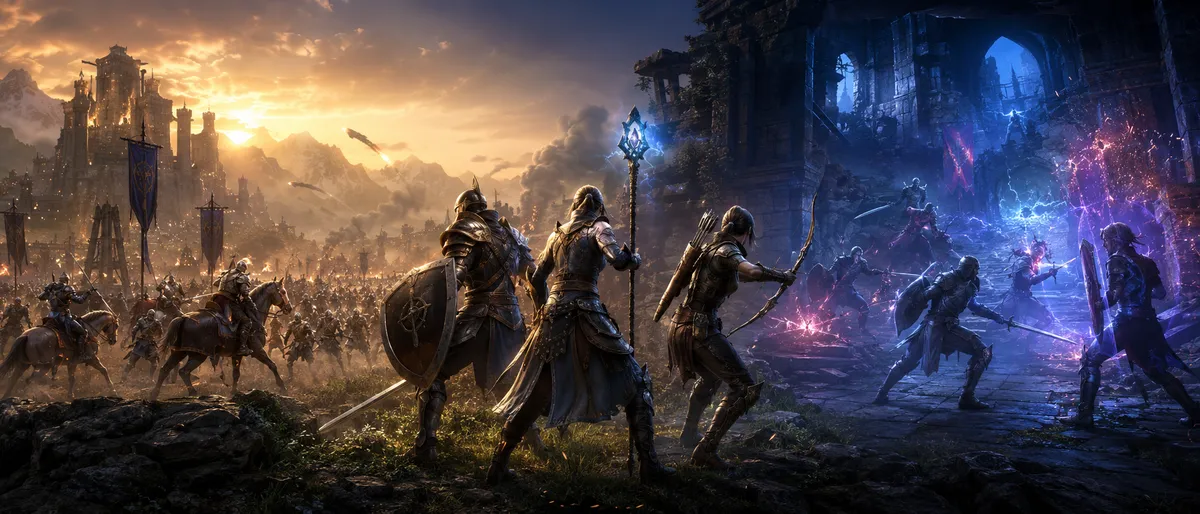
What Changed in 2026: The PvP Systems That Affect New Players
PvP in 2026 is not just “go fight.” Several systems influence progression and where beginners should spend time.
PvP Veterancy (Update 50 / Season Zero)
Update 50 introduced a new PvP progression system called Veterancy, designed as an account-wide track that rewards participation across PvP modes. The goal is simple: you play PvP and you earn a visible progression path with rewards. This matters for beginners because it makes “just playing and learning” feel more rewarding and less like wasted time.
Vengeance campaign (full-time availability)
Update 50 also brought back Vengeance as a permanent Cyrodiil campaign option. This matters because it creates a different on-ramp for players who want a structured ruleset and a less traditional campaign experience.
Battleground format changes (recent updates)
In recent years, Battleground formats have included multiple match sizes and queues. This matters because the “best learning environment” depends on which queue is currently active and which style you enjoy most.
The beginner takeaway: PvP progression is more structured now than it used to be, and you can pick the mode that matches your learning style without feeling like you’re missing out.
Before You Queue: The PvP Starter Checklist
Most first-time PvP frustration comes from entering unprepared. This checklist takes 5 minutes and saves you hours of pain.
Build separation
PvE setups often collapse in PvP because PvP pressure is unpredictable. Create a dedicated PvP setup (even a simple one) so you aren’t trying to do two different jobs with one layout.
Survival button
Have at least one reliable “save me” tool you can press without thinking when you get pressured.
Sustain plan
If your resources collapse, you stop contributing. Make sure you can keep casting/using abilities for at least 45–60 seconds in a real fight without hitting zero.
Food buff
Always run a food/drink buff in PvP. It’s one of the cheapest power upgrades in the game.
Inventory and repair sanity
Clear enough bag space for rewards and keep enough gold for repairs. PvP has a lot of quick reward items and you don’t want to spend your session in menus.
Mindset reset
Your first goal is not “top score.” Your goal is:
- Stay alive longer
- Understand why you died
- Improve one habit per session
That mindset is how you improve fast.
PvP Build Basics for Beginners: What Makes a Setup Actually Work
You do not need a perfect meta build to start PvP. You need a build that does three things reliably: survive pressure, keep resources stable, and contribute to objectives.
Survivability is your first DPS increase
In PvP, being alive is output. A player who stays alive keeps pressure on objectives, helps teammates, and keeps earning rewards. A player who drops instantly contributes almost nothing.
A simple stat priority concept (for most beginners)
- Enough health to survive burst moments
- Enough resistances/mitigation to not melt instantly
- Enough sustain to keep abilities flowing
- Then optimize damage once you’re stable
Avoid the “glass” trap early
New players often copy a high-damage setup and wonder why they explode. High damage setups usually assume excellent positioning, timing, and awareness. Start stable, then get sharper.
Two beginner-friendly playstyles
Skirmisher (safe learning style)
- Move with your team
- Take safe angles
- Contribute steady pressure
- Peel for allies (help when a teammate is being pressured)
- This style teaches positioning and awareness fast.
Objective specialist (fast win style)
- Focus on objectives rather than chasing fights
- Defend, capture, escort, and hold positions
- Win matches even without “top damage”
- This style teaches smart decision-making and often earns rewards efficiently.
The biggest build rule for improving fast
If your build is unstable, you can’t practice. Stability is what gives you learning time.
Cyrodiil 101: The Alliance War in Plain English
Cyrodiil is ESO’s large-scale PvP zone where alliances fight for control over territory, score, and campaign dominance.
You enter Cyrodiil through campaigns
Before entering, you choose a home campaign. Some campaigns are alliance-locked, meaning your characters in that campaign must match the alliance you committed with when you entered. You also have guest options. This matters because it affects where you play, who you fight with, and how your long-term campaign progress works.
What you do in Cyrodiil (beginner perspective)
Cyrodiil isn’t “run around until you find fights.” It’s objective-based. The most common contributions are:
- Attacking or defending major objectives
- Helping secure routes and travel links
- Responding to calls for defense
- Supporting a group push through coordinated movement
How you earn Alliance Points (AP)
AP is the main PvP currency and score contributor. You earn it by participating in the war: capturing and defending objectives, assisting in fights, and contributing to campaign activity.
Why Cyrodiil feels hard at first
- It’s huge, so you can feel lost
- Battles can be chaotic
- You might run into experienced groups
- It’s easy to overextend and get punished
- The fix is not “be stronger.” The fix is “play with structure.”
Cyrodiil Starter Plan: Your First 60 Minutes (No Stress)
If you want to step into Cyrodiil and feel useful quickly, follow this path.
Minute 1–10: Choose a campaign and anchor yourself
Pick one campaign and stick with it for a while. You want familiarity with map flow and where fights usually happen.
Minute 10–20: Do the intro quest if it’s your first time
The intro helps you understand basic movement systems inside Cyrodiil and how to navigate the zone. Even if you don’t love tutorials, doing it once prevents “I’m lost” frustration later.
Minute 20–35: Join a group (the biggest beginner power-up)
In Cyrodiil, solo play can be fun later, but it’s a harder learning curve. Group play gives you:
- Safety
- Structure
- Calls to follow
- A clear place to stand and move
- Even if you don’t speak, simply following a coordinated group teaches you more than wandering alone.
Minute 35–50: Contribute to simple objectives
Your job is not to be a hero. Your job is to contribute:
- Stay with the group
- Follow calls
- Don’t chase random fights far from the team
- Help finish objectives and then move together
Minute 50–60: Review one death and fix one habit
After your first session, pick one thing to improve next time:
- “I overextended” → next time, stay within support range
- “I didn’t see danger zones” → next time, increase visual clarity and move earlier
- “I ran out of resources” → next time, adjust sustain and stop panic-spamming
- One fix per session is how you improve rapidly.
Cyrodiil vs Battlegrounds: The Learning Differences That Matter
New players often ask which mode is “easier.” The real answer is: they teach different skills.
Cyrodiil teaches:
- Map awareness and choosing battles
- Group movement and discipline
- Objective value (when to push, when to defend)
- Patience and timing (you don’t need to fight every second)
Battlegrounds teach:
- Fast positioning decisions
- Target awareness (who is pressuring whom)
- Objective execution under pressure
- Quick recovery after mistakes (short matches = rapid learning loops)
If your goal is “get better fast,” Battlegrounds provide more repetitions per hour. If your goal is “learn the war,” Cyrodiil gives the full MMO PvP experience.
Battlegrounds 101: The Fast PvP Mode
Battlegrounds are shorter match-based PvP sessions accessed through the Group & Activity Finder.
Team size and structure
You queue into a match with a small team. Depending on the current format and queue type, matches can be structured around different team sizes.
Champion Points and fairness
A key beginner-friendly detail is that Battlegrounds do not use Champion Points the same way open-world PvE does. This helps reduce one layer of power gap. Gear and build still matter, but the mode is designed to be more controlled.
Matchmaking and queues
Battleground matchmaking is influenced by multiple factors, including your level range and performance. This is one reason queues and match difficulty can feel inconsistent: the system is trying to build fair matches with whoever is currently queueing.
Why Battlegrounds are great for beginners
You get the fastest “practice loop” in ESO PvP:
- Enter match
- Learn objective
- Make mistakes
- See results quickly
- Improve next match
That repetition is what creates rapid improvement.
Battleground Modes: What You’re Actually Trying to Do
You don’t need to memorize every mode perfectly. You just need to know the basic win condition and one beginner rule for each.
Team Deathmatch (TDM)
Win condition: score points by defeating opponents more efficiently than they defeat you.
Beginner rule: don’t go alone. Small-team PvP punishes solo wandering.
Domination
Win condition: control capture points to generate score.
Beginner rule: your body on the point matters more than chasing someone off-point.
Crazy King
Win condition: capture points that move/rotate over time.
Beginner rule: rotate early. Getting there first is often stronger than arriving late with perfect damage.
Chaosball
Win condition: hold the objective item to score over time.
Beginner rule: don’t treat it as a dueling match. Treat it as escort and protection.
Capture the Relic
Win condition: take the enemy relic and return it to your base while protecting yours.
Beginner rule: defense wins games. A team that ignores defense often loses even if they “win fights.”
The universal Battleground lesson
Objectives win matches. Fights are tools to secure objectives.
How to Improve Fast: The 7 PvP Skills That Matter Most
Your class matters less than these skills. If you improve these, your PvP results improve regardless of build.
1) Positioning
Positioning is “where you stand” and “where you move next.” Good positioning keeps you inside support and outside danger.
2) Awareness
Awareness is knowing:
- Where your teammates are
- Where the objective is
- Where danger is coming from
- When the fight is turning against you
- Awareness prevents panic.
3) Timing
Timing is when you push and when you back off. Beginners often push at the worst time and retreat at the wrong time. The fix is learning “pressure windows”: moments when your team is strong and moments when you should reset.
4) Resource management
If your resources hit zero, you lose options. Your goal is to keep a stable rhythm rather than bursting everything at once and collapsing.
5) Defensive reactions
The best PvP players don’t just do damage—they react. When pressure spikes, they stabilize first, then re-engage.
6) Objective discipline
Objective discipline means you don’t abandon the winning play for a tempting chase. Many matches are lost because players chase and forget the objective.
7) Emotional control
This sounds simple, but it’s huge. PvP punishes frustration. The faster you reset after a mistake, the faster you improve.
If you focus on these skills, improvement becomes predictable.
The Fastest Way to Improve: “One Focus Per Session” Training
Trying to improve everything at once is how players get overwhelmed. Instead, choose one focus every time you PvP.
Session focus examples
- “I will stay with my team at all times.”
- “I will rotate early to objectives.”
- “I will stop chasing low-health opponents off objective.”
- “I will prioritize survival before re-engaging.”
- “I will keep resources above 30% whenever possible.”
This method works because it creates a clear win condition you can control.
A 7-Day PvP Improvement Plan (Beginner Friendly)
Use this if you want rapid improvement without burnout. Each day can be as short as 30–60 minutes.
Day 1: Build stability
Goal: stop collapsing instantly.
- Add survivability and sustain until you can stay active in fights longer
- Focus on staying alive, not winning fights
Day 2: Learn objectives in Battlegrounds
Goal: stop playing every mode like it’s Deathmatch.
- Play matches and focus on the objective win condition only
- Notice how often “objective presence” beats “chasing”
Day 3: Team movement discipline
Goal: improve positioning through teamwork.
- Stay within support distance of teammates
- Don’t go alone, even if you feel strong
- Learn how much safer you are when you move as a unit
Day 4: Cyrodiil orientation session
Goal: stop feeling lost.
- Spend a session learning the map flow and where action usually happens
- Join a group and follow calls
- Practice responding quickly instead of wandering
Day 5: Defensive timing
Goal: learn when to reset.
- When pressured, stabilize first and reset position
- Don’t “fight to the last hitpoint” every time
- Learn the difference between a winnable fight and a doomed fight
Day 6: Objective leadership (small)
Goal: take one small leadership action.
- In Battlegrounds, ping or move toward objectives early
- In Cyrodiil, respond to defense calls or follow an organized push
- You don’t need to be a raid lead—just a reliable contributor.
Day 7: Review and refine
Goal: lock in your biggest improvement.
- Identify the #1 reason you died most this week
- Fix that one thing (positioning, sustain, reaction, awareness)
- Keep the new habit for next week
Repeat this plan once and your PvP confidence usually doubles.
The Beginner “Do Not Do This” List
If you stop doing these things, you’ll improve instantly.
Don’t bring a pure PvE setup and expect it to work
PvP needs survivability and sustain first.
Don’t fight alone
Solo fights can be fun later, but they’re a harder learning curve. Early on, team play is the fastest improvement tool.
Don’t chase off objectives
Most losses come from chasing and abandoning objectives.
Don’t stand still when the fight is moving
Movement is survival. Standing still makes you an easy target.
Don’t panic-spam abilities until resources hit zero
Stable rhythm beats panic.
Don’t tilt after one bad match
PvP has variance. Your job is to learn one thing from each session.
Progression and Rewards: Why PvP Time Is Worth It
A big reason people quit PvP early is feeling like they “got nothing.” In reality, PvP is full of progression layers—you just need to know what they are.
Alliance Points (AP)
AP is the core PvP currency that reflects participation and contributes to campaign progress.
Alliance War menu and campaign identity
Your campaign choice affects your long-term PvP story: which battles you join, how your alliance performs, and which community you regularly encounter.
Rewards for the Worthy
ESO has a reward system where participating and earning AP grants mailed reward containers on a threshold basis. This is one of the most consistent “I did PvP and got loot” systems because it arrives automatically.
Veterancy progression (2026)
Veterancy adds a broader progression track across PvP modes. This helps beginners because your improvement sessions also feed a visible reward path.
The best beginner mindset about rewards
Treat rewards as a byproduct of showing up and improving. If you chase only rewards, you burn out. If you chase skill, rewards pile up naturally.
Cyrodiil vs Battlegrounds: How to Pick Your “Main Mode”
Once you’ve tried both, you’ll naturally prefer one style. Use these questions to choose.
Choose Cyrodiil if you love:
- Big war energy and large-scale teamwork
- Longer sessions where momentum builds
- Strategy, map flow, and group coordination
- The feeling of contributing to a campaign
Choose Battlegrounds if you love:
- Quick matches and fast learning
- Short sessions with clear win conditions
- Small-team coordination and objective execution
- Consistent action and constant practice
You don’t have to pick only one
Many players use Battlegrounds for skill practice and Cyrodiil for the “main PvP experience.”
PvP Etiquette: How to Be the Teammate People Actually Want
PvP communities remember behavior. Good etiquette makes you get better groups, better learning opportunities, and better long-term fun.
Communicate simply
Short messages win:
- “Group up on objective.”
- “Rotate to next point.”
- “Defend our base.”
- You don’t need essays. You need clarity.
Don’t blame in chat
Blame increases tilt and makes teams play worse. If you want to improve, focus on what you can control.
Respect objectives
Even if you’re strong in fights, abandoning objectives is how teams lose. Teammates respect players who win matches, not players who chase.
Learn from strong players instead of resenting them
If someone is clearly experienced, watch where they stand and how they move. Copying movement and timing is one of the fastest learning shortcuts.
Be honest about experience when joining organized groups
If you join a coordinated group in Cyrodiil, saying “new to PvP, happy to follow” is respected far more than pretending you know everything.
BoostRoom: A Faster PvP Learning Curve Without Guessing
If you want to enjoy PvP but you’re tired of the “enter, die, feel confused, log off” loop, BoostRoom can help you improve with structure.
What BoostRoom can help you with
A stable beginner PvP setup
A practical foundation that survives long enough for you to learn positioning, objectives, and timing.
Skill-focused coaching
Improvement is faster when you know what to practice: movement, awareness, objective play, resource rhythm, and defensive timing.
Mode choice planning
Whether you want short practice loops in Battlegrounds or large-scale campaign play in Cyrodiil, BoostRoom helps you build a plan so every session feels like progress.
The goal is simple: spend less time guessing and more time getting better.
FAQ
Can I start ESO PvP as a new player?
Yes. PvP becomes available at level 10. The best beginner approach is to start with simple goals: stay with your team, play objectives, and build survivability first.
Is Battlegrounds or Cyrodiil better for beginners?
Battlegrounds usually teach faster because matches are short and you get more repetitions per hour. Cyrodiil is better for learning large-scale teamwork and campaign strategy. Many beginners do Battlegrounds first, then Cyrodiil.
Do Champion Points matter in Battlegrounds?
Battlegrounds are commonly treated as a no-CP environment for match power, which helps keep fights more controlled. Gear and build still matter, but the mode reduces one layer of power gap.
Why do I feel useless when I enter PvP with my PvE setup?
PvE setups often lack the survivability and sustain required for PvP pressure. PvP is unpredictable, so you need a dedicated setup that stays stable under burst and crowd control.
What’s the fastest way to improve in PvP?
Pick one improvement focus per session (positioning, objective rotation, staying with your team, resource rhythm, defensive timing). Short consistent practice beats long frustrated sessions.
What should I do in Cyrodiil if I’m new and don’t want to feed deaths?
Join a group, follow calls, and contribute to objectives. Staying with coordinated teammates is the safest way to learn Cyrodiil without feeling lost.
What causes most Battleground losses for beginners?
Ignoring objectives, wandering alone, late rotations, and chasing fights off-point. Objective discipline wins matches.
What is PvP Veterancy in 2026?
Veterancy is a new progression system introduced with Update 50 that rewards participation across PvP modes and provides a visible track of progress and rewards.



