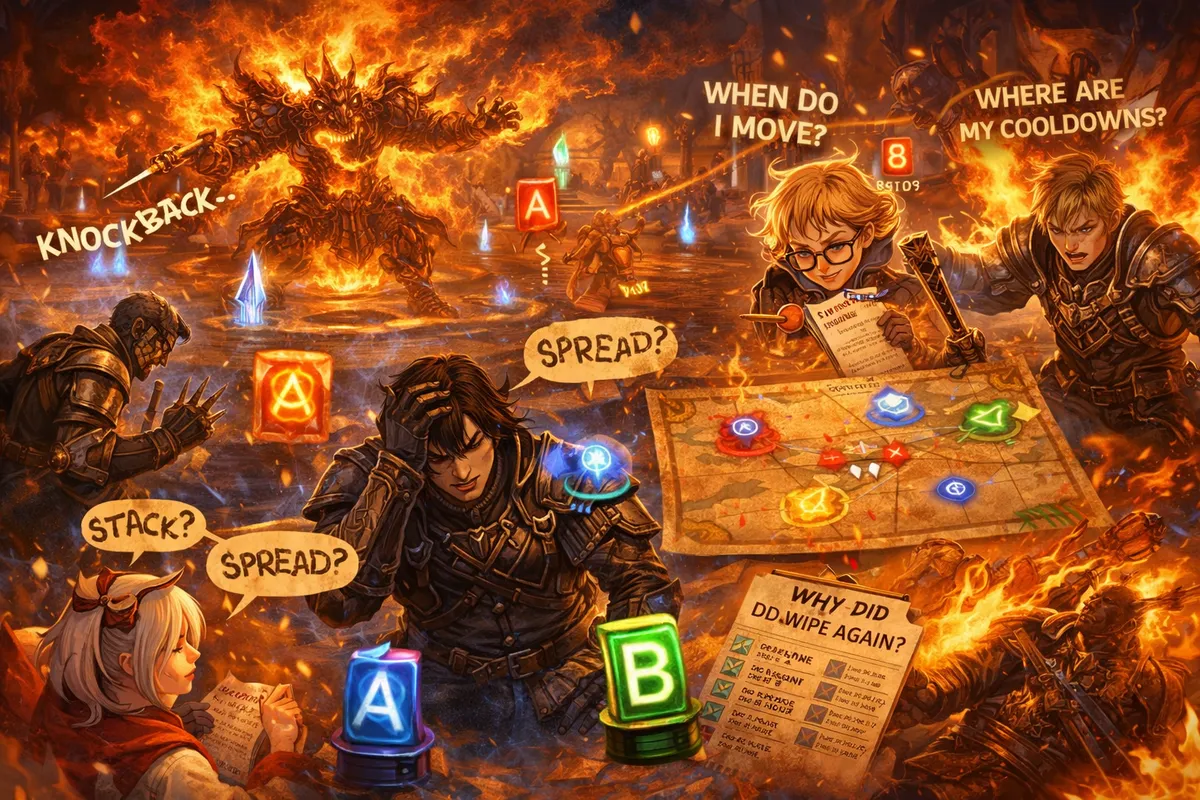
Why Wipes Happen (And Why They Repeat)
Most raid wipes happen for one of three reasons:
1) The party didn’t agree on a rule.
Everyone “thought” they knew the strat, but half the group resolves a mechanic one way and half resolves it another way. This is the most common PF wipe cause: not low skill—low alignment.
2) The party can’t read the tell fast enough.
The game gives a signal (cast bar, marker, debuff, tether, add spawn, arena animation), but players notice it late, panic-move, and collide.
3) The party fails the survival layer.
Even if the mechanic is understood, the group dies because of missing mitigation, late healing, poorly timed invulns, or someone greedily eating damage “for uptime.”
Wipes repeat because the group never identifies which of these it is. If every wipe is described as “we messed up,” nothing improves. Clean groups are the ones that can name the wipe in one sentence.
The One-Sentence Wipe Diagnosis (Use This Every Time)
After a wipe, force the group (or yourself) to answer one sentence:
“We died because ___ happened, so next pull we will ___.”
Examples:
- “We died because two people soaked the same tower, so next pull towers are assigned by roles.”
- “We died because spreads clipped, so next pull everyone spreads to cardinals.”
- “We died because raidwide + bleed ticked us out, so next pull we mit + heal proactively.”
This sentence does two things:
- It turns chaos into a pattern.
- It creates a single actionable fix.
If you can’t complete the sentence, you don’t understand the wipe yet—so you’ll repeat it.
The Top Wipe Category: Positioning Errors
Positioning wipes are the most common because they’re fast and visual. One person in the wrong place can:
- clip the party with a spread
- bait an AoE through the stack
- break a tether incorrectly
- point a cleave into the group
- drop an explosion on the safe spot
The fix is rarely “be better.” The fix is using fixed reference points:
- cardinals (N/E/S/W)
- intercardinals (NE/SE/SW/NW)
- numbered spots (1–4)
- light parties (Group 1 and Group 2)
- partner assignments (your buddy)
If your party is “freeforming” positions, you’re gambling every pull.
Mistake #1: Stack and Spread Confusion
This is the classic wipe: a stack marker appears, but someone spreads—or spreads appear, but someone stays in the stack.
What’s actually happening
- Stack markers are often designed to split damage among multiple players.
- Spread mechanics are designed to punish overlapping hitboxes.
- Many fights chain them: stack → spread → partners → stack. The trick is timing.
Why parties wipe
- Players don’t know whether the mechanic is “everyone stack” or “light party stack.”
- Players stack too late and arrive after the damage snapshot.
- Players spread randomly and clip someone who moved late.
- Players follow one person who ran to the wrong place (follow-the-lemming wipe).
Fixes that instantly help
- Decide your default: “Stacks mid unless strat says otherwise.”
- For spreads, use fixed spots: cardinals for 4 spreads, intercards for 8 spreads, or “clock spots.”
- If it’s “partners,” stand with your assigned partner early, not at the last second.
- Move early, then stop. Over-moving creates more collisions than late-moving.
Mistake #2: Towers and Soaks Not Assigned
Towers (or soak circles) are a common “silent wipe” mechanic because it looks simple… until it isn’t.
What’s actually happening
- Towers require one or more players to stand in them.
- Missing towers often causes huge raid damage or instant wipe effects.
- Sometimes towers require specific roles (tank-only, healer-only, “one player each,” “two players each,” etc.).
Why parties wipe
- Two people enter the same tower, leaving another tower empty.
- Nobody takes ownership (“someone will do it”).
- A ranged player tries to soak while also handling a bait mechanic and fails both.
- Players don’t notice the number of towers or the spawn location in time.
Fixes
- Assign towers before pulls: “Tanks take north/south towers; healers take east/west” (example logic).
- If towers spawn based on debuffs, assign by debuff: “Red debuff soaks, blue debuff stays out.”
- Use markers: place waymarks where towers usually appear so people move early.
- During prog, prefer safe assignments over “flexing.” Flexing is advanced. Consistency is beginner-friendly.
Mistake #3: Tethers Misread (Close vs Far vs Break vs Don’t Break)
Tethers are one of the biggest “we wipe even though we know the fight” mechanics because different fights use tethers differently.
What’s actually happening
A tether can mean one of these:
- Stay close to reduce damage or share it.
- Move far to reduce damage or avoid explosions.
- Break line of sight.
- Break the tether by moving a specific distance.
- Don’t cross tethers or you create extra hits.
Why parties wipe
- People assume all tethers mean “run away.”
- People break a tether that should stay connected.
- Two tethers cross, causing chain explosions.
- One player drags their tether through the stack group.
Fixes
- Name the tether type in your head: “close tether” or “far tether” or “break tether.”
- Create a “tether lane” on the arena edge where tether holders go by default.
- If tether holders must rotate, define rotation direction (clockwise/counterclockwise).
- During prog, tether holders should move early and hold still—tethers become lethal when people improvise mid-animation.
Mistake #4: Knockbacks and Movement Tools Not Planned
Knockbacks kill players for two reasons: they forget it’s coming, or they fight it too late.
What’s actually happening
- Knockbacks usually have a predictable timing (cast bar + animation).
- The arena often has danger zones (walls, pits, lethal edges, proximity AoEs).
- Many jobs have tools to resist or reduce knockback, but even without them, positioning solves most knockbacks.
Why parties wipe
- Players stand in the “wrong lane” and get launched into death.
- Players sprint too late and don’t reach the safe spot.
- Players overlap with spreads right before the knockback and collide.
- Players rely on knockback immunity incorrectly and press it too early/late.
Fixes
- Pre-position early: treat knockback as “go to spot A and wait.”
- Use a marker as the knockback anchor spot.
- If you have knockback tools, treat them as backup—not your main plan until you’re consistent.
- For melee: learn the boss hitbox so you can stay in range while positioning for knockback lanes.
Mistake #5: Gaze Mechanics Ignored (Look Away)
Gaze mechanics are “cheap wipes” because they’re often instant and don’t care about gear.
What’s actually happening
- A gaze mechanic punishes players who face a specific enemy/object at resolution time.
- It can be a stun, damage, doom-like effect, or instant death depending on the fight.
Why parties wipe
- Players tunnel their rotation and never look away.
- Players turn away but then rotate their camera, accidentally turning character back.
- Players don’t know which object is the gaze source (boss vs add vs orb).
Fixes
- When you see the tell, stop rotating. Turn away and hold your character facing away until it resolves.
- Use “camera discipline”: don’t spin camera wildly during gaze windows.
- If multiple gaze sources exist, choose a consistent “look at wall” direction and commit.
Mistake #6: Tank Facing and Cleave Discipline
Some wipes are caused by the tank without the tank realizing it—because the tank is “alive,” but the party is dead.
What’s actually happening
- Many bosses have frontal cleaves or directional attacks.
- If the boss rotates unexpectedly, the party gets clipped.
- Some mechanics target the current boss facing or require the boss to be centered.
Why parties wipe
- Tanks rotate the boss during mechanics.
- Tanks chase the boss during movement patterns and swing the hitbox through players.
- Tanks don’t re-center after dodging and the arena becomes unpredictable for everyone.
Fixes
- Tanks should commit to one stable facing direction whenever possible.
- When you must move, move minimally and then re-lock the boss.
- If the fight requires a swap, swap cleanly and re-establish facing immediately.
- If you’re not tanking, stand away from the boss front even if you think it’s safe—your life depends on tank consistency.
Mistake #7: Debuff Timers Mismanaged
Debuff mechanics are the biggest leap from casual content to real raiding, because they require timing and personal responsibility.
What’s actually happening
- Debuffs often decide your assignment: where you go, who you stack with, when you move.
- Many debuff mechanics resolve on expiration time.
- Some debuffs require passing to someone else or cleansing at the correct moment.
Why parties wipe
- Players never look at their debuff bar.
- Players look once, then forget and “wing it.”
- Players resolve early or late (wrong snapshot timing).
- Players with the same debuff stack together and explode.
- Players don’t understand which debuffs can be cleansed and which can’t.
Fixes
- Make debuffs readable: enlarge debuff display and move it near center.
- Create a simple internal rule: “My debuff decides my lane.”
- Call your debuff to yourself mentally: “I’m red at 12 seconds.”
- Move early and hold position; most debuff mechanics punish last-second movement.
- During prog, sacrifice tiny DPS to read debuffs cleanly—staying alive is the bigger output.
Mistake #8: Mitigation Not Used (Or Used All at Once)
Mitigation wipes don’t always look like “we forgot mitigation.” They look like “healers couldn’t keep up,” or “raidwide one-shot us,” or “tank exploded randomly.”
What’s actually happening
- Raidwides often require layered mitigation as difficulty increases.
- Tankbusters often require a defensive plan.
- Using all mitigations on one raidwide can leave you naked for the next two.
Why parties wipe
- Tanks hoard cooldowns “for emergencies,” so every hit is an emergency.
- Healers try to fix missing mitigation by brute-force healing and run out of tools.
- The party never uses group mitigations (party shields, raidwide reductions).
- Mitigation is pressed late (after damage snapshot).
Fixes
- Use mitigation proactively: press it before the damage event resolves.
- Layer defensives: one big tool + one smaller tool, then cycle.
- Plan: “We mitigate raidwide #1 with X, raidwide #2 with Y.”
- For DPS: use your personal defensives on predictable heavy raidwides—this often prevents healer panic and stabilizes the run.
Mistake #9: Healer Panic Patterns (Overhealing, Late Healing, MP Collapse)
Healer wipes often look like “healers bad,” but the root cause is usually planning and efficiency, not raw skill.
What’s actually happening
- Healers are expected to heal efficiently and use cooldowns.
- Many fights have predictable damage timelines (raidwide → mechanic → raidwide).
- MP and cooldowns are resources that must be paced.
Why parties wipe
- Healers panic and spam big GCD heals, then have no MP later.
- Healers save cooldowns too long, then “need them” after the party is already dead.
- Healers focus on healing chip damage while missing a coming raidwide.
- Healers die to mechanics because they tunnel party frames.
Fixes
- Use a “timeline mindset”: raidwide moments are planned, not surprising.
- Stabilize, then return to damage—fights end faster, and fewer mechanics occur.
- Use MP tools early and consistently.
- Value survival: healer deaths are disproportionately wipe-prone.
Mistake #10: DPS Greed and Deaths
The biggest DPS mistake is not low damage—it’s dying.
What’s actually happening
- Death removes your damage, your resources, and often breaks buff alignment.
- Raises cost healer resources and time.
- One greedy step can cause a chain wipe in debuff-heavy mechanics.
Why parties wipe
- DPS chase uptime through unsafe zones.
- DPS ignore personal defensives and rely on healers to “save them.”
- DPS don’t respect spreads and clip the group.
- DPS don’t adjust to PF movement patterns and stand where someone else needs to be.
Fixes
- Treat survival as the first DPS optimization.
- Use defensives on predictable raidwides.
- During prog, focus on clean mechanics; optimize damage after consistency.
- Learn “minimum movement” routes so you can keep uptime without dangerous greed.
Mistake #11: Add Phases Mismanaged (Target Priority and Cleave)
Adds are where parties wipe quietly: you “feel fine,” then you’re suddenly overwhelmed.
What’s actually happening
- Adds often have specific casts that must be interrupted, stunned, killed, or separated.
- Some adds must die together.
- Some adds apply stacking debuffs or raidwides if not handled.
Why parties wipe
- Everyone hits different targets and nothing dies.
- People tunnel boss while adds are the real threat.
- Tanks don’t separate adds or don’t pick them up quickly.
- DPS don’t use AoE/cleave correctly when it’s required.
Fixes
- Decide target priority before pull: “Kill add A first, then B.”
- Mark the kill target if needed.
- Tanks pick up adds immediately and position them to enable cleave safely.
- DPS swap quickly and commit—half-hearted target swapping kills speed.
Mistake #12: Poor Pull Rhythm (Countdown Chaos, No Ready Check, Tilt Spiral)
Some wipes are not mechanical. They are “process wipes.”
What’s actually happening
- The group loses rhythm: early pulls, missing openers, people not ready, long downtime between pulls.
- Learning slows because the party is tired and frustrated.
Why parties wipe
- No ready check, short countdowns, random early pulls.
- People argue after wipes instead of making one fix.
- The party never replaces mismatched players, so the same mistake repeats.
- Breaks happen without communication; momentum dies.
Fixes
- Use ready check and consistent countdowns.
- Keep wipe talk short: one cause, one fix, pull again.
- If a party is stuck on the same wipe for too long, adjust strategy or replace mismatched roles calmly.
- If you’re not learning, leave politely. Time is valuable.
Party Finder Wipes: The Most Common PF-Specific Mistakes
PF has its own wipe causes that are less about mechanics and more about alignment:
Prog skipping: people join parties above their real prog point.
Strat mismatch: half the party is doing “Strat A,” half is doing “Strat B.”
Unclear markers: players interpret markers differently.
Loot/goal conflict: farm vs clear vs practice mindsets collide.
PF fixes
- Listings should clearly state: goal, prog point, and strat.
- Joiners should match the stated prog point honestly.
- Before pull, confirm one sentence: “Using X strat, positions are Y.”
- If the party is mislabeled (clear party wiping early), decide quickly whether to stay or leave.
Clean PF is built on clarity, not luck.
Role-Specific “Stop Wiping” Checklists
Use these as your personal “pre-raid brain reset.”
Tanks: Clean Runs Checklist
- Keep boss facing stable and away from party.
- Mitigate tankbusters proactively, not reactively.
- Use party mitigation on raidwides when needed.
- Control adds fast and position them for safe cleave.
- Communicate swaps clearly if the fight requires it.
- Don’t spin the boss during spreads/partners—your rotation can wait; party survival cannot.
Healers: Clean Runs Checklist
- Plan for raidwides: mitigate + heal before/after, not only after.
- Use cooldowns early in prog; don’t hoard.
- Keep MP stable with early MP tools and efficient healing.
- Prioritize survival: your death often means wipe.
- Raise intelligently: stabilize tank first, then raise when safe.
- Don’t over-heal chip damage while ignoring a coming big hit.
DPS: Clean Runs Checklist
- Stop dying: survival is your biggest damage gain.
- Respect spreads and partner rules; clipping is the fastest raid wipe.
- Use personal defensives on heavy raidwides.
- Keep uptime with minimal movement—move early, then stop.
- Swap to add targets quickly when needed.
- In prog, do mechanics first; optimize DPS later.
The “Fast Improvement” Wipe Review Routine
If you want to improve quickly, do this after every raid session:
- Write down the top two wipe causes that happened most.
- For each, write one fix you will do next session.
- Practice that fix intentionally for 20 pulls.
Examples:
- Wipe cause: “I clip spreads.” Fix: “I always spread to my clock spot and stop moving.”
- Wipe cause: “I miss debuffs.” Fix: “I move my debuffs near center and call my timer out loud.”
- Wipe cause: “I die to knockback.” Fix: “I pre-position at marker B every time knockback cast starts.”
This works because you stop trying to improve everything at once.
How BoostRoom Helps You Turn Wipes Into Clears
If you’re tired of repeating the same wipe patterns—especially in Party Finder—BoostRoom can help you tighten the fundamentals that create clean runs.
BoostRoom can support you with:
- A personalized wipe diagnosis for your role (what you’re missing and the easiest fix)
- Mechanic reading habits (how to recognize tells faster)
- Positioning systems (clock spots, partners, light party splits that match PF norms)
- Mitigation planning for tanks and healers (stable raidwide and buster coverage)
- DPS uptime coaching that avoids greedy deaths
- PF-ready routines so your runs become consistent instead of random
The goal is simple: fewer repeated wipes, faster prog, and cleaner clears that feel fun.
FAQ
Why do PF groups wipe so much even when “everyone knows the fight”?
Usually because the party doesn’t share the same strat or the same prog point. “Knowing the fight” isn’t enough if players resolve mechanics differently.
What’s the most common raid wipe mechanic type?
Stacks/spreads and positioning errors are the most common because they punish overlap and late movement immediately.
How do I stop clipping people during spreads?
Pick a fixed spread spot (clock spot/cardinal), move early, and stop. Most clipping happens from last-second running.
How do I get better at debuff mechanics?
Make debuffs visible on your UI, learn what your debuff means in one sentence, and move early based on your timer.
Why do we die to raidwides even with “good healers”?
Often missing mitigation or late mitigation. High-end raidwides are designed around layered mitigation plus healing, not healing alone.
Is chasing uptime worth it during prog?
Not if it causes deaths. A death destroys uptime far more than playing slightly safer for a few pulls.
What should we talk about after a wipe?
One cause, one fix. Long debates reduce pull count and slow learning.
How can I help a struggling PF group without sounding rude?
Offer a specific solution: “Let’s assign towers,” “Let’s spread to cardinals,” “Let’s confirm strat.” Practical suggestions feel helpful; blame feels toxic.



