Why Mining Is Top-Tier in TBC Classic
Mining is more than “pick up ore and sell it.” In TBC Classic, it’s one of the best professions because it gives you three different ways to win:
Direct gold: ore and bars sell every day, especially before raid nights and after weekly resets.
Crafting power: if you pair Mining with Blacksmithing, Engineering, or Jewelcrafting, you control your own progress instead of paying premium prices.
Hidden value: Outland deposits can drop motes (especially Fire and Earth), which combine into Primals—some of the most important crafting reagents in the expansion.
If you want a profession that stays relevant forever, Mining is exactly that. It scales with your playtime, it scales with server population, and it scales with every phase.
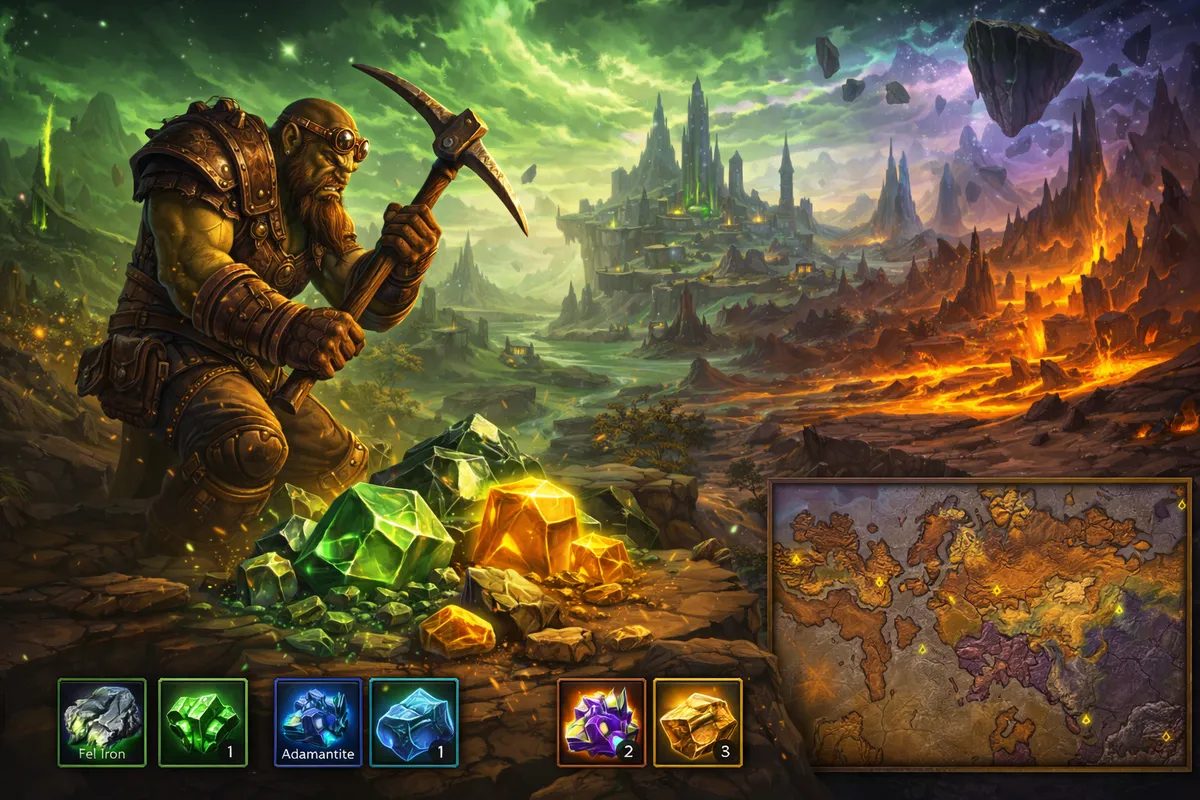
What Mining Supports in TBC (The “Big 3” Professions)
Mining is the primary supplier for:
Jewelcrafting (new in TBC): Prospecting destroys ore to generate gems. When Jewelcrafting demand rises, Mining demand rises with it.
Engineering: bombs, ammo, casings, scopes, gadgets, and high-end parts all eat ore and bars.
Blacksmithing: armor, weapons, sharpening stones, and endgame crafts consume huge amounts of bars.
A simple truth: if any of these professions are popular on your realm (and they almost always are), Mining is never “dead.”
Mining Basics You Must Set Up First
Before routes and zones, set up the fundamentals that prevent wasted time.
Keep a Mining Pick in your bags
You don’t need to equip it, but you do need one in your inventory.
Turn on “Find Minerals” at all times
Mining is a minimap profession. If your tracking is off, you’re farming at half speed.
Know the node color rules (orange/yellow/green/gray)
Orange: skill ups very often
Yellow: skill ups frequently
Green: skill ups sometimes
Gray: no skill ups
This matters because Mining is one of the professions where you can “feel stuck” if you’re mining gray nodes out of habit.
Use loops, not straight lines
A loop is how you farm respawns. A straight line is how you run into empty terrain and lose gold per hour.
Smelting: The Fastest “Lazy” Way to Level Early
Mining has a unique advantage: you can gain skill by smelting (turning ore into bars) as long as the smelt is still giving skill-ups.
Smelting is powerful because:
Smelting has two important limitations:
You must be near a forge to smelt.
Smelting skill-ups eventually slow down (many smelts turn yellow/green quickly), so it’s not always the cheapest method—especially if ore prices are high on your realm.
Practical rule:
If ore is cheap, smelt more. If ore is expensive, mine more. The best path is whatever your server economy makes affordable.
Outland Mining Training: Where to Learn 300–375
To push Mining beyond 300 in TBC Classic, you train Outland Mining in Hellfire Peninsula:
Train as soon as you can. The earlier you unlock Outland Mining, the sooner you start benefiting from the real money ores: Fel Iron, Adamantite, and Khorium.
Outland Mining Nodes You’ll Farm (Skill Requirements + Profit)
Outland Mining is built around four node types that define your entire 300–375 journey.
Fel Iron Deposits (minimum skill 275)
Fel Iron is the entry Outland ore and still remains valuable because:
it’s used in a wide range of engineering and blacksmithing crafts
it can be prospected for gems by jewelcrafters
it can drop Mote of Fire and Mote of Earth as bonus loot
it can also yield small amounts of Eternium Ore and occasional gems
Fel Iron is the “volume ore” that rewards speed and route efficiency.
Adamantite Deposits (minimum skill 325)
Adamantite is where the real Outland economy begins. It’s used heavily for:
higher-end blacksmithing and engineering crafts
jewelcrafting prospecting (because players chase rare gems)
crafting components that remain important in multiple phases
Adamantite deposits can drop:
If Fel Iron is the starter currency, Adamantite is the working professional’s paycheck.
Rich Adamantite Deposits (minimum skill 350)
Rich Adamantite deposits matter because:
they yield more ore per node than standard deposits
they become a major “cap push” resource from 350–375
they’re one of the best “nodes per hour” targets once you have flying
They’re often positioned in:
Khorium Veins (minimum skill 375)
Khorium is the rare jackpot ore in TBC Classic. The reason it’s so valuable:
it’s required for some high-end crafting recipes
it’s scarce enough that supply stays tight
Khorium veins can drop both Earth and Fire motes as bonus loot
they can also yield other valuable extras like Eternium and gems
Khorium isn’t a “farm it nonstop” ore for most players. It’s a “build routes that include Khorium spawns, then take it whenever it appears” ore. Treat it as the bonus that spikes your session’s profit.
Motes and Primals: The Hidden Profit Most Miners Ignore
A lot of miners sell ore and forget the biggest secret: Outland Mining nodes can produce motes.
Mote of Fire is commonly associated with Fel Iron and Khorium nodes.
Mote of Earth is commonly associated with Fel Iron, Adamantite, Rich Adamantite, and Khorium nodes.
10 motes combine into 1 Primal of that element.
This matters because:
Primals are used constantly in crafting (not just one profession)
primal demand spikes during new raid tiers and crafting waves
primal markets often remain strong even when ore prices dip
Practical mindset:
Track your profit in “ore + motes,” not just ore. Many routes become dramatically better once you count the primal value.
Mining 1–300 Leveling Path (Azeroth)
There are many valid zone paths, but the goal stays the same: move through brackets quickly, train ranks early, and avoid getting stuck mining gray nodes.
Mining 1–65 (Copper)
Mine Copper in any starter-friendly zone. Copper is everywhere, and efficiency comes from tight loops near mountains and caves.
Tips that speed up this bracket
Mine near cliffs and ridges—Copper likes terrain edges.
Caves are often packed with nodes, but only enter if your level can handle the mobs.
Mining 65–125 (Tin + Copper + occasional Silver)
Tin becomes the core ore. You’ll still see Copper, but Tin will drive your skill-ups.
Efficiency rule
If one zone is crowded, switch zones. Early Mining is not worth fighting over.
Mining 125–175 (Iron + Tin + occasional Gold)
Iron is the main target. This bracket is where players often waste time running across empty terrain—so prioritize zones with continuous mountain lines.
Practical tip
If you enjoy smelting, this is a good time to smelt some Iron into bars for steady skill points, especially if you plan to level Blacksmithing or Engineering later.
Mining 175–245 (Mithril + Truesilver)
Mithril is the core, and Truesilver is a valuable bonus. This bracket often feels long, so your goal is to find a zone where you can complete a smooth loop without constant dismounting.
Comfort matters
Choose a zone that fits your class. If you’re fragile, avoid elite-heavy routes. If you have stealth, caves become much more efficient.
Mining 245–300 (Thorium + Rich Thorium)
Thorium carries you into Outland readiness. If you can access Rich Thorium consistently, your speed improves.
Key idea
Once you’re close to 275, you have a choice:
If Outland is not overly crowded on your realm, starting Fel Iron early can make your progression feel much smoother.
Mining 275+: When Outland Becomes Worth It
Fel Iron mining begins at a minimum of 275 skill, which means many players prefer to enter Outland before reaching 300.
Why this is often smart:
Fel Iron nodes can still give skill-ups for a long time
Hellfire Peninsula is extremely dense and easy to loop
Fel Iron has stronger market demand than many late-Azeroth ores on many realms
If your server’s Outland zones are heavily contested, pushing to 300 in Azeroth first can still be the calmer option.
Mining 300–375 Leveling Path (Outland, Step-by-Step)
This is the path most players follow because it’s efficient, simple, and works on almost every realm.
300–325: Hellfire Peninsula (Fel Iron Focus)
Hellfire Peninsula is famous for Fel Iron because it’s dense and straightforward.
Why Hellfire is great
How to route
Run the outer edges and mountain lines. Your goal is to maximize deposits per lap, not to chase one rare spawn into a dangerous area.
325–350: Terokkar Forest or Zangarmarsh (Fel Iron + Adamantite)
At 325, Adamantite becomes available. This is where your ore value jumps.
Terokkar Forest
Zangarmarsh
Goal for this bracket
Don’t over-focus on Adamantite alone. Mixed node farming keeps your skill-ups steady and your bags full.
350–375: Nagrand, Netherstorm, or Shadowmoon Valley (Rich Adamantite + Khorium Dreams)
Once you hit 350, Rich Adamantite opens up, and your endgame Mining identity begins.
Nagrand
Netherstorm
great for structured loops
strong density once you have flying
solid chance to include rare spawns in routes, depending on server competition
Shadowmoon Valley
high-value zone with strong node potential
can be dangerous on PvP realms
often has profitable “quiet pockets” if you avoid the most traveled roads
Important reality check
You can mine almost everything Outland offers at 350—except Khorium, which requires 375. That means 350–375 is mostly about grinding Rich Adamantite and standard Adamantite efficiently until you cap.
Best Outland Mining Zones (What to Farm Where)
If you want Mining to feel profitable, route choice matters more than almost anything else. Here’s how to pick zones based on your goal.
Best zone for Fel Iron volume: Hellfire Peninsula
Hellfire is the classic Fel Iron farm because Fel Iron is extremely common there and your loop stays efficient.
Best for
leveling 300–325 quickly
filling bank stacks for engineering/blacksmithing
fueling jewelcrafting prospecting
farming motes as bonus profit
Best zones for mixed Fel Iron + Adamantite: Terokkar Forest and Zangarmarsh
These zones are ideal when:
you need a balanced bag of ore types
you’re pushing the mid skill brackets
you want consistent node hits without relying on rare spawns
Best zone for Adamantite consistency: Nagrand
If your goal is straightforward “ore per hour,” Nagrand is a favorite because the zone supports clean circular routes and strong deposit density.
Best zone for structured flying routes: Netherstorm
Netherstorm rewards miners who like repetition and rhythm:
Best high-risk, high-reward zone: Shadowmoon Valley
Shadowmoon can be extremely profitable, but it punishes careless routing—especially on PvP realms. If you like risky, high-value farming, Shadowmoon is the zone that can spike your session’s profit.
Dungeon Mining (The Quiet Strategy)
Some Outland dungeons contain mining nodes (including Fel Iron and sometimes richer deposits depending on instance). Dungeon mining is powerful because:
you avoid open-world competition
you can combine mining with reputation farming
you turn dungeon time into extra profit
Practical etiquette
If you’re in a group, don’t slow the run. Mine nodes quickly during natural pauses or after pulls. Your reputation as a player matters more than one node.
Mining Without Flying vs Mining With Flying
Flying changes Outland Mining more than almost anything else. But you can still profit without it.
Mining without flying
What to prioritize
zones with open terrain: Nagrand is excellent
edge loops: mountains and outer borders
caves only if your class can handle them efficiently
How to win
You win by consistency. Your route may be slightly slower, but your profit remains strong if you keep mining instead of fighting.
Mining with flying
What changes
you can hit ridge spawns instantly
you can include “floating” or elevated spawn areas without detours
you can chain nodes faster and avoid most mobs
How to win
Build tighter loops and reduce downtime. Flying miners are basically competing on “nodes per hour,” so every second of travel matters.
Selling Strategy: Ore vs Bars vs “Value-Add”
Mining profit isn’t only “sell ore.” The best miners choose what to sell based on demand.
Sell ore when
jewelcrafters are prospecting heavily
players are leveling crafting professions in waves
the ore market is strong and liquid (fast sales)
Sell bars when
blacksmithing and engineering demand spikes
players prefer buying bars to save time
bar price is significantly higher than ore price after conversion
Smelt decisions that protect your gold
Smelting can be profitable, but don’t assume it always is. Always think like this:
“What is 1 ore worth?” versus “What is 1 bar worth?”
“How many ore per bar?” (most bars are 1:1, but some conversions are different)
“How fast will it sell?” (sometimes the fastest sale beats the highest theoretical margin)
The Jewelcrafting synergy (why TBC Mining is even better)
Because Jewelcrafting is new in TBC, the expansion creates a constant loop:
miners supply ore
jewelcrafters prospect ore
gem cuts sell to raiders and PvPers
more players need more gems, forever
If you want the strongest pairing in TBC Classic, Mining + Jewelcrafting is one of the best “self-sufficient” combos:
Even if you don’t pick Jewelcrafting yourself, your realm’s jewelcrafters guarantee consistent demand for your ore.
The Engineering synergy (steady, reliable demand)
Engineering consumes large quantities of:
Engineering also stays popular because it adds utility (bombs, repair bots, gadgets). That popularity keeps Mining demand stable.
If your goal is “I want Mining to pay my bills forever,” Engineering demand helps guarantee that.
The Blacksmithing synergy (big crafting waves)
Blacksmithing tends to create demand spikes:
early expansion gearing and weapon crafting
phase transitions when new crafts become relevant
alt waves when players power-level professions
When you notice crafting waves on your server, Mining becomes the easiest way to profit—because blacksmithing consumes ore at scale.
Advanced Mining Tips (The Stuff That Actually Increases Gold Per Hour)
These are the habits that separate casual miners from “I paid for epic flying with ore.”
Track competition and rotate zones
If your best zone is crowded, don’t force it. Move to your second-best zone and mine uninterrupted. Uninterrupted mining usually beats contested “perfect routes.”
Farm off-peak
Mining profit often doubles simply by mining when fewer people are online. Fewer players means:
Route discipline beats random wandering
Choose a loop and stick to it for at least 20–30 minutes. Random wandering creates dead travel time and lowers nodes/hour.
Use your hearth and mail like a pro
Mining fills bags fast. The best miners:
mail ore to a bank alt often
keep their main’s bags clean
avoid “I have to stop because I’m full” moments
Protect your time on PvP realms
If you’re farming in contested zones:
Your goal is ore volume, not revenge.
Mining Gold Plans That Work Every Week
If you want a repeatable plan instead of guessing, use this.
The 60-minute weekly miner plan
20 minutes: Hellfire Peninsula Fel Iron loop (fast volume + motes)
20 minutes: Nagrand Adamantite/Rich Adamantite loop (value ore)
20 minutes: Netherstorm or Shadowmoon loop (premium zone attempt)
Sell your ore in one consistent posting window (usually before peak raid hours). This plan is simple, repeatable, and surprisingly effective.
The “crafting wave” plan
When a new phase drops or an alt wave hits:
mine more Adamantite and Rich Adamantite
smelt when bars spike above ore value
post in smaller stack sizes for faster sales (many crafters buy in bursts)
The “motes matter” plan
If primal prices are strong:
prioritize routes that maximize Fel Iron and Adamantite nodes
track your mote drops as part of your profit
combine motes into primals if primals sell better on your realm
This plan is often the difference between “Mining is okay” and “Mining is insane.”
BoostRoom: Turn Mining Into Fast Progress (Not a Grind)
Mining is one of the best professions in WoW TBC Classic—but it can also become a time sink if you’re trying to do everything at once: level to 70, farm gold for flying, gear up, and keep up with raid prep.
That’s where BoostRoom helps you keep momentum. If you want Mining to become an advantage quickly, BoostRoom can support you with:
efficient progression planning so you hit 1–375 without wasting time on dead routes,
smoother Outland farming efficiency so your sessions produce more ore per hour,
time-saving support while you focus on raids, PvP, and gearing goals,
and practical help reaching the point where Mining actually feels powerful (flying routes, consistent farming windows, and stable gold flow).
If your goal is epic flying, crafted upgrades, or a steady gold engine that funds your whole TBC experience, BoostRoom helps you get there faster—without turning Mining into a second job.
FAQ
Do I need to equip a Mining Pick to mine?
No. You only need to have a Mining Pick in your inventory.
Is smelting faster than mining for leveling?
Sometimes. Smelting is safe and predictable, but it depends on ore prices. If ore is expensive, mining routes are often cheaper. If ore is cheap, smelting can be a very fast way to gain skill.
When can I start mining in Outland?
Fel Iron can be mined starting at 275 Mining, and many players go Outland before 300 to speed up progression.
What Mining skill do I need for Outland ores?
Fel Iron requires 275, Adamantite requires 325, Rich Adamantite requires 350, and Khorium requires 375.
Why do miners talk about “motes” so much in TBC?
Because Outland deposits can drop Mote of Fire and Mote of Earth, and 10 motes combine into a Primal. Primals are used heavily in crafting and can add major profit to your routes.
What’s the best Outland zone to level Mining quickly?
For 300–325, Hellfire Peninsula is the classic choice due to heavy Fel Iron density. For 350–375, Nagrand is often one of the smoothest zones for consistent Adamantite/Rich Adamantite mining.
Can I make gold with Mining without flying?
Yes. Flying increases efficiency, but you can still make strong gold by choosing open zones (like Nagrand), using edge loops, and farming off-peak hours to reduce competition.
Should I sell ore or smelt it into bars?
Sell whichever is higher value on your realm. Ore often sells well to jewelcrafters for prospecting, while bars often sell well to blacksmiths and engineers. Compare prices and choose the faster, higher-margin option.
What’s the best profession to pair with Mining in TBC?
The best “money + power” pairing is often Jewelcrafting because Prospecting turns ore into gems. For utility and long-term demand, Engineering is also a strong pairing.



