What Jewelcrafting Adds to TBC Classic
Jewelcrafting isn’t “just another crafting profession.” It’s the profession that powers the entire socket and gem economy of The Burning Crusade. When you choose Jewelcrafting, you’re choosing a profession that affects:
- How strong your gear becomes after you get it (because sockets are where a lot of stats are “finished”).
- How flexible your build is (you can shift gems when you swap roles, specs, or content types).
- How you make gold (Prospecting, cutting, and selling high-demand gems can become a permanent income lane).
- How prepared you are for every phase (new content waves often spike gem demand overnight).
Jewelcrafting also has a special “identity” in TBC Classic:
- It’s not primarily a “one big craft” profession (like a single epic weapon).
- It’s a portfolio profession: the more useful cuts you learn, the more valuable you become to yourself, your guild, and the market.
If you enjoy progression that keeps paying off over time, Jewelcrafting is one of the most rewarding choices in the expansion.
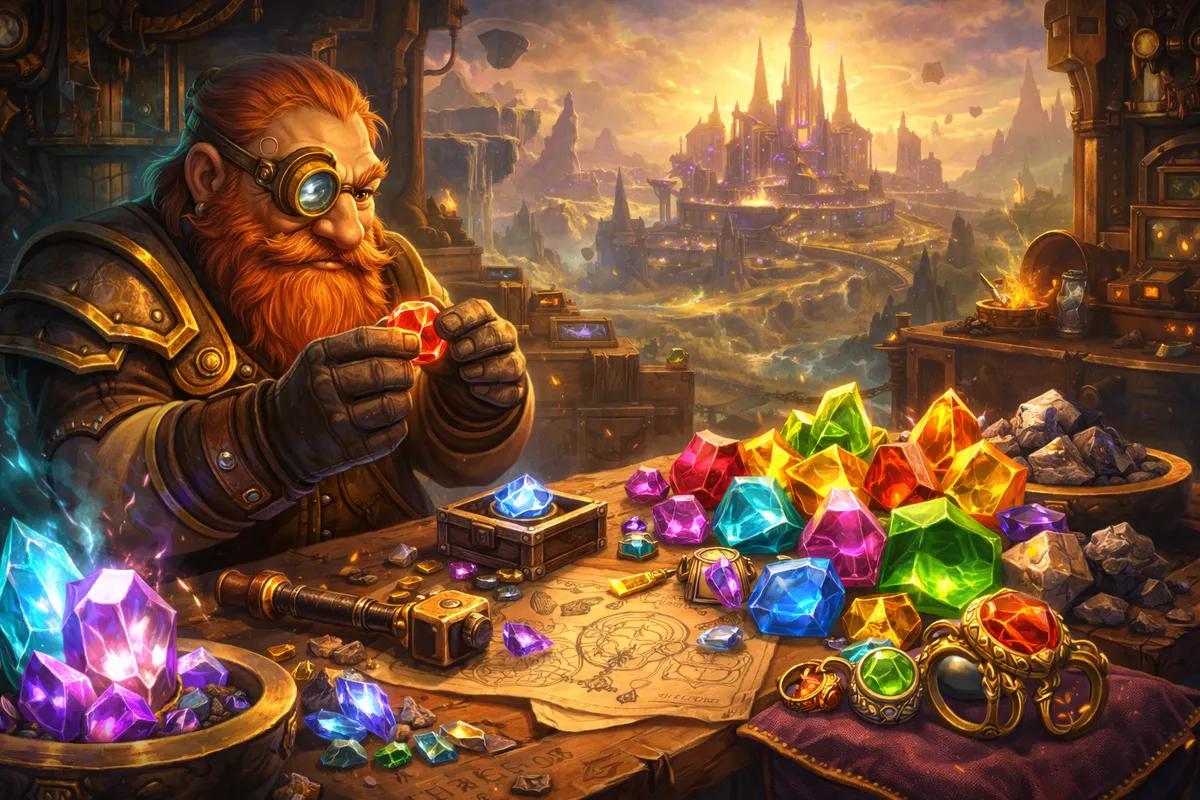
How Gems, Sockets, and Colors Work
TBC introduces a gem system that rewards players who understand it. You don’t need to memorize every detail to win with Jewelcrafting, but you do need the fundamentals.
Socket colors you’ll see most:
- Red sockets
- Blue sockets
- Yellow sockets
- Meta sockets (special socket type, usually on helms)
Gem colors and why they matter:
- Red / Blue / Yellow are the “core” colors.
- Orange / Purple / Green are hybrid colors that count as two colors at once (for matching socket bonuses and activating meta requirements).
- Meta gems have special effects and activation requirements.
Socket bonuses:
Many items give a bonus stat if you match the socket colors correctly. The key is knowing when a socket bonus is worth chasing.
A practical rule that works for most players:
- Chase socket bonuses when the bonus is strong and your matching gems are still good for your build.
- Ignore weak bonuses if matching would force bad gem choices.
Meta gems (why they’re a big deal):
Meta gems are often “build-defining,” especially for:
- casters who want damage-focused effects,
- healers who want mana efficiency,
- players who want run speed or special survivability effects.
Meta gems must be “activated” by meeting requirements like having certain numbers of specific colors. That’s why hybrid gems become so valuable: they help you activate metas while still keeping strong stats.
If you want Jewelcrafting to feel easy, treat gems like a simple system:
- Pick a meta goal (or decide you’re not meta-focused yet).
- Choose your main stat gems for most sockets.
- Use hybrid gems only where they help activate meta or earn a meaningful socket bonus.
Prospecting: Turning Ore Into Gems
Prospecting is the mechanic that makes Jewelcrafting feel unique. Instead of relying on random world drops for gems, you can create your own supply by breaking down ore.
How Prospecting works (in real gameplay terms):
- You use 5 ore per Prospecting cast.
- The ore is destroyed and you receive a mix of gems (and sometimes other materials).
- Different ore types yield different gem pools and rarities.
Why Prospecting matters so much in TBC:
- It turns Mining into direct Jewelcrafting fuel.
- It’s a built-in goldmaking engine (because you can profit from the output even if you don’t craft gear).
- It gives you control: you can prospect what the market needs instead of praying for a drop.
The biggest Prospecting mindset shift:
Don’t think, “I need a specific gem.”
Think, “I need profitable outcomes.”
Sometimes the best play is to prospect, sell what’s hot, and buy the one gem you personally need.
Getting Started: Tools, Trainers, and Smooth Setup
Jewelcrafting has a few “new profession” quirks that catch players off guard. Set up correctly and you avoid 90% of the frustration.
Essential tools you’ll want early:
- Jeweler’s Kit (core crafting tool)
- A simple plan for bank space (Jewelcrafting creates lots of small items and quickly clogs bags)
Trainer flow that keeps you efficient:
- Train early, don’t sit at skill caps.
- If you’re aiming to hit Outland fast, push as much skill as you can before you enter heavy competition zones.
The most important pairing: Jewelcrafting + Mining
You can level Jewelcrafting without Mining, but it’s usually more expensive because:
- you need a lot of metal bars for rings/necklaces,
- you need a lot of ore to prospect,
- and Outland materials spike in price whenever new content pushes players into gem upgrades.
If you want Jewelcrafting to feel “self-powered,” Mining is the most natural partner.
Outland trainers and why Shattrath matters:
Once you hit Outland, you’ll spend a lot of time in Shattrath because it’s the profession hub and reputation hub. Jewelcrafting is especially tied to reputation vendors, so Shattrath becomes your “business headquarters.”
Outland Gem Types You’ll See (Uncommon, Rare, Meta, Epic)
To use Jewelcrafting well, you need a simple mental map of Outland gem tiers.
Uncommon Outland gems (your early crafting fuel)
These are the green-quality gems you’ll see constantly from early Outland Prospecting and leveling crafts. Examples include the familiar Outland set like:
- Blood Garnet (red)
- Flame Spessarite (yellow)
- Azure Moonstone (blue)
- Shadow Draenite (purple base)
- Golden Draenite (yellow base)
- Deep Peridot (green base)
These gems matter because they power:
- early Outland leveling recipes,
- starter cuts that still sell well to fresh 70s and alts,
- and the “mass market” of budget gems.
Even late in TBC, uncommon gems can remain profitable if your realm has lots of alts gearing up.
Rare Outland gems (the core market)
Rare gems are where Jewelcrafting becomes truly powerful. The classic examples most players chase are the rare gems used for the most popular cuts:
- Living Ruby (red rare)
- Noble Topaz (orange rare)
- Talasite (green rare)
- Star of Elune (blue rare)
- Dawnstone (yellow rare)
- Nightseye (purple rare)
Rare cuts are your “bread and butter.” The market usually favors a few top stat lines:
- Spell damage / spell power
- Healing power
- Agility
- Strength
- Attack power
- Hit rating
- Critical strike rating
- Stamina
- Defense rating (tank-focused)
If you want consistent income, build your cut portfolio around the stats people actually gem every week.
Meta gems (your premium specialty lane)
Meta gems are crafted from base meta materials and cut into powerful effects. In TBC, meta gems are often limited by supply (because the base metas are created through cooldown-limited sources), which is why meta cuts frequently become one of the most reliable profit lanes for jewelcrafters.
A practical market truth:
- If you can reliably cut a “popular meta,” you can often sell that service (and the gems) for the entire expansion.
Epic gems (phase-dependent demand spikes)
Epic gems become a major topic later in TBC’s lifecycle. When epic gems enter the economy more broadly, demand shifts from “rare gem cuts” into “epic gem cuts,” and jewelcrafters with the right designs become extremely valuable overnight.
If your goal is to stay ahead of the market, plan your Jewelcrafting as a long-term profession:
- Rare cuts carry early and mid-phase demand.
- Epic cuts and late recipes create huge endgame waves of profit and relevance.
Leveling Jewelcrafting 1–300: The Fast, Low-Drama Plan
The biggest mistake players make while leveling Jewelcrafting is trying to “wing it.” Because the profession eats ore and bars, small inefficiencies become big gold losses.
Here’s the clean mindset for 1–300:
- You are buying skill points.
- Your goal is not to craft “cool stuff.”
- Your goal is to reach Outland skill ranges where cutting and selling becomes profitable.
Key leveling principles that save gold:
- If you have Mining, prospect what you mine and bank the gems.
- If you don’t have Mining, buy ore in bulk during low-demand hours instead of buying gems one-by-one at peak price.
- Craft recipes that stay orange/yellow for long stretches and use cheap mats.
What you’ll craft a lot while leveling 1–300:
- Simple rings and necklaces using copper, bronze, silver, gold, mithril, truesilver, thorium
- Occasional settings and crafting components
- Some stone-based crafts (depending on your leveling path)
Azeroth leveling tip that prevents frustration:
Don’t overcommit to a single “perfect” guide if your realm economy is weird. If one gem is overpriced, pivot to a nearby alternative recipe. Jewelcrafting has multiple valid leveling routes—your best route is the one your Auction House makes affordable.
Leveling Jewelcrafting 300–375: Outland Strategy That Doesn’t Bleed Gold
Outland is where Jewelcrafting becomes both more expensive and more profitable—depending on how you play it.
The core Outland leveling loop:
- Get Outland ore (Fel Iron → Adamantite → Khorium).
- Prospect it for gems and materials.
- Use the output to craft rings, settings, and cuts that give skill-ups.
- Sell what you don’t need to fund what you do need.
Why Outland leveling feels expensive:
- Everybody wants Outland ore.
- Everybody wants rare gems.
- Many crafters are pushing professions at the same time.
How to make Outland leveling pay for itself:
- Don’t vendor anything “just because it’s green.”
- Track which cuts are in demand on your realm and cut those while leveling.
- Treat “leftover” gems as your business inventory, not as clutter.
The final stretch (often the hardest):
The last points toward 375 are where smart jewelcrafters avoid “dead crafts” and instead finish with recipes that:
- still sell afterward (so the gold isn’t wasted),
- or produce items you personally want for endgame.
Two strong finishing mindsets:
- Finish with meta gems if you have access to good meta designs and your market supports them.
- Finish with high-value rare cuts or figurines/jewelry if your server prices make meta gems too costly at the time.
Reputation and Recipe Strategy (Where Your Best Cuts Come From)
Jewelcrafting is not a “trainer-only” profession. Trainers teach basics, but the cuts that actually define your profit and usefulness come from:
- reputation vendors,
- dungeon and raid drops,
- special faction vendors in later phases.
Why reputation matters more for Jewelcrafting than most professions:
A single high-demand design can turn you into “the server’s go-to jewelcrafter” for a specific gem.
A practical way to choose which reputations to prioritize:
Instead of farming rep because “a guide said so,” farm rep based on what you want from Jewelcrafting:
- Want caster/healer gems and strong metas? Prioritize the factions that sell those designs.
- Want tank or melee-focused cuts? Prioritize the factions tied to those patterns.
- Want late-phase advantage? Prioritize factions tied to endgame recipe waves.
How to build a cut portfolio (the smart way):
Start with cuts that match huge demand segments:
- “Main stat” gems (agility, strength, spell damage/spell power, healing)
- “Threshold” stats (hit rating is a constant seller because people chase caps)
- Tank essentials (stamina and defense are always needed by fresh tanks)
Then expand into:
- meta gems,
- niche PvP cuts,
- resistance or specialty gems if your realm’s meta supports it.
If you only learn random cuts, you’ll always be “kind of useful.” If you build a deliberate portfolio, you become the jewelcrafter people whisper first.
Jewelcrafter-Only Power: Unique Gems and Figurine Trinkets
Jewelcrafting isn’t only about selling gems. It also gives you personal power options that feel uniquely “TBC.”
Jewelcrafter-only unique gems
TBC has a set of crafted, Bind-on-Pickup gems that only jewelcrafters can realistically access. These gems become a real profession “perk” because:
- they’re often strong compared to standard rare gems,
- and they let you personalize your build in a way non-jewelcrafters can’t easily replicate.
Examples you’ll hear about frequently include unique cuts tied to factions and endgame reputation goals. These are especially attractive to players who want Jewelcrafting as a personal performance profession, not only a gold profession.
A practical note:
Some players level Jewelcrafting specifically to craft these unique gems and then consider dropping the profession. If you’re thinking about that, remember: Jewelcrafting’s real value comes from long-term access to cuts and market control. Dropping it often costs more value than players expect.
Figurine trinkets (Jewelcrafting’s most iconic crafts)
Figurines are one of the most famous parts of TBC Jewelcrafting: Bind-on-Pickup trinkets that require Jewelcrafting to craft and typically fit specific roles.
Some classic examples include:
- A tank-focused figurine that boosts survivability and provides an on-use dodge effect.
- A melee-focused figurine that provides attack power and a summon-style on-use effect.
- A caster-style figurine with intellect/stamina and a burst spell power on-use.
- A stealth-flavored figurine that includes stealth effectiveness plus an attack power burst.
Why figurines matter:
- They can be legitimately useful early at level 70.
- They’re a clear “profession identity item” (people remember you as the jewelcrafter with the figurine).
- They give you a tangible reason to keep Jewelcrafting for personal benefit, not just for gold.
Crafted Jewelry Worth Knowing
Jewelcrafting can produce more than “filler” rings. In TBC, some crafted jewelry becomes genuinely desirable depending on phase, role, and availability.
Here are a few notable categories you should understand:
Endgame necklaces with real utility
Some crafted necklaces aren’t just stat sticks—they have unique effects that keep them relevant:
- party buff effects,
- on-use boosts,
- and competitive stat profiles.
If you care about optimizing group performance or having a unique “tool piece” for specific situations, pay attention to these designs.
Late-phase epic jewelry
As TBC progresses, jewelcrafting gains access to more powerful rings and necklaces that can show up on “best in slot” discussions and phase preparation lists.
The key takeaway:
- Jewelcrafting doesn’t always give you the single best item on day one.
- It often becomes more valuable as phases progress and new recipes enter the game.
If your goal is long-term endgame strength, Jewelcrafting rewards patience and planning.
Goldmaking With Jewelcrafting: What Actually Works
Jewelcrafting goldmaking can feel confusing because there are so many options. The secret is to focus on lanes that stay profitable on most realms.
1) Prospecting as a profit engine
Prospecting can be profitable in three different ways:
- Sell the raw gems (fastest, simplest).
- Cut the gems (higher margin if you have in-demand designs).
- Convert outputs into high-demand crafts (slower, but sometimes the highest margin).
A smart weekly habit:
- Track which ore is undervalued relative to its prospecting output.
- Buy ore in bulk when it’s cheap.
- Prospect in batches.
- Sell the best outcomes quickly and bank the rest for later.
2) High-demand rare cuts
This is the classic jewelcrafter income stream:
- Players bring you uncut gems.
- You cut them (sometimes for tips, sometimes you sell cut gems yourself).
- You become known for being “the person who has the cut.”
To make this work consistently:
- Prioritize cuts that match popular specs on your realm.
- Keep a clean, simple message ready for trade chat (“Cutting popular gems, tips appreciated”).
- Be reliable and fast—speed and reputation matter more than sales talk.
3) Meta gems (premium, steady demand)
Meta gems often sell well because:
- they’re powerful,
- they’re limited by base supply,
- and many players don’t want to research activation rules and “which meta is best” on their own—they just want the finished gem.
If you can craft and sell popular meta gems consistently, Jewelcrafting becomes one of the most stable gold professions in TBC Classic.
4) Endgame and phase-transition waves
The biggest Jewelcrafting profits often happen during transitions:
- New raid tier releases
- PvP season shifts
- Late-phase recipe additions
- Big alt waves (when players gear multiple characters)
If you want to “time” your Jewelcrafting income:
- Stockpile ore before hype spikes.
- Learn new cuts early if possible.
- Be ready to craft the moment demand surges.
Auction House Tactics for Jewelcrafters
Jewelcrafting is one of the most competitive markets on many realms. Winning isn’t about undercutting by 1 copper all day—it’s about smart patterns.
Tactics that work on most servers:
- Sell in the stack sizes buyers prefer. Some buyers want single gems; some want sets. Offer both.
- Post during demand windows. Gems often move fastest before common raid start times.
- Avoid posting every cut you own. Focus on your best sellers so you don’t flood your own inventory with unsold listings.
- Treat “cut value” as a service. If you can’t beat the market price, offer cutting for tips instead and let others provide the gem.
- Track your winners. A small set of 10–15 designs often produces most of your profit.
A simple, repeatable weekly plan:
- Prospect ore in a single big batch.
- Sort outcomes into “hot sellers,” “future sellers,” and “my personal use.”
- Cut only the hot sellers.
- Post at peak demand.
- Restock ore only when prices dip again.
This keeps your Jewelcrafting income consistent without turning you into a full-time Auction House player.
Practical Rules for TBC Jewelcrafters
If you follow these rules, Jewelcrafting stays fun, profitable, and useful.
- Rule 1: Learn designs with purpose. A cut that never sells is just a trap.
- Rule 2: Don’t level on “dead crafts” if the output won’t sell. Whenever possible, level using crafts that you can resell.
- Rule 3: Value ore by output, not by price. Cheap ore can be expensive if it prospects poorly for your market.
- Rule 4: Build a “core cut list.” Aim to cover: caster, healer, melee, tank basics.
- Rule 5: Keep your meta gem plan simple. Hybrid gems exist to make meta activation easier—use them.
- Rule 6: Reputation is part of your profession. If you ignore reputations, you’ll always be missing your best profit tools.
- Rule 7: Your best gold is often your consistency. Small daily or weekly sessions beat occasional long grinds.
- Rule 8: Protect your time. If trade chat is slow, sell cut gems; if AH is crowded, sell cutting services.
Common Mistakes (And How to Avoid Them)
These are the most common ways players waste gold and burn out on Jewelcrafting.
- Mistake: Buying random designs because they look cool.
- Fix: Buy designs that match popular stat needs first. Cool designs can come later.
- Mistake: Prospecting without a plan.
- Fix: Prospect in batches and know what you’ll do with each output type.
- Mistake: Ignoring meta gem activation requirements.
- Fix: Plan your gem colors ahead of time so you don’t waste gold on “perfect stats” that don’t activate your meta.
- Mistake: Posting too many different gems at once.
- Fix: Focus on your best sellers. Depth beats breadth in competitive markets.
- Mistake: Forgetting that Jewelcrafting is a long game.
- Fix: Treat designs and reputations like investments. The payoff grows every phase.
- Mistake: Leveling Jewelcrafting late and paying peak prices.
- Fix: If you can, level earlier or buy materials during quiet market windows.
BoostRoom: Hit 375 Faster and Monetize Your Cuts
Jewelcrafting in TBC Classic is powerful—but it can also be one of the most time-consuming professions to set up properly because it ties into ore supply, Prospecting volume, and reputation-based designs.
BoostRoom helps you turn Jewelcrafting into an advantage faster, whether your goal is personal power, gold, or both. With BoostRoom, you can:
- Reach 375 efficiently without wasting gold on bad leveling choices,
- Secure the right progression support so you can keep raiding, gearing, and PvPing while your profession grows,
- Speed up key reputations that unlock valuable gem cuts and late-game designs,
- and stabilize your economy so your gems, enchants, and consumables don’t feel like a constant gold drain.
If you want Jewelcrafting to feel like a weapon—not a chore—BoostRoom is the shortcut that keeps your character moving forward while the profession catches up fast.
FAQ
Is Jewelcrafting worth it in WoW TBC Classic?
Yes. It’s the new profession that directly powers the socket/gem economy, stays relevant in every phase, and can be both a personal power profession and a consistent goldmaker.
Do I need Mining with Jewelcrafting?
You don’t need it, but it’s the best pairing for cost control. Mining feeds Prospecting and provides the bars used in many leveling crafts.
What’s the fastest way to level Jewelcrafting in TBC?
The fastest practical approach is to keep a steady ore supply, prospect in bulk, and level using crafts that either resell well or convert into in-demand cuts—especially in the Outland 300–375 range.
How does Prospecting work?
Prospecting consumes five ore per cast and converts it into gems (and sometimes other materials). Different ores yield different gem pools and rarities.
What should I focus on first as a new jewelcrafter at 70?
Build a core cut portfolio for the biggest demand groups: caster/healer primary cuts, melee primary cuts, hit rating cuts, and a few tank essentials. Then move into meta gems and niche cuts.
Are there Jewelcrafter-only items in TBC?
Yes. TBC features unique Bind-on-Pickup crafted gems and iconic figurine trinkets that are closely tied to Jewelcrafting.
Why do meta gems matter so much?
Meta gems often provide powerful effects but require activation rules. If you understand those rules and can supply popular metas, you gain both performance and profit advantages.
How do I make steady gold with Jewelcrafting?
Prospect ore in batches, cut the most demanded gems, and sell either finished cut gems or cutting services. Consistency and smart design choices beat constant undercut wars.



