What “weekly gearing” really means in Midnight
In Midnight, “gearing” isn’t about playing 12 hours a day. It’s about stacking weekly wins:
- One guaranteed weekly reward (your Great Vault choice)
- A steady flow of crests (so your gear actually improves instead of sitting at “almost upgraded”)
- Targeted drops (trinkets, weapons, tier-style pieces, and best-in-slot slots)
- A routine you can repeat without burnout
The best-geared players aren’t always the ones who never log off. They’re the ones who keep their week clean: they do the highest-value objectives first, then stop when the returns drop.
Midnight supports that style more than ever because Blizzard is building clearer baseline systems: built-in Boss Warnings and a Boss Timeline, plus Mythic+ early-key features meant to help groups learn without turning every run into a routing argument.
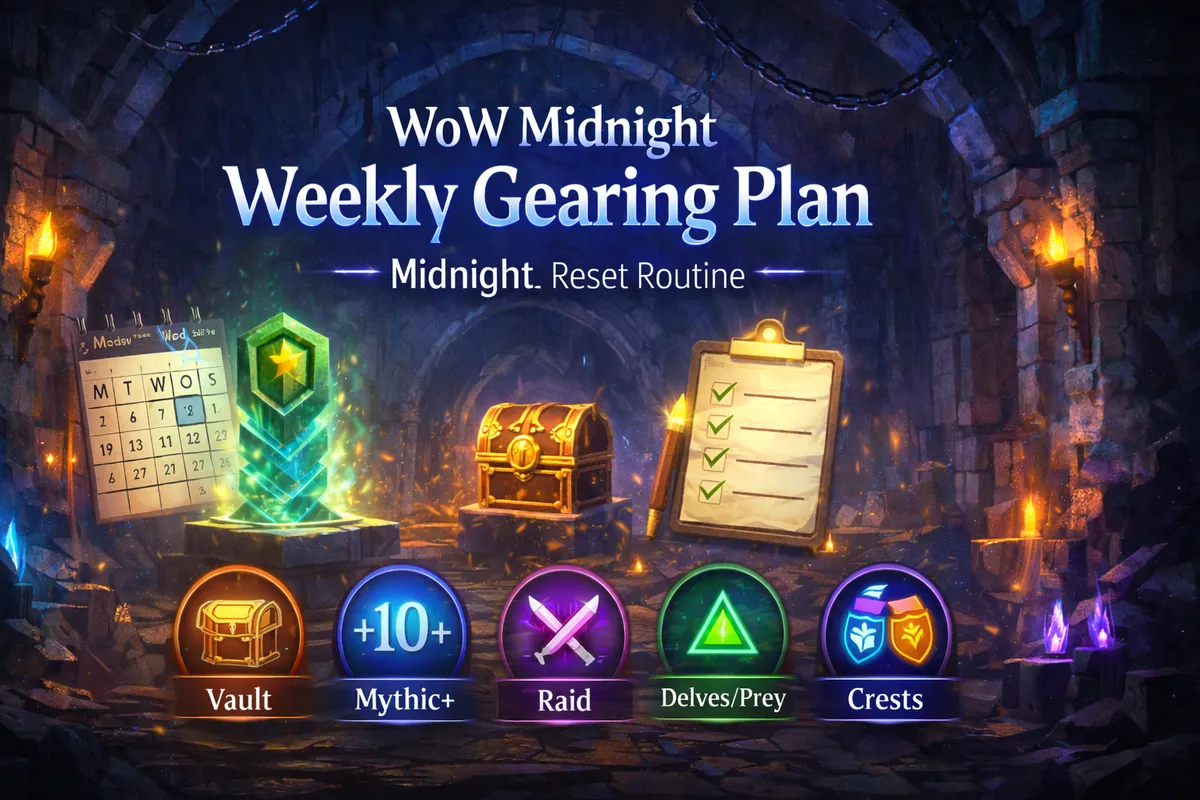
Know your reset: what changes each week (and what doesn’t)
A simple routine starts with understanding what the weekly reset actually flips.
Typically resets weekly:
- Great Vault rewards (you can claim one reward per week)
- Raid lockouts (how many bosses you can loot)
- Many weekly quests and weekly event rewards
- “Weekly caps” and weekly progress bars (where relevant)
- Mythic+ seasonal objectives tied to the Vault and weekly cycles
Does not reset weekly (usually):
- Your long-term reputation / renown progress
- Your permanent unlocks, achievements, and collections
- Your learned routes and skill (the biggest upgrade of all)
EU vs NA reminder (so you don’t miss the best timing):
Weekly resets are region-based. If you play on EU realms (common for players in Egypt), reset happens early Wednesday. Exact maintenance windows can vary week to week, so it’s smart to glance at the launcher message when you care about timing.
The three weekly gear engines: Vault, Crests, and Time
If you only remember one section, remember this: your weekly power comes from three engines.
1) The Great Vault (your weekly “big swing”)
The Vault is your single most consistent high-impact reward. Even if your week goes badly, the Vault gives you another shot next reset.
2) Crests (your “guaranteed progression”)
In Midnight, upgrades matter even more because Blizzard has moved toward a crest-only upgrade approach (Valorstones are being removed). That means your power isn’t only “did I get lucky with drops?”—it’s also “did I collect and spend crests wisely?”
3) Time (your real cap)
Most players aren’t limited by skill or motivation. They’re limited by time. Your weekly plan should fit your schedule, not punish you for having one.
This guide gives you three routines—minimum, balanced, and power—so you can pick a lane and still feel progress.
Your simple reset routine (15-minute checklist)
This is the routine you do right after weekly reset—before you get distracted.
Reset Checklist (do this in order):
- Claim your Great Vault reward (don’t forget it)
- Equip upgrades immediately (or save them if you’re waiting on a set bonus / weapon decision)
- Decide your weekly goal: 1 key / 4 keys / 8 keys and 2/4/8 world activities
- Decide your “one big push”: the highest Mythic+ key you can reasonably complete this week
- Set your UI and boss warnings once (Midnight’s built-in tools matter)
- Spend 5 minutes planning which slots you want to upgrade with crests this week (don’t freestyle it)
That’s it. This prevents the classic trap: wandering around for an hour, doing random stuff, then logging out feeling like you made no progress.
Step 1: Great Vault strategy (how to get the best option)
The Vault gives you choices, and choices are power—because you can pick what your character actually needs.
How to “fill” the Vault without wasting your week
The Vault is typically divided into three categories:
- Raids
- Dungeons (including Mythic+)
- World content (like Delves and, in Midnight, systems that count toward that row such as Prey)
Each category usually lets you unlock up to three reward options by completing more objectives (for example, 1/4/8-style or 2/4/8-style breakpoints depending on the category). More options doesn’t mean more loot—you still choose only one item—but it massively increases your chance of seeing something useful.
The #1 Vault rule: always get at least two options
One Vault option is gambling. Two or more options is consistency.
A simple weekly target:
- Dungeons row: aim for at least 1 completed Mythic+ dungeon, ideally 4 if you have time
- World row: aim for at least 2 world activities that count (Delves/Prey/etc.), ideally 4
- Raid row: if you raid at all, try to get enough boss kills to open at least one option
Picking the best Vault item: a practical decision order
Use this order to avoid regret:
- Massive item level jump in a weak slot (especially weapon/trinket)
- Set/tier-style piece (if your season’s set system makes it valuable)
- Best-in-slot trinket (even at slightly lower item level, trinkets can be game-changers)
- Perfect stat item (when the item level difference is small)
- Anything that helps you qualify for better groups (higher item level can open doors)
If you want a stress-free rule: take the item that helps you do harder content next week. That’s how you climb.
Step 2: Mythic+ plan (from one key to a full dungeon row)
Mythic+ is the cleanest weekly gearing tool because it scales: you can do one run or eight runs, and both are valid.
Your Mythic+ weekly goal should be one of these three
Pick one based on your time:
- The “One-Key Week” (fastest): do one Mythic+ at your highest comfortable level
- The “Four-Key Week” (balanced): do four Mythic+ dungeons total
- The “Eight-Key Week” (max choices): do eight Mythic+ dungeons total
If you have limited time, always prioritize the highest key you can complete, then fill extra dungeons later for Vault choices.
Midnight’s early-key change that helps you gear
Midnight Season 1 introduces an early Mythic+ affix designed to help groups learn routing: Lindormi’s Guidance, active in keys +2 through +5. It visually marks certain enemies and makes routing more straightforward at low key levels, reducing stress for new tanks and new groups. This matters for weekly gearing because it makes your “four dungeons for the Vault” goal easier to hit early in the season—even if you’re not pushing high keys yet.
The most efficient Mythic+ weekly structure
Here’s the simplest structure that works for most players:
- Run your highest key first (when you’re fresh and focused)
- Then do 2–3 lower keys quickly to fill Vault options and collect crests
- If you still have energy, add more dungeons on the weekend (when friends are online)
Mythic+ weekly role tips that save hours
If you’re DPS:
- Your job is mechanics first, damage second. Dead DPS does zero damage.
- Interrupts are free progress. Treat them like damage.
If you’re healer:
- Plan your cooldowns early. You don’t “save” cooldowns for a perfect moment; you use them to prevent wipes.
If you’re tank:
- Keep your route simple early in the season. Midnight is literally trying to reduce low-key route pressure—use that.
Step 3: Raid plan (how raids fit a “simple reset routine”)
Raiding is still one of the best sources for targeted loot and character growth, but it can also eat your whole week if you let it.
Midnight Season 1 is unusual because Blizzard is launching with three raid zones totaling nine bosses. That creates more options, but it also creates a trap: trying to do everything every week.
A simple raid rule: raid only as much as you can do consistently
If your schedule supports one raid night, build around one night. If your schedule supports none, don’t force it—use Mythic+ and world content.
Pick your raid style for the week
Choose one:
- Story-focused: do the minimum to keep up with narrative and unlocks
- Gear-focused: clear the bosses most likely to drop your best upgrades
- Achievement-focused: target specific kills that matter to you
- Progression-focused: push the hardest difficulty you can handle with a stable group
The best raid-and-M+ combo for weekly gearing
If you can raid even a little, the most efficient combo is:
- One raid night (for boss drops + Vault credit)
- One meaningful Mythic+ key (for Vault quality)
- Two to four world activities (for consistent progress)
This trio gives you a “complete” week without burning out.
Step 4: World plan (Delves + Prey + weekly events)
World content is not just filler anymore—especially with Midnight’s systems.
Delves: the consistent solo/small-group engine
Delves are great because they:
- fit into short play sessions
- work for solo players and small groups
- contribute to your weekly progression rhythm
Even if you don’t love open-world grinding, Delves are a smart “low-drama” way to fill your weekly world progress.
Prey system: why it matters for weekly gearing
Midnight introduces the Prey system, an open-world hunt loop where you opt in and complete objectives for rewards. The key gearing impact is that Prey:
- contributes to the outdoor/world activity progress used for weekly rewards
- is designed to offer meaningful power rewards up to high-end tracks over time
For a weekly routine, Prey is valuable because it gives you something you can do between dungeon queues or on days you don’t have a group.
World row efficiency: the “2/4/8” mindset
Treat world progress like Mythic+ progress:
- 2 activities = quick weekly baseline
- 4 activities = comfortable consistency
- 8 activities = max options (only if you actually enjoy it)
Most players should aim for 2 or 4 and move on.
Step 5: Crafting and upgrades (crest-only world, smarter spending)
Midnight’s gearing philosophy pushes upgrades toward a simpler currency story: crests matter more, and you can’t waste them.
Why “crest-only” changes your habits
When a system removes a secondary upgrade currency (like Valorstones), upgrades become:
- easier to understand
- harder to spam thoughtlessly
- more dependent on weekly caps and smart planning
So the goal isn’t “upgrade everything.” The goal is upgrade the right things.
The best crest spending rules (simple and effective)
Use these rules all season:
Rule 1: Upgrade your weakest slot that blocks you from doing harder content.
Example: your weapon is old, your trinket is terrible, or your lowest item is dragging your average down.
Rule 2: Don’t over-upgrade placeholders early.
If you know you’ll replace a slot soon (like a low-quality ring), don’t dump your best crests into it.
Rule 3: Spread upgrades early; specialize upgrades later.
Early season, you often gain more power by pushing multiple items up a few steps. Later, when you have near-BiS pieces, you push them to max.
Rule 4: Save “top-tier” crests for items you won’t replace.
If you’re unsure, wait one day. The best upgrade is the one you won’t regret.
A simple “upgrade priority list” that fits most classes
This won’t be perfect for every spec, but it’s a strong default:
- Weapon
- Trinkets
- Chest/Legs/Helm (high stat budget slots)
- Rings/Neck (often replaced, but powerful when high quality)
- Everything else
If your spec relies on a particular stat breakpoint or trinket effect, that can jump the list.
The “minimum viable week” (2–3 hours total)
This routine is for busy players who still want real progress.
Goal: Open at least two Vault options and earn enough crests to upgrade something meaningful.
Do this:
- Claim Vault
- Run 1 Mythic+ dungeon at your highest comfortable key level
- Do 2 world activities (Delves/Prey/weekly event progress)
- Spend crests on one high-impact upgrade (weapon/trinket/weak slot)
Why this works:
You secure a meaningful Vault, keep your crest economy moving, and avoid burnout.
The “balanced week” (5–7 hours total)
This is the best routine for most players.
Goal: Get strong Vault choices and steady upgrades without living in dungeons.
Do this:
- Claim Vault
- Run 4 Mythic+ dungeons total (highest first, then faster keys)
- Do 4 world activities (easy wins that fit your schedule)
- Optional: kill a few raid bosses if you have a group night
- Upgrade 2–4 items (spread upgrades if you’re early season)
Why this works:
Four dungeons gives you real Vault flexibility and consistent crest income, while world activities keep progress steady even when you’re not grouping.
The “power week” (10+ hours, still sane)
This is for players who like pushing but want structure.
Goal: Max Vault choices, push higher difficulty, and stack weekly power.
Do this:
- Claim Vault
- Run 8 Mythic+ dungeons total (with at least one high key)
- Do 8 world activities only if you enjoy it (otherwise stop at 4)
- Raid on your main raid night
- Craft or commission key crafted pieces (if your plan includes crafting)
- Spend crests with a clear priority list (no impulse upgrades)
Why this works:
You get maximum Vault flexibility and enough weekly momentum to climb quickly—without random wandering.
Example day-by-day schedule for an EU reset (Cairo-friendly)
This is a repeatable weekly rhythm. Adjust days as needed.
Reset day (Wednesday, EU realms)
- Claim Vault first
- Do your highest key of the week
- Do 2 world activities (quick Delves/Prey progress)
- Upgrade 1–2 items (only if you’re confident they’re worth it)
Thursday
- Do 1–2 Mythic+ keys (aim for smooth clears)
- If you’re tired, stop early—consistency beats marathon runs
Friday
- Raid night if you raid
- If not raiding: do one more Mythic+ key or a quick world activity set
Weekend (Saturday/Sunday)
- Fill remaining dungeons to hit 4 or 8 total
- Finish world progress to 4 if you haven’t yet
- Run with friends, because clean groups are faster than pug roulette
Monday/Tuesday (cleanup)
- Patch holes: missing dungeons, missed world activities, unfinished weekly quest
- Spend crests only after you’re done earning them for the week (prevents regret)
This schedule works because it respects your energy: you do the hardest content early, then you clean up later.
Gear decision rules (what to equip, what to upgrade, what to ignore)
A lot of gearing stress comes from indecision. Use these rules and you’ll stop second-guessing yourself.
Equip rule
If it’s a big item level jump and doesn’t destroy your key stat balance, equip it—especially early season.
Upgrade rule
Upgrade only if the item is:
- a slot you won’t replace soon, or
- a slot that blocks you from getting invited to better content, or
- a high-impact slot (weapon/trinket) even if it might be replaced later
Ignore rule
Ignore upgrades on:
- items you expect to replace within 1–2 runs (temporary filler)
- “tiny” upgrades that cost your best crests early season
- vanity upgrades when you still have weak slots
Common gearing mistakes (and quick fixes)
Mistake 1: Doing 8 low keys instead of 1 meaningful key first
Fix: Always do your highest key first, then farm lower keys for options.
Mistake 2: Upgrading too early
Fix: Earn crests first, upgrade after your main activities are done.
Mistake 3: Trying to do every system every week
Fix: Pick a lane: Mythic+, raids, or world. Then add one secondary lane only if you have time.
Mistake 4: Ignoring the world row completely
Fix: Do 2 world activities weekly. It’s the easiest consistency win in the game.
Mistake 5: Pugging until you hate the game
Fix: Set a cap. If you’ve had two bad groups, stop and do a guaranteed solo win (Delves/Prey), then come back later.
BoostRoom weekly help: choose what to outsource
A “simple reset routine” is supposed to reduce stress. If your week is already busy, the fastest way to keep gearing consistent is outsourcing the most time-consuming parts.
Here’s the smart way to use BoostRoom without turning WoW into a job:
- Vault-focused week: Get your highest-value Mythic+ completion handled cleanly, then you do the rest casually
- Dungeon-row week: Fill 4 or 8 dungeons efficiently so your Vault has real options
- Raid week: Get reliable raid clears or targeted bosses so your week isn’t stuck in wipe cycles
- Learning week: Get coaching-style runs so you gear up and improve
BoostRoom is especially useful in Midnight because consistency will matter more: Blizzard is reducing how much combat addons can “play the game for you,” so clean execution and calm leadership become the real advantage.
BoostRoom routine bundles (simple examples you can copy)
These are easy “plug and play” weekly plans.
Bundle A: The Busy Week
- 1 high-value Mythic+ completion
- 2 world activities (you do these yourself)
- Upgrade 1–2 items
Bundle B: The Balanced Week
- 4 Mythic+ completions
- Targeted raid bosses or a short clear
- 4 world activities
- Upgrade 2–4 items
Bundle C: The Push Week
- 8 Mythic+ completions (with at least one high key)
- Raid clear or end-boss goal
- Optional world row if you enjoy it
- Focus upgrades into long-term pieces
Pick the bundle that matches your life, not your ego. The best weekly plan is the one you’ll actually repeat.
FAQ
What’s the fastest weekly gearing plan in WoW Midnight?
Claim your Vault, complete one meaningful Mythic+ key, do two world activities (Delves/Prey), then spend crests on one high-impact upgrade.
Do I need to do raids to gear well in Midnight?
No. Raids are excellent for targeted loot, but a Mythic+ plus world-content routine can keep you gearing consistently—especially if you’re busy.
How many Mythic+ runs should I do each week?
If you’re short on time: 1. If you want consistency: 4. If you want max Vault choice flexibility: 8.
What’s the point of doing world activities every week?
They’re the easiest way to keep weekly progress consistent. Even two quick activities can improve your Vault options and keep your gearing from stalling.
Is the Prey system worth doing for gearing?
If you like open-world content, yes—because it contributes to the same weekly progress ecosystem and can support steady upgrades over time.
Should I upgrade gear immediately after reset?
Usually no. Do your main content first, then upgrade after you’re done earning crests for the week. It prevents regret.
What should I upgrade first with crests?
Weapon and trinkets are usually the best upgrades, then your high-stat armor slots. Avoid dumping top crests into items you’ll replace soon.
How do I avoid burnout while gearing?
Pick one main lane (Mythic+, raids, or world), set a weekly cap (like 4 dungeons), and stop when you hit it. Consistency beats marathons.
Why do my weeks feel unproductive even when I play a lot?
Because time spent isn’t the same as progress. A good weekly plan prioritizes Vault quality, crest income, and targeted upgrades—then ends.
How can BoostRoom help with my weekly reset routine?
BoostRoom can handle your highest-value Mythic+ completions, fill your dungeon row efficiently, and provide reliable raid clears—so your week stays clean and predictable.



