Why Toxic Teammates Feel Unbeatable (But Aren’t)
Toxic teammates feel “unwinnable” for three reasons:
- They steal attention. Your brain can only focus on so much. When chat is heated, you lose map awareness, wave timing, and objective prep.
- They break coordination. Even strong players throw when everyone’s arguing because nobody arrives to the same place at the same time.
- They create impulsive decisions. You start forcing plays to “prove” something, or you tilt-chase to make the game feel fair again.
But here’s the part that helps: toxicity mostly wins through distraction and tempo loss, not through raw mechanics. If you can protect your focus and play a more structured plan, you remove a huge amount of toxicity’s power.
Think of toxic games like bad weather. You don’t fight the weather. You change how you drive:
- slower,
- safer,
- clearer route,
- fewer risky passes.
In MLBB terms: fewer coin-flips, more wave control, more objective timing, and communication that doesn’t trigger drama.
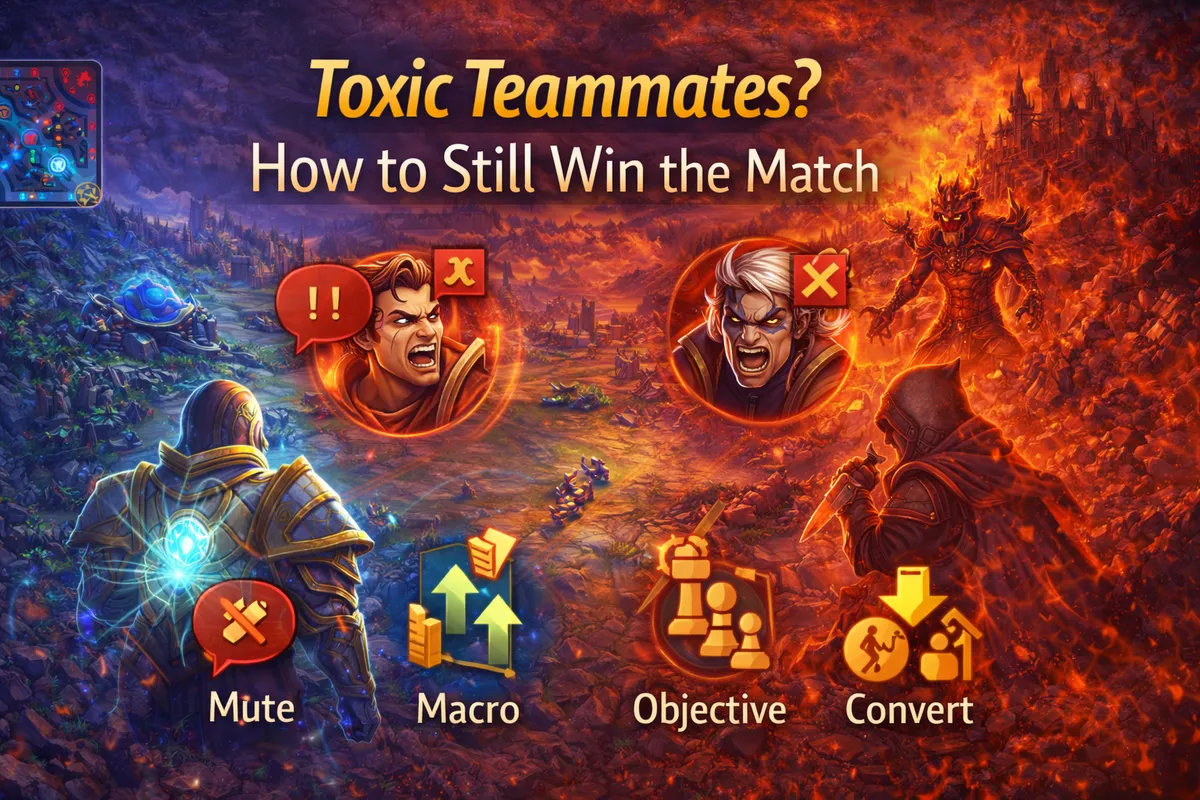
Types of Toxicity in MLBB (And What Each One Costs)
Not all toxicity is the same. You need different responses.
1) The Flamer (talks, still plays)
This is the easiest type to win with. They’re annoying, but they often still farm and fight. Your goal is to stop them from draining your attention.
2) The Ping Spammer (tilts everyone with noise)
Their pings aren’t information — they’re pressure. The danger is you start reacting emotionally instead of logically.
3) The Refuser (won’t group, won’t help objectives)
This is common: they keep side-laning forever or split the map without timing. Your goal becomes playing a plan that either (a) benefits from their pressure or (b) minimizes the damage.
4) The Soft Griefer (takes bad fights, “accidentally” dies a lot)
You can still win if you stop joining their losing fights and instead trade the map.
5) The AFK / DC (true 4v5)
Hardest — but still not “instant loss.” Your plan becomes wave clear, defense, pick potential, and forcing the enemy to overextend.
The key: don’t treat every toxic behavior like the same emergency. Identify the type, then use the right counter-plan.
The #1 Goal: Protect Your Focus and Your Time
In toxic games, your real enemy is not your teammate — it’s the focus leak.
A focus leak looks like:
- reading chat while you walk into a gank,
- typing while mid wave crashes,
- arguing while Turtle spawns,
- chasing a teammate’s mistake instead of setting up the next objective.
So your #1 rule is simple:
If an action doesn’t increase your chance to win the game, it’s not allowed.
That means:
- No debates.
- No sarcasm.
- No “I told you so.”
- No typing while alive unless it’s one short call.
Toxic games are won by the player who stays in “solution mode.” Every second you spend on drama is a second the enemy spends farming, pushing, or setting up Lord.
Pre-Game: How to Reduce Toxicity Before the Match Starts
You can’t control matchmaking, but you can reduce how often toxicity ruins your game.
1) Use a tiny pre-queue check
If you’re already irritated, tired, or stressed, you’re more likely to engage with toxicity. Before you press Ranked, ask:
- Am I calm enough to ignore nonsense?
- Can I play one full match without typing emotionally?
If the answer is no, switch modes or take a short break. This is not “soft.” This is win-rate protection.
2) Pick heroes that don’t require perfect teamwork
In solo queue, especially in toxic lobbies, value heroes with:
- reliable wave clear,
- safe positioning tools,
- objective impact,
- and the ability to function even if your team is uncoordinated.
You don’t need “1v9” fantasy. You need “still useful no matter what.”
3) Decide your match identity early
Before minions spawn, decide:
- Are we playing for early tempo and snowball?
- Are we playing for scaling and defense?
- Are we playing for pick-offs and punishing mistakes?
When your mind has a plan, toxicity has less space to drag you around.
The Mute Strategy: When to Mute, Who to Mute, and Why It Works
Muting is not surrender. Muting is staying in control.
Here’s a practical muting system that wins games:
Instant mute triggers (mute immediately):
- insults, name-calling, or blame spam
- repeated sarcasm or “FF” spam
- nonstop ping spam that’s clearly emotional
- anyone who distracts you more than they help you
Selective mute (mute one person, keep team comms):
- when one teammate is toxic but others are still trying
- when you still need basic pings for objectives
- when the toxic teammate is not your lane partner
Full chat off (for consistency climbers):
- if you notice chat affects your mood often
- if you want to climb with a stable mental every session
- if you prefer quick chat/pings only
Why muting works: it stops your brain from reacting to social threat. Your hands get calmer, your minimap attention returns, and you make cleaner decisions. In ranked, that’s priceless.
Communication That Survives Toxic Chat (The 3-Message System)
Typing a lot in MLBB usually lowers win rate — even when you’re right — because it steals time and creates arguments.
Use the 3-message system:
Message 1: A simple plan
Examples:
- “Play for Turtle. Group 20s before.”
- “Clear waves, then Lord setup.”
- “Don’t chase. Take towers.”
Message 2: One reminder at the right time
- “Turtle 20s — come river.”
- “Lord soon — push side waves first.”
Message 3: One calm reset (if needed)
- “It’s winnable. Focus objectives.”
- “No flame, just play.”
After that: stop typing. Use pings.
This avoids the biggest trap: trying to “fix” people mid-match. You don’t need everyone to be happy. You need 2–3 players to follow a repeatable objective plan.
Win-Condition Thinking: How to Carry When Your Team Is Arguing
Toxic games feel chaotic because you’re trying to win “normally.” Instead, choose a win condition that works with low cooperation.
Common solo queue win conditions that survive toxicity:
1) Front-to-back teamfights (safe and simple)
Protect your damage dealers, fight around tight areas, punish divers, and win extended fights.
2) Pick-off wins (catch someone, then take objective)
If your team won’t coordinate 5v5, coordinate 2v1. One pick before Lord is often enough.
3) Split pressure with timing (use the refuser instead of fighting them)
If someone refuses to group and keeps pushing a side lane, don’t waste energy yelling. Instead, adjust your team’s plan:
- play safely mid,
- defend vision around objectives,
- and punish enemies who over-rotate to the splitter.
4) Turtle defense into Lord flip (comeback plan)
If early game is messy, stop forcing. Defend towers, farm safely, and turn one late objective into a comeback push.
The key question to ask yourself:
What is the simplest way to win this specific match with these specific teammates?
Simplicity is strength in toxic games.
Macro Over Drama: The Map Plan That Wins with Minimal Cooperation
If you want a “toxicity-proof” macro plan, use this:
Step 1: Make the map predictable
Predictable means:
- waves are pushed before objectives,
- your team is not randomly scattered,
- and you’re not face-checking darkness.
Step 2: Trade instead of coin flipping
If your team is late or tilted, don’t flip Turtle/Lord. Trade:
- take opposite-side tower pressure,
- steal jungle camps,
- or shove waves to force defense.
Step 3: Convert every win immediately
Toxic teammates often chase for kills. Your job is to lead the conversion:
- “tower” after pick,
- “Lord” after wipe,
- “reset and buy” after objective.
Step 4: Reduce deaths before objectives
Most losses come from one teammate dying 15 seconds before Turtle/Lord, forcing a bad fight. You can’t control them completely, but you can:
- ping retreat early,
- be early yourself,
- and avoid joining bad fights that start from desperation.
Macro wins because it doesn’t require everyone to agree — it requires you to consistently choose the high-percentage play.
Objective Play with a Toxic Team (Turtle and Lord Without Trust)
Objectives are where toxic teams throw, because objectives require timing. Here’s how to run objectives when your team is unreliable:
1) Start earlier than normal
If your team is messy, you must compensate with earlier movement. Arrive first, hold a safe bush, and ping “Gather” before the panic starts.
2) Don’t start the objective just because you’re there
Toxic games often become “someone hits Turtle/Lord and everyone scrambles.”
Instead, ask:
- Are waves okay?
- Are key ultimates up?
- Is the enemy jungler visible or controllable?
- If not, stall, poke, or look for a pick.
3) Make the secure moment boring
A good secure is not a dramatic flick + Retribution miracle. It’s:
- enemy jungler zoned,
- your jungler healthy,
- your team positioned to block entry.
4) If your team won’t come, don’t donate kills
Sometimes you simply can’t contest. That’s fine. The losing play is dying trying to “prove” you should contest. If you can’t contest safely:
- clear waves,
- defend towers,
- and look for the next mistake to punish.
A calm team can win without every Turtle. A tilted team loses by throwing fights around every Turtle.
Wave Control as a Toxicity Counter (Freeze, Crash, Slow Push to Stabilize)
Wave management is the most underrated “anti-toxicity” skill because it creates time windows and reduces chaos.
Crash before you roam
If you want to help a fight, crash the wave first so you don’t lose your lane while you rotate.
Slow push to force enemy decisions
When your team is arguing, a slow push creates pressure that doesn’t require communication. The enemy must answer the wave or lose towers.
Defend high ground with wave clear
If the game becomes a defense situation (AFK, heavy feeding), wave clear is your oxygen. Clear waves safely, avoid over-extends, and make the enemy work for every tower.
Wave control helps because it shifts the match from emotional to structural. Structures don’t care about flame. Minions still walk. Towers still fall. That’s how you win games that “should be messy.”
Role-by-Role Carry Plans When Teammates Are Toxic
Different roles win toxic matches in different ways. Here are practical role scripts you can follow.
Gold Lane (Marksman): “Uptime over ego”
- Farm safely and avoid risky trades when the map is dark.
- Don’t chase into fog. Hit the closest safe target in fights.
- Be early to Lord pushes and stay alive for the siege.
- Your job is damage that arrives on time, not highlight kills.
Mid Lane (Mage): “Wave first, then move”
- Clear mid fast, then hover to the side where action is likely.
- Use your wave clear to prevent towers falling during chaos.
- In toxic games, your best carry tool is controlling choke points and defending entrances before objectives.
Jungle: “No coin flips”
- Route toward objectives and avoid forced fights started by tilted teammates.
- If the setup is bad, trade instead of flipping.
- Focus on guaranteed resources: camps, buffs, safe picks, and objectives only when controllable.
- Your job is stability and secure timing, not responding to blame.
EXP Lane: “Space and timing”
- Manage wave so you can rotate for objectives.
- Don’t over-chase side-lane kills; they often bait you into ganks.
- Be the entrance blocker around Turtle/Lord so your team can position safely.
Roam/Support: “Reduce chaos”
- Mute early if chat distracts you.
- Use pings to guide, not to punish.
- Decide each fight: engage or peel. Don’t do both badly.
- Your carry is preventing picks and creating clean starts.
If you want to climb with toxic teammates, stop thinking “How do I fix them?” and start thinking “What does my role do to keep the game winnable?”
How to Win 4v5 or “Soft 4v5” Games (AFK, Feeding, Griefing)
You’ll lose some 4v5 games. That’s real. But you’ll win more than you expect if you use the correct plan.
1) Stop taking equal fights
You are down a player. Don’t fight fair 5v5. You want:
- picks,
- tower defense,
- and punishing over-extends.
2) Protect wave clear at all costs
If your wave clear heroes die, the game ends quickly. Prioritize survival and defensive positioning.
3) Turn the map into a trap
Enemies get confident in 4v5. They dive too deep. They face-check alone. They chase.
Your job is to punish that:
- hold tight areas,
- wait for cooldowns to be wasted,
- then collapse for a quick kill and reset.
4) Trade objectives intelligently
If they take Turtle/Lord and you can’t contest, don’t die. Take something else:
- shove lanes,
- take a turret if possible,
- steal jungle camps,
- or set up defense for the next push.
5) Make the enemy spend time
In 4v5, time is how you survive. Drag the game out, farm safely, and wait for enemy mistakes. Many teams throw by getting bored and diving high ground.
The core mindset:
In 4v5, you’re not trying to “dominate.” You’re trying to survive long enough for the enemy to hand you a mistake.
How to Deal with a Teammate Who Refuses to Group
This is one of the most common “toxic but playable” situations.
First, decide if they are:
- Split pushing productively (creating real pressure), or
- Wandering uselessly (feeding and getting nothing).
If they are creating pressure, use them:
- Don’t force 5v5 at Lord immediately.
- Hold vision and defend mid.
- Punish the enemy when they over-rotate to catch the splitter.
- Start objectives only when you have numbers advantage or when the split pressure forces someone to defend.
If they are wandering and feeding:
- Stop following them into bad fights.
- Play tighter with the teammates who are trying.
- Shift to defense + pick plan and minimize deaths.
- Use pings like “Retreat” and “Defend” once — then let it go.
A powerful rule:
Never let one teammate’s refusal force you into repeated losing fights.
You can win with 4 coordinated players. You usually can’t win with 5 players doing 5 different things.
How to Deal with a Teammate Who Feeds Early
Early feeding feels like doom because it creates a snowball. The mistake most players make is panicking into more fights.
Here’s the calm recovery plan:
1) Stop the chain reaction
Feeding usually causes teammates to “help” and die too. Don’t join doomed fights. If you arrive late, you’ll just donate another kill.
2) Identify the fed enemy’s job
Is the enemy fed hero:
- a diver assassin,
- a burst mage,
- or a marksman DPS?
Then adjust:
- protect your carry,
- build survivability if needed,
- and avoid the fed hero’s strongest timing windows.
3) Farm and trade
Push waves safely, take jungle camps, and avoid unnecessary fights until your team hits item spikes.
4) Punish greed
Fed players overextend because they feel invincible. Set traps in bushes near lanes and objectives and punish that overconfidence.
The goal is not to “out-fight” the fed hero immediately. The goal is to stop feeding more gold and wait for a cleaner fight window.
How to Deal with a Teammate Who Steals Jungle or Trolls Lanes
This one is annoying because it damages your team’s economy.
If someone steals buffs or takes your camps as a jungler:
- Don’t chase them around. That wastes time and makes you poorer.
- Mirror farm on the opposite side. Take available camps and look for safe steals on the enemy side when you have lane priority.
- Shift to objective safety. Even with less farm, you can still win by smarter Lord/Turtle setups and picks.
If someone trolls a lane assignment:
- Pick the simplest repair plan. Who has wave clear? Who can safely hold which lane?
- Stabilize towers first. A messy lane swap is survivable if you stop early tower collapses.
- Avoid ego fights. Your goal is to keep the map standing until your comp can group.
And if someone is clearly griefing:
- focus on winning the match first,
- then report after.
- Arguing mid-match rarely helps and often makes the griefing worse.
How to Deal with Negative Pings and Spam
Pings are powerful — until they become emotional weapons.
If a teammate spam-pings you:
- Treat it as noise, not information.
- Mute their pings if needed.
- Keep your own pings clean: one ping that matters is worth more than ten spam pings.
A simple “healthy ping rule”:
- Ping to share information: “Gather,” “Retreat,” “Enemy missing,” “Defend.”
- Don’t ping to punish mistakes.
When your pings stay calm, teammates are more likely to trust them. When pings become emotional, everyone ignores them.
Mental Reset Tools Mid-Match (Simple, Fast, Effective)
You don’t need a big mindset speech. You need quick resets you can actually use.
The 5-second reset after a mistake
- Long exhale
- Relax shoulders
- One cue phrase: “Next play.”
- One decision: “Wave” or “Objective setup” or “Defend.”
Between objectives
- Do 2 rounds of box breathing (inhale 4, hold 4, exhale 4, hold 4).
- This reduces panic and helps your hands stay steady for skills and Retribution timing.
When you feel the urge to type
- Ask: “Will this message improve our next 30 seconds?”
- If not, don’t type. Ping instead.
Your mental goal is not to be emotionless. Your goal is to keep emotions from stealing the next best decision.
Closing Games Safely When Toxicity Improves but Throws Still Happen
A lot of toxic games flip because the team finally gets an advantage… then throws it by chasing.
Use this closing checklist:
- After a pick: take tower or start Lord (if safe).
- After Lord: group and escort the push — don’t split randomly.
- Protect shutdown gold: if you’re ahead, don’t farm dark jungle alone.
- Don’t chase into fog: take the map instead (towers, waves, jungle).
- Reset after big wins: buy items, heal, then regroup.
In toxic lobbies, the enemy is often just as emotional. They’ll give you a window. Your job is to not throw your own window back.
Practical Rules
- Toxic teammates win through distraction — so protect your focus first.
- Mute early and confidently when chat or pings reduce your decision quality.
- Use the 3-message system: one plan, one reminder, one reset — then stop typing.
- Choose a win condition that works with low cooperation (front-to-back, picks, split timing, defense into Lord).
- Don’t coin flip objectives when your team is late or tilted — trade instead.
- Convert every win into something permanent (tower, Lord, jungle control), then reset.
- Don’t join losing fights started by emotional teammates; defend, farm, and punish over-extends.
- In 4v5, play for wave clear, picks, and enemy greed — not fair fights.
- Keep your pings clean and informational; don’t use pings to blame.
- After the match: report quietly, reset your mental, and avoid rage-queue spirals.
BoostRoom
Toxic teammates are one of the biggest reasons players feel stuck — not because it’s impossible to win, but because it makes you play emotional, messy MLBB instead of structured MLBB. BoostRoom helps you build a “toxicity-proof” ranked style that still climbs:
- Personal win-condition planning (what to do when your team won’t cooperate)
- Objective setup routines that work even with low communication
- Role scripts for toxic games (gold/mid/jungle/EXP/roam) so you always know the next best play
- Anti-tilt systems: muting rules, reset routines, and loss-streak protection
- Conversion coaching: turning small wins into towers and Lord pushes instead of throws
If you want ranked to feel calmer and more controllable — even in bad lobbies — BoostRoom is built for exactly that.
FAQ
Should I mute chat every ranked game?
If chat often affects your mood or focus, yes — it can raise consistency a lot. If you prefer some communication, selectively mute toxic players fast and rely on pings/quick chat.
Is it possible to win with a feeder on my team?
Yes, sometimes. The key is to stop the chain reaction: don’t join doomed fights, protect wave clear, trade the map, and punish the fed enemy when they get greedy.
What do I do if my teammate refuses to group for Lord?
Decide if their split push creates pressure. If it does, play around it: defend mid, punish over-rotations, and start objectives only when you have numbers or wave advantage.
What’s the best way to respond to a toxic message?
Usually: don’t. If you must, keep it one calm line about the plan (“Play for Lord,” “Clear waves”) and then stop typing. Arguing almost always lowers win rate.
How do I stop myself from typing when I’m angry?
Use a rule: only type if it improves the next 30 seconds. Otherwise, use one ping and focus on waves/objectives.
What if the toxic player spam-pings me all game?
Mute their pings. Your performance matters more than their noise. Keep your own pings minimal and useful.
How do I win a true 4v5?
Avoid fair fights, protect wave clear, punish dives and over-extends, and trade objectives intelligently. Make the enemy spend time and eventually overcommit.
Should I report during the match or after?
Report after when possible. Mid-match reporting or threats often distract you and can escalate behavior. Focus on winning first.
Why do toxic games feel like I can’t carry even when I’m ahead?
Because toxicity causes bad conversions: chasing, splitting at the wrong time, and flipping objectives. If you lead conversions into towers/Lord and reset properly, you’ll close more games.
What’s the single most important tip to still win with toxic teammates?
Mute early, pick a simple win condition, and play macro: waves → setup → objective → conversion. Don’t let chat choose your plays.



