Route: The “No Confusion” Access Plan (Two Tracks, Same Goal)
There are two ways players talk about “access” to Tempest Keep: The Eye, and mixing them up is the #1 reason raid nights start late.
Track A — Modern access (zone-in focused):
Your goal is simply to reach the raid portal and get your roster inside with minimal delay. This matters on versions where raid attunements are not required for entry.
Track B — Classic-style unlocking (Tempest Key focused):
Your goal is to complete The Tempest Key quest chain (including the Trial of the Naaru quests and Magtheridon). This matters on rule sets that enforce the original gating, and it’s also valuable “progression discipline” even when entry is open—because it forces your roster to finish key heroics and be ready for higher tiers.
This guide gives you both, but the fastest way to use it is simple:
- If your raid leader only cares about zoning in: follow Track A fully, and use Track B as an optional “credibility upgrade.”
- If your realm requires unlocking: follow Track B in the exact order below, and use Track A so you don’t lose time at the portal.
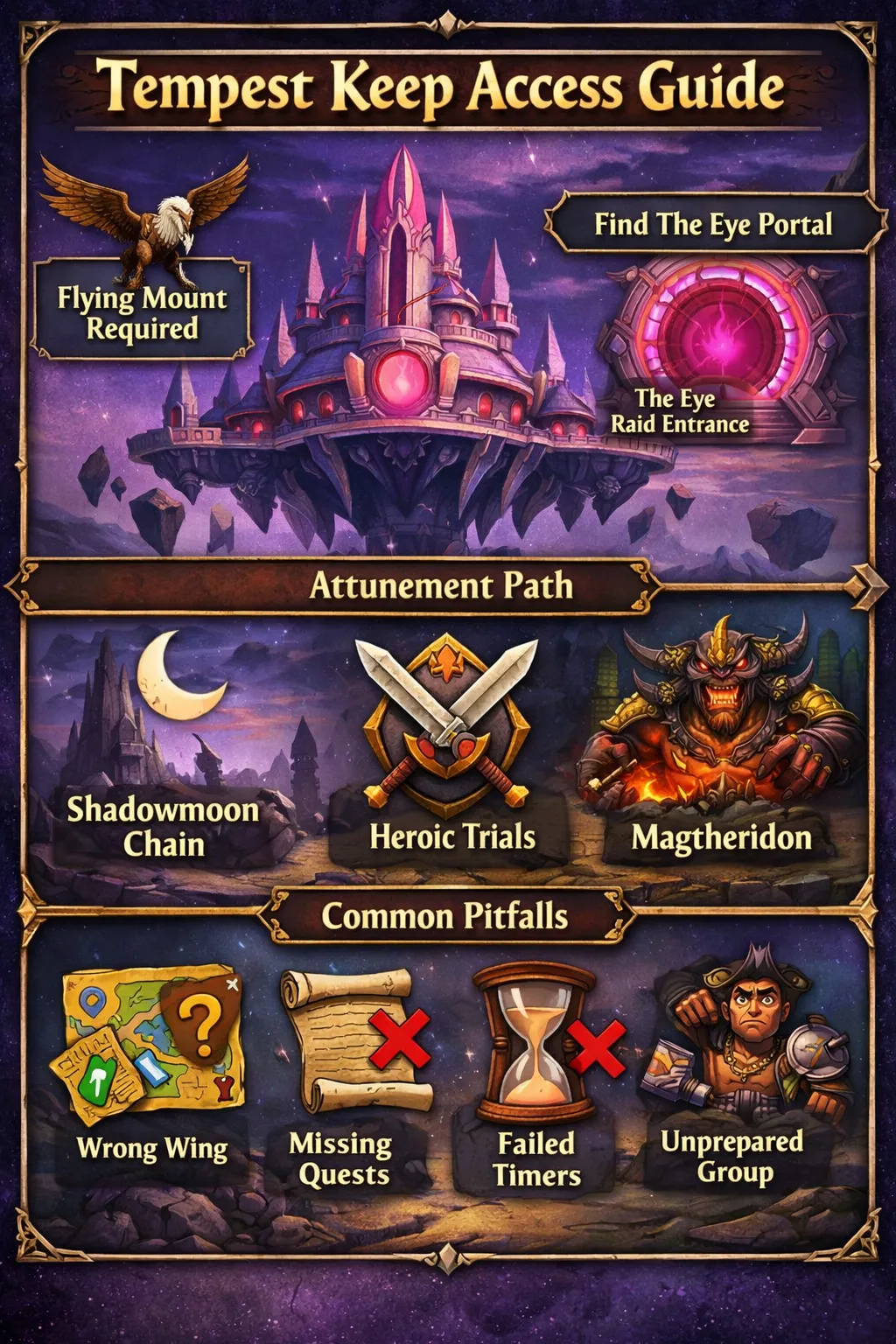
Route: Track A — How to Physically Reach The Eye Fast (Netherstorm, Flying, and Portal Discipline)
Most access problems aren’t “mechanics.” They’re travel and organization. Fix those once, and every future lockout becomes smoother.
What The Eye actually is (quick clarity):
Tempest Keep is the floating fortress in Netherstorm with multiple wings. The Eye is the 25-player raid wing—separate from the 5-player dungeon wings (The Mechanar, The Botanica, The Arcatraz). A lot of players say “TK” and mean different things, so always confirm: “TK raid” = The Eye.
Step 1: Get your roster to Netherstorm efficiently
Your raid’s biggest time loss is usually not the flight—it’s the slow drip of people arriving from different places with no plan.
Fast travel habits that make you look like a pro:
- Set your “pre-raid meet point” somewhere consistent (many groups use Shattrath as the staging hub because it’s central for Outland travel).
- Leave early if you’re the summon starter (warlocks, officers, or anyone who helps stage summons).
- If you’re not staging summons, your job is still simple: be on time, be repaired, and arrive with bags not overflowing.
Step 2: Understand the flying requirement (and don’t gamble your raid night on summons)
Tempest Keep is in the air. Reaching the actual entrances is commonly done with a flying mount (or flight form). Some versions allow creative summoning; other versions are stricter about where you can summon. The only “always safe” plan is:
Assume you need flying to reach the entrance platform.
If you personally don’t have flying yet, coordinate ahead of time so you’re not the person blocking the start.
Practical roster rule that prevents delays:
- Your raid should have enough flyers to stage the group quickly (and not rely on one person who might be late).
- If your raid uses summoning, treat it like a planned job: “two helpers + warlock + location,” not “we’ll figure it out.”
Step 3: Find the correct wing (The Eye raid portal)
This is where “no confusion” matters. The Tempest Keep complex has multiple entrances for different instances. The Eye raid portal is on its own access point. When people go to the wrong wing, you lose 10–20 minutes to backtracking, explanations, and frustration.
No-confusion rule:
If you’ve never been there, follow a player who has. Don’t “guess,” because guessing is how you end up at the wrong wing.
Step 4: Form the raid group before you ask people to travel
This sounds obvious, but it’s a consistent mistake:
- People fly out, land, and then the raid lead spends 15 minutes rebuilding the roster from scratch.
- Summoning becomes messy because nobody is in the raid yet.
Smooth start script (works every week):
- Raid lead forms raid in the city (invites by list).
- Raid lead confirms roles and loot rules briefly.
- Then everyone travels (or the summon team travels first and starts pulling people).
Step 5: Make “portal readiness” part of your invite value
If you want to get invited to more Tier 5 raids, become the player who never causes a delay:
- You know where the portal is.
- You arrive with flying handled.
- You don’t ask “which wing?” in raid chat five minutes before pull.
- You help stage summons without drama.
This seems small, but raid leaders remember the players who make logistics painless.
Route: Track B — Unlocking The Eye With The Tempest Key (Classic-Style, Step-by-Step)
If your realm requires The Tempest Key (or you want the full progression unlock for status and discipline), this is the complete path—written to prevent dead ends and repeated runs.
Big picture: what The Tempest Key chain requires
The classic chain is long, but it’s not complicated once you view it as three blocks:
Block 1: Finish the Shadowmoon Valley quest chain that leads to the Cipher of Damnation completion.
This is the “story unlock” that triggers your next step.
Block 2: Complete the Trial of the Naaru quests (Heroic dungeons).
These are your “prove you’re ready” checks.
Block 3: Kill Magtheridon and turn everything in to earn The Tempest Key.
This is the final gate.
If you do these blocks in the correct order, you won’t waste time. If you do them randomly, you’ll constantly run into “I don’t have the quest yet,” “I can’t enter heroic,” or “I missed the objective.”
Block 1: Shadowmoon Valley — finishing the Cipher of Damnation path
This is where many players stall because they underestimate the time. The key mindset is:
Don’t try to do everything in one rushed session.
Do it in focused chunks so you don’t burn out and quit halfway.
Practical approach that works:
- Treat Shadowmoon Valley chain progress like a “daily progress bar.”
- Commit to finishing a defined segment each day (or each play session).
- Keep your quest log organized so you don’t lose track of which son/fragment line you’re on.
When you finish the Cipher of Damnation culmination, you receive the trigger that moves you forward (commonly a letter directing you to Shattrath to speak with Khadgar and/or begin the next chain).
Pitfall to avoid:
Players finish “most” of the chain but don’t complete the final step, then wonder why the Trial chain never appears. If you want the key, you must finish the chain fully.
Block 2: Trial of the Naaru — the Heroic checklist (Mercy, Strength, Tenacity)
Once you’re directed to Shattrath and speaking with the correct NPCs, you’ll be sent to complete the Trial quests. These are the backbone of “unlocking The Eye.”
Trial of the Naaru: Mercy (Heroic Shattered Halls)
Goal: rescue the prisoners in time and obtain the required proof item.
This heroic is notorious for two reasons: it’s mechanically punishing for early groups, and the timed prisoner component can fail if your group is slow or disorganized.
How to make Mercy reliable:
- Bring a group with real interrupts and stuns (this is not the place for “we’ll just face-tank casts”).
- Assign one player to call focus targets so you don’t waste time.
- Pull with intent: chain pulls with control, not reckless speed that causes wipes.
Common Mercy failure points (and fixes):
- Prisoners die because the group is slow: tighten your pace and reduce downtime; don’t full-stop after every pull.
- Wipes cost too much time: play safer on pulls that commonly wipe groups (a single wipe can be the difference between success and failure).
- People leave early: tell your group up front you’re completing the Trial objective so nobody bails after the final boss.
Trial of the Naaru: Strength (Heroic Steamvault + Heroic Shadow Labyrinth)
Goal: retrieve specific proof items from the final bosses of two heroics.
This trial is often easier than Mercy, but it has a different risk: people forget to loot or forget they need credit from both heroics.
Make Strength smooth:
- Do the two heroics on the same day if possible (momentum matters).
- Announce before each final boss: “Everyone who needs the Trial must loot.”
- Keep bag space free before you go in.
Common Strength failure points (and fixes):
- “I did it but didn’t get the item”: the solution is almost always looting discipline and quest tracking. Don’t rush out of the room after the kill.
- Shadow Lab groups falling apart: build the group with at least one reliable interrupter and one solid healer; Shadow Lab punishes chaos more than people expect.
Trial of the Naaru: Tenacity (Heroic Arcatraz)
Goal: rescue Millhouse Manastorm during the final encounter and keep him alive through the end.
Tenacity is one of the most “oops we failed it” steps because groups don’t treat Millhouse as a protected objective.
How to make Tenacity reliable:
- Explain the objective before the final boss: Millhouse must survive.
- Assign someone to watch him during chaotic moments (this can be a healer who keeps a HoT/shield habit on him, or a player who peels threats off him quickly).
- Keep the encounter controlled; sloppy add management or panic movement is what gets him killed.
Common Tenacity failure points (and fixes):
- Millhouse dies to chaos: your fix is to treat him like an escort target, not a decoration.
- Group tunnels DPS and ignores the objective: assign responsibility explicitly (“You watch Millhouse, you watch interrupts”).
Heroic entry keys and reputation: don’t get stuck at the door
On many TBC-style rule sets, entering heroics requires keys tied to reputations. Even on versions where requirements were lowered later, it’s still one of the biggest “why can’t I enter?” confusion points.
Practical checklist of what you may need (depends on ruleset):
- A heroic key for Hellfire Citadel heroics (used for Shattered Halls)
- A heroic key for Auchindoun heroics (used for Shadow Labyrinth)
- A heroic key for Tempest Keep heroics (used for Arcatraz)
- A heroic key for Coilfang Reservoir heroics (used for Steamvault)
How to avoid rep grind panic:
- Start these reputations early, even before you “need” them.
- Run the relevant normal dungeons while you’re still gearing; it stacks gear progress with rep progress.
- If your version has lowered requirements, still treat keys as a checklist item—because you don’t want to discover your restriction at the instance portal with a full group waiting.
Block 3: Trial of the Naaru: Magtheridon (the raid step)
After completing the heroic trials, the chain typically ends with:
Kill Magtheridon.
This is where players realize something important: unlocking The Eye isn’t just “questing.” It’s a progression gate that expects you to be raid-ready and able to coordinate.
Make Magtheridon step painless:
- Don’t try to “wing it” with random pugs unless they have a cube plan.
- Join a run with clear cube assignments and backups.
- Make sure you have the quest step active so you don’t need to repeat it.
Once Magtheridon is complete, you return to the quest giver in Shattrath to receive The Tempest Key and finish your classic-style unlock.
Bonus value: the “Champion of the Naaru” credibility effect
On some implementations, completing the Tempest Keep and SSC attunement-style quests was associated with the “Champion of the Naaru” style prestige. Even where titles are purely cosmetic, the social effect is real:
Raid leaders trust players who finish long prerequisite chains.
It signals you can follow instructions, show up consistently, and complete “unfun” steps without being babysat—exactly the traits that matter in Tier 5 progression.
Loot: Why Unlocking The Eye Is More Than “Just Another Raid”
Access guides shouldn’t ignore motivation. The reason The Eye matters isn’t only Kael’thas drama—it’s how much progression it unlocks for your character and your roster.
Tier 5 progression value (why rosters care who is ready)
Tier 5 raids accelerate upgrades because they offer:
- Major power spikes from raid gear compared to dungeon/Phase 1 items
- Token progression that helps classes reach important set bonuses
- BiS or near-BiS pieces that remain relevant for a long time
If you want invites, “I’m ready for The Eye” is stronger when you can also say:
- You can reliably get to the portal
- You won’t be the reason the raid delays
- You’ve handled the prerequisite discipline that Tier 5 culture expects
The Eye’s unique long-term value: progression chains beyond Tier 5
The Eye is historically tied into broader Tier 6 readiness because it’s connected to the idea of proving you can clear higher-end bosses and obtain specific boss drops used for future access chains (depending on version).
Even when later content is open, these “chain items” still matter socially: guilds often expect you to be part of the pipeline, not just a passenger.
Invite psychology: why access competence gets you more raid spots
A Tier 5 raid lead often has one nightmare: wasting the first 30 minutes because of avoidable roster issues. Players who eliminate those issues become “default invites.”
If you want more invites, your goal isn’t just to have gear.
Your goal is to have reliability:
- You show up early.
- You’re at the correct portal.
- You have the prerequisites handled.
- You don’t need a raid leader to explain the basics.
That’s the “loot” many players miss: reputation.
Extraction: Turn Access Into a Repeatable Weekly Routine
Extraction means turning “ugh, I need to unlock TK” into a simple routine that doesn’t steal your entire week.
Extraction plan for solo/alt players (fastest realistic pacing)
Day 1–2: Shadowmoon Valley progress
- Work through the chain consistently rather than randomly.
- Keep your quest log clean.
- Knock out sections in batches so you don’t lose momentum.
Day 3: Start heroic key/rep cleanup
- Identify which heroics you still can’t enter.
- Focus your dungeons on reputations that unlock those heroics.
Day 4–5: Trial heroics with a fixed group if possible
- Mercy and Tenacity are dramatically easier with a consistent team.
- If you can’t build a fixed team, at least build your groups with the required tools (interrupts, control, stable healer).
Day 6–7: Magtheridon step + turn-in
- Join a structured run with a real cube plan.
- Turn in immediately so you don’t forget.
This pacing is realistic, reduces burnout, and prevents the classic failure: “I tried to do everything in one day, got stuck, and quit.”
Extraction plan for guild leaders (how to unlock 25 people without chaos)
If you’re organizing a roster, treat unlocks like a mini project.
Guild unlock playbook:
- Make a roster tracker: “Shadowmoon chain done / heroics available / Mercy done / Strength done / Tenacity done / Magtheridon done.”
- Schedule two ‘attunement nights’: one for heroics, one for Magtheridon.
- Assign role anchors: one tank and one healer per group who you know will show up and keep runs stable.
- Batch similar needs: run Mercy for the people who need Mercy; don’t mix groups where half the players are just “there for fun” and half are on a timed objective.
Guilds that do this unlock quickly. Guilds that “let people handle it themselves” often end up with 10–15 players ready and 10–15 players stuck—then wonder why Tier 5 nights are inconsistent.
Time-saving habits that protect raid nights
- Don’t wait until raid day to learn where the portal is. Do a quick scouting trip once and memorize it.
- Always keep one spare bag row before Trial runs. Loot mistakes waste weeks.
- Write down your next step when you log out. Most unlock chains fail because players forget where they left off and lose momentum.
Practical Rules: The Exact Pitfalls That Create “Access Confusion” (And the Fix)
This section is designed to stop the most common “we lost an hour” problems.
Pitfall 1: “Tempest Keep” means four different things to four people
What happens: half the raid flies to a dungeon wing, half goes to the raid wing, and you lose time regrouping.
Fix: always say “The Eye raid portal” when you mean the raid.
Pitfall 2: Someone can’t reach the entrance because they assumed summons would solve it
What happens: one or two players don’t have flying and expect the raid to “figure it out” at the last minute.
Fix: assume flying is required and plan ahead. If your raid uses summoning, stage it deliberately with enough flyers.
Pitfall 3: People do Trial heroics without the correct quest step active
What happens: they complete a heroic, but get no credit or no item, and must repeat it.
Fix: before you enter the dungeon, open your log and confirm the Trial quest is active.
Pitfall 4: Mercy fails because the group didn’t treat it like a timed objective
What happens: prisoners die and you fail the Trial condition.
Fix: build a real group (interrupts + control), move with intent, and avoid wipe risks that cost too much time.
Pitfall 5: Strength fails because someone didn’t loot or didn’t realize it’s two heroics
What happens: “I did Steamvault but not Shadow Lab,” or “I forgot to loot the item.”
Fix: do both in one session and use a simple habit: nobody leaves the room until quest holders confirm.
Pitfall 6: Tenacity fails because Millhouse dies
What happens: the boss dies, but the objective fails.
Fix: assign someone to protect Millhouse and explain the objective before the final encounter begins.
Pitfall 7: Magtheridon step becomes a wall because the group has no cube plan
What happens: repeated wipes, tilt, and a wasted night.
Fix: only join Magtheridon runs with assigned cubes and backups. If a group says “we’ll wing it,” your time is better spent elsewhere.
Pitfall 8: People finish steps but never turn in
What happens: they technically “did the content” but remain unflagged where flagging matters.
Fix: turn in immediately after completing the step—same day, same session.
Pitfall 9: A player gets invited to The Eye but looks unprepared
What happens: they can zone in, but they don’t know the basics, arrive late, and get quietly replaced next week.
Fix: access is not the finish line. Learn the portal route, show up early, and be the player who reduces stress for the raid leader.
BoostRoom: Get The Eye Access Handled Without Burning Your Week
Unlock chains and access logistics are where most players lose momentum. Not because they’re incapable—but because they’re doing it alone, without a plan, and without stable groups for the key heroics that punish sloppy comps and shaky execution.
BoostRoom is built around removing that friction:
- Clear step-by-step planning so you always know your next requirement
- Structured runs for the heroics that commonly block players (especially Mercy and Tenacity)
- Organized raid scheduling so Magtheridon isn’t a “maybe” and your unlock doesn’t stall
- A repeatable routine that turns The Eye from a confusing goal into a weekly reality
If your goal is simple—get invited more, progress faster, and stop losing raid nights to travel and prerequisite chaos—then treating access like a system (not a scramble) is one of the smartest upgrades you can make.
FAQ
Do I need an attunement to enter The Eye in TBC Classic?
On many modern implementations, entry attunements for Tempest Keep and Serpentshrine are not required to zone in. However, the classic quest chains still exist and are often completed for prestige, progression discipline, or because some rule sets still enforce them.
What is “The Tempest Key”?
It’s the classic-style unlock tied to a quest chain culminating in Trials (heroic dungeons) and a Magtheridon kill, historically used to grant access to The Eye.
Where does the Tempest Key chain start?
It begins after completing the Shadowmoon Valley quest chain that leads into the Cipher of Damnation completion and the follow-up that sends you back toward Shattrath to begin the Trial chain.
Which heroics are required for the Trial quests?
Commonly: Heroic Shattered Halls (Mercy), Heroic Steamvault + Heroic Shadow Labyrinth (Strength), and Heroic Arcatraz (Tenacity), followed by a Magtheridon kill.
Why does Mercy fail so often?
Because it includes a timed prisoner objective and many groups underestimate how punishing Shattered Halls can be without interrupts, control, and steady pacing.
What do people mess up on Tenacity?
Millhouse Manastorm must survive the final encounter for credit. Groups that don’t protect him often “complete the run” but fail the objective.
Do I need flying to reach The Eye?
In practice, flying is the standard way to reach Tempest Keep entrances in the air. Don’t rely on last-minute solutions—plan as if you need flying.
Can’t we just summon everyone?
Summoning rules vary by version and location. The safest plan is always to have enough flyers and a prepared summon team so you aren’t gambling your raid start on technical limitations.
If entry attunements aren’t required, why bother unlocking?
Because it proves reliability, unlocks heroics you’ll run anyway for gearing, builds progression habits, and makes you a stronger candidate for consistent Tier 5 invites.
What’s the fastest way to become “invite-ready” for The Eye?
Know the portal route, handle flying, show up early with repairs and clear bags, and complete whatever prerequisite steps your realm or raid leader expects—without needing reminders.



