Route
If your goal is “join groups confidently,” your route should be less about rushing to the hardest fights and more about building proof-of-skill in small, repeatable steps. Confidence comes from familiarity: knowing what the LFG wants, knowing what your build is supposed to do, and having already done a few clean clears in lower-pressure content.
Here’s the route that works for most players in 2025—whether you’re brand new to instanced PvE or you’ve only ever done open world and story.
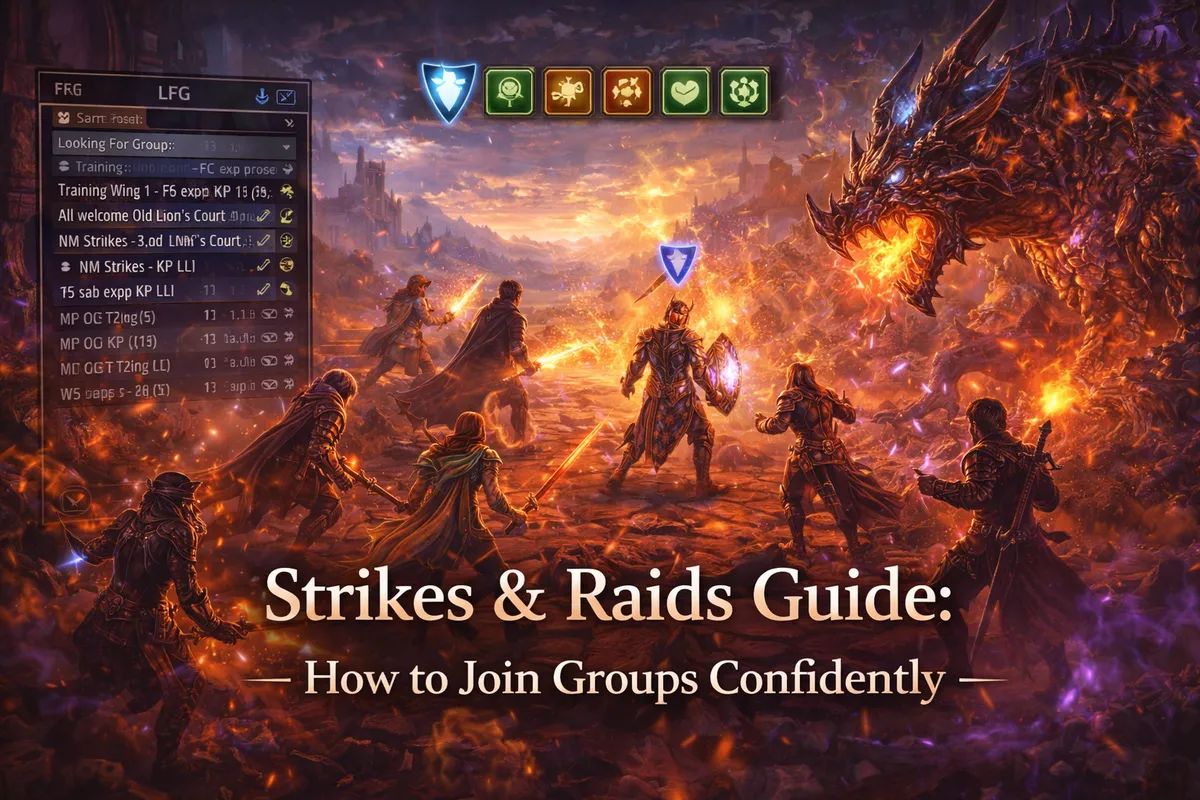
Step 1: Understand what you’re joining (strikes vs raids).
Strikes are usually single-boss 10-player encounters. You zone in, fight one boss (or one “mission-style” encounter), get rewards, and you’re done. They’re designed to be approachable, especially on normal mode, and many of them are great “first group content.”
Raids are organized into wings—a sequence of encounters that you progress through. They typically demand more coordination, more role clarity, and more patience when learning.
Step 2: Pick one “main role” and one “backup role.”
Most LFG friction happens because someone joins a squad that needs a specific role and then can’t actually provide it. To avoid that, decide:
- Main role: either DPS (damage) or boon DPS (damage + quickness/alacrity) or healer support (healing + boon).
- Backup role: something you can swap to quickly if needed (often another DPS build or a second boon build).
You don’t need ten builds. You need two reliable builds you can play without thinking.
Step 3: Build your “minimum viable readiness” (MVR).
This is the baseline where you won’t feel like you’re holding the group back:
- Level 80 character
- Correct gear stats for your chosen build (full exotic is fine for most normal modes)
- Correct traits, weapons, utilities
- Runes and relic set up (not random)
- Food + utility consumables (cheap versions are OK)
- You understand your job: stack, dodge big hits, do breakbar, follow markers
Step 4: Start with beginner-friendly strikes (your confidence ladder).
The best first wins are the ones where mechanics are readable, failure isn’t instant, and the squad can recover mistakes. A proven “confidence ladder” is:
Icebrood Saga strikes (great for first clears)
- Shiverpeaks Pass (Icebrood Construct) – commonly considered the easiest first strike, with forgiving mechanics.
- Fraenir of Jormag – multi-phase but straightforward.
- Voice & Claw of the Fallen – two linked bosses, simple if you stay with the group.
- Whisper of Jormag – more mechanics, still learnable with a calm squad.
- Boneskinner – punishing if chaos starts; great for learning “stack discipline.”
- Cold War – more event-style pressure; valuable practice for target priority and staying together.
- Forging Steel – mission-style encounter; good for learning group movement and objective focus.
End of Dragons strikes (where role clarity matters more)
- Aetherblade Hideout
- Xunlai Jade Junkyard
- Kaineng Overlook
- Harvest Temple (normal mode is still a bigger step; treat it as a “later” goal)
Other strikes to know
- Old Lion’s Court (a popular strike that can be run often)
- Secrets of the Obscure strikes
- Cosmic Observatory
- Temple of Febe (more punishing when mechanics are failed repeatedly)
You don’t need to clear everything immediately. Your first objective is simple: clear 2–3 easier strikes with clean behavior (stacking, doing breakbars, following instructions). That alone makes joining future groups feel normal.
Step 5: Join “training” and “all welcome” groups first (and don’t rush KP groups).
You’ll see LFG listings that ask for proof like KP or LI. Those aren’t “toxic by default”—they’re usually trying to keep the run fast and predictable. But they’re also not the best place to learn. Your route should be:
- All welcome / chill runs
- Training runs (explicit learning)
- Experienced runs for content you’ve already cleared
- KP/LI runs only when you can honestly meet the listing
Step 6: Graduate into raids with Wing 1 and Wing 4.
If you want raids without anxiety, start with wings that the community often treats as learnable entry points:
- Wing 1: Spirit Vale (Vale Guardian → Gorseval → Sabetha)
- Wing 4: Bastion of the Penitent (Cairn is widely considered one of the easiest raid bosses)
Then expand to:
- Wing 2: Salvation Pass (Slothasor, Matthias are classic “learn mechanics” fights)
- Wing 3: Stronghold of the Faithful (Xera is a bigger step)
- Wing 5+ when your squad comfort is real
Step 7: Keep an eye on the 2026 changes (confidence boost).
ArenaNet announced that strikes and raids will be merged into a single raids mode in 2026, with a new raid UI, difficulty ratings, a quickplay mode for easier encounters, and a merged reward system. That’s intended to reduce confusion and make it easier to find groups—especially for newer players. You don’t have to “wait” for it to start learning, but it’s reassuring: the game is actively moving toward smoother group entry.
Loot
Joining groups is easier when you’re excited about what you’ll earn. Strikes and raids aren’t just “challenge content”—they’re also some of the most direct progression paths in GW2.
Here’s what the loot ecosystem looks like in plain language.
1) Strike rewards: fast, repeatable value
Strikes are popular because they compress a lot of reward into short sessions:
- Currency used for strike-related vendors and progression
- Weekly and daily reward structures (often “bouncy chest” style rewards)
- A natural routine: do a few per day or do a batch on the weekend
Strikes were designed as an accessible bridge into organized instanced PvE, and reward structures have been updated over time to make them clearer and more consistent.
2) Raid rewards: weekly boss value + long-term legendary progression
Raids are structured around weekly incentives. Even if you only raid one night a week, that can be enough to:
- Work toward major long-term goals (including legendary projects)
- Earn raid currencies used at raid vendors
- Build “experience capital” (the thing that makes joining groups easy)
3) Legendary-related currencies you’ll hear constantly
These are the terms that show up in LFG and group chat, so knowing them removes a lot of fear:
- LI (Legendary Insights): a currency associated with raid boss kills and (in some cases) high-end strike difficulty. In everyday LFG talk, “LI” is often used as a shorthand for “this person has raided enough to be reliable.”
- KP (Kill Proof): proof that you’ve cleared specific bosses/encounters, often shown by linking a token/item or achievement evidence accepted by that community.
- Magnetite Shards / Gaeting Crystals (raid currencies): currencies used at raid vendors and sometimes referenced when people talk about weekly raid value and vendor purchases.
You don’t have to obsess over these on day one, but you should know what they mean so the LFG doesn’t feel like a different language.
4) Why veterans care about “fast and clean runs”
A lot of experienced groups run strikes and raids like a weekly chore list:
- They want roles filled correctly (quickness/alacrity/heal)
- They want minimal downtime (ready checks, pull timers, quick resets)
- They want predictable clears (no arguing mid-fight)
That’s why KP/LI requirements exist. The easiest way to fit into that world is not “be perfect”—it’s be honest, join the right listing, and do your role.
5) Loot that indirectly improves your account
Even when the direct drops don’t look flashy, strikes/raids often help you progress in ways that matter:
- Building a stable set of ascended gear over time
- Funding crafting goals through steady weekly income
- Unlocking account confidence: “I can join endgame whenever I want”
That last one is the real loot. Once you feel at home in 10-player content, GW2 opens up.
Extraction
“Extraction” means turning your time into lasting progress—so each strike/raid session makes the next one easier.
Here’s how confident players extract value from every run.
1) Extract confidence with a repeatable pre-flight checklist (2 minutes).
Before you click “Join,” ask:
- Can I provide the role they asked for? (DPS vs qDPS vs aDPS vs heal)
- Is this a training/all-welcome run or an experienced/KP run?
- Do I have the right build loaded and the right gear equipped?
- Do I know the “one thing that wipes squads” in this encounter? (Every fight has one.)
If you can answer these, you join calmly. If you can’t, you pick a different listing—no shame, just smart routing.
2) Extract social trust by communicating like a teammate, not a tourist.
When you join a squad, your first message sets the tone. Use short, useful info:
- “Hi! DPS (power/condi). Can swap if needed.”
- “Hi! Alac DPS ready.”
- “Hi! Healer + quickness if you need it.”
- “Hi, new to this strike—OK if I join training? I watched a quick guide.”
That last line is magic in training runs. It signals humility and effort, and leaders relax instantly.
3) Extract learning without info overload: learn one mechanic per run.
Don’t try to memorize an entire guide mid-fight. Pick one learning target:
- “I will always do breakbar.”
- “I will never drift off stack.”
- “I will watch the boss animation and dodge the big slam.”
- “I will prioritize staying alive over greed DPS.”
This is how players become “reliable” fast: they build clean habits.
4) Extract “resume value” by tracking what you’ve cleared.
You don’t need spreadsheets, but you should know:
- Which strikes you’ve cleared on normal mode
- Which raids/encounters you’ve cleared
- Which role you cleared them on
Why? Because when an LFG says “exp,” you’ll know if you should join. Confidence is often just clarity.
5) Extract weekly value by batching content intelligently.
A simple pattern:
- Weeknight (30–45 min): do a couple easy strikes with low drama
- Weekend (1–2 hours): join a training raid wing or a strike set you’re learning
- Optional: one “reach” fight with a patient group (not a KP group)
This keeps progression steady without burnout.
6) Extract momentum by respecting reset culture.
Many groups run their biggest clears soon after weekly reset, then disappear. If you want more LFG options:
- Look for groups earlier in the weekly cycle
- Or join communities/guilds that schedule training regularly
Either way, timing helps confidence—because more groups = more chances to practice.
7) Extract calmness by using the “right difficulty for today.”
Some days you’re sharp, some days you’re tired. Confident players pick content that matches their energy:
- Tired? Do easier strikes as DPS.
- Focused? Try a new fight in training.
- In a rush? Join a quick clear you already know.
This prevents the spiral of “I joined, I underperformed, now I’m scared forever.”
Practical Rules
These are the unwritten rules that make you feel “native” in strike/raid culture. Follow them and you’ll join groups confidently even if you’re still learning.
1) Read the LFG like it’s a contract.
If it says:
- “CM” = Challenge Mode (harder, usually stricter)
- “NM” = Normal Mode
- “exp” = experienced (not a first-timer learning run)
- “training” = learning run (questions welcome)
- “chill” = relaxed pace, but still try
- “FC” = full clear (often multiple bosses/encounters in a row)
- “KP/LI” = proof requested
If you can’t meet it, don’t join and hope nobody notices. That’s how runs get tense fast.
2) If you don’t understand the listing, ask before joining.
A quick whisper saves everyone time:
- “Hey—do you need quickness or alacrity for this slot?”
- “Is this OK for first clear if I’m on DPS and I watched a guide?”
Good commanders appreciate clarity.
3) Always bring your role, not your wish.
You might “want” to play a certain weapon set, but groups need functions:
- Quickness
- Alacrity
- Heals
- DPS
- Crowd control (breakbar)
If your build can’t provide what you claim, you’ll feel anxious—and the squad will notice. Your goal is confidence, so be accurate.
4) Stack discipline is 50% of success in normal modes.
Most beginner wipes come from people drifting:
- Boons miss you
- Heals miss you
- Mechanics become harder
- Revives become impossible
If you do nothing else: stay with the commander tag unless told otherwise.
5) Breakbars are not “someone else’s job.”
Even DPS players should bring at least one strong crowd control option. When a breakbar appears:
- Use CC skills immediately
- Don’t wait for someone else
- Learn which of your skills are CC (stuns, dazes, pulls, knockbacks, etc.)
Nothing boosts your confidence like being the person who reliably helps breakbars.
6) Don’t fix the strategy mid-pull.
If you have suggestions, wait for a wipe or a pause. During the fight:
- Follow calls
- Keep comms short
- Focus on execution
7) Own your mistakes quickly (and move on).
The best sentence in GW2 group content is:
- “My bad—got it next pull.”
No excuses. No drama. Confidence grows when you stop fearing mistakes.
8) Learn the “standard squad structure.”
Many squads are two subgroups of five. A common expectation (especially after the shift toward 5-target boon logic) is that each subgroup wants access to key boons and support coverage, often meaning quickness and alacrity sources arranged across subgroups, plus healing coverage depending on strategy.
You don’t have to micromanage this as a new player. You just need to recognize why groups ask for “qDPS” or “aHeal” and why they care where you stand.
9) If asked to swap, treat it as teamwork—not criticism.
Swapping roles is normal. If you prepared a backup role, you can respond confidently:
- “Yep, I can swap to alac DPS.”
- “I can heal if you want, give me one minute to change.”
That’s how you become the player people want to re-invite.
10) Respect “time-boxing.”
If you’re learning and the group is struggling, it’s okay to ask:
- “Want to do 2–3 more pulls, then decide?”
This keeps morale healthy. Confident groups manage energy, not just mechanics.
BoostRoom
If you want to join strikes and raids confidently, the fastest path is usually guided practice—not endless reading and not random “hoping the group carries.” That’s exactly what BoostRoom is built for.
At BoostRoom, the focus is on turning you into a player who can join LFG and feel calm:
- Role coaching: learn how to play DPS, quickness, alacrity, or healer properly (and what groups actually expect)
- Build and gear check: fix the small mistakes that quietly ruin performance (wrong traits, missing boon duration, bad utility choices, incomplete runes/relics)
- Mechanic training: learn the 1–2 key mechanics that cause most wipes in popular strikes and beginner raid wings
- Communication scripts: what to say when you join, how to call your role, how to ask questions without sounding lost
- Structured learning runs: a clean progression route so your first clears feel controlled, not chaotic
Most importantly: BoostRoom is about confidence and competence, not shortcuts. You keep your account, your playstyle, and your dignity—while learning the habits that make endgame groups feel welcoming instead of intimidating.
If your biggest blocker is anxiety (“I don’t want to mess up”), a guided session often solves it in one evening—because once you’ve done a few clean pulls with a supportive squad, joining public groups stops feeling scary.
FAQ
What should I join first: strikes or raids?
Start with strikes. They’re usually shorter, easier to repeat, and they teach the core habits raids demand: stacking, breakbars, role discipline, and calm communication.
Do I need full ascended gear to join strikes or raids?
For many normal mode strikes and beginner raid training, full exotic is commonly acceptable if your build is correct and you play it properly. Ascended helps, but good fundamentals matter more than shiny stats.
What do “KP” and “LI” mean in LFG?
KP is kill proof—evidence you’ve cleared a specific encounter. LI is legendary insights, commonly used as a shorthand measure of raid experience. If a group asks for KP/LI and you don’t have it, don’t join that listing—look for training or all-welcome instead.
What does “chill” mean? Can I still be new?
Usually yes, but “chill” doesn’t mean “AFK.” It means relaxed attitude. You should still bring the right role, follow instructions, and try to learn.
How do I say my role when I join a group?
Keep it short: “DPS,” “quick DPS,” “alac DPS,” “heal quick,” or “heal alac.” If you’re new, add one sentence: “New—OK for training?”
I’m nervous about voice chat. Do I need it?
Not always. Many normal mode groups run without voice. Some training groups prefer voice because it speeds up learning. If you don’t want to talk, you can often listen only and communicate in squad chat.
What’s the single most important habit for not wiping the group?
Stay with the squad (stack discipline) and do breakbars. Those two habits alone prevent a huge percentage of beginner wipes.
How do I avoid joining the “wrong” group?
Read the listing carefully. If it says “exp,” “CM,” or requests KP/LI, it’s not a first-timer learning run. Choose “training,” “all welcome,” or “chill” when you’re starting.
Are raids and strikes changing soon?
Yes—ArenaNet announced that strikes and raids will be merged into a single raids mode in 2026, including a new raid UI with difficulty ratings and a quickplay option for easier encounters. That’s designed to make it easier for newer players to understand the content and find groups.
How can BoostRoom help me specifically?
BoostRoom helps you pick a role, set up the correct build, learn the key mechanics, and practice with structure—so you can join public groups confidently instead of guessing.



