Sell Aion 2 Items: Turn Loot Into Kinah Faster (Without Guesswork)
In Aion 2, power doesn’t come only from leveling—it comes from how efficiently you convert time into progress. And the fastest “progress converter” in the game is the player economy: the moment you learn how to sell Aion 2 items the smart way, your drops stop being clutter and start becoming Kinah, upgrades, and faster access to the content you actually want to play.
Aion 2 is built as a modern sequel that keeps the heart of the original—Elyos vs Asmodians, aerial identity, and high-stakes zones like the Abyss—while scaling everything up for a new era. It’s set 200 years after the original AION, and the world is described as 36 times larger, with a flight system designed to let you fly across all regions. Aion 2 also launched with eight classes and a massive PvE focus, including 200+ dungeons across solo and group formats.
That scale matters for sellers: more content means more drops, more materials, more crafting loops, more build chasing, and more demand. If you can identify what players are buying and list it correctly, you’ll stay ahead of inflation, avoid wasting deposits and fees, and keep your character’s growth curve smooth instead of stuck.
This page is your complete, practical guide to selling items in Aion 2—how the market works, what tends to sell, how to price items like a veteran, and how BoostRoom helps you farm and profit faster without burning your time.
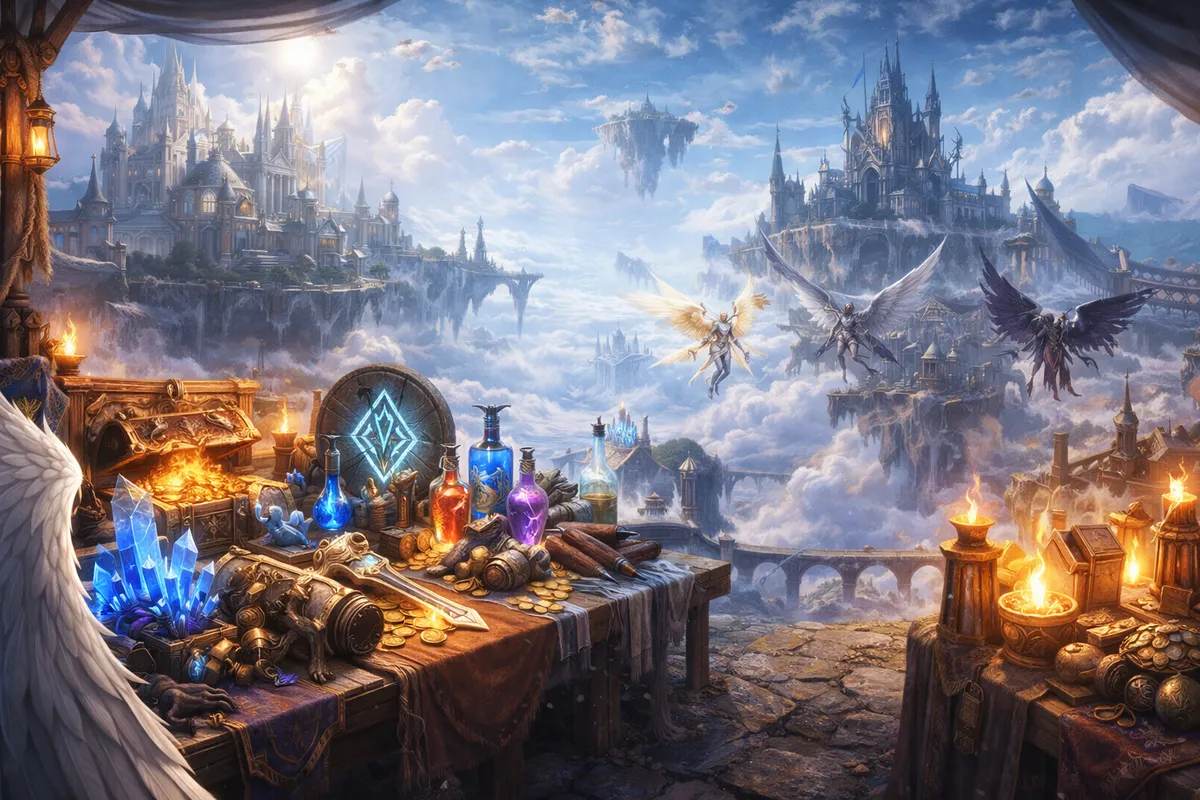
Why Selling Items in Aion 2 Matters More Than “Grinding Hard”
In most MMORPGs, you can brute-force progression by grinding longer. In Aion 2, you can grind—but the players who progress the fastest usually do something different:
- They sell what they don’t need immediately.
- They buy bottleneck items instead of farming them at terrible rates.
- They treat Kinah like a resource to invest, not something to hoard.
- They follow market cycles around patches, resets, and “content hype.”
Because Aion 2’s business model includes Memberships/Passes and a premium economy layer, the game also supports exchanging in-game currency for premium currency, which increases the importance of market knowledge and timing. Whether you’re fully free-to-play or someone who occasionally invests in convenience, your smartest move is still the same: turn extra loot into usable power.
Aion 2 Economy Basics: The Currencies Sellers Should Understand
Kinah: The Core Currency That Drives the Market
Kinah is the foundation of trading and everyday progression. Official pre-registration rewards for the KR/TW launch included a 100,000 Kinah Box, which is a strong sign that Kinah is positioned as the central economic fuel from the very start.
If you want to be a consistent seller, your goal is simple:
- build a reliable inflow of tradable items
- convert them into Kinah efficiently
- use that Kinah to remove progression bottlenecks (gear, upgrades, consumables, crafting)
Premium Currency and Exchange Layer
Aion 2’s developers have described a model with Memberships/Passes for convenience and cosmetics (costumes, weapon skins, pets, wings), and they’ve stated players will be able to exchange in-game currency for premium currency.
On KR/TW servers, player discussions and coverage have also referenced a premium currency called Quna and a currency exchange feature—details can change by region and patch, but the important seller takeaway is stable:
- When a game supports currency exchange, market demand can spike around premium changes, shop rotations, or economy adjustments.
(Always rely on your in-game Exchange screen/tooltips for the exact names and rules in your region.)
Abyss Points and PvP Rewards
The Abyss was showcased as core PvP content where players contest bosses, artifacts, and earn Abyss Points, with unrestricted race-based PvP. While Abyss Points may not be a direct trading currency, PvP systems often drive demand for:
- consumables and buffs
- upgrade materials
- build-specific items
- “ready-now” gear pieces
- So even as a PvE-focused player, you can profit from PvP-driven demand.
Where You Sell Aion 2 Items
Aion 2’s marketplace is commonly referenced as an Exchange / Auction House style system. Your options typically fall into three seller pathways:
1) The Exchange (Marketplace/Auction House)
This is the primary place to list items to the wider playerbase. It’s where most of your consistent income will come from, because it scales:
- you list while you play
- your item sells while you’re offline
- you collect Kinah and reinvest
Important: In KR/TW, access rules for the market have reportedly been tightened as an anti-bot measure, with marketplace buying/selling becoming tied to Membership status in patches and announcements. If you’re playing in another region later, the exact gating may differ—but expect the game to actively protect its economy.
2) Direct Player-to-Player Trading
Direct trades are useful when:
- you sell bulk materials quickly
- you sell to friends/legionmates
- you negotiate a fair price without waiting for market visibility
However, direct trades usually carry higher risk (mistakes, scams, misunderstandings). Sellers should prefer the Exchange for most transactions unless they’re trading within a trusted group.
3) Legion/Guild-Based Internal Sales
Legions often create internal economies:
- discounted prices for members
- trade networks for crafting
- dedicated farmers supplying upgrades to core raid groups
If you want repeat buyers, legions are excellent—because consistency beats “one lucky sale.”
Membership and Market Access: What Sellers Need to Know
Aion 2’s developers openly described Memberships/Passes as part of the business model. In KR/TW specifically, the market/trading layer has been a hot topic, and coverage has stated that trading and auction-house-like features have been tied to paid tiers as part of anti-bot policy, which has also triggered community controversy and subsequent responses.
Here’s the practical seller interpretation:
- If your region requires Membership for Exchange access, treat it as an “economic unlock.”
- If you don’t have market access, your best money-making shifts to:
- direct trades inside trusted circles
- crafting for guaranteed buyers (friends/legion)
- farming items that convert into value through NPC systems rather than player trading
- Expect rules to evolve. The economy is one of the most frequently adjusted systems in live-service MMORPGs.
Seller mindset: Don’t panic about changes—profit from them. When market access rules shift, supply changes overnight. That’s when prices move.
Tradable vs Bound: The #1 Rule of Selling Aion 2 Items
Most players fail at selling because they ignore one critical truth:
Not every “valuable-looking” item is sellable.
In modern MMORPG design, items often exist in one of these states:
- Tradable: can be listed on the Exchange
- Bound/Soulbound: cannot be sold once equipped, identified, or used
- Conditionally tradable: tradable only before a step (like identification), or tradable only a limited number of times
If Aion 2 uses “identify → bind” patterns (a common anti-whale and anti-RMT mechanic), then a seller’s job is to understand when an item is most sellable:
- sell it while it’s still tradable
- don’t “test it” if identification binds it
- compare the value of using it vs selling it immediately
Practical routine: every time you finish a dungeon session, scan your bag and ask:
- Is this an upgrade for my build right now?
- Is it tradable and currently in demand?
- If it’s an upgrade, would selling it fund a bigger upgrade faster?
How to Sell Items on the Exchange (Step-by-Step Seller Workflow)
The UI details can vary by region and patch, but a winning workflow stays consistent. Use this exact routine every time you list:
Step 1: Sort Your Inventory Into “Keep / Sell / Convert”
- Keep: immediate upgrades, build-critical items, progression unlocks
- Sell: tradable items that you won’t use in the next 24–48 hours
- Convert: items better turned into crafting components, enchant materials, or other resources
This reduces listing regret (and prevents you from rebuying your own mistakes later).
Step 2: Check Market Price Range Before Listing
Never list blind.
- Search your item on the Exchange
- Look at the lowest listed price (current floor)
- Look at the common selling range (where multiple listings cluster)
- If your Exchange shows recent transaction history, use it
If you list at the floor every time, you’ll sell fast—but you’ll often lose profit to resellers. Your goal is controlled speed, not desperation.
Step 3: Choose a Selling Goal
Every listing should have a purpose:
- Fast sale: undercut the floor slightly to convert immediately to Kinah
- Fair value: list where the market clusters (best long-term income)
- Premium sale: list above the cluster only when supply is low or demand is peaking
Step 4: List in Buyer-Friendly Quantities
This is one of the most overlooked tactics in MMO economies.
If you list crafting mats in huge stacks, you reduce your buyer pool.
If you list them in reasonable chunks, you capture:
- crafters finishing one recipe
- players pushing a single upgrade
- casual buyers with limited Kinah
More buyers = faster turnover.
Step 5: Respect Fees, Deposits, and Time Limits
On KR/TW, multiple player guides report Exchange listings are time-limited (commonly referenced as 72 hours) and that listing deposits may be non-refundable even if you cancel—details can shift, but the lesson is permanent: listing mistakes cost money.
So list carefully:
- confirm price
- confirm quantity
- confirm duration/fees
- Then post once and let it work.
What Sells Best in Aion 2 (High-Demand Item Categories)
Because Aion 2 has eight classes—Gladiator, Templar, Assassin, Marksman, Sorcerer, Spiritmaster, Cleric, Chanter—demand naturally clusters around build-defining items and upgrade materials that every class needs.
Below are the categories that typically generate the most consistent sales.
1) Upgrade Materials (Enchants, Enhancement Stones, Refinement Items)
Upgrade systems create constant demand because:
- every player wants more power
- upgrades are repeatable sinks (you always need more)
- even “failed” upgrade sessions keep the market alive
If you’re deciding what to farm for stable income, upgrade materials are usually your safest bet.
2) Build System Items (Stigmas, Stones, Skill-Related Materials)
Community guides for Aion 2 have highlighted the Stigma system as a meaningful build layer that requires dedicated growth materials (often referenced as stigma shards).
Whether the exact names differ in your region or patch, build systems always create buyers because:
- players change builds for PvE vs PvP
- players optimize for specific dungeons
- build items often have “breakpoints” that feel mandatory
If a build layer exists, sellers profit from it.
3) Crafting Materials and Profession Inputs
In large PvE games with many dungeons, crafting thrives because players want control:
- craft to avoid RNG
- craft for guaranteed power increments
- craft consumables for tough fights
That means raw materials sell, even when gear prices fluctuate.
4) Dungeon-Exclusive Drops
Aion 2 is described as offering 200+ dungeons spanning solo and group sizes (including 4- and 8-player formats). With that many instances, players chase:
- specific boss drops
- set pieces
- rare crafting components
- “one-per-run” materials
When a dungeon becomes “the meta,” its outputs become a goldmine.
5) Consumables (Potions, Scrolls, Buff Food)
Consumables are the quiet kings of MMO markets:
- they sell every day
- they’re used up constantly
- they scale with difficulty spikes (new bosses, new PvP modes)
If you prefer steady income over jackpot hunting, consumables can outperform rare drops over time.
Pricing Strategy That Works in Aion 2 (Without Starting Price Wars)
Here’s how experienced sellers price:
Anchor to the Cluster, Not the Floor
The floor is the cheapest listing.
The cluster is where items actually move at healthy profit.
If you always match the floor, you race bots, resellers, and panic sellers. Instead:
- list at the cluster when demand is normal
- only undercut the floor when you need instant Kinah
Use “Timing” Like a Weapon
Aion 2 has large-scale systems that encourage peak activity:
- PvP content like the Abyss and related competitions
- ongoing developer broadcasts and content pushes
- When players log in for new content, they buy:
- consumables
- upgrades
- build items
- materials to catch up
So the best sellers don’t just price well—they list at the right time.
Don’t Fear Holding Inventory
If your item is genuinely scarce (or tied to a meta build), holding can beat fast selling. Your inventory is a portfolio:
- some items are liquid cash (fast sales)
- some items are investments (hold for spikes)
Price for Net Profit
If your Exchange takes a cut (tax, fee, deposit), your “sale price” isn’t your real income. Always think in:
- expected sale price
- minus fees/tax
- equals net Kinah
That net number is what funds your upgrades.
Market Cycles: How Patches and Announcements Change Prices
Aion 2 has already shown that economy rules and monetization/tier access can become community flashpoints and trigger fast changes. Whenever a live-service MMO adjusts market rules, three things happen:
- Supply changes
- Demand changes
- Prices re-balance (sometimes violently)
Examples of “Spike Moments” to Watch
- Market access changes (Membership gating adjustments)
- New dungeon releases or dungeon reworks
- PvP incentives/season updates tied to Abyss activity
- Shop rotations that shift what players farm vs buy
Seller advantage: You don’t need insider info—just pay attention. If everyone is talking about a change, prices will move.
How to Farm Items That Sell (Efficient Paths for Sellers)
Aion 2’s core structure encourages high-volume PvE and repeatable content, with the developers emphasizing a large PvE experience, cross-platform play, and modern tech. That’s ideal for sellers—because PvE is the most reliable source of tradable resources.
Dungeon-Focused Farming
With 200+ dungeons, many of them will be “economy dungeons”—not the hardest, but the best profit per hour.
Your goal is to find:
- short run times
- consistent drops
- materials that are always needed
Open-World Events and Region Activity
Aion 2 describes numerous open-world events across the large world. Events tend to generate:
- crafting components
- consumables
- trade-friendly rewards
- competition-driven demand spikes
Class-Specific Efficiency
The eight class roster includes roles built for farming speed (damage + mobility) and roles built for safe solo play. If you farm to sell, your build should prioritize:
- clear speed
- sustain
- low downtime
- Even small changes in your farming efficiency compound into massive profit across a week.
Safe Selling Rules: Avoid Scams, Mistakes, and Account Risk
Selling items is supposed to make you richer—not stressed.
Always Prefer In-Game Systems Over “Private Deals”
Direct trade can be fine inside trusted groups, but most scam stories begin with:
- “I’ll pay after”
- “trade to my alt”
- “I’ll add extra if you hurry”
- If a deal creates urgency, it’s usually designed to make you misclick.
Double-Check Item Names and Grades
In fast trade windows, people mistake:
- similar item names
- different grades
- different enhancement levels
- Slow down. One misclick can erase hours of farming.
Avoid Any Real-Money Item Selling Shortcuts
Even if third-party markets exist, the safest long-term route is always the official in-game economy. When you build wealth inside the system, you protect your account, your progress, and your time.
How BoostRoom Helps You Sell Aion 2 Items Faster
BoostRoom is built for players who want a smarter path to progression—especially in games with deep economies.
BoostRoom Farming Support (More Sellable Loot, Less Wasted Time)
Instead of grinding randomly, BoostRoom helps you:
- pick the best farm targets for your class and power level
- build efficient routes focused on high-demand drops
- reduce downtime and increase profit per hour
- prepare for content spikes so you can sell when prices peak
BoostRoom Build Optimization for Market Profit
Your build directly impacts income. Better builds mean:
- faster clears
- safer solo farming
- better dungeon consistency
- access to higher-value content earlier
We help you optimize your setup so your character becomes an engine that produces sellable value daily.
BoostRoom Selling Strategy Coaching
Most players lose Kinah by:
- listing too low
- listing in the wrong stack sizes
- wasting deposits through cancellations
- chasing price wars
BoostRoom helps you build a clean routine: what to sell, what to hold, and how to price for net profit—so your market game becomes predictable and repeatable.
FAQ
Can I sell any item I get in Aion 2?
No—many MMORPGs include bound/soulbound states, and some items become non-tradable after certain actions (like equip/identify). Always check the item’s trade status in-game before making decisions.
Where do I sell items in Aion 2?
Typically through the Exchange/marketplace system (Auction House style). You can also use direct trades or legion networks, but the Exchange is usually the best for consistent sales.
Do I need Membership to use the marketplace?
In KR/TW, market access has been widely reported as tied to Membership and has been adjusted as an anti-bot measure. Rules can differ by region and patch, so always confirm inside your client.
What currency do I get when my item sells?
Kinah is positioned as a central currency (including official launch rewards), so most item sales commonly settle in Kinah.
What items usually sell the fastest?
Upgrade materials, crafting inputs, consumables, and build-system items tend to sell consistently because demand never stops.
Is it better to undercut the cheapest listing?
Only if you need instant Kinah. Otherwise, pricing around the “normal selling range” often produces better profit without starting price wars.
How do I avoid losing money on listing fees?
List carefully once: confirm price/quantity/duration, then post. Avoid canceling and relisting repeatedly, because deposits/fees can punish indecision (rules vary by region).
How do I know when prices will spike?
Watch for dungeon meta shifts, PvP activity changes (Abyss-focused periods), market access rule updates, and major announcements—these change supply and demand quickly.
What is Aion 2’s class lineup (and why does it matter for selling)?
Aion 2 revealed eight classes (Gladiator, Templar, Assassin, Marksman, Sorcerer, Spiritmaster, Cleric, Chanter). Class popularity influences what gear and build items sell fastest.
How can BoostRoom help me make more Kinah?
BoostRoom helps you farm smarter, optimize builds for efficient clearing, and apply pricing/market strategy so you sell faster and waste less time.
Start Selling Smarter: Make Your Loot Pay for Your Power
Aion 2’s world is massive, content-rich, and competitive—exactly the kind of MMO where smart sellers dominate progression. With the right approach, you don’t need perfect RNG to grow fast. You need a system:
- farm what people buy
- list it correctly
- price for profit
- reinvest into power
And if you want that system built faster, BoostRoom is ready to help you turn Aion 2 into a steady stream of upgrades, Kinah, and momentu



