Prey Rewards at a Glance
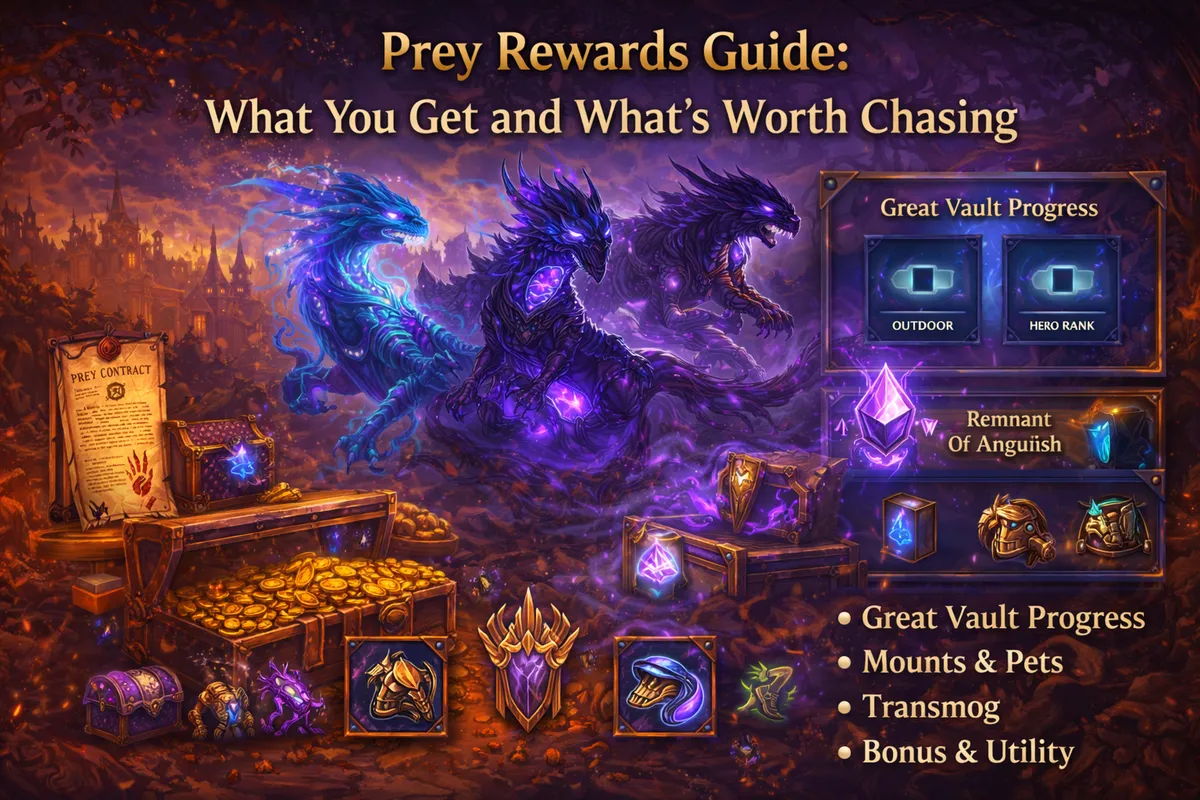
Prey rewards fall into three big buckets, and knowing which bucket you care about is the fastest way to avoid wasting time:
1) Weekly power progression (gear and Vault value)
Prey contributes to the Great Vault outdoor activity slot and can reward power up to the Hero track (as described in official previews). If you’re gearing alts, catching up, or simply want another non-raid route to strong weekly upgrades, this is the “always relevant” lane.
2) A collectible reward ecosystem (account-wide value)
Prey is also a collector feature. The reward pool includes mounts (mana wyrm-themed), transmog appearances, battle pets, and convenience items (like a toy that returns you to the Prey hub). Cosmetics are what keep Prey worth doing even when you don’t “need” gear.
3) A vendor + currency path (you control what you earn)
In current testing coverage, Prey uses a currency called Remnant of Anguish and a progression track referred to as Preyseeker’s Journey, with items sold by a dedicated vendor at the Prey hub. This matters because vendor rewards are predictable: instead of praying for a drop, you can plan your purchases.
The big picture: Prey is both a weekly progression tool and a long-term collection system. If you treat it like only one of those, you’ll either burn out (trying to farm everything) or miss the best rewards (by ignoring the track and currency).
How You Earn Prey Rewards
Prey is opt-in. You start the system by speaking with Magister Astalor Bloodsworn in Murder Row in Silvermoon City, then selecting a contract and a target. Once active, you keep playing normally — world quests, exploration, routine zone activities — while the system can trigger encounters and ambushes.
The most important reward-related rules are tied to difficulty:
Normal
- Designed as the on-ramp.
- Other players can help you in the open world when your target appears.
- Best for steady farming, learning, and low-stress repetition.
Hard
- Adds extra abilities called Torments that make the hunt and the final fight more challenging.
- The final encounter is meant to be “you and your friends,” not a crowd.
- Best for players who want challenge and higher-intensity progression.
Nightmare
- The highest difficulty tier described in official previews.
- Built to be punishing and to require real survival discipline.
- Best for prestige achievements and “I want the hard version” collectors.
Even if you never touch Nightmare, you can still get plenty of reward value by combining Normal farming with a weekly Great Vault plan. The system is designed to reward both “I want danger” players and “I just want progress” players.
What’s Officially Confirmed vs What’s Listed in Testing
If you want a clean “trust hierarchy,” use this:
Officially confirmed in previews
- Prey offers cosmetic rewards, including mana wyrm-themed mounts and transmog appearances.
- Prey offers power rewards up to the Hero track.
- Prey contributes to the Great Vault outdoor activity slot each week.
- Prey has Normal, Hard, and Nightmare difficulties, with Torments in higher difficulties, and finals that avoid large raid-group pile-ons.
Currently listed in testing coverage and item databases
- A currency called Remnant of Anguish used to purchase Prey-themed rewards.
- A vendor called Construct V’anore selling mounts, cosmetics, and utility items at Astalor’s Sanctum.
- A progression track called Preyseeker’s Journey that gates certain purchases by rank.
- Specific named rewards (Preyseeker’s mounts, Preyseeker-themed transmog pieces, two battle pets, enchant formulas, a housing-related technique, and a teleport toy).
Why this matters: you can confidently plan around the types of rewards (gear, Vault, cosmetics) even if tuning changes. For the detailed lists and costs, treat them as “current build info” that may shift as Midnight evolves.
Great Vault and Gear Rewards
If your goal is “What reward is worth chasing no matter what?” the answer is the Great Vault contribution.
Why Vault value is so strong:
- It’s weekly and structured — you don’t need perfect RNG to benefit.
- It turns outdoor gameplay into a reliable power path.
- It keeps Prey relevant for alts, even if your main is raid-geared.
How to make Vault progress feel effortless:
- Stack Prey with whatever you already do outdoors. If you’re doing world quests, gathering, or zone objectives, keep a contract active so those sessions double as Prey progress.
- Treat Vault as your weekly minimum. Once you’ve hit the weekly progress you want (check your Great Vault UI for the exact thresholds), everything after that is optional: farm currency, chase cosmetics, or stop.
- Pick the difficulty you can finish consistently. The fastest progression is the tier you can complete without deaths and resets. In Prey, reliability beats bragging.
What “Hero track” means in practical terms:
- You’re looking at rewards that can stay relevant longer than “starter” gear.
- For many players, this is the sweet spot: strong upgrades without committing to raid schedules.
If you only care about cosmetics, you still should care about Vault progress — because Prey lets you keep collecting while your character stays geared enough to survive higher difficulties comfortably.
Remnant of Anguish: The Currency That Makes Rewards Predictable
The most collector-friendly part of Prey is the currency path. In testing coverage, Remnant of Anguish is used to buy mounts, cosmetics, and housing-related items from the Prey vendor.
Why this currency matters:
- It turns Prey into a “progress bar” instead of a slot machine.
- It lets you choose what to buy first (mounts vs transmog vs utility).
- It reduces burnout because every hunt moves you forward.
How to use Remnant of Anguish the smart way:
- Decide your first “big purchase” before you farm. If you want a mount, don’t waste early currency on small cosmetics you won’t wear.
- Buy utility early if it saves time. A teleport-style toy can reduce travel friction and make your Prey routine faster over weeks.
- Don’t buy everything the moment you can. Your taste will change. Your transmog wardrobe will evolve. Save currency for items that stay exciting.
A simple currency priority (works for most players):
- One headline collectible (usually a mount)
- One utility purchase (if available and useful)
- Your favorite transmog set pieces
- Pets (if you collect)
- Extra cosmetics that match your main aesthetic
- Anything you won’t actually use (last)
Preyseeker’s Journey: Why Some Rewards Are Gated
In current listings, key Prey rewards are gated behind a progression track called Preyseeker’s Journey. This is good news for collectors: it means rewards are meant to be earned over time, not instantly no-lifed in a weekend by a tiny group.
What Journey gating does for you:
- Gives you a clear long-term roadmap (rank milestones = new unlocks).
- Encourages consistent weekly play instead of pure grinding.
- Creates prestige layers for players who push higher difficulties.
The most important takeaway is practical:
If a reward is locked behind Journey rank, you should plan your week around moving that rank forward first. Currency doesn’t help you buy a mount you can’t purchase yet.
A smart mental model:
- Journey Rank = permission
- Remnant Currency = payment
You want both.
Mount Rewards: What You Get and What’s Worth Chasing
Mounts are usually the #1 reason collectors stay engaged with a system long-term. Official previews mention mana wyrm-themed mounts, and current testing listings expand that into specific named Prey mounts.
Preyseeker’s Hubris (vendor mount)
In current listings, Preyseeker’s Hubris is sold by the Prey vendor and costs 2000 Remnant of Anguish, with a requirement of rank 5 in Preyseeker’s Journey.
Worth chasing if: you want an achievable “first big trophy” mount early in your Prey life.
Best for: collectors, casual Prey players, and anyone who wants a guaranteed mount without Nightmare difficulty.
Preyseeker’s Wrath (vendor mount)
In current listings, Preyseeker’s Wrath is sold by the same vendor and costs 2550 Remnant of Anguish, with a requirement of rank 10 in Preyseeker’s Journey.
Worth chasing if: you’re willing to commit to the track and want the “I stuck with the system” reward.
Best for: steady weekly players who like structured progression.
Preyseeker’s Nightmare (achievement mount)
In current listings, Preyseeker’s Nightmare is tied to an achievement that requires defeating a specified list of 30 Prey targets on Nightmare difficulty.
Worth chasing if: you want prestige and you enjoy the hardest tier.
Best for: high-difficulty hunters, title/achievement completionists, and “I want rare mounts” players.
Are the mounts actually worth it?
Yes — for three reasons:
- Vendor mounts are predictable (currency + rank).
- The Nightmare mount is prestige (difficulty + completion).
- Mana wyrm aesthetics are a strong collector theme, especially for players who love Blood Elf / arcane / Silvermoon vibes.
If you’re choosing only one mount goal:
Go for Hubris first (fastest guaranteed), then decide if you want to commit to Wrath and/or Nightmare.
Transmog Rewards: The Pieces Most Players Should Prioritize
Transmog rewards are the “use it every day” collectibles. In current listings, Prey includes items such as:
- Skilled Preyseeker’s Plumed Helm
- Skilled Preyseeker’s Shoulder-Spikes
- Famed Preyseeker’s Plumed Helm
- Famed Preyseeker’s Shoulder-Spikes
- Famed Preyseeker’s Knapsack
What’s worth chasing depends on how you actually play:
If you only play one main character
- Prioritize the pieces you will wear constantly: helm, shoulders, and back pieces are high-visibility.
- Pick a single “set identity” (Skilled vs Famed) and finish it rather than buying random parts.
If you play multiple classes
- Back pieces (like a knapsack) tend to be more universally useful across aesthetics.
- Focus on neutral items first, then buy louder “statement” pieces later.
If you’re a roleplayer or housing/event host
- High-character items (plumes, spiked shoulders, themed backpacks) are worth more than subtle belts or boots because they communicate identity instantly in screenshots.
A simple transmog priority order:
- Back piece (if it fits your style)
- Helm or shoulders (your “silhouette” pieces)
- Any unique visuals that match your main theme
- Everything else
Battle Pets: The Collector-Friendly Bonus Rewards
In current listings, Prey includes battle pets such as:
- Lil’ Preyseeker
- Preyseeker’s Immature Behemoth
Are pets worth chasing?
- Yes, if you’re a pet collector or you like theme sets (mount + pet matches are always satisfying).
- Maybe, if you don’t pet battle — pets can still be “collection value” even if you never use them.
A practical pet strategy:
- Don’t buy pets first unless pets are your main collection hobby.
- Treat pets as “rounding out the set” once you’ve secured your mount and your key transmog pieces.
Utility Rewards: The Toy That Makes Farming Easier
One of the most practical listed rewards is a toy called Astalor’s Summons, described as returning you to Astalor’s Sanctum with a 2-hour cooldown.
Why it’s worth chasing:
- It reduces travel friction.
- It makes “grab contract → hunt → return to vendor” loops faster.
- Over weeks, convenience rewards save more time than most people expect.
This is the kind of reward that doesn’t look exciting on day one — and then becomes a permanent part of your routine.
If you’re a “short sessions” player, utility items are often the best value-per-currency purchase after your first mount.
Housing-Related Rewards: Why Decor Players Should Care About Prey
Even though Prey is a hunting system, it can matter a lot for housing-focused players because it appears to feed into housing-friendly reward types.
In current listings, the Prey vendor stock includes Technique: Harandar Runestone, described as a recipe for crafting a housing décor item.
Why this is a big deal for decorators:
- Housing is about building cohesive themes, and rare décor recipes help your home stand out.
- A Prey-linked décor unlock creates a fun loop: your dangerous outdoor hunts literally fund your peaceful interior design.
If your main endgame is housing:
- Treat Prey as a “decor funding lane.”
- Prioritize housing-related unlocks early if they fit your theme.
- Pair Prey with your décor collection sessions: hunt for an hour, then spend that progress making your house better.
And if you host events or do guild housing nights: unique décor is social capital. It’s the difference between “nice home” and “how did you get that?”
Enchanting Formulas and Crafting Extras: Hidden Value for Min-Maxers
In current listings, the Prey vendor includes enchant formulas such as:
- Formula: Enchant Shoulders – Nature’s Embrace
- Formula: Enchant Boots – Farstrider’s Hunt
Whether these are worth chasing depends on your goals:
If you’re a crafter
- Recipes can be long-term value, especially early in an expansion’s economy.
- Being first (or early) with a new formula often creates a window where demand is high.
If you’re not a crafter
- Recipe rewards can still matter if they unlock enchants you want on your gear — but that depends on how Midnight’s profession economy lands.
A safe, practical approach:
- Collect recipes if you craft.
- If you don’t craft, don’t force it — focus on mounts/transmog/utility unless the enchant is specifically relevant to you.
What’s Worth Chasing? Reward Priority Lists by Player Type
Here’s the part that saves the most time: choose the reward plan that matches your identity.
If you’re gearing your main
- Weekly Great Vault progress
- Reliable difficulty you can clear consistently
- Currency farming only after weekly progress is satisfied
- One cosmetic goal at a time
If you’re gearing alts
- Great Vault progress (alt-friendly routine)
- Normal difficulty farming for consistency
- Vendor mounts as long-term goals
- Transmog pieces that work across multiple characters
If you’re a mount collector
- Preyseeker’s Hubris (fast guaranteed)
- Preyseeker’s Wrath (rank 10 long-term)
- Preyseeker’s Nightmare (prestige, hardest)
- Pets that match the set
If you’re a transmog collector
- High-visibility pieces (helm/shoulders/back)
- Finish one themed look before starting another
- Utility toy to speed your routine
- Pets and extra cosmetics last
If you’re a housing decorator
- Housing-related technique/recipes
- Utility toy (for faster hub loops)
- Mount (because screenshots)
- Transmog that matches your house theme (Light/Void/Arcane vibes)
If you’re time-limited (15–45 min sessions)
- Great Vault progress first
- One predictable vendor goal (mount or key transmog)
- Utility reward to reduce travel
- Ignore the “do everything” temptation
The golden rule: one big chase at a time. Prey is designed to be ongoing; you don’t need to finish it in a week.
A Simple Weekly Prey Rewards Routine
If you want progress without burnout, use this weekly structure:
Step 1: Lock your weekly minimum
- Do enough Prey to satisfy the Great Vault progress you want (check your UI for exact thresholds).
Step 2: Choose one “primary chase”
Pick one:
- Hubris mount currency + rank
- Wrath mount rank milestone
- Nightmare target list progress
- A specific transmog set
- Pets
- Utility + housing unlocks
Step 3: Finish with short, repeatable sessions
- 20–30 minutes of consistent clears beats one exhausting marathon.
- Stop when you start making mistakes — dying is the fastest way to turn Prey into frustration.
Step 4: Spend currency with purpose
- Buy what moves your primary chase forward.
- Don’t “clear the vendor” just because you can.
This routine keeps Prey rewarding even when you’re busy, and it makes the system feel like progress instead of chaos.
How to Farm Rewards Faster Without Making Prey Miserable
Prey’s biggest danger isn’t the target — it’s the way players farm it poorly. Use these strategies to stay efficient:
Prioritize consistency over difficulty
Hard and Nightmare are exciting, but the fastest currency and progress often come from the tier you can finish reliably.
Avoid farming while distracted
Because Prey can interrupt you, it punishes multitasking. If you’re half-focused, you’ll lose time to deaths and resets.
Use smart “commit windows”
Don’t spend your big cooldowns on random mobs right before a hunt is likely to pop off. Keep at least one defensive and one stop available during your outdoor loop.
Farm in sessions with a clear endpoint
Examples:
- “I’m farming until I can buy Hubris.”
- “I’m farming until Journey rank increases.”
- “I’m farming until I hit my weekly Vault goal.”
If you log out with a clear win, you’ll come back excited instead of exhausted.
BoostRoom: The Fastest Way to Secure the Rewards You Actually Want
Prey rewards are exciting — but the path can be time-consuming, especially if you’re chasing higher difficulty clears, Journey rank milestones, or prestige achievement progress.
BoostRoom helps you unlock Prey rewards faster by focusing on the parts that usually slow players down:
- Consistent contract completion (no wasted attempts)
- Efficient progression planning (rank + currency strategy)
- Support for harder-tier finals where mistakes are expensive
- Time-saving routines so your weekly Vault progress and your collector goals stay on schedule
If your goal is “I want the mount, the key transmogs, and my weekly Vault progress — but I don’t have unlimited time,” BoostRoom is built for exactly that. You keep the fun part (the thrill of the hunt and the satisfaction of collection), while the grindy friction gets minimized.
FAQ
Do Prey rewards include real gear progression or only cosmetics?
Prey includes both. Official previews describe power rewards up to the Hero track and Great Vault outdoor slot contribution, alongside cosmetics like mounts and transmog.
What are the most valuable Prey rewards for most players?
Weekly Great Vault progress is the most universally valuable. After that, vendor mounts are often the best “big chase” because they’re predictable.
Is Remnant of Anguish guaranteed, or RNG-based?
Current testing coverage describes it as a currency earned through hunts and spent at the Prey vendor. Exact rates and tuning can change, but the structure is designed to be predictable over time.
What should I buy first with Remnant of Anguish?
Most players should buy one headline collectible (typically a mount) or a utility item that speeds up farming, then move into transmog and pets.
Are there mounts tied to Prey besides “mana wyrm-themed mounts”?
Official previews confirm mana wyrm-themed mounts generally. Current listings show named Preyseeker mounts (Hubris, Wrath) sold for currency and gated by Journey rank, plus a Nightmare achievement mount.
Is Nightmare difficulty required to get good rewards?
No. Nightmare appears to be for prestige goals and completionist achievements. You can get strong weekly value and meaningful cosmetics without Nightmare.
How do I avoid burning out while farming Prey rewards?
Set a weekly minimum (Vault), pick one main chase (mount/transmog), and stop sessions when you start making mistakes. Consistency beats marathon grinds.
How does BoostRoom help with Prey rewards?
BoostRoom helps you complete contracts efficiently, plan your rank/currency path, and tackle harder tiers with fewer wasted attempts — so you reach mounts, transmogs, and weekly progress faster.