What “Neighborhoods” Actually Mean in Midnight
In Midnight, your home lives inside one of two dedicated housing zones—one Alliance-themed and one Horde-themed. Each zone is made up of neighborhood instances containing roughly 50 plots of identical size. Every plot has a house footprint and yard space, and the neighborhood is designed to be large enough that plots have breathing room—so you’re not fighting your neighbor’s trees, fences, or oversized decorations.
Here’s the simplest mental model:
- Neighborhood (shared outdoors): You see other plots, yards, players moving around, and neighborhood “life.”
- Your plot (semi-private outdoors): Your yard is yours, but you decide who can step onto it.
- Your interior (private instance): Your house interior is instanced and fully controlled by you via access permissions.
That combination solves the classic “garrison problem” (everyone isolated) while still protecting the “this is my space” feeling.
Neighborhoods are also persistent in the sense that your neighbors are intended to be stable, not constantly reshuffled. You can still move whenever you want, but the default experience is that you’ll recognize names, see ongoing decoration changes, and feel like you live somewhere rather than simply teleporting into a personal box.
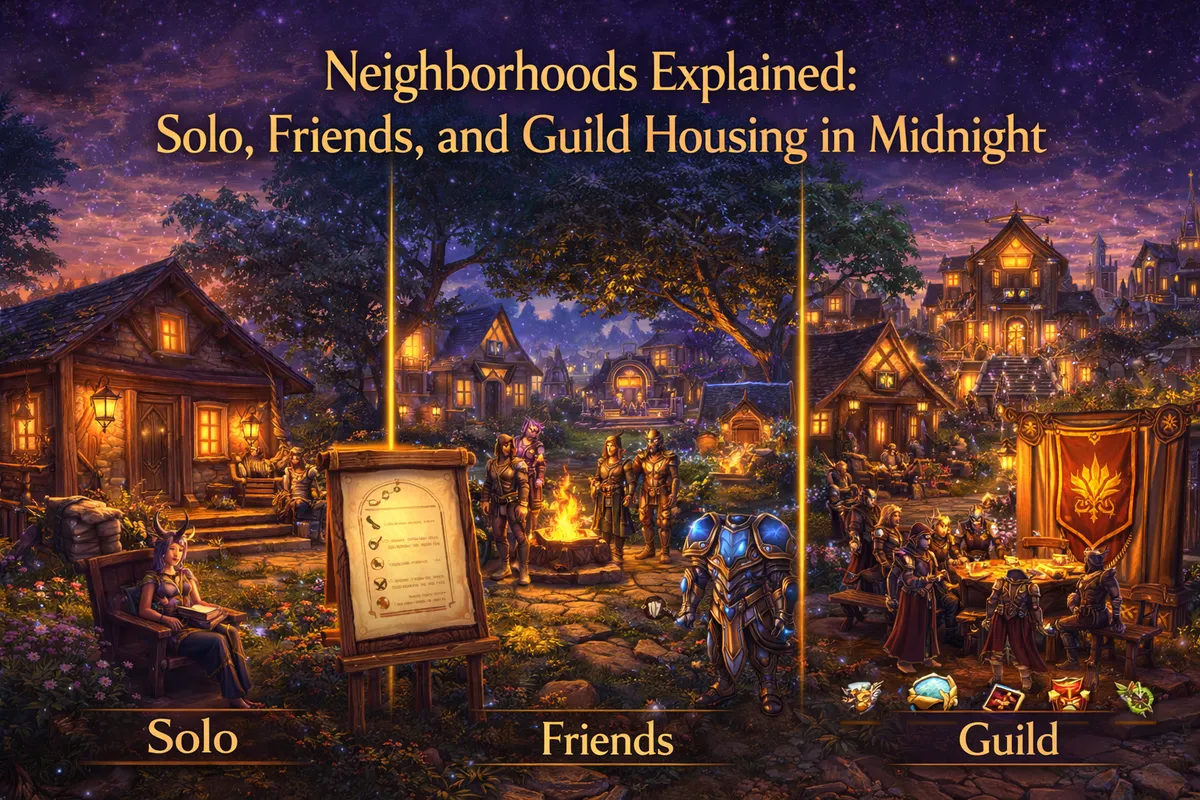
The Three Housing Lifestyles: Solo, Friends, and Guild
Most confusion around Midnight housing disappears when you stop asking “How do I get a house?” and start asking “What kind of neighborhood life do I want?”
Solo lifestyle (quiet, flexible, low coordination)
Solo housing doesn’t mean “you’re literally the only person in the neighborhood.” It means:
- You don’t rely on invites or group management to have a home.
- You can join a neighborhood instantly and begin decorating immediately.
- Your privacy is handled through permissions, not social obligations.
Friends lifestyle (invite-only, curated, community vibe)
Friends housing is about control and consistency:
- You decide who lives near you.
- You can create a space that matches your group’s vibe (casual, roleplay, screenshot studio, crafting co-op, party hub).
- You coordinate neighborhood progression (like Endeavor themes) with people you actually know.
Guild lifestyle (large-scale community, roster-based living)
Guild housing is for groups that want a “real district” feeling:
- Membership is linked to the guild roster.
- The neighborhood is built to support guilds larger than one 50-plot instance by linking additional instances.
- It’s the closest thing to a shared guild headquarters that still gives everyone a personal home.
The best choice depends on how much coordination you enjoy and how much stability you want around your neighbors.
Public vs Private Neighborhoods: The Core Choice
Neighborhoods come in two main categories:
Public neighborhoods
Public neighborhoods are handled by the game:
- Anyone can buy a plot there (no approval needed).
- Instances are created as needed, so availability is designed to be frictionless.
- Endeavor selection is handled automatically by the system.
Public is the best “start now” option because there’s no leadership overhead. If your goal is to decorate, test layouts, and learn the system, public neighborhoods are the easiest ramp.
Private neighborhoods
Private neighborhoods are controlled by players and come in two forms:
- Guild neighborhoods (roster-based)
- Charter neighborhoods (invite-only roster managed through a dedicated UI)
Private is ideal when you want:
- Consistent neighbors you actually care about
- A controlled social environment (no randoms)
- More intentional community goals and a stronger “we built this together” feel
Private is also where social organizing matters. Someone has to manage membership, and for some groups, that’s a feature—not a burden.
Solo Housing Explained: How to Live Alone Without Being Lonely
If you mostly play solo—or you’re the kind of player who loves having a home but hates having obligations—public neighborhoods are built for you.
What solo players get (and why it works)
- Immediate access: You can claim a plot, decorate, and start progressing without waiting for anyone.
- Stable environment: You’ll see familiar neighbors over time, but you’re not responsible for managing them.
- Full privacy control: You decide if people can step onto your plot or enter your home—independently.
In practical terms, solo housing in Midnight is about making your home a personal utility space:
- A calm log-out location
- A transmog/screenshot set
- A “museum” for your favorite collectibles
- A cozy roleplay corner even if you don’t roleplay in public
- A creative project that doesn’t require a group schedule
The solo privacy setup that most players prefer
If you want your home to feel safe but not dead, try this approach:
- Plot access: Neighbors or Friends
- House interior access: Friends only (or completely private)
That lets your neighborhood feel lived-in while keeping your interior truly yours.
Solo-friendly progression mindset
Solo players get the most satisfaction by treating neighborhood features like “bonus progression,” not chores:
- Contribute when you’re already playing your preferred content
- Don’t chase every task
- Focus on steady, month-to-month improvements to your home level and decoration collection
Your house should feel like a reward for playing the game, not a second job.
Friends Housing Explained: Charter Neighborhoods and Small-Group Living
If your favorite WoW moments happen with a consistent circle—two friends, a mythic+ trio, a roleplay group, a raid friend cluster—charter neighborhoods are the sweet spot.
What a charter neighborhood is (in plain terms)
A charter neighborhood is a private, invite-only neighborhood where:
- A leader (or leadership group) controls who can live there
- Members can be from different guilds
- The neighborhood is limited to the standard neighborhood capacity (roughly 50 plots per instance)
Charters are built for:
- Friend groups that want to live together without merging guilds
- Cross-guild communities (PvP teams, mythic+ circles, roleplay communities)
- Creator communities (screenshots, machinima, design showcases)
- “Found family” guild-adjacent groups that don’t want guild politics
Why charter neighborhoods feel so good
The outdoor space becomes a shared identity:
- Coordinated street decoration themes
- Shared social rules (quiet neighborhood vs party neighborhood)
- A consistent crowd you recognize
- A place where visiting feels meaningful because you know whose home you’re seeing
Charter living turns housing into a social feature, not just an interior decorating mini-game.
How to avoid the two classic charter mistakes
Mistake 1: Inviting too broadly too fast
If you fill a charter with “friends of friends” early, you lose the curated feel. Start small, build culture, then expand.
Mistake 2: No leadership rules
Even chill groups need clarity:
- Who can invite new residents?
- Who can remove inactive residents?
- Who chooses Endeavor themes (if your neighborhood gets that choice)?
- What happens when someone quits or transfers realms?
A short, simple agreement prevents drama later.
Guild Housing Explained: How Guild Neighborhoods Stay Scalable
Guild neighborhoods are where Midnight housing becomes a true community system—especially for big guilds.
The key guild neighborhood promise
Guild neighborhoods are designed to make sure everyone in the guild can have a home, even if the guild is larger than one neighborhood instance. The system supports this by linking additional attached instances, rather than forcing guilds to pick “the lucky 50.”
The real difference between guild and charter neighborhoods
Guild and charter neighborhoods share many features—naming, membership control, managers, Endeavors—but they diverge in one major way:
- Guild neighborhoods scale to support the guild roster via multiple instances
- Charter neighborhoods stay capped at one standard neighborhood’s plot limit
That’s why guild housing is the best option when you want a large community vibe without exclusion.
Guild neighborhoods and membership reality
Guild housing is tied to membership:
- If someone leaves the guild, their place in the guild neighborhood is not guaranteed to remain.
- Guild leadership has meaningful power: it can shape where the guild “lives,” who has neighborhood access, and how the neighborhood’s community vibe develops.
That’s not automatically a downside. For many guilds, it’s the point: guild housing is meant to feel like guild territory.
The “10 active members” checkpoint
Guild neighborhood creation is tied to a minimum activity requirement (commonly described as at least 10 active members within a recent time window). This exists to keep the system sustainable, avoid dead neighborhoods being created endlessly, and ensure neighborhoods have enough players to participate in shared features.
The best guild approach is simple:
- Don’t rush to create a guild neighborhood on day one unless your roster is stable.
- If you’re a smaller guild, decide if guild housing is worth the roster pressure or if a charter neighborhood gives you a better long-term experience.
Cross-Faction and Warband Reality: Who Can Live Where
Midnight housing is built around faction-themed zones, but the practical experience is more flexible than most players expect.
Two faction-themed zones, wide access
Housing zones are visually distinct:
- Alliance-themed zone
- Horde-themed zone
However:
- Cross-faction visiting and living are supported as a core feature.
- Once a house is purchased, characters across your Warband can typically access and use it regardless of faction.
The practical rule that matters most
Buying a house in a faction-themed zone may require a character of the matching faction to purchase it.
Using and visiting the home afterward is Warband-friendly and cross-faction friendly.
This matters if you:
- Want one Alliance-themed home and one Horde-themed home for aesthetics
- Play cross-faction with friends or a cross-faction guild
- Have a main on one faction but love the vibe of the other faction’s housing zone
The best collector mindset is: treat your two-home limit as two different “moods” you can swap between.
Ownership Limits and the “Two Homes” Strategy
Midnight housing is designed so your account (Warband) can own up to two houses total—typically one in each housing zone.
This has a big strategic implication:
- Your housing choice isn’t “one forever home.”
- It’s “two homes that serve different purposes.”
A strong two-home strategy looks like this:
- Home A (social): The one you invite people to, built for visitors, screenshots, and events
- Home B (private): Your personal cozy space, achievement museum, or minimalist utility home
Or:
- Home A (friends/guild): Your community home
- Home B (public): Your “freedom plot” where you can move anytime, redesign constantly, and test builds without social pressure
If you love housing design, the second approach is extremely satisfying.
How to Start: Claiming Your First Plot Without Regret
Starting housing is straightforward, but the first choice you make is the one you’ll remember: your plot.
The safe first plot rule
Pick a plot that makes it easy to learn:
- Close enough to the neighborhood hub that you don’t feel lost
- Clear sightlines so you understand space and yard boundaries
- A vibe you like without requiring “perfect decor” immediately
You can always move later, but the first plot should reduce friction.
The “signpost” loop
Claiming and moving homes often revolves around the plot sign:
- You interact with the sign to purchase a plot
- You interact with the sign when packing up and relocating your home
- Your home’s saved state makes moving feel like “unpack here,” not “start over”
The beginner mistake to avoid
Don’t spend your first hour farming rare decor or obsessing over a final theme. Instead:
- Place your basic functional layout (rooms, pathways, lighting)
- Identify your favorite “anchor” spots (entry area, centerpiece corner, yard focal point)
- Then start collecting decor as a long-term hobby
Housing becomes addictive when you build a foundation first.
Moving Homes: How “Pack and Unpack” Keeps Housing Flexible
Midnight housing is designed to make moving feel painless:
- You can pack your house state
- Move to a new plot or neighborhood
- Unpack it with your layout intact
This is crucial because neighborhoods are intended to be persistent. If you don’t like your neighbors, your vibe changes, or you join a new community, moving should be a choice, not a punishment.
When moving is the right move
- Your neighborhood feels inactive and you want a livelier street
- Your friend group forms a charter neighborhood and you want to join them
- Your guild opens housing and you want to move into the guild district
- You realize your plot’s lighting/terrain makes your theme harder than it needs to be
The “regret timer” idea
Housing includes a safety valve: if you move out and immediately regret it, the system is designed to protect you from permanently losing your old home instantly. That makes experimenting feel less risky—especially early.
Switching guild neighborhoods without pain
Moving between guild neighborhoods can involve extra steps because membership matters. A practical approach many players follow:
- Move to a public neighborhood temporarily
- Transfer ownership to an appropriate character if needed
- Then move into the new guild neighborhood
It’s not hard—it’s just a process.
Permissions and Safety: How to Make Your Home Social or Private
Housing is only fun if it feels safe. Midnight handles this with a key design choice:
Your plot permissions and your house permissions are separate.
That means you can:
- Let anyone walk around your yard
- While keeping your interior locked to friends only
- Or:
- Keep your yard private
- While opening your interior for an invite-only event
Common permission presets that work well
Friendly neighbor
- Plot: Neighbors + Friends
- House: Friends
Event host
- Plot: Anyone (temporarily)
- House: Party / Friends (during the event)
Solo sanctuary
- Plot: No one
- House: No one
Guild hangout
- Plot: Guild + Friends
- House: Guild + Friends
Why permissions matter for neighborhoods as a “third place”
A good neighborhood needs a mix:
- Some people want full privacy
- Some people want open yards
- Some people want to host parties and tours
Permissions let all three playstyles coexist without conflict, which is exactly what neighborhoods are meant to achieve.
Neighborhood Favor: The Progression System That Rewards Everyone
Neighborhoods aren’t just cosmetic spaces. They have shared progression through Neighborhood Favor, which functions like a neighborhood-wide track.
The practical idea:
- As the neighborhood participates in shared activities, it earns Favor.
- Favor progression unlocks perks and upgrades that benefit residents.
- Some rewards impact your personal housing experience, like increasing decor placement limits.
Favor makes neighborhoods feel like real communities because your actions contribute to a shared “we built this” progress bar.
The healthiest way to think about Favor
Favor isn’t meant to be a grind you optimize into misery. It’s meant to:
- Reward you for playing the game in multiple ways
- Give neighborhoods a shared identity and progress story
- Encourage visiting, participation, and community “seasonal life”
If you treat Favor like a scoreboard, you’ll burn out. If you treat it like a seasonal community bonus, it stays fun.
Endeavors: Monthly Neighborhood Events and Why They’re a Big Deal
Endeavors are the system that turns neighborhoods from “a place with houses” into “a place with community life.”
What an Endeavor is
An Endeavor is a neighborhood-wide activity that runs about once per month:
- Your neighborhood receives a themed set of tasks
- Players contribute by completing tasks through normal gameplay (crafting, gathering, questing, dungeons, raids)
- As tasks are completed, the neighborhood gains rewards and the neighborhood can visually shift with the theme
The key: Endeavors are designed to support different playstyles. You don’t need to be a raid player to contribute. You can play the game your way and still push the neighborhood forward.
The currencies and rewards you’ll care about
Endeavors introduce collectible-focused rewards that housing fans love:
- Neighborhood Favor (progression and house growth)
- Endeavor currency and/or Community Coupons (used for themed decoration purchases)
- Housing Experience (advancing your personal housing progression)
Public vs private Endeavor selection
- In public neighborhoods, Endeavors are selected automatically by the system.
- In private neighborhoods, leadership can often choose from a selection of themes, which lets your group chase the vibe you actually want.
This is one of the biggest reasons friend groups choose charters: you can steer your neighborhood’s “seasonal decor story.”
Visiting Other Neighborhoods: Why It’s Part of the Design
Midnight housing actively encourages visiting:
- You can visit friends’ neighborhoods
- You can tour other players’ homes
- Visiting matters because different neighborhoods can have different themes active, different decor availability, and different community vibes
This creates a healthy loop:
- Your neighborhood becomes your home base
- Other neighborhoods become destinations
Even if you’re a solo player, visiting is a fun way to collect inspiration, copy layout ideas, and shop themed decor when it’s available elsewhere.
Choosing the Right Neighborhood Type: A Quick Decision Guide
If you’re not sure what to choose, decide based on these three questions:
How much control do you want over who lives near you?
- If you want maximum control: Charter
- If you’re fine with organic neighbors: Public
- If you want roster-based community: Guild
How much leadership work do you want?
- None: Public
- Light: Charter (small leadership group)
- Ongoing: Guild (officer coordination, membership reality)
What’s your main reason for housing?
- Decorating hobby + flexibility: Public
- Social hangout + curated vibe: Charter
- Community identity + big-group living: Guild
If you’re still unsure, start public. You can learn the system, build a baseline layout, then move into charter or guild housing later without losing your work.
Neighborhood Etiquette: How to Be the Kind of Neighbor People Want
Neighborhoods are social spaces even when you’re not chatting. The way you decorate your yard changes the “street vibe.” If you want your neighborhood to feel good long-term:
- Respect sightlines: Giant walls can be cool, but they can also make streets feel cramped.
- Use lighting intentionally: A well-lit yard makes the whole neighborhood feel safer and more inviting.
- Signal your vibe: A cozy porch says “welcome.” A locked gate says “private.” Both are fine—clarity helps.
- Host occasionally if you enjoy it: One open-house night per month can turn your neighborhood from silent to alive.
- Don’t pressure others to participate: Some neighbors will be private forever. That’s normal and healthy.
The best neighborhoods aren’t the loudest; they’re the ones where different playstyles coexist comfortably.
BoostRoom: Make Housing Fun by Outsourcing the Time-Sinks
Housing is at its best when you spend your time on the creative parts: designing rooms, collecting decor you actually love, and hosting friends. But the game side can still be time-consuming—especially if you’re chasing monthly Endeavor progress, trying to earn currency efficiently, or juggling guild expectations.
BoostRoom helps players enjoy Midnight housing without turning it into a schedule stressor. If your goal is “beautiful home, active neighborhood life, zero burnout,” BoostRoom can support you with:
- Progression planning: A clean weekly routine that advances housing progression, Favor, and monthly Endeavors alongside your normal gameplay goals.
- Task completion support: If specific Endeavor tasks lean toward content you don’t enjoy, BoostRoom helps you handle the gameplay requirements efficiently so you can get back to decorating.
- Time-efficient currency routes: Smart ways to gather what you need for decor purchases without wasting evenings.
- Group coordination: For guild neighborhoods, coordinated progress matters. BoostRoom can help streamline your group’s approach so the neighborhood doesn’t stall.
Your home should be your favorite place to log out—not another checklist you dread.
FAQ
What’s the simplest neighborhood type for beginners?
Public neighborhoods. You can claim a plot immediately, learn decorating and permissions, and move later if you decide you want charter or guild living.
Can I live “solo” and still participate in neighborhood features?
Yes. Even if you prefer privacy, you can contribute through normal gameplay and benefit from neighborhood-wide systems like Favor and monthly Endeavors.
What’s the difference between a charter neighborhood and a guild neighborhood?
Charter neighborhoods are invite-only and managed manually, usually best for friend groups across different guilds. Guild neighborhoods are roster-based and designed to scale with guild size via linked instances.
Do I lose my house if I don’t like my neighbors?
No. The system is designed around pack-and-unpack moving, so relocating is meant to be frictionless.
Can people just walk into my yard or house?
Only if you allow it. Plot and interior permissions are separate, so you can keep your interior private even if your yard is open—or the reverse.
Are Endeavors mandatory for enjoying housing?
They’re not mandatory, but they’re a major source of themed decor and neighborhood progress. The healthiest approach is contributing naturally through the content you already enjoy.
Can cross-faction friends visit my house?
Housing supports cross-faction visiting and Warband access. Purchasing rules may be faction-dependent, but usage and visiting are designed to be flexible once the home exists.
What neighborhood type is best for guild social events?
Guild neighborhoods are ideal for large-scale events because your roster is the community. Charter neighborhoods are best for curated invite-only events.



