Route: Fast Nagrand Progression (Loops, Checkpoints, and When to Leave)
Nagrand is huge and open, which tricks people into slow play. The zone only feels “fast” when you run it like a set of loops that end in heavy turn-ins—then you pivot into a group quest burst (Ring of Blood + Wanted elites) for a big XP and gear jump.
The Nagrand mindset
- You’re not trying to “finish the map.”
- You’re trying to chain dense pockets of objectives with minimal backtracking.
- You’re using group quests as scheduled XP injections, not as random detours.
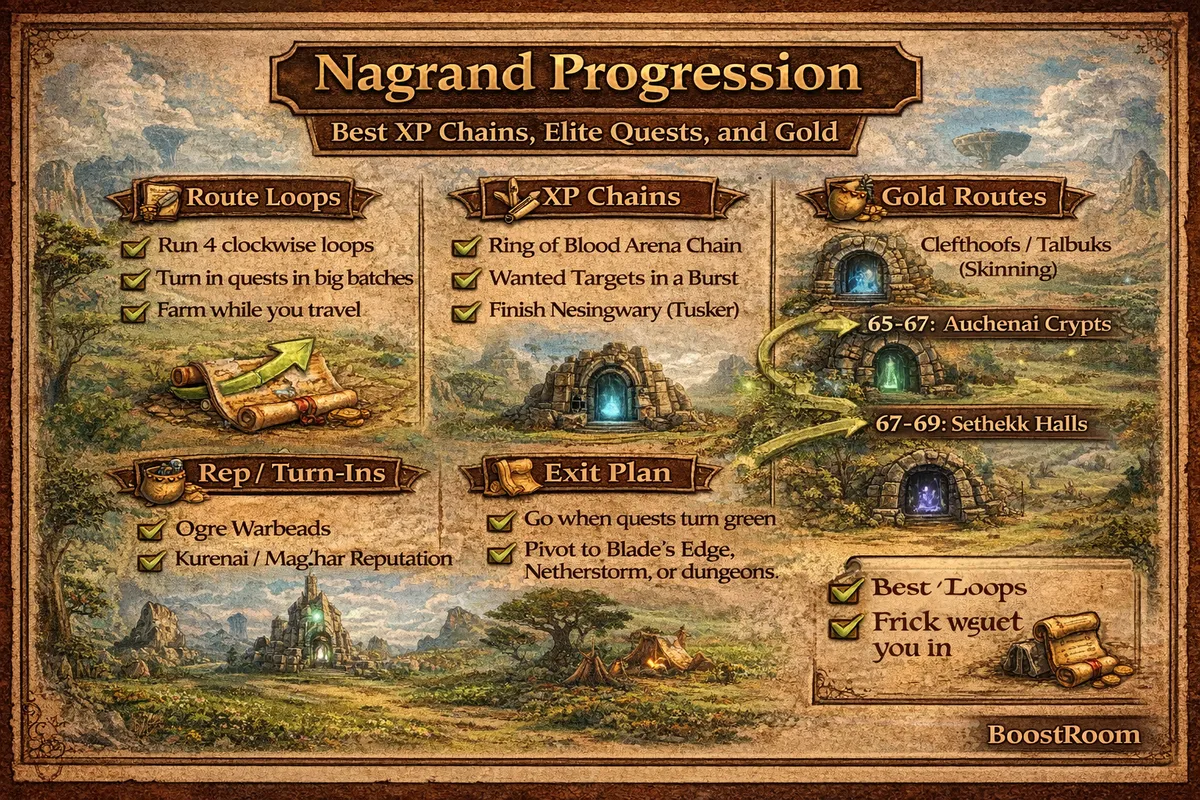
Nagrand checkpoints (use these to stay on pace)
Checkpoint 1: Setup (first 10 minutes)
- Grab your faction hub flight path and set hearth.
- Pick up all hub quests that point in the same direction.
- Decide your first loop: south/east is usually safest and fastest.
Checkpoint 2: Your first full loop
- Complete one pocket fully (8–12 quests if possible).
- Return for a big batch of turn-ins.
- Refill supplies and immediately build loop #2.
Checkpoint 3: Central pivot hubs
- Add the neutral hubs that match your build:
- Nesingwary Safari (massive XP chain value).
- Throne of the Elements (efficient chains and kill pockets).
- Aeris Landing (optional but strong if you want Consortium progress).
Checkpoint 4: Group quest burst
- Do Wanted quests and Ring of Blood in a single scheduled block.
- Leave that block with a weapon upgrade or a major stat upgrade.
Checkpoint 5: Gold integration
- Identify a “you’re already here” farm that matches your professions (or no professions).
- Farm only while moving between objectives or while waiting for a group.
Checkpoint 6: Exit plan
- When your quest density drops or quests go green, pivot out.
- Most players leave around 67–68, either to Blade’s Edge, Netherstorm, or dungeon pushing.
Alliance route anchor points
Primary hub: Telaar
Best loop style: clockwise loops that return through the central road spine
Extra value: Kurenai reputation and warbead turn-ins
Horde route anchor points
Primary hub: Garadar
Best loop style: clockwise loops that end near the road spine or Nesingwary
Extra value: Mag’har reputation and warbead turn-ins
The “four-loop Nagrand route” (fast, repeatable, hard to mess up)
This is the simplest structure that keeps your XP high and your travel low.
Loop 1: South plains loop (starter loop)
- Focus on objectives near your faction hub and the nearby plains.
- This loop is where you stack “kill X beasts” with “collect Y drops” naturally.
- You should end this loop with a big hub turn-in burst.
Loop 2: East fortress loop (high density, more danger, bigger payout)
- East-side pockets are often dense and efficient, but can be contested.
- Treat this as a “finish everything in one sweep” loop—don’t half-complete it.
Loop 3: Central/neutral loop (Safari + Elements pivot)
- Pick up Safari chains and Throne chains.
- This loop is where your quest log becomes a machine: everything overlaps if you route cleanly.
Loop 4: North-west loop (ogres + group quests scheduling)
- This loop is where you plan your Warmaul/Ogre content and your arena chain timing.
- If you have a group, this loop ends with your biggest XP spike.
- If you don’t have a group, you still get solid solo value and warbeads/gold.
Travel shortcut rule that makes Nagrand feel “small”
Nagrand’s open terrain is a gift if you commit to one rule:
Never cross the zone for a single turn-in.
Turn in only when you have enough completions to justify the ride. If you find yourself “just popping back to town,” your route is bleeding time.
Route: Best XP Chains (Do These First, Skip the Traps)
Nagrand has a lot of quests, but the best XP comes from a handful of chains that are designed to stack objectives in the same areas. These chains also tend to unlock additional quests, which means they increase density instead of draining it.
Chain 1: The Nesingwary Safari (the highest XP chain value in the zone)
This is the classic Nagrand hunting chain—Windrocs, Talbuks, Clefthoofs, and named targets—ending in a group-style finale.
Why it’s so good
- Huge overlap with general questing and travel routes.
- Predictable objectives (fast to execute).
- Named hunts often align with other objectives, so you get “free completions.”
How to run it fast
- Treat it like a background engine:
- Every time you ride out, kill what you need for the Safari step in that area.
- Don’t dedicate an entire session to one animal unless you’re trying to finish a chain fast.
- Save the finale for when you can group anyway (or when you’re powerful enough to handle it confidently with minimal help).
The finale (The Ultimate Bloodsport)
The final step involves killing a legendary elite elekk named Tusker and returning the heart. This is worth doing because it closes the chain and is usually a strong XP payout moment—especially if you schedule it alongside other group quests.
Safari speed tip
If you’re short on time, prioritize the steps that match your natural travel:
- Windrocs are often available everywhere.
- Talbuks and Clefthoofs are perfect “kill while moving” targets.
- The named targets are best done when you’re already near their roaming area.
Chain 2: Wanted quests (short, high value, and they stack well)
Wanted quests are some of the best “progression per minute” content in Nagrand because they:
- pay well in XP and rewards,
- usually target high-density camps,
- and can be done with a small group quickly.
The key Nagrand wanted targets
- Wanted: Giselda the Crone
- Wanted: Zorbo the Advisor
- Wanted: Durn the Hungerer (commonly unlocked after completing the earlier wanted targets)
How to time wanted quests
- Don’t do them as random errands.
- Do them as a block when you have:
- at least one other player, or
- a full group forming for Ring of Blood anyway.
Why this timing matters
These targets can be contested, and they often live in areas where wiping or slow pulls destroys the value. If you run them as a planned burst with group momentum, they become some of the fastest XP in the zone.
Chain 3: Throne of the Elements (great overlap and clean loop design)
Throne of the Elements chains tend to be efficient because:
- they cluster around elemental and spirit pockets,
- they stack naturally with nearby kills,
- and they route well into other central objectives.
How to run it fast
- Pick up multiple Throne quests before leaving.
- Finish them in one continuous loop, then return for batch turn-ins.
- If you’re farming elementals for gold (later section), Throne routing becomes even better.
Chain 4: Oshu’gun and the “around-the-mountain” pockets
Oshu’gun sits like a giant route anchor in the middle of Nagrand, and several objectives cluster around it. The big mistake is circling it repeatedly for single tasks.
The fast way
- Build a full “Oshu’gun ring” loop:
- complete the south edge objectives,
- swing east for a second pocket,
- then return on the north or west edge for finishing kills and drops.
- End the loop in a place that naturally connects to your next plan (Safari, Ogres, or hub turn-ins).
Chain 5: Alliance-only: Corki’s Ransom chain (worth doing if you want efficient story + progression)
This chain revolves around rescuing Corki from the Warmaul ogres and usually pulls you into one of Nagrand’s densest ogre pockets.
Why it’s worth it
- It aligns with ogre killing you may do anyway for rep/gold.
- It’s a clean “story chain” that doesn’t waste your time if you route it correctly.
- It often becomes easier when you’re already in the area for other objectives.
How to keep it fast
- Don’t go to Warmaul Hill for Corki alone.
- Go when you also plan to:
- farm warbeads,
- complete ogre objectives,
- or coordinate group quests nearby.
Chain 6: Horde-only: Mag’har story progression (big value if you care about rep and long-term rewards)
Horde players have a broader Mag’har storyline that can be very rewarding in XP and progression feel. If you care about Mag’har reputation (mounts, patterns, long-term goals), Nagrand is where it becomes easy to push.
Speed rule
Do Mag’har story steps while your quests are still yellow. If you wait until 70, you’ll still do it—but it won’t push your leveling, and you’ll feel the time cost more.
Route: Elite and Group Quests (What’s Worth It, and How to Do Them Without Wasting Time)
Nagrand has two kinds of “elite” content:
- Structured group quest chains (high value, predictable)
- Camp elites and named targets (variable value, often contested)
You want the first category almost always. You want the second category only when it stacks with your route.
Group Quest #1: Ring of Blood (the biggest single XP spike in Nagrand)
The Ring of Blood is a sequence of arena-style fights that you start at Warmaul Hill. It’s famous for a reason:
- very high total XP for the time spent,
- a strong gold reward chunk,
- and a rare-quality weapon reward choice that can last you to 70 for many specs.
Why it’s worth scheduling
Ring of Blood is one of the best time-to-reward chains in Outland if your group is competent. It’s also a “morale boost” chain—people like doing it, so it’s easier to form a party than for random kill quests.
How to do Ring of Blood fast
- Form a 5-player group if possible (tank + healer makes it smooth).
- Clear your bags and bring enough food/water.
- Understand the biggest time-waster:
- waiting for other groups to finish or failing pulls because the group is underprepared.
- If the area is crowded, be patient but efficient:
- stay ready to start the next fight immediately,
- avoid long breaks between fights.
Reward rule (important)
Choose the weapon reward that matches your build’s leveling engine:
- Melee: prioritize the biggest weapon upgrade.
- Casters: prioritize the spell power or best stat stick you’ll actually use.
- Tanks: prioritize threat and survivability if it’s a meaningful step up.
A good Ring of Blood weapon is often a “speed multiplier” for the next 2–4 levels.
Group Quest #2: The Ultimate Bloodsport (Tusker)
Even though it’s part of the Safari chain, it behaves like a group quest because Tusker is elite and dangerous if you’re undergeared or underleveled.
Best timing
- Do it when you’re already grouping for:
- Ring of Blood,
- Wanted quests,
- or ogre elites.
- That way you get multiple group tasks done in one session and never have to “form a group just for one kill.”
Group Quest #3: East-side fortress elites (Wanted targets)
Wanted targets can be fast and rewarding, but only when done right.
Fast method
- Enter the camp with a plan:
- clear a safe path,
- mark targets,
- finish the named kill,
- and leave immediately.
- Staying to “finish the camp” is only worth it if you still have overlapping quest objectives there.
Group Quest #4: Ogres and summon-style elites
Nagrand has content that involves summoning or fighting stronger elite targets tied to spirit/ogre quest chains. These can be very worthwhile if:
- you already have a group,
- you’re close to completing the chain,
- and you want the “big finish” XP and reward.
The trap
If you force these with an underpowered duo and wipe repeatedly, you’ll lose more time than you gain. In Nagrand, the rule is simple:
- one clean kill is fast,
- three wipes is a time disaster.
Soloing elites (the practical truth)
At the “right” level and gear, some players can solo parts of this content, but you shouldn’t build your route assuming you can. The fastest plan is:
- do solo loops while waiting for a group,
- then convert that group into a “burst session” of all group quests at once.
Route: Reputation That Helps Progression (Without Becoming a Grind)
Reputation in Nagrand can be a trap if you grind it blindly. Done intelligently, it’s a bonus engine that rewards you while you level.
Kurenai (Alliance) / Mag’har (Horde): Obsidian Warbeads strategy
Obsidian Warbeads drop from ogres in Nagrand and are used for repeatable turn-ins.
The key value
- Each turn-in uses 10 warbeads and gives a chunk of reputation.
- You gain additional reputation from killing the ogres themselves.
- This creates a “double-dip” rep strategy: kills + turn-ins.
The leveling-friendly approach
- Don’t stop leveling to grind warbeads from zero.
- Do this instead:
- whenever your route naturally brings you into ogre pockets, kill extra ogres until you complete your nearby objectives,
- then turn in warbeads in batches when you’re already returning to town.
- This way, reputation feels like “free progress,” not a grind.
Where warbeads fit perfectly
- Warmaul Hill loops
- Laughing Skull / Burning Blade style ogre pockets
- Any chain that already asks you to kill ogres
Consortium (optional, but great if you like value stacking)
Aeris Landing offers quests that give Consortium reputation and can be paired with:
- ogre kills (warbeads can also be used for Consortium in some versions of the system),
- and certain repeatables tied to item turn-ins.
When to care
If you’re the kind of player who likes unlocking extra vendors, patterns, and long-term rewards, doing Aeris Landing content while leveling is efficient. If you only care about speed to 70, treat it as optional.
Halaa (world PvP value, not required for leveling speed)
Halaa is the contested town in the center of Nagrand. It’s not necessary for leveling, but it can be a “bonus value” target if your server actually has activity there.
What you can get
- Battle tokens from PvP kills near Halaa (when conditions are met)
- Research tokens via turn-ins while your faction controls Halaa (commonly tied to Oshu’gun-related items)
The leveling rule
If Halaa is quiet and controlled, it can be a quick bonus. If it’s chaotic and slows your route, ignore it completely—your leveling speed matters more than token drama.
Loot: Nagrand Rewards That Actually Increase Your Speed
Loot matters in Nagrand because it changes how fast you can chain fights without stopping. The goal isn’t “best-in-slot at 66.” The goal is “I kill faster, I die less, I drink less.”
The Nagrand loot priority order
- Main damage source upgrades (weapons, wands, big spell-power jumps)
- Survivability that prevents deaths (stamina, armor, defensive stats that actually reduce damage taken)
- Sustain that reduces downtime (regen, intellect, spirit, MP5—whatever supports your class)
- Everything else
Ring of Blood reward: why it’s a progression milestone
Ring of Blood is the standout because it offers rare-quality weapon choices and a large XP payout. Many classes use the reward weapon until 70 (or close to it), especially if they haven’t had a recent weapon drop.
Practical pick rule
Pick the reward you will equip immediately and keep for multiple levels. A “technically better” item you won’t equip is not a reward—it’s vendor gold.
Wanted and chain quest rewards
Wanted quests and major chains often give:
- strong slot upgrades,
- good vendor value,
- and sometimes unique items that patch weak gear gaps.
Loot discipline
- Take upgrades that reduce your downtime.
- Skip “tiny upgrades” that cost you hours to chase.
- If you need 45 minutes of extra farming for a 6 DPS improvement, that is not leveling progression—that’s distraction.
Role-based loot priorities
Tanks
- Your leveling speed is your group’s speed.
- Prioritize upgrades that reduce healer stress:
- armor and stamina,
- defensive pieces that prevent spike damage,
- and threat-friendly stats that keep pulls smooth.
- If your healer drinks every pull, your tank gearing is slowing the entire run.
Healers
- Mana longevity is your speed.
- Upgrades that let you heal more pulls per drink are the best leveling gear.
- Keep a small DPS/solo set so your questing downtime doesn’t feel terrible.
Melee DPS
- Weapon upgrades are the biggest multiplier.
- If you’re constantly bandaging, upgrade survivability and clean up your pull habits.
- Don’t waste gold on minor upgrades you’ll replace quickly.
Ranged physical (Hunters)
- Weapon and ammo efficiency matters.
- Avoid overpulling if pet survivability is your downtime bottleneck.
- Take upgrades that let you keep moving without resets.
Caster DPS
- Spell power reduces casts per kill.
- Intellect/regen reduces drinking breaks.
- If your pace is slow, your best upgrade is often “less downtime,” not “more burst.”
Extraction: End Every Nagrand Session With Momentum (Not Confusion)
Nagrand is perfect for short sessions—if you extract correctly. Bad extraction turns a 45-minute session into 20 minutes of “where do I go again?”
The Nagrand extraction checklist
Before you log out:
- Repair and vendor (don’t start next session with broken gear and full bags).
- Refill essentials (water, ammo, reagents, bandages).
- Reset your hearthstone to match your next plan:
- Set to Telaar/Garadar if you’re continuing hub loops,
- Set closer to your next objective cluster if you’re doing a long loop next session.
- Park your character at the start of a loop, not at the far end of the last objective.
- Batch your quest log:
- keep quests that belong to your next loop pocket,
- drop leftovers that would force cross-zone travel for one turn-in.
Group-session extraction (Ring of Blood / Wanted / Tusker)
If your next session is “group burst content,” extract like this:
- Log out near the area that makes grouping easiest (close to travel paths).
- Make sure your bags have space for loot and quest items.
- Write a one-line plan for yourself:
- “Next: Ring of Blood chain + Wanted block + Tusker if group stays.”
- That plan alone saves you the decision time that kills momentum.
Gold: Best Nagrand Money Routes While Leveling (No Auction House Required)
Nagrand is one of the best leveling zones to build gold because:
- mobs are spread out but plentiful,
- many drops have consistent value,
- and several farms stack naturally with quests.
This section focuses on gold you can make while still leveling efficiently, not “stand still and grind forever.”
Gold rule #1: Farm only when it stacks
The fastest gold is often the gold you earn while completing objectives you already need. If you stop leveling for 90 minutes to grind a single item, you might earn gold—but you’ll lose progression time and burn out.
The right pattern is:
- quest loop → farm pockets on the way → cash out → repeat.
Gold route A: Clefthoof + Talbuk (skinning-friendly and vendor-friendly)
Clefthoofs and Talbuks are everywhere, which makes them excellent “in-between” farms:
- kill them while traveling between objectives,
- skin them if you have skinning,
- vendor gray drops and meat if you don’t.
Why it works
- low risk mobs,
- easy to chain,
- steady loot without needing perfect competition conditions.
Best use case
- You’re waiting for a group for Ring of Blood.
- You’re finishing Safari steps anyway.
- You want reliable gold without fighting over a single tiny spawn point.
Gold route B: Elemental Plateau (motes that stay valuable)
The Elemental Plateau in northern Nagrand is famous for a reason: elementals that drop motes used to create primals.
Why it’s strong
- You can farm multiple elemental motes in one area depending on spawn distribution.
- These motes are evergreen crafting materials, which means they keep demand.
Leveling-friendly use
- Don’t camp it for hours unless you’re intentionally farming.
- Use it as a burst farm:
- 15–30 minutes when you’re near it or when you’re waiting for a dungeon/group.
- That keeps it profitable without derailing your route.
Competition rule
This area is often crowded. If it’s packed, don’t fight over tags—pivot to another gold route and keep moving.
Gold route C: Oshu’gun void pockets (motes of shadow style farms)
Around Oshu’gun, you can find void-style mobs that are commonly farmed for shadow-related motes.
Why it fits leveling
- Oshu’gun is already a central route anchor.
- Many players pass through the area repeatedly for quest loops.
- That means you can “farm lightly” as you move rather than committing to a grind.
Gold route D: Water/earth elementals on the outskirts (quiet, consistent, low drama)
Some elemental farms are less popular than the Plateau but still solid:
- water-based farms near lakes,
- earth-based farms on southern edges.
Why it’s good
- lower competition,
- steady kills,
- and often safer for solo players.
Gold route E: Engineers—gas clouds as “bonus money”
If you’re an engineer with the right extractor tool, Nagrand can provide extra motes from gas clouds.
Why it’s leveling-friendly
- clouds can be harvested while you travel,
- it’s passive value you pick up between objectives,
- it doesn’t require stopping for long.
Gold rule #2: Convert “dead time” into income
Dead time includes:
- waiting for a group,
- flying/riding long distances,
- searching for contested quest mobs,
- downtime after a wipe or disband.
In Nagrand, the best players convert dead time into gold by having a default option:
- farm clefthoofs/talbuks,
- or do a short elemental burst,
- or clear an ogre pocket for warbeads and vendor loot.
Gold rule #3: Don’t spend your way into poverty while leveling
Nagrand tempts players to buy lots of upgrades. Keep spending disciplined:
- spend gold on things that reduce downtime (skills, core consumables you actually use),
- avoid expensive “minor upgrades” you’ll replace soon,
- and remember: your biggest power spikes are from quest rewards and group quest weapons, not from over-shopping.
Practical Rules: The Nagrand Playbook for XP + Elite Clears + Gold
- Rule 1: Always run loops. If you cross the zone for one quest, you’re losing time.
- Rule 2: Turn in in batches. Big stacks of turn-ins are your XP spikes.
- Rule 3: Schedule your group burst. Ring of Blood + Wanted + Tusker in one session beats forming groups three separate times.
- Rule 4: Farm only when it stacks. If a farm doesn’t overlap your route, it’s optional.
- Rule 5: Don’t fight crowded spawns. Competition is a signal to pivot to a different loop or farm.
- Rule 6: Pick the Ring of Blood reward you’ll equip now. Immediate power is the point.
- Rule 7: Use ogre pockets for double value. Reputation + vendor loot + warbeads.
- Rule 8: Use “dead time” for gold. Default to clefthoofs/talbuks or a short elemental burst.
- Rule 9: Leave Nagrand when it stops being yellow. Green quests are a trap if you care about speed.
- Rule 10: Extract with a plan. Next session should start with action, not decision-making.
BoostRoom: Skip the Slow Parts, Keep the Fun Progression
Nagrand’s biggest time sinks are predictable:
- Ring of Blood groups that wipe or disband halfway through,
- contested elite targets that turn into long waiting games,
- messy “Wanted” clears with underleveled parties,
- and wasted travel caused by rerouting for a single group kill.
BoostRoom helps you keep your Nagrand progression clean and fast:
- Smooth completion of Ring of Blood for the XP spike and weapon reward
- Fast clears of Wanted elites without long spawn camping
- Help finishing Tusker and other group-style steps without burning your session
- Route-friendly support so you stay leveling and still walk out with more gold and better gear
If you want the most efficient approach, many players run a hybrid:
- you do the fast loops and the Safari chain at your own pace,
- BoostRoom handles the high-friction group checkpoints,
- and you hit 68+ faster, with stronger gear, and without spending nights stuck on one elite.
FAQ
When should I start Nagrand in TBC Classic?
Most players enter in the mid-60s and stay until 67–68. If your quests remain yellow and your turn-ins are dense, Nagrand stays efficient. If everything turns green, it’s time to pivot to a higher zone.
What are the best XP chains in Nagrand?
The Nesingwary Safari chain is the standout because it stacks well with travel and overlaps with other objectives. Wanted quests and Throne of the Elements chains also deliver excellent XP per minute when routed as loops.
Is Ring of Blood worth it while leveling?
Yes. It’s one of the strongest XP spikes in Outland and offers a rare-quality weapon reward that can last many classes close to 70. It’s best done with a solid group in one planned burst.
What elite/group quests should I prioritize?
Prioritize Ring of Blood, Wanted targets (especially if you can stack them), and the Safari finale (Tusker). Do other elites only if they overlap your route or you already have a group.
How do I make gold in Nagrand without stopping my leveling?
Use “stack farms”: kill clefthoofs/talbuks while traveling, do short elemental bursts when you’re nearby, and farm ogre pockets for warbeads while completing ogre quests. Convert dead time into gold instead of standing still.
Should I grind Kurenai/Mag’har reputation while leveling?
Only if it overlaps your route. The most efficient approach is to earn rep naturally from quests and ogre kills, then turn in Obsidian Warbeads in batches when you’re already returning to town.
Is Elemental Plateau still a good gold spot?
It’s strong because motes/primals stay useful for crafting, but it can be crowded. Treat it as a 15–30 minute burst farm and pivot if competition is high.
Where do I go after Nagrand?
Common transitions are Blade’s Edge Mountains or Netherstorm, depending on your level and whether you prefer questing or dungeon progression. If you’re 68+, you’ll usually feel ready to move on quickly.



