How This Ranking Works
This is a ranking of Void threats we might face—not a promise of exact boss orders, surprise betrayals, or hidden final bosses. Midnight is designed as a “second chapter,” which means Blizzard will almost certainly keep some reveals close to the chest.
To keep this useful and spoiler-light, the ranking is based on five things players can evaluate without plot leaks:
- Impact: How much this threat can change the world state (or the Sunwell’s fate).
- Proximity: How directly it targets Quel’Thalas, Silvermoon, and core campaign locations.
- Agency: Whether it acts like a mastermind (plans and manipulation) or a hazard (predation and chaos).
- Escalation potential: How easily the threat can scale from zone story to raid-level stakes.
- Likelihood: How strongly it’s tied to publicly framed Midnight pillars like the Voidstorm, Season 1 raids, and the Light vs Void clash.
You’ll also see two kinds of language throughout:
- “We know” = strongly aligned with publicly described Midnight pillars.
- “We suspect” = grounded speculation (what the structure and themes suggest), clearly marked.
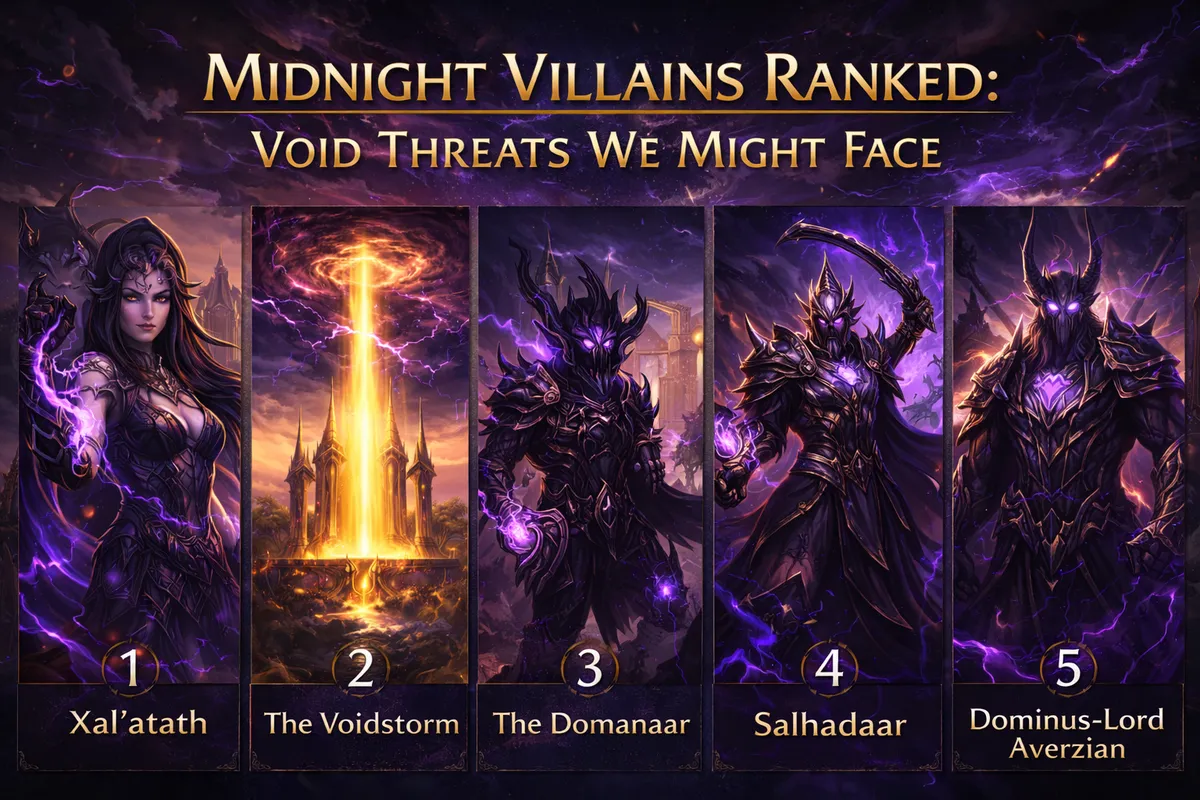
Rank 1: Xal’atath, the Harbinger
If Midnight has a face, it’s Xal’atath—because she isn’t just “a villain.” She’s the kind of antagonist that turns the whole expansion into a pressure test.
Why she ranks #1
- She has the clearest narrative agency. A Void invasion is scary; a Void invasion driven by a planner is worse. Xal’atath is framed as a threat that doesn’t merely attack—she orchestrates.
- She makes every other threat more dangerous. Predators, cults, commanders, corrupted zones—those are terrifying, but a Harbinger turns them into tools in one larger play.
- She targets meaning, not just territory. Midnight’s premise isn’t “capture some land.” It’s “extinguish light,” with Quel’Thalas and the Sunwell’s symbolism doing heavy emotional work.
What to look for in-game
- Social fracture attempts: The Void’s best victories come from turning allies into suspects. Watch for quests that revolve around misinformation, mistrust, and “someone inside the walls.”
- Symbolic attacks: When the story lingers on Silvermoon architecture, Sunwell-adjacent spaces, or “renewed power,” assume Xal’atath is aiming at identity as much as magic.
- Strategic pacing: Big villains in chapter-two stories often “win early” in subtle ways. If the campaign feels like it’s constantly reacting, that’s intentional: the Harbinger wants you off-balance.
How she hits different than many WoW villains
Some villains are disasters. Xal’atath is a designer of disasters. That makes Midnight feel less like a monster hunt and more like a chess match where the board itself is being corrupted.
Rank 2: The Voidstorm
The Voidstorm is the rare kind of “villain” that isn’t a person—and still deserves a top ranking. Think of it as a weaponized environment: a looming darkness that threatens to cover the world and reshape reality.
Why it ranks #2
- It’s an expansion-defining threat. Midnight isn’t merely “Void appears.” It’s “Void becomes weather.” When a cosmic force becomes the sky, the map, and the mood, it stops being background and becomes the story.
- It forces the Light vs Void theme into every scene. The moment you’re living under a Voidstorm, the conflict is no longer philosophical. It’s physical: visibility, safety, sanity, and survival all feel threatened.
- It creates constant escalation without needing constant cutscenes. Even when you’re just doing world content, the zone itself can tell you “you’re in danger.”
What to watch for
- Predation mechanics in the world: If the zone is described as a place where predation reigns, expect threats that stalk you, ambush you, and punish autopilot play.
- Environmental storytelling: Void storms, corrupted horizons, unnatural light boundaries—these are likely to be repeated motifs, not one-off visuals.
Why it’s a “middle chapter” masterpiece
Chapter-two stories often pull you into the enemy’s domain. The Voidstorm is that domain—an entire space designed to feel like the Void has home-field advantage.
Rank 3: The Domanaar
Domanaar are framed as powerful Void beings tied to the Voidstorm’s identity (even appearing as a key enemy concept in the large-scale battleground setting). Whether you meet them in story scenes, world content, or PvP-themed conflicts, they’re positioned as the kind of threat that makes the Void feel intelligent and militarized—rather than purely chaotic.
Why they rank #3
- They represent organized Void power. The Void can be depicted as madness and mutation, but the Domanaar concept signals hierarchy and intent: the Void isn’t just leaking in—it’s arriving with purpose.
- They fit the “predation” theme perfectly. Domanaar are thematically aligned with hunting, domination, and survival-of-the-strongest logic. That’s exactly the kind of world rule the Void would celebrate.
- They can scale from “elite enemy” to “seasonal threat.” A strong enemy archetype can be used everywhere: open world elites, dungeon packs, mini-bosses, and raid set dressing.
What to look for
- Consistent silhouettes and iconography: When Blizzard wants a new enemy group to matter, they repeat shapes, banners, rune styles, and armor language. If you start seeing the same “Domanaar identity” across multiple activities, you’re looking at a major throughline.
Rank 4: Salhadaar
Salhadaar is publicly positioned as a major showdown presence within Midnight’s Season 1 raid structure, which already tells you a lot: if a name is highlighted this early, Blizzard expects it to matter.
Why Salhadaar ranks #4
- Raid-tier relevance is a loud signal. Midnight is split across multiple raid experiences, and being explicitly associated with a high-profile raid showdown implies this is not a throwaway lieutenant.
- He likely represents command-and-control. Even if you treat this spoiler-light, a named figure placed beside other highlighted threats suggests leadership, strategy, and the ability to deploy others.
- He’s a story accelerant. Mid-chapter expansions often introduce “big commanders” who force heroes to adapt, unite, and evolve—especially when the core villain is playing the long game.
What to watch for
- How the story frames his role: Is Salhadaar a dedicated commander? A rival? A partner in the same machine? Pay attention to whether his presence feels like “another boss” or like “a pillar of the invasion.”
Rank 5: Dominus-Lord Averzian
A title like “Dominus-Lord” is not subtle. It reads like hierarchy, dominion, and cosmic authority—exactly the kind of language WoW uses when it wants you to feel small.
Why Averzian ranks #5
- He’s framed as a cosmic horror, not a local menace. In Midnight, that matters: the story is anchored in a homeland, so cosmic-scale threats need to feel like they’re crashing through the ceiling of your world.
- He’s built for spectacle. Bosses with “lord of dominion” energy typically represent the moment a raid says: “This is the Void at full volume.”
- He reinforces the ‘Void is structured’ idea. Whether the Void is chaotic or organized is a big tone choice. A title-heavy figure suggests structured evil—cold, deliberate, and confident.
What to watch for
- The environment around him. Void-aligned bosses often “infect” the arena. If Averzian’s spaces feel like reality is being rewritten, that’s a signal he’s meant to embody the Void’s worldview, not just its damage type.
Rank 6: The Undreamt God
Midnight’s Season 1 includes a single-encounter raid concept built around an “undreamt god” and a veil between primordial dreams and brutal reality. Even in a spoiler-light framing, this is one of the most uniquely terrifying concepts in the expansion.
Why it ranks #6
- It’s existential in a different way. Xal’atath is a planner. The Voidstorm is a domain. The undreamt god is a narrative wildcard: something that “never should have been,” pressing against the boundaries of existence.
- It suggests reality-friction, not just invasion. When your threat is “half-birthed,” “undreamt,” and lashing out against existence, you’re no longer fighting a normal enemy—you’re fighting an error in creation.
- It broadens Midnight beyond Quel’Thalas while still supporting the core theme. Mid-chapter storytelling often introduces a secondary horror that expands the scale without derailing the main plot.
What to look for
- Fear of the unknown: If the campaign starts using language like “we don’t have words for this,” you’re in undreamt territory.
- Dream imagery that feels wrong: In WoW, dreamlike visuals can be serene. If Midnight’s dream visuals feel predatory, jagged, and unfinished, that’s intentional.
Rank 7: Rift-Spill Abominations
Even if your main focus is “the boss,” the framing of Dreamrift includes “half-birthed abominations that lash out against existence.” That means the threat isn’t just one entity—it’s the ecosystem around it.
Why they rank #7
- They embody the Void’s favorite kind of violence: destabilization. The most horrifying enemies aren’t those that kill you. They’re those that make the world unrecognizable.
- They’re perfect for repeatable content. Abomination-style enemies are ideal for dungeon packs, delve encounters, public events, and open-world hazard zones.
- They pressure healers and coordination. Even in a spoiler-light context, “half-birthed” implies unstable patterns: unpredictable spikes, erratic behaviors, and mechanics that punish sloppy movement.
What to look for
- Behavioral design: Do these enemies move like animals, like soldiers, or like glitches in reality? Their motion language will tell you whether Midnight wants horror, war, or both.
Rank 8: Void-Predators and Hunger-Driven Creatures
Voidstorm is framed as a land of all-consuming cosmic predation—creatures driven by deep hunger, eager to devour to gain power. This is the “wildlife tier” of the invasion, and it can be more dangerous than it sounds.
Why they rank #8
Check out some of our most popular WoW Midnight services:
- They make the world feel unsafe. Big villains are thrilling, but everyday danger is what makes a zone feel like a war zone.
- They create constant friction for travel and exploration. When predators exist, you can’t treat the environment as a hallway between objectives. The environment becomes the objective.
- They reinforce Midnight’s survival tone. If the Void is predation, then everything in Voidstorm is a lesson: “the Void doesn’t just conquer; it consumes.”
What to look for
- Hunting mechanics: If Midnight’s systems encourage “hunt or be hunted” gameplay vibes, these predators will likely be the content backbone that makes that feel real.
Rank 9: Sunwell-Adjacent Corruption Attempts
In Midnight, the Sunwell is not only a place—it’s a symbol of recovery, identity, and survival for Quel’Thalas. That makes it the perfect target. Even if the expansion doesn’t reveal every detail early, we can confidently say this: anything that threatens the Sunwell is automatically top-tier danger.
So why isn’t this ranked higher? Because this category is about methods, not a single named villain. It’s the toolbox: rituals, corruption vectors, destabilization tactics, sabotage, and infiltration.
Why it ranks #9
- It’s the most emotionally loaded threat. When the Sunwell is pressured, the story stops being “global fantasy war” and becomes “home under siege.”
- It forces hard choices. Defending a sacred power source often creates moral conflict: who gets access, what defenses are acceptable, who is trusted, and what happens when the defenders disagree.
- It creates long-term stakes. Even if a battle is won, corruption plots can leave scars—rules, restrictions, lingering instability, or permanent changes in how Quel’Thalas sees itself.
What to look for
- Wards, rituals, and sanctum politics: If the story focuses on rules and barriers, it’s telling you the threat isn’t “just monsters.” It’s “the wrong influence in the wrong place.”
Rank 10: Opportunists Wearing the Void Like a Mask
Every invasion brings a second wave: the people who aren’t the main villain, but who profit from chaos. In Midnight’s setting, this can include extremist cults, desperate scavengers, and local enemies who see the Void as either a weapon or a distraction.
This is especially relevant because the Eversong framing includes “threats both familiar and new.” In a homeland story, familiar threats often return—not because they’re stronger than the Void, but because the Void gives them openings.
Why they rank #10
- They multiply problems when resources are thin. While heroes fight the invasion, opportunists hit supply lines, refugees, relic sites, and defensive weak points.
- They create the most relatable quest drama. Not every villain needs cosmic power to hurt you; a small group of saboteurs can ruin a city’s defense.
- They keep the world from feeling one-note. A purely cosmic expansion can feel abstract. Opportunists make it grounded.
What to look for
- Story “side conflicts” that won’t stay on the side. In WoW, today’s side threat becomes tomorrow’s dungeon wing surprisingly often.
What This Ranking Suggests About Midnight’s Story Tone
If you look at the top of the list, Midnight’s villain design leans into three distinct flavors of fear:
- The mastermind (Xal’atath): fear of manipulation and inevitability
- The environment (Voidstorm): fear of living under a hostile sky
- The unknown (undreamt god): fear of reality itself becoming unstable
That blend is why Midnight feels like it can deliver something Warcraft hasn’t always nailed: a Void story that is both cosmic and personal.
Where You’re Likely to Meet These Threats
Midnight’s content structure is a major clue. You’re not only fighting “villains.” You’re fighting them across different kinds of experiences—each tuned to a different intensity.
Here’s a spoiler-light “where to expect what” map:
- Leveling campaign (Quel’Thalas zones): Xal’atath’s pressure, infiltration vibes, homeland defense, early signs of Voidstorm impact
- Voidstorm end-zone: predation-driven threats, elite enemy archetypes, environment-as-villain storytelling
- Dungeons: concentrated doses of enemy identity (Void forces, homeland threats, old scars reopened)
- Raids: named commanders, cosmic horrors, and the biggest “story hinge” moments
- Delves: repeatable, story-rich side threats—often where “opportunists” and “abominations” thrive
If you want to feel smart on week one, don’t only read villain names—watch how the expansion delivers them. The structure tells you what Blizzard wants to emphasize.
How to Prepare for Void-Focused Enemies
You can’t fully “prep” for the unknown, but you can prep for how Void content tends to play: high movement demands, frequent interrupts, heavy debuffs, and moments where panic kills groups faster than damage.
Here’s a practical preparation checklist that stays evergreen even as tuning changes:
- Bring interrupts and stuns seriously. Void-caster packs are rarely polite. If you’re used to “someone else will kick,” Midnight will punish that.
- Practice defensive timing, not just DPS. Void-themed encounters love burst windows—survive the burst and the fight becomes normal again.
- Plan your mobility. If you’re a class with limited movement, practice pre-positioning. If you’re a mobility class, learn how to use it for mechanics, not only for speed.
- Get comfortable with dispels. Void debuffs tend to be nasty. A group with dispel discipline feels like a different game.
- Build a small, reliable group circle. Midnight’s early season will be crowded and chaotic. Even a trio you trust improves your entire experience.
Practical Rules for Reading Midnight Villains Without Spoiling Yourself
If you love theorycrafting but hate ruining surprises, follow these rules while you play and watch cinematics:
- Rule 1: Treat named raid figures as “pillars,” not “final answers.” A featured boss is important—but not necessarily the final twist.
- Rule 2: Trust repeated motifs more than single scenes. If you keep seeing the same symbol or enemy type across zones and systems, that’s a true expansion identity marker.
- Rule 3: Watch who gets blamed. The Void thrives on scapegoats. When the story frames a group as “dangerous allies,” pay attention.
- Rule 4: Separate “hazard” from “villain.” The Voidstorm can kill you without being the mastermind. Don’t confuse the weapon with the wielder.
- Rule 5: Expect a mid-chapter gut-punch. Second chapters often escalate by forcing a loss or a compromise. If something feels like it’s building toward a painful choice, it probably is.
BoostRoom: Beat the Void Without Wasting Your Season
Midnight’s villain lineup is designed to hit harder because the expansion is built around pressure: invasion pacing, a hostile Voidstorm zone, and raid story moments that many players will want to experience early.
Check out some of our most popular WoW Midnight services:
BoostRoom helps players enjoy Midnight’s biggest story beats and seasonal rewards with less friction—especially during the launch rush when groups are inconsistent and time is precious.
With BoostRoom, players typically focus on:
- Mythic+ runs with reliable teams to gear efficiently and learn the season without pug roulette
- Raid support to experience key story moments cleanly (and chase your season goals faster)
- Coaching to build real skill against Void-style encounter pressure—interrupt discipline, defensive timing, and mechanic execution
- Alt catch-up so your Warband stays strong without turning your week into a second job
BoostRoom is a third-party service and is not affiliated with Blizzard Entertainment.
FAQ
Q: Who is the main villain in WoW Midnight?
A: Midnight is framed around Xal’atath, the Harbinger, driving a Void invasion tied to Quel’Thalas, the Voidstorm, and the story’s core escalation.
Q: What is the Voidstorm in Midnight?
A: Voidstorm is presented as a hostile, Void-shaped zone and a looming threat that can “cover the world in darkness,” reinforcing the expansion’s survival and predation tone.
Q: Are there other major named villains besides Xal’atath?
A: Publicly described Season 1 raid framing highlights major figures such as Dominus-Lord Averzian and Salhadaar as part of the Voidspire showdown.
Q: What is the Dreamrift “undreamt god” threat?
A: Dreamrift is described as a single-encounter raid where players step into a boundary between primordial dreams and reality to hunt an “undreamt god” and stop abominations that lash out against existence.
Q: Will Midnight’s villains mostly be raid-only?
A: No. Midnight’s structure suggests villain pressure across the full game: leveling campaign, dungeons, delves, and world content—especially in Voidstorm where the environment and its predators are central.
Q: How can I prep for Void-heavy enemies?
A: Build good habits: reliable interrupts, disciplined defensives, dispel awareness, movement planning, and a small consistent group circle for early-season stability.