🏠 The Big Picture: Why Housing Matters (Way More Than You Think)
In Ashes of Creation, housing is tied to the living world. Nodes grow, trade routes shift, PvP happens for real, and player politics decide what stays standing. That means your home isn’t just “a place to decorate.” It can be:
- A progression booster (rested XP / functional furniture vibes)
- An economic engine (processing, crafting stations, services)
- A social anchor (guild hangout, community hub, meeting point)
- A strategic asset (location near routes, hunting zones, oceans, markets)
- A prestige play (because not everyone can have the best land)
Big truth: if you treat housing like an “endgame later” thing, you’ll show up when the best spots are already taken.
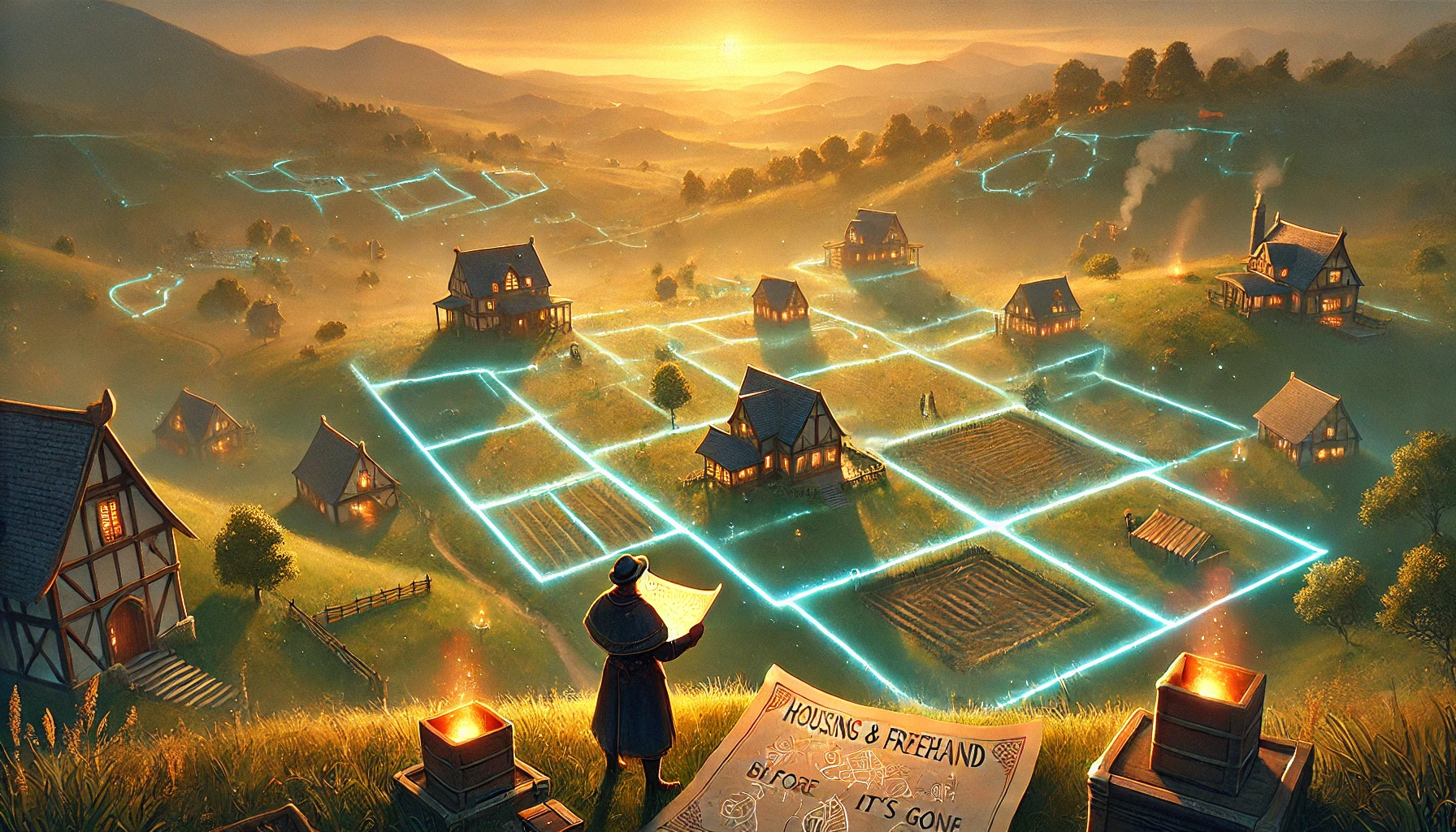
🏘️ Housing Types: What You Can Own (And What Each One Is For)
You’ll hear “housing” and people instantly think Freeholds. But the game is designed so you can still have a real home experience even if you never win the land race.
Here’s the simple breakdown:
- Inns (renting a room): the “I need a bed and a base” option. Great early convenience.
- Apartments (instanced): more stable access, usually easier than competing for prime outdoor land.
- Static housing inside a Node: the “real neighborhood” feel — limited, valuable, and usually contested.
- Freeholds: the top-tier dream — the biggest freedom, the biggest upside, and the biggest target on your back.
Important mindset: your “first home” and your “forever home” might be different. A lot of smart players start practical, then upgrade into the dream.
🌍 Node Housing vs Freeholds: The Real Difference (In One Sentence)
Node housing is about living inside civilization.
Freeholds are about owning a piece of the world outside the walls — and building something that can matter to other players.
Freeholds are framed as the “pinnacle” of housing and a major accomplishment — but they’re also designed to be limited, competitive, and something you maintain through effort and planning. (More on that in the “don’t lose it” sections.)
🏞️ What a Freehold Actually Is (And Why Land Runs Out Fast)
A Freehold is not “place house anywhere.” It’s more structured than that, and that structure is what makes Freeholds both fair and insanely competitive.
The dev info basically paints this flow:
- Nodes have regions with reserved land parcels meant for the Freehold + Guildhall ecosystem.
- Those parcels are grouped into areas called Baronies.
- Inside each Barony are multiple Estates that players can bid on.
- When you win an Estate, you place your Freehold deed within that Estate boundary.
Why land disappears: there are not enough Freeholds for everyone at the same time. The game expects churn — some players lose Freeholds, others take their place. So if you want one, you’re racing both players and time.
🧭 How to Get a Freehold (Step-by-Step, No Fluff)
If you want the clean path, here’s the practical “what to do” plan:
✅ Step 1: Pick Your “Home Region” Early
Don’t wait until you’re rich. By then, you’re choosing between leftovers. Decide:
- Do you want trade traffic nearby?
- Do you want gathering routes close?
- Do you want ocean access later for naval life?
- Do you want quiet land for farming/crafting?
Bold reality: you can make money anywhere, but your location decides how stressful that money is to earn.
✅ Step 2: Get Ready for the Freehold Requirements
Freeholds are meant to be earned. The official write-up describes the path starting with a Lord’s quest that proves you’re fit to control an Estate, and then you receive a bound Freehold Deed. That deed is what lets you participate in the next step.
✅ Step 3: Win an Estate Through Auction
Once you have an unplaced deed, you can bid in the Estate auction. Estates are limited, and the number of deeds available depends on node progression.
This is where most people lose. Not because they’re “bad,” but because they show up with:
- no budget
- no backup plan
- no timing
- no team support
✅ Step 4: Place the Deed + Use Your Shed
After you win an Estate, you place your Freehold footprint in it and your Freehold begins. You also gain access to a shed, which is basically your early “construction storage” while you haul in materials.
Pro tip: treat the shed like your staging area. Bring enough resources to build immediately — because a Freehold that stays “half-built” is basically a billboard that says: “I’m unprepared.”
📍 Choosing a Freehold Location That Won’t Make You Regret Everything
A Freehold location can be “pretty” and still be a bad pick.
When you’re choosing where to drop your footprint, think like a sweaty MMO goblin (respectfully 😄
🚚 Traffic = Profit
If your Freehold supports crafting, processing, or services, you want to be near:
- travel routes
- farming zones
- common quest paths
- “hot” gathering loops
If people pass by, people use your stuff. If nobody passes by, you’re building a museum for yourself.
🛡️ Risk = How Often You’ll Sweat
Some land is safer by nature because fewer players care about it. Other land is basically a warzone because it’s “too good.”
Ask yourself:
- Can I defend this with my guild/friends?
- If I get attacked later, will losing this spot break me?
- Is this location worth becoming a recurring target?
📏 Spacing Is a Real Thing
Freeholds aren’t stacked like sardines. There’s a stated minimum distance between Freeholds, which helps prevent land from becoming a single mega-slum of walls and rooftops.
🏗️ Building Your Freehold Home: Your First Big Decision
The system pushes one clear rule:
Your house is the first building you’ll be prompted to build.
You’ll need:
- a house blueprint
- required materials
- your chosen size: small / medium / large
Bigger houses generally mean:
- more floors
- more furniture space
- more room to turn your home into something functional and flex-worthy
Comfort tip: don’t go “largest possible” just for ego. Your house is part of a bigger puzzle: you also need space for what makes the Freehold valuable.
🪑 Furniture Isn’t Just Decoration (It Can Be Gameplay)
This is where housing gets fun.
Some furniture is described as functional — example given: beds can give rested experience, which boosts XP gain for a period after resting.
So yes… in Ashes, a good bed is basically a legal performance enhancer 😄
🔧 The Freehold Economy: Artisan Buildings, Stations, and Why Freeholds Are “Big Money”
If you want your Freehold to matter to the economy, artisan buildings are the heart.
Key ideas straight from the dev write-up:
- Freeholds are where the highest levels of processing are available.
- Building artisan structures lets you place profession stations tied to that building.
- Stations can be placed around the Freehold where the surface allows — not necessarily inside the building.
- Artisan buildings can provide bonuses to stations on the Freehold.
Big takeaway: a well-planned Freehold becomes part of the server’s supply chain. People will literally depend on what you can produce.
📜 Permits and Upkeep: The “Hidden Cost” People Forget
Not every building is “drop blueprint and chill.”
Freehold buildings (other than your house) are described as requiring permits tied to node level, and that can mean extra upkeep costs to keep them running.
Bold warning: the players who lose their Freehold aren’t always the ones who get PvP’d. Sometimes they simply get out-expensed.
🛒 Business Buildings: Turn Your Land Into a Destination
If you want visitors and passive value, business buildings matter. The examples given include things like:
- item shops
- tavern consumables
- resting/inn services
And notably: some services can function without the owner being present, which is huge if you want your Freehold to stay useful even when you’re off doing other content.
Business buildings also involve licensing/payments to the node, and they tie into the same permit/upkeep concept.
🌾 Farming & Livestock: The Cozy Trap That Becomes a Power Move
Farming sounds peaceful until you realize it’s also:
- steady income
- crafting fuel
- trade leverage
- guild support infrastructure
The system is described as a balancing act because Freeholds have space constraints. You’re choosing:
- buildings vs farmland
- crops vs animals
- layout vs defense
Also: livestock can sometimes be interacted with in different ways (example: milk vs meat).
Pro play: build for what your server actually buys. Don’t roleplay a farmer on a server where everyone is paying top coin for processed materials and trade goods.
👥 Permissions: Don’t Accidentally Create a “Free Loot House”
Freeholds can be managed through permissions tied to affiliations like:
You can control access to things like:
- entering the house
- using furniture
- storage access
- crafting/processing interaction
- harvesting crops/animals
Bold rule: if you don’t set permissions properly, your Freehold becomes a community chest… and you’re the one funding it.
🛡️ Safety: Can People Just Jump You at Home?
There’s an official note that your home building footprint is safe from PvP damage — basically, when you’re on the footprint, you can’t be harmed by other players.
So your house is your “breather zone.” Your land outside that footprint? That’s still Verra 😄
💸 Taxes, Upkeep, and Foreclosure: The Quiet Killer
There are at least two clear ways you can lose a Freehold:
- Node siege destruction → Freeholds can be attacked/pillaged for a period
- Not paying property taxes/fines → foreclosure
If foreclosure happens, stored/placed props like furniture are returned, but materials stored on the Freehold can be included in the auction for the deed.
Bold survival tip: always keep a “tax buffer” fund. If you’re living paycheck-to-paycheck with upkeep, you’re one bad week away from losing the dream.
⚔️ War Risk: What Happens When Your Node Gets Wiped
If the node tied to your Freehold is destroyed during a siege, there’s a window where Freeholds in that zone can be attacked, destroyed, and pillaged, and attackers can take resources.
The upside (so it doesn’t feel like pure grief):
- stored/placed props like furniture are returned
- blueprints are returned
- blueprint progression is stated as saved even if the Freehold falls
Translation: you can lose the land, but you don’t necessarily lose your entire “life investment.” You rebuild — if you’re still strong enough to claim again.
🏡 Node Housing Strategy: How to Win Even If You Never Get a Freehold
Let’s be real: some servers will be brutal. Some players will never win a Freehold auction. That doesn’t mean you’re homeless.
The official info explicitly says you can still get citizenship/customize your home through other housing types, including:
- static housing inside nodes
- instanced apartments
- renting a room in an inn
So the smart path is:
- secure any housing early
- build wealth + connections
- upgrade into better housing later
That way you’re never “locked out” of the lifestyle side of the game while you chase the big prize.
📈 “Land Before It’s Gone” Checklist (Quick and Practical)
If you only remember one section, remember this:
- Pick your target region early
- Follow node growth and politics
- Save for auction + permits + upkeep
- Prep building materials before you win
- Design your Freehold for purpose (not vibes)
- Control permissions day one
- Keep a tax buffer fund
- Assume your node can be attacked someday
- Have a fallback housing option ready
❓ FAQ (Fast Answers) 🧠
Can everyone own a Freehold?
No — the system is intentionally limited, and the game expects a cycle where some players lose Freeholds and others get chances to claim them.
Do I need a Freehold to enjoy housing content?
No. Other housing types exist (node housing, apartments, inns), and you can still customize and benefit from housing without owning a Freehold.
What’s the biggest mistake new players make with housing?
They pick a location based on “pretty” instead of “useful.” Profit and safety usually beat aesthetics.
Is a Freehold only for farmers and crafters?
Not at all. Even pure PvE/PvP players can use housing for convenience, buffs, storage, and social value.
What’s the #1 reason people lose Freeholds (besides war)?
Upkeep. Taxes, permits, and recurring costs are the silent threat if you don’t plan your economy.
🏁 Conclusion 🏁
Housing in Ashes of Creation is designed to be part of the world’s power structure, not just a decoration minigame. If you want land that matters, you plan early, you build with purpose, and you respect the fact that Verra will fight you back — economically and politically.
Start small if you must, but start smart. The players who “live good” in Verra aren’t always the strongest… they’re the ones who prepared first.