Route
Your route is the order you do things in. The best route does two things at once: it upgrades your character while unlocking the next tier of content. The fastest players don’t “farm gear,” they unlock efficiency, then the gear comes naturally.
Route: Stage 0 — Set Your Role, Then Build Around It
Before you farm anything, lock in your main role for Karazhan (and be honest about it). A fresh 70 trying to gear for two roles at once usually ends up good at neither.
Pick one primary path:
- Tank path: survivability first, then threat, then utility sets.
- Healer path: mana stability first, then +healing throughput, then utility (haste/regen) options.
- DPS path: hit first (where relevant), then main stat/spell damage, then haste/crit.
Then choose one “secondary” goal that helps your primary:
- Tanks: a basic DPS/off-set for solo farming.
- Healers: a basic regen set and a “boss throughput” set.
- DPS: a basic survivability kit (stamina, resist/defensive pieces) to reduce deaths in Heroics.
Your entire week gets easier when your upgrades aren’t split across three gear sets.
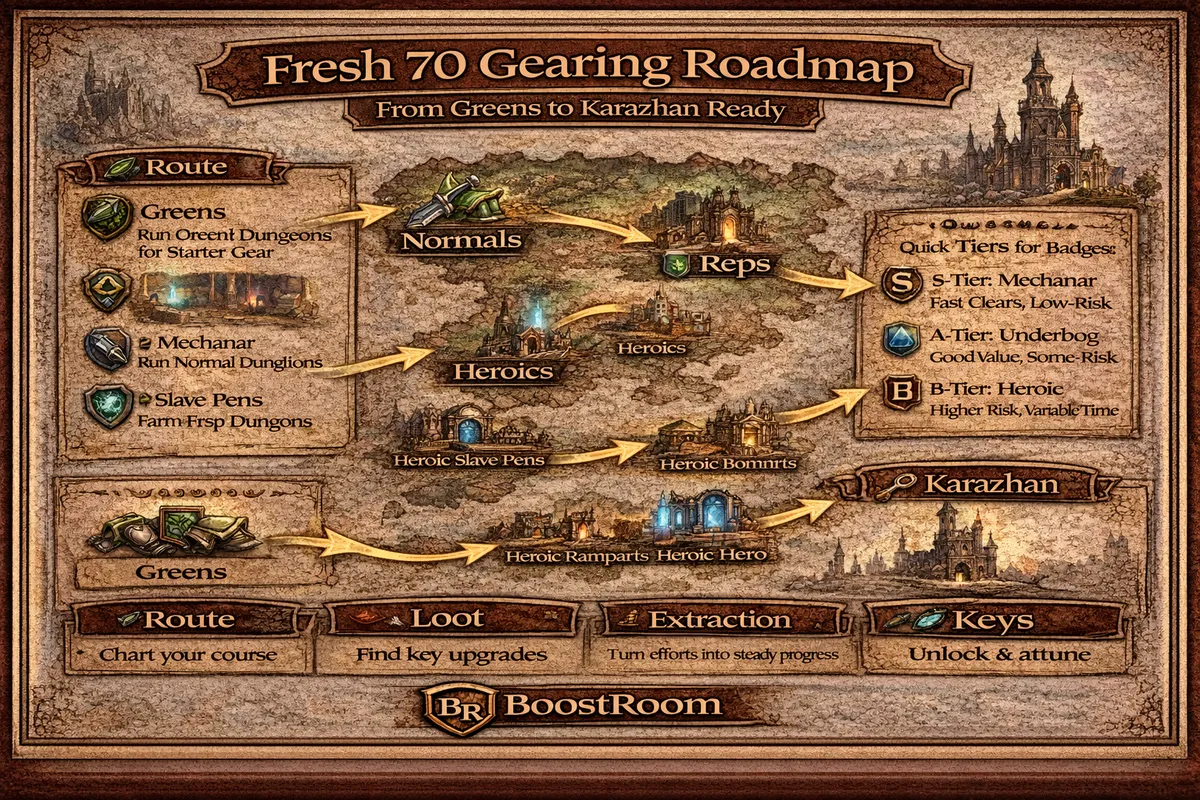
Route: Stage 1 — The First 60 Minutes at 70 (Quick Wins That Matter)
These steps are boring, but they remove most early friction.
1) Clean your bags and set your hearth
- Start with space. Heroic and dungeon quests drop items constantly.
- Set Hearth to Shattrath (default hub) unless you’re doing a dedicated “dungeon day” (more on that later).
2) Replace your worst slots immediately
Look for the “red flag” slots that kill groups:
- A weapon that’s 10+ levels behind
- Trinkets that do nothing for your role
- A mix of random spirit/int on melee DPS or random agility on casters
- Tanks missing defense/avoidance stats entirely
If you must buy or craft anything, prioritize:
- Weapon
- Trinket
- Chest/Helm/Legs (big stat density)
- Then rings/neck/cloak
3) Lock in your profession advantage
At 70, professions aren’t “nice extras.” They’re real gearing tools:
- Tailoring can create early spell sets that carry you into raids.
- Leatherworking can stabilize early melee/hunter gear or drums utility depending on rules.
- Blacksmithing can solve early weapons.
- Engineering can offer utility, survivability, and role-focused headpieces.
You don’t need perfect professions today—but you should know what your profession path is doing for you.
Route: Stage 2 — Normal Dungeons First (Because They Give the Most Gear Per Stress)
Normal 70 dungeons are the highest “upgrade per hour” content for a fresh character because:
- they’re easier to organize,
- they’re forgiving while you learn pulls,
- they drop the exact blue gear you need to stop feeling squishy,
- and they unlock/accelerate your reputation and future Heroic access.
The fastest normal-dungeon order (works for most players)
This order prioritizes repeatable value: strong loot + clean clears + useful rep.
1) The Mechanar (Normal)
A classic fresh-70 engine: efficient layout, great early upgrades, and repeatable group formation.
2) The Botanica (Normal)
Slightly longer, but high value and often fills multiple slots.
3) The Steamvault (Normal)
Great for players who need both upgrades and progression into higher-end dungeon routing.
4) Shadow Labyrinth (Normal)
Harder pulls but huge value—especially because it intersects with key quest progression for Karazhan access requirements.
5) Old Hillsbrad → Black Morass (Normal)
These aren’t just dungeons; they’re gates for important quest chains. Even one completion can unblock major progression later.
If you’re still missing a lot of upgrades, repeat Mechanar/Botanica until you’ve replaced most greens, then move into Steamvault/Shadow Lab.
Role-based dungeon emphasis (so you don’t waste runs)
Use this as a directional guide:
- Tanks: focus dungeons that drop mitigation/threat pieces and teach controlled pulls (Mechanar, Botanica, Shadow Lab once stable).
- Healers: focus dungeons that give regen and +healing pieces while letting you practice mana pacing (Mechanar, Steamvault, Botanica).
- DPS: focus dungeons that offer hit/crit/haste options and strong weapons (Mechanar/Botanica first, then Shadow Lab/Steamvault based on needs).
The “one run, many turn-ins” normal rule
Before you step into a normal dungeon you plan to clear, stack:
- all dungeon quests you can,
- any related zone chains that lead into the dungeon,
- and any “follow-up” quests that start inside the instance.
Those turn-ins often equal the value of an extra boss worth of loot and help you maintain a clean progression pace.
Route: Stage 3 — Unlock Heroics Efficiently (Without Grinding the Wrong Thing)
Heroics aren’t just harder dungeons—they’re a currency machine (badges), a pre-raid loot machine, and often the fastest way to become raid-accepted in pug culture.
But Heroics require two kinds of access:
- Heroic keys (faction requirements vary by ruleset/phase; historically they were lowered to Honored in patch changes)
- Dungeon access requirements (some dungeons have extra door/key chains)
The smart key philosophy
Your goal is not “max rep.”
Your goal is: hit the key threshold, buy the key, move on.
You can always push reputations later passively while running Heroics for badges.
The 5 reputations that matter most early
- Cenarion Expedition (Coilfang Heroics)
- Honor Hold / Thrallmar (Hellfire Heroics)
- The Sha’tar (Tempest Keep Heroics)
- Lower City (Auchindoun Heroics)
- Keepers of Time (Caverns of Time Heroics)
The best fresh 70 route typically unlocks:
- Cenarion Expedition + The Sha’tar first (because they pair with your best gearing normals),
- then
- Lower City + Hellfire rep, then
- Keepers of Time (best done as a focused sprint).
Route: Stage 4 — Karazhan Access: What You Actually Need to Do
Many players say “Karazhan ready” and mean “I’m geared.” In TBC Classic, Karazhan readiness also includes access requirements and basic execution.
The Karazhan key quest line (commonly called the Master’s Key chain) is important even on servers/rulesets where the raid entry requirement is relaxed—because it teaches the exact dungeon progression that makes your character better.
The Karazhan key chain at a practical level
A clean, beginner-friendly summary of what you’ll do:
1) Start outside Karazhan (Deadwind Pass)
You pick up two starter quests near the gate area and complete simple objectives in nearby caves.
2) Deliver messages to the right NPCs
You get sent to a Dalaran contact, then to Khadgar in Shattrath.
3) Get the first key fragment
You run Shadow Labyrinth and retrieve the first fragment from a guarded container near the end of the dungeon.
4) Get the second and third fragments
- Second fragment: The Steamvault (guard spawns when looting the container)
- Third fragment: The Arcatraz (you can reach it without killing bosses, but access and navigation matter)
5) “Activate” the key in Black Morass
You protect Medivh during Black Morass and complete the key activation step.
6) Return to Khadgar
You finish the chain and receive the key reward.
The hidden blockers that stop fresh 70s
These are the reasons people get stuck mid-chain:
- Shadow Labyrinth needs a door solution
- Shadow Lab requires a key or lockpicking option depending on group access. Plan this early so your “kara key night” doesn’t become wasted travel.
- Arcatraz has an access chain
- Arcatraz access commonly requires an additional key chain or a party member who can open it. Don’t assume you can walk in on day one.
- Black Morass requires earlier Caverns of Time progression
- Most players need to complete Old Hillsbrad progression to unlock Black Morass access.
If you treat these as part of your gearing roadmap—not annoying chores—your Karazhan readiness becomes automatic.
Route: Stage 5 — Your First Heroic Week (The Schedule That Produces Raid Gear Fast)
A fresh 70’s best week is not “random heroics.” It’s a plan that:
- gets you consistent clears,
- builds badges steadily,
- and upgrades your weakest slots first.
The “safe heroics first” rule
If you’re new or undergeared, start with Heroics that are:
- short,
- predictable,
- and not caster-chaos nightmares.
A common safe-start set:
- Heroic Mechanar
- Heroic Ramparts
- Heroic Slave Pens
Then expand into:
- Heroic Botanica
- Heroic Underbog
- Heroic Steamvault (once interrupts are reliable)
Save “punishing” Heroics (like Shattered Halls / Shadow Lab heroic difficulty) until your group’s control is clean and your gear stabilizes.
Why badges are your “raid acceptance” accelerator
Badges of Justice are a direct line to high-value epic upgrades through badge vendors, and they scale with consistency. Even if your dungeon loot is unlucky, badges keep paying you.
A simple badge mindset:
- If your group wipes, your badges/hour collapses.
- The best badge groups are not always the highest DPS groups—they’re the clean execution groups.
Route: The Karazhan Readiness Checklist (If You Can Check These, You’re Ready)
Karazhan isn’t a gear-check wall; it’s a coordination and consistency raid. This checklist is realistic and works for most groups:
For everyone
- Most greens replaced by dungeon blues (and a few crafted/rep items if possible)
- Proper gems (even cheap ones) and basic enchants on core slots
- Consumables prepared (at least basic potions and food)
- Key access requirements handled (or someone in the raid can handle them)
For tanks
- Crit immunity planning is handled (defense/resilience approach)
- You can tank your farm Heroics without getting deleted by trash spikes
- You know how to line-of-sight casters and control pulls
For healers
- You can heal a full Heroic without constant panic spam
- Your mana plan works (downranking/efficient heals/drink timing)
- You can handle dispels and predictable damage patterns
For DPS
- You can follow kill orders, interrupt, and avoid pulling threat
- Your hit plan is progressing (you’re not wearing random stats)
- You stay alive—dead DPS does zero DPS and slows the raid
If you can do those, you’re Karazhan ready in the only way that matters: you can contribute without being carried.
Loot
Loot is what you chase, but the real objective is power per hour. This section tells you what to prioritize so upgrades translate into faster clears and easier raid invites.
Loot: The Slot Priority That Makes You Strong Fast
Not all upgrades are equal. If you want the biggest power spikes early:
Top priority
- Weapon (massive output for DPS, major threat for tanks, sometimes huge healing value for healers)
- Trinkets (often the best “effect per slot” items in pre-raid gearing)
- Chest / Helm / Legs (high stat density and strong enchant value)
Mid priority
- Shoulders, gloves, belt, boots (often easy to replace via rep/crafts/dungeons)
Low priority
- Rings/neck/cloak (still important, but often smaller raw stat jumps unless you’re replacing very old pieces)
The “don’t chase tiny upgrades” rule
If you’re spending hours for a +6 stat bump, you’re doing it wrong. Your early gearing should be about replacing bad items with correct-stat items, not perfecting minor differences.
Loot: Tank Gearing Targets That Prevent Heroic Wipes
Tanks are the “pace setters” of the entire gearing pipeline. If the tank stabilizes, everything speeds up.
Crit immunity (what it means in TBC terms)
Raid bosses are treated as higher level than you, and tanks aim to remove the chance to be critically hit. A widely referenced benchmark for level 70 tanks against raid bosses is 490 defense skill for crit immunity, and resilience can also contribute toward the total crit reduction target.
Practical interpretation for fresh 70 tanks:
- If you are not yet in that stable zone, use more crowd control, pull smaller, and farm the normal dungeons that drop real tank items.
- “More stamina” is not a substitute for being crittable in content where one spike can instantly kill you.
The two tank sets you should build early
- Mitigation set: defense/avoidance/stamina for dangerous trash and bosses.
- Threat set: hit/expertise/strength/spell power (depending on class) for smoother group DPS without aggro issues.
You don’t need both to start Heroics, but you’ll want them as you move into faster clears and Karazhan.
Loot: Healer Gearing Targets That Make Runs Smooth
Healer gearing is less about raw +healing early and more about mana stability and consistency.
What makes a healer feel “raid ready”
- Your mana doesn’t collapse halfway through every dungeon.
- You can keep the tank stable through trash spikes without spamming your most expensive heal repeatedly.
- You can keep yourself safe (positioning, threat awareness, and defensive habits).
The healer “two kit” concept (simple and powerful)
- Efficiency kit: regen stats, mp5, spirit (where relevant), and “cheap cast” habits.
- Throughput kit: higher +healing for bosses and fights with sustained damage.
In Karazhan, you’ll swap based on encounter style. In Heroics, you’ll lean efficiency unless your group is extremely clean.
Loot: DPS Gearing Targets (Hit First, Then Real Damage)
DPS gearing fails when players stack “big stats” but ignore the basics that make damage consistent.
Hit fundamentals (why “cap” talk matters)
- Many melee specs target a 9% hit plan for consistent special attacks against boss-level targets, with class/talent variations.
- Casters often plan around a 16% spell hit target for boss-level enemies, with reductions from talents and raid debuffs (meaning you may need less from gear depending on spec and group).
You don’t need to solve hit perfectly in week one. You do need to be moving toward it and not wearing random mismatched stats that delay the goal.
The “damage you can actually use” rule
If you die, you lose:
- your uptime,
- your cooldown windows,
- your potions and consumable value,
- and your group’s pace.
So early DPS gearing should include:
- enough stamina to survive mistakes,
- a threat plan (especially in fast groups),
- and utility habits (interrupts, stuns, control) that prevent wipes.
Loot: Crafted Gear (The Shortcut That’s Worth It When Chosen Correctly)
Crafted gear can be a major accelerator, but only if you use it with restraint.
When crafting is worth it
Craft a piece when it meets at least two of these:
- It replaces a weak green or wrong-stat slot.
- It lasts into Karazhan (or beyond).
- It enables a key threshold (hit/defense/regen breakpoint).
- It saves you multiple dungeon nights worth of RNG.
When crafting is not worth it
Avoid expensive crafts when:
- you’ll replace the piece immediately with a dungeon drop,
- you can farm a similar item reliably in 1–2 runs,
- or the craft delays your actual Heroic and badge pipeline.
Crafting is a tool, not a personality.
Loot: Reputation Rewards (The Quiet Power Spikes People Forget)
Reputation rewards matter because they’re predictable. You can plan them.
Your best early rep approach:
- Push to the level you need for Heroic keys and any high-value pre-raid upgrades.
- Don’t overgrind reputations early “just because” unless the reward is a major power spike for your role.
The fastest characters use reputations as a bridge into Heroics, then let Heroics and raids carry rep naturally.
Loot: Badges of Justice (Why They Change Everything)
Badges are your anti-RNG system. If dungeon loot hates you, badges still pay you.
Important badge facts that shape your roadmap:
- Badges drop from Heroic bosses (with additional patterns depending on boss position in the dungeon).
- Karazhan itself is a famous badge source because a full clear yields a large bundle of badges for each raider.
- Badge vendors in Shattrath offer significant epic upgrades, and later-phase badge inventories expanded substantially.
Practical badge strategy for fresh 70:
- Spend your early badges on high-impact slots (trinkets, weapons if available, key armor pieces).
- Avoid spending on tiny upgrades unless you’re blocking yourself from a major threshold.
Extraction
Extraction is how you turn “a night of dungeons” into permanent momentum. Most gearing plans fail because players don’t lock in progress between sessions.
Extraction: The Daily Loop That Makes You Stronger Every Login
Use this loop every day you play at 70:
1) One targeted normal or Heroic run
Pick a dungeon based on your current weakest slot or rep/key goal.
2) Turn in stacked quests immediately
Don’t hoard turn-ins. Turn-ins are:
- rep,
- gold,
- and often gear rewards.
3) Do your “two-minute maintenance”
- Repair
- Restock (potions, reagents, ammo)
- Clear bags
- Mail auctionables to an alt if you have one
4) Set your next session anchor
- Shattrath if you’re doing mixed goals
- Coilfang hub if you’re farming that set
- Tempest Keep hub if you’re running Mechanar/Botanica
- Caverns of Time if you’re pushing Old Hillsbrad/Black Morass progression
This is how you keep your playtime efficient without feeling like you’re “planning” all the time.
Extraction: The Karazhan Key Night (Do It Like a Project, Not a Rand
om Attempt)
The Master’s Key chain becomes painless if you schedule it correctly:
Prep checklist before your key night
- Your group can enter Shadow Lab (door access handled)
- Your group can enter Arcatraz (access handled)
- Your group has already progressed Caverns of Time enough for Black Morass
- You have at least a basic consumable kit (wipes waste time)
- You’ve stacked any dungeon quests connected to Shadow Lab / Steamvault / Arcatraz / Black Morass
Then run it in this order:
- Shadow Lab fragment night
- Steamvault fragment + Arcatraz fragment
- Black Morass activation
- Turn in and finish
Treat it as three short sessions instead of one chaotic marathon.
Extraction: The “Group Stability” Trick (Your Biggest Hidden Multiplier)
Gear comes faster when your group stays together.
If you clear one dungeon smoothly, don’t disband instantly. Chain 2–3 runs while:
- everyone is warmed up,
- loot rules are understood,
- and travel overhead is minimized.
This is one of the biggest differences between a fresh 70 who gears in a week and one who gears in a month.
Extraction: Raid-Ready Prep (The Small Things That Make You Look Serious)
Karazhan groups often accept players who feel prepared, even if their gear isn’t perfect.
Do these before your first raid:
- Put basic enchants on visible core slots (weapon, chest, legs, cloak) if possible.
- Gem your gear, even with budget gems.
- Bring consumables (food, potions, class reagents).
- Know your role’s basic responsibilities:
- tanks: marks, LoS pulls, cooldown timing
- healers: dispels, mana pacing, triage
- DPS: interrupts, threat management, kill orders
Prepared players get reinvited. That’s one of the fastest gearing hacks in the entire game.
Practical Rules
These rules keep the roadmap fast and prevent the common fresh-70 traps:
- Pick one main role and gear for it first.
- Replace the worst slot first (weapon/trinket/chest/helm/legs).
- Do normals until most greens are gone—Heroics aren’t a starter mode.
- Stack dungeon quests before you enter. One run should produce multiple turn-ins.
- Don’t overfarm a dungeon for tiny upgrades. Move forward.
- Unlock Heroic keys by hitting the requirement, then stop and pivot.
- Cluster dungeons by zone to reduce travel waste (Coilfang day, TK day, CoT day).
- If your group wipes twice to the same trash pack, change the plan (CC, LoS, kill order).
- CC and interrupts are progression stats. Use them.
- Tanks: control pulls first, speed later.
- Healers: drink early; stopping for mana is faster than wiping.
- DPS: follow Skull/X; split damage = split threat = slow runs.
- Don’t break CC while learning Heroics.
- Build at least one “safe farm” dungeon you can clear daily without drama.
- Spend badges on power spikes, not tiny upgrades.
- Don’t ignore rep rewards—predictable upgrades beat RNG.
- Treat the Karazhan key chain like a planned project with access solved in advance.
- If you can’t enter a dungeon door, your time is being stolen—solve access early.
- Always repair before starting a chain of runs.
- Use consumables on trash, not only bosses; most wipes happen on packs.
- Avoid “random stat” gear—correct stats beat higher item level with wrong stats.
- Keep bag space; missed quest drops slow progress.
- Log out in an efficient hub so your next login starts strong.
- Track your next goal in one sentence (“Need trinket + Steamvault fragment tonight”).
- Consistency beats intensity. Steady daily progress gears faster than occasional marathons.
BoostRoom Promo
If you want to go from fresh 70 to Karazhan-ready without wasting nights on failed groups, wrong dungeon choices, or access blockers, BoostRoom turns this roadmap into a smooth, predictable progression pipeline.
BoostRoom helps you:
- target the highest-value dungeons for your role (so upgrades come faster),
- unlock Heroic access efficiently (keys, reputation routing, and correct dungeon order),
- complete Karazhan access requirements without getting stuck on doors or prerequisite chains,
- farm badges with low-risk, fast-clear routes,
- and show up to Karazhan prepared—geared, enchanted, and ready to perform.
The goal isn’t just “get carried.” The goal is to upgrade fast, learn the right habits, and be raid-ready sooner—with less time wasted.
FAQ
How geared do I need to be for Karazhan?
You don’t need perfect gear. You need mostly level 70 dungeon blues (plus a few crafted/rep upgrades), basic enchants/gems, and enough execution to follow kill orders and mechanics without constant deaths.
Should I farm normal dungeons or jump straight into Heroics?
Farm normals first until most greens are gone. Heroics reward clean control and punish weak gear and sloppy execution—starting too early usually slows you down.
What should I upgrade first as a fresh 70?
Weapon and trinkets are usually the biggest immediate power spikes. After that, chest/helm/legs because they carry high stat density and strong enchant value.
Do I need the Karazhan key on every character?
Some rulesets relaxed entry requirements later, and historically only one person in the raid needed the key to enter. Even if entry is relaxed, the quest chain is still valuable because it forces you through key dungeons that also gear you.
Why do people get stuck on the Karazhan key chain?
The most common blockers are Shadow Labyrinth access, Arcatraz access, and needing earlier Caverns of Time progression before Black Morass.
What’s the best way to unlock Heroics quickly?
Hit the required reputation threshold for the key, buy it, and move on. Don’t overgrind reputations early unless you’re chasing a specific reward.
Are badges worth farming before Karazhan?
Yes. Badges provide predictable upgrades through vendors and remove a lot of RNG pain from early gearing.
How do I know I’m “Heroic ready”?
If your group can clear a couple of safer Heroics (like Mechanar/Ramparts/Slave Pens) without repeated wipes, and your role feels stable (tank not spiking, healer not OOM constantly, DPS not dying to aggro), you’re ready.
What matters more for fresh-70 DPS: raw damage stats or hit?
Consistent hits matter because missed attacks/spells reduce real damage output. Most DPS builds plan toward hit thresholds first, then stack main damage stats.
What’s the fastest weekly plan for a fresh 70?
Normals for quick blues → unlock key reputations → safe Heroics for badges → finish Karazhan access tasks → raid with basic enchants/gems and consumables.



