The BoostRoom Method in One Sentence
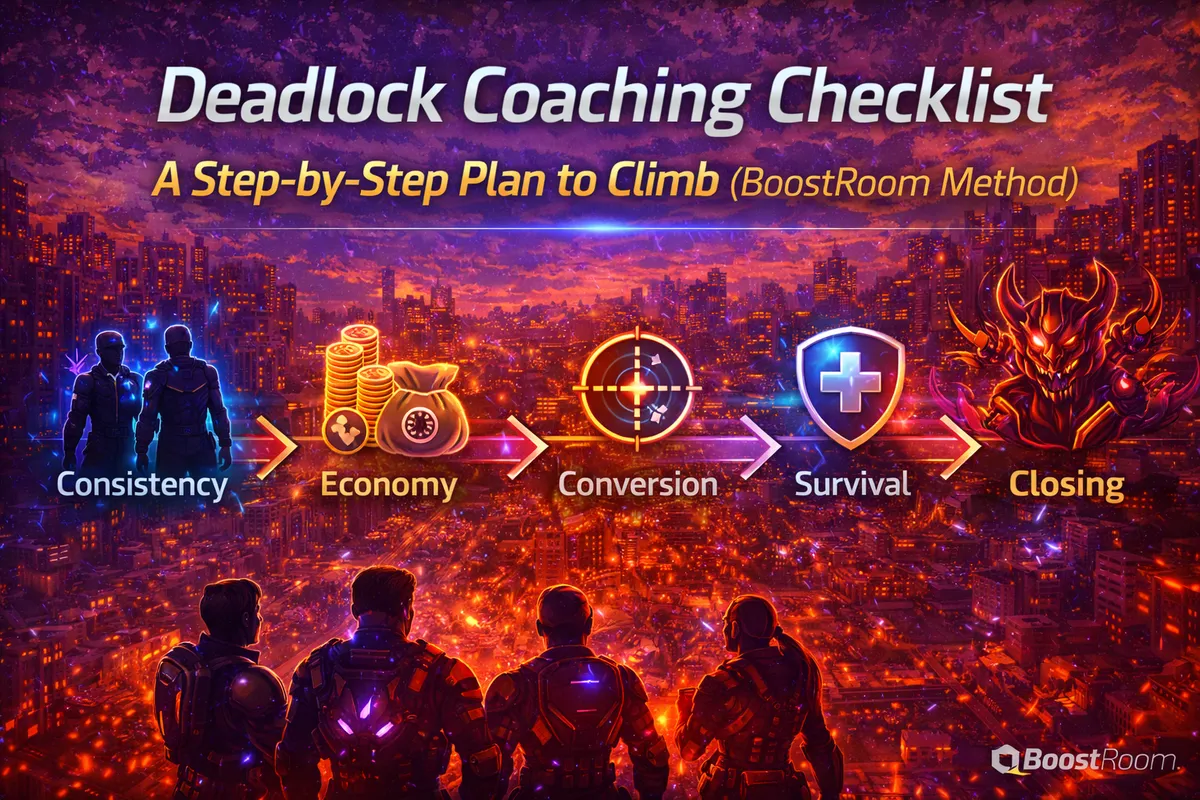
You climb faster when you stop trying to “play better” everywhere and instead improve in this order: Consistency → Economy → Conversion → Survival → Closing.
That order matters because it matches how Deadlock decides matches:
- Consistency keeps you from losing to random streaks.
- Economy gets you items earlier than your opponents.
- Conversion turns wins into Walkers and map progress.
- Survival keeps your damage and utility active in fights.
- Closing turns leads into Patron kills instead of throws.
Everything in this page is built around that sequence.
How to Use This Checklist Without Overthinking
This plan works best when you run it like a weekly cycle:
- Pick one main hero and one backup for the week.
- Track only 5 stats (simple, not stressful).
- Review two moments after each match (one loss moment, one win moment).
- Focus on one “theme” per day (lane, conversions, teamfights, endgame).
- After 7 days, adjust only one thing (hero pool, item habit, or macro habit).
The biggest mistake is changing everything at once. The fastest climb comes from stable repetition.
Step 0: Build Your Climb Environment
Before you “train,” make sure the game is set up so improvement actually sticks.
Your goal: stable performance and consistent input.
If your FPS stutters, your aim timing won’t stabilize. If your sensitivity changes weekly, your micro-control won’t settle.
Checklist
- Cap FPS to a value you can hold in real fights (stable > high).
- Turn off visual clutter that hides targets (motion blur, heavy bloom, depth of field).
- Keep one sensitivity for at least 7 days.
- Use a clear crosshair you can see in effects.
- Use headphone audio settings so you can hear rotations and ziplines.
This is not “min-maxing.” It’s removing friction so your practice transfers into wins.
Step 1: Lock a 2–3 Hero Pool That Matches Climbing Reality
Deadlock matchmaking has hero-based skill evaluation layers, which means your difficulty can shift depending on the hero you queue. For climbing, the best strategy is a small pool.
BoostRoom rule: 2–3 heroes total.
- Hero 1 (Main): your highest winrate comfort pick.
- Hero 2 (Backup): covers a role gap your team often needs (frontline or support).
- Hero 3 (Optional): only if you truly need a “safe pick” into bad matchups.
How to choose your main
Pick the hero that gives you the most consistent value even in messy games:
- reliable wave control
- reliable teamfight contribution
- clear objective conversion (can hit Walkers/Shrines safely after fights)
- doesn’t require perfect team coordination to function
How to choose your backup
Choose a hero that fixes the most common solo queue loss condition:
- If your carry always dies first → play a frontline/peel hero.
- If fights are chaotic and no one stabilizes → play utility/support.
- If your team never converts objectives → play a hero that melts Walkers fast.
Hero pool discipline rule
If you want MMR to move, stop “sampling” heroes. Run 10–20 games on your main before you judge results.
Step 2: Set Your Weekly Goal Using Only 5 Trackable Metrics
A coaching checklist needs measurable outcomes. But tracking too many stats makes you tilt. Track five.
The BoostRoom 5
- Early deaths (0–10 min): how often you die before your first big item.
- Deaths with a large wallet: how often you die holding enough Souls to buy a meaningful upgrade.
- Fight conversion rate: after a won fight, did your team take a Walker/Guardian or meaningful structure damage?
- First-to-objective arrivals: do you arrive early to Urn/Mid Boss/Walker fights or late?
- Endgame throws: deaths in enemy base or during a shaky “finish.”
These five metrics map directly to wins. You don’t need a spreadsheet to start—just note them mentally or in a quick note after matches.
Step 3: Win Lane by Controlling Tempo, Not by Winning Duels
Your lane goal isn’t “kill them.” Your lane goal is hit your first midgame spike on time while keeping your objective healthy.
BoostRoom lane win condition
- You collect consistent wave value.
- You don’t die early.
- You create a crash window to shop first.
- You chip the Guardian only with a wave (not with your face).
The Lane Tempo Loop
Run this loop until it’s automatic:
- Hold or stabilize if you’re weaker or alone.
- Slow push when you want a bigger wave.
- Crash when you want to shop or roam.
- Reset/shop after the crash.
- Return stronger and repeat.
If you leave lane without crashing first, you pay the “wave tax” and fall behind even if you feel active.
The 10-Minute Lane Checklist
- I did not die before my first meaningful purchase.
- I crashed at least one wave before a reset.
- I did not hit the Guardian without Troopers tanking.
- I did not chase into open space for a deny that cost my HP bar.
- I left lane only for a real purpose (objective timing or guaranteed fight).
If you do this, your midgame becomes easier automatically because you arrive with items, not excuses.
Step 4: Master the Midgame Loop That Actually Wins Matches
Deadlock midgame is where most players throw wins. The reason is simple: they fight without converting.
BoostRoom midgame rule: Every fight must buy something permanent.
Your default midgame conversion ladder:
- Walker
- Guardian (if Walker isn’t available)
- Mid Boss (only if safe and fast)
- Soul Urn (only if lanes are stable and you can escort)
- Wave crash + structure chip (if your team is low)
Why Walkers Are the Midgame Gate
Walkers aren’t only map progress—they’re also tied to important build flexibility systems, which means Walker control often translates into stronger teamwide scaling. When you treat Walkers as the default reward for winning fights, you stop “winning fights and losing games.”
The 60-Second Objective Setup
Before you contest a major objective window, do these in order:
- Fix waves first (stabilize the lane you’re leaving).
- Spend Souls (fight with items, not wallets).
- Arrive early (take angles and cover before the enemy shows).
- Fight with a purpose (win → convert).
Most teams do Step 4 only. That’s why fights feel random.
Step 5: Learn “Fight Selection” So Your Wins Become Repeatable
Winning players don’t take more fights. They take better fights.
BoostRoom fight rule: Fight only with at least one advantage.
- numbers advantage (someone caught or late)
- item advantage (you shopped; they didn’t)
- position advantage (you control cover)
- cooldown advantage (their big tool is down)
- objective advantage (fight is next to something you can take)
If you fight with no advantage, you’re flipping the match. The moment you stop flipping, your MMR stabilizes and starts rising.
Step 6: Teamfight Positioning That Works in Solo Queue
Teamfights are chaotic in Deadlock, but your job can be simple if you follow two principles:
- Play from cover
- Keep an exit route
The Safe Triangle
Every fight position should give you:
- cover to break line-of-sight
- an angle to deal damage or control space
- an escape path back to teammates or behind a corner
If you don’t have all three, you’re gambling. Great teamfight positioning feels boring because it’s stable.
Target Priority That Wins Fights
Don’t pick targets by ego. Pick targets by this order:
- Threat: who is killing or disabling your team right now?
- Access: who can you hit safely right now?
- Time-to-kill: who can your team finish quickly?
Most fights are decided when a team correctly deletes the first real threat, then snowballs into the rest.
Step 7: Itemization as a Checklist, Not a Guess
Most “unwinnable” games are actually “wrong items” games.
Use this decision tree every time you shop:
What caused the last loss moment?
- Nobody dies → buy anti-heal.
- I get chain-controlled → buy anti-CC/cleanse tools.
- I die instantly → buy a barrier/survivability layer.
- Everyone escapes → buy anti-mobility.
- One fed shooter deletes us → buy disarm/uptime reduction or stronger peel/saves.
The One Defensive Layer Rule
If you’re a damage role, you still need one defensive layer by midgame:
- a barrier/save
- a cleanse/anti-CC
- slow resistance if positioning is being destroyed
Damage doesn’t matter if you die before your second rotation.
Step 8: Objective Closing Discipline
A huge portion of Deadlock losses are throws during “we’re in base, let’s brawl.” You end games by staying disciplined.
BoostRoom closing rule: End the match like an operation, not a chase.
Endgame checklist
- Did we clear waves so we can hit objectives safely?
- Are Shrines the next required step?
- Do we have enough enemy deaths to finish before respawns?
- Are we grouped with a frontline and a backline?
- If the end isn’t guaranteed, can we reset and keep the lead?
If you can’t guarantee the end, reset and repeat. Keeping a lead is a skill.
The BoostRoom Step-by-Step Weekly Plan
This is the core “method.” Run it for 4 weeks and you’ll feel your games stabilize.
Week 1: Stop Losing for Free
Goal: reduce chaos losses.
- Focus: early deaths + dying with Souls.
- Habit: crash before reset.
- Rule: if you can buy a meaningful item, reset before the next fight.
Week 1 success looks like
- You hit your first spike earlier.
- You stop getting snowballed by early mistakes.
- Your losses feel “closer” instead of hopeless.
Week 2: Convert Fights into Walkers
Goal: turn wins into permanent progress.
- Focus: fight conversion rate.
- Habit: after every won fight, immediately move toward the Walker and ping it.
- Rule: no chase unless it’s a guaranteed kill under 5 seconds.
Week 2 success looks like
- You win more games with fewer kills.
- Your team “accidentally” follows you to objectives more often.
- Your midgame becomes predictable.
Week 3: Win More Objective Fights by Arriving First
Goal: stop face-checking into prepared enemies.
- Focus: first-to-objective arrivals.
- Habit: rotate early and hold angles.
- Rule: push/stabilize waves before rotating.
Week 3 success looks like
- You win fights that used to feel 50/50.
- You get more free Walker damage after fights.
- You feel in control of the map.
Week 4: Close Games Without Throwing
Goal: make leads convert into wins.
- Focus: endgame throws.
- Habit: two clean pushes beat one greedy push.
- Rule: if you can’t end before respawns, reset.
Week 4 success looks like
- You win more “we were ahead” games.
- Your losses become more about outplays than throws.
- Your badge becomes more stable.
Role-Specific Coaching Checklists
Different roles climb with different priorities. Use the checklist that matches your job.
Carry Checklist
- I’m farming consistently and not missing waves for random fights.
- I reset on time so I fight with items, not a wallet.
- I fight from cover and don’t become the closest visible target.
- I buy one defensive layer by midgame.
- After winning a fight, I immediately hit the objective.
Carry success is uptime. If you are alive and shooting, your team can win.
Frontline Checklist
- I arrive early and hold the dangerous space so my team doesn’t have to.
- I don’t overextend past my team’s damage range.
- If divers jump our carry, I peel first.
- I build survivability plus anti-CC so I don’t get deleted or controlled.
- I help convert by holding angles while teammates hit the objective.
Frontline success is space. If your team can stand and shoot, you did your job.
Initiator Checklist
- I don’t start fights unless my team is in range to follow.
- I lock a target that can be killed quickly, not the tank by default.
- If my engage misses, I reset instead of feeding deeper.
- I track objective timing so engages happen near conversions.
- I preserve stamina for exit after entry.
Initiator success is permission. You create fights that your team can actually win.
Support/Utility Checklist
- I keep our win condition alive through the first burst.
- I buy at least one fight-saving tool early enough to matter.
- I position so I can help without dying first.
- I use pings and simple calls to guide conversions.
- After a fight win, I stabilize the push so we can hit objectives safely.
Support success is stability. Your job is turning chaos into a clean win.
VOD Review: The 8-Minute Method That Actually Helps
You don’t need hour-long reviews. You need focused feedback.
After each match, review only these two moments:
- One death that mattered
- One fight win that didn’t convert (or did convert well)
Ask these questions:
- Was my wave state handled before this moment?
- Did I have enough stamina to survive?
- Was I in cover or in open space?
- Did I shop before the fight?
- Did we convert after the fight?
Write one sentence: “Next game, I will ___.”
That’s it. Improvement compounds when feedback is simple.
Daily Routine: 30 Minutes That Moves MMR
If you want a daily plan that doesn’t burn you out:
- 10 minutes: quick warmup (tracking + micro-clicks + short peeks)
- 2 matches: play with one focus theme (lane tempo, conversion, teamfights, closing)
- 8 minutes: review one death + one conversion moment
This is enough to climb because you’re training what wins matches, not what looks cool.
Communication for Climbing (Even Without Voice)
Most players don’t need long comms. They need a few consistent calls.
Use short, repeatable messages:
- “Crash then shop.”
- “Win fight → Walker.”
- “Don’t chase—objective.”
- “Urn soon, push waves.”
- “Mid Boss soon, set up.”
If you ping and move first, teammates often follow. You don’t need perfect teamwork—just direction.
How BoostRoom Fits Into This Method
BoostRoom is built around turning this checklist into a personalized plan, not a generic tip list.
A BoostRoom-style coaching flow looks like this:
- Identify your biggest loss pattern (from your own matches).
- Choose the one habit that fixes it first (lane tempo, resets, conversion, positioning, item answers).
- Build a 1–2 hero pool that matches your strengths and reduces lobby variance.
- Use short VOD reviews to lock in changes fast.
- Track the BoostRoom 5 metrics so you see progress even before the badge jumps.
The purpose isn’t to change who you are as a player. It’s to make your wins repeatable.
FAQ
How fast can I climb using this checklist?
Climbing speed depends on your current habits and consistency, but most players feel immediate improvement once early deaths and fight conversions are fixed.
Do I need to play a lot of games to improve MMR?
You need enough games for consistency to show, but quality beats quantity. Two focused matches with review often beat five tilted matches.
What’s the single highest-impact habit for climbing?
Fight conversion: winning a fight and immediately taking a Walker (or another permanent objective) wins more games than chasing kills.
Why do I win lane and still lose?
Usually because you didn’t convert your lane lead into objectives, or you died with a large wallet and gave the enemy a midgame timing swing.
How do I stop dying first in teamfights?
Arrive earlier, fight from cover, keep one stamina reserved, and buy a defensive/utility layer if you’re being focused.
Should I switch heroes when I lose?
Not often. A small hero pool improves stability. Swap only if a hero truly doesn’t fit your role or you can’t execute its win condition.
What do I do if my team refuses to play objectives?
Be the objective magnet: after wins, ping the Walker and move to it. Catch waves and arrive early to real objective fights so your team’s “random fights” happen near conversions.
What’s the best way to use BoostRoom for the fastest results?
Use it to diagnose your top loss pattern, build a 2–3 hero pool, and get a weekly focus plan with short VOD reviews and clear metric tracking.



