Why Caravans Matter in Verra 🌍
Caravans aren’t a side activity. They’re one of the most “real MMO” systems you’ll touch because they force three things to happen at once:
1) The world gets busy.
People aren’t teleporting around with infinite bags. A caravan literally creates movement and conflict.
2) PvP becomes meaningful.
Not “random road murder,” but fights with clear reasons: profit, control, and territory.
3) Markets become different from node to node.
Trade creates winners. Some nodes become rich hubs, others become resource farms, others become war zones. And all of that changes depending on what players do.
If you want that old-school MMO feeling — caravans are it. 🔥
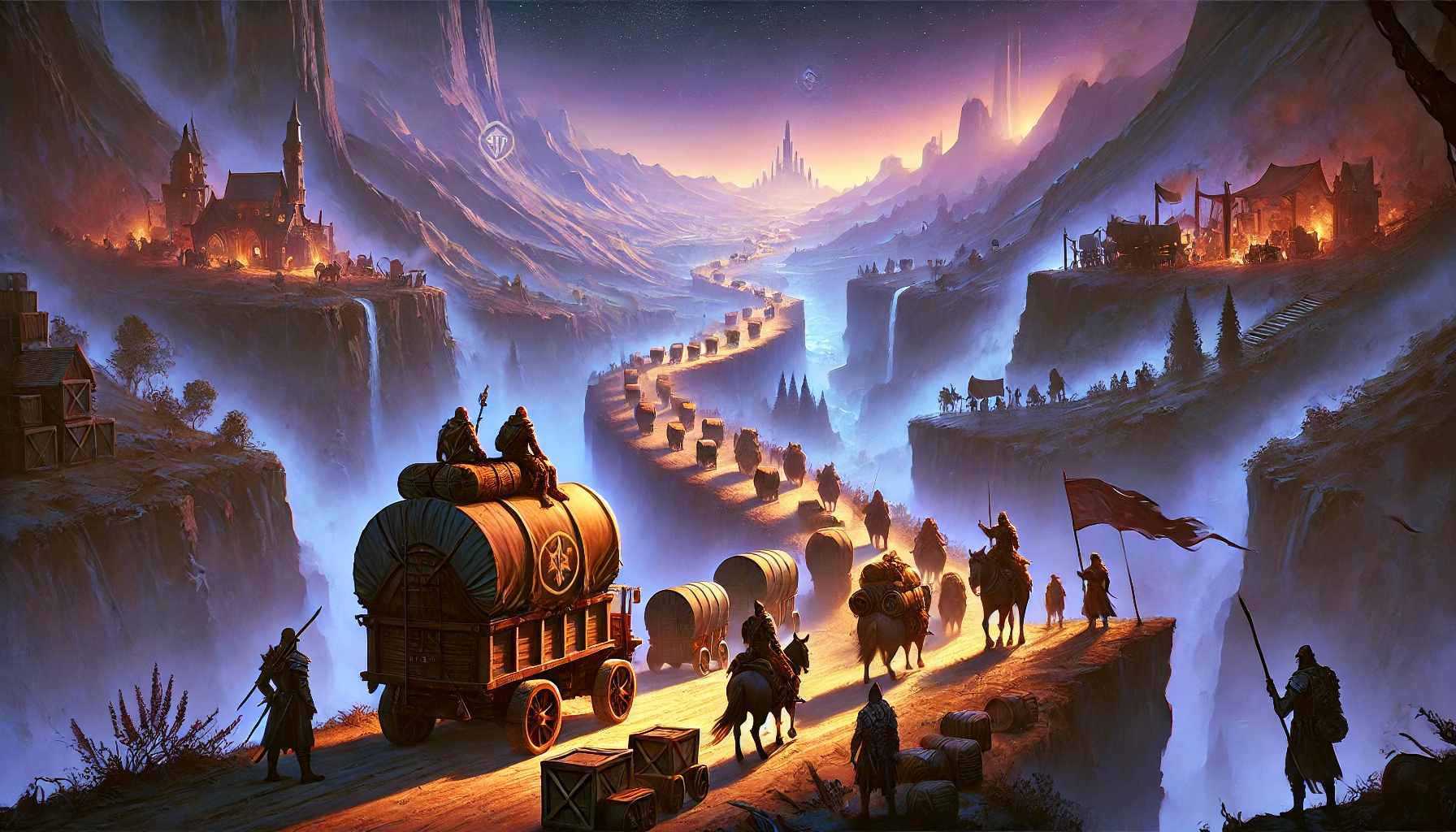
The Caravan Trading Loop (The Simple Version) 🧠
Let’s keep it clean:
Step 1: You earn Glint.
Glint is what you use to buy caravan commodities.
Step 2: You buy commodities from a node.
You’re basically buying “trade cargo” meant to be sold somewhere else.
Step 3: You go to the Caravansary / Caravan Master and start the run.
You spawn the caravan, load cargo, and roll out.
Step 4: You travel.
Distance matters. Terrain matters. Ambush risk matters.
Step 5: You deliver at another node and get paid.
Profit is tied to things like distance and what you traded.
That’s the loop. Everything else in this blog is about not getting deleted in Step 4 and making Step 5 worth it. 😅
What You’re Really Selling (Commodities & Value) 📦
When people say “I’m doing caravans,” what they really mean is:
“I’m converting my time + risk into profit.”
So here’s how to think about commodities like a trader, not like a gambler:
Buy cargo with a plan, not with vibes.
Before you load anything, decide which of these you are doing:
Fast flip run 🚀
- Short route, low time, lower profit
- Goal: consistency and safety
Mid-range money run 💰
- Medium distance, medium risk
- Goal: profit per hour
Big haul / big flex 🏆
- Long route, high risk
- Goal: huge payout (or huge pain)
Pro tip: Your best runs will usually be the ones where your group can repeat the route comfortably. Consistency beats “one legendary run” for most players.
Where Profit Actually Comes From (Distance, Time, Risk) 📈
Most players only look at the payout and ignore the real math.
Here’s the better mindset:
Profit = payout − losses − wasted time
So don’t just ask “How much gold?”
Ask these instead:
How long does the run take?
A 20-minute safe run can beat a 60-minute risky run even if the risky payout is bigger.
How likely am I to get attacked?
If your route is popular, your caravan is basically a walking billboard.
If I get attacked, do I survive?
Survival rate is everything. A run you survive 80% of the time is a money printer.
Bold rule: Your “best route” is the one you can finish the most often. ✅
Route Planning Like a Real Trader 🧭
Routes win or lose runs before you even spawn the caravan.
Pick routes that match your team
If you’re solo or duo, your route needs to be short and smart.
If you’re a full group, you can take longer routes and force fights.
Avoid “obvious roads” when you’re weak
If there’s a main highway between nodes, that’s usually:
- the easiest place to get spotted
- the easiest place to set up a choke
- the easiest place for attackers to stack and jump you
Use terrain like a shield
Good terrain choices:
- wide fields (harder to trap you)
- multiple exits (harder to box you in)
- areas with visibility (harder for stealth ambushes)
Bad terrain choices:
- bridges, narrow passes, canyon chokepoints
- tight forest roads where attackers can collapse fast
- “one way” paths where you can’t reset or kite
Water crossings and weird paths 🌊
Ashes caravans aren’t always about staying on land. Some runs involve adapting to terrain — including using water routes or raft-style solutions to move goods across rivers.
Translation: if everyone expects you to use the bridge, don’t be there. 😈
Caravan Builds: Speed vs Tank vs Cargo 🛠️
A lot of players fail because they build the wrong caravan for the run.
Think of your caravan like a character build:
Speed build ⚡
- Goal: finish fast
- Strength: less time exposed
- Weakness: if caught, you die fast
Tank build 🛡️
- Goal: survive ambushes
- Strength: can outlast attackers until help arrives
- Weakness: slower = more chances to be spotted
Cargo build 📦
- Goal: max payout
- Strength: huge profit potential
- Weakness: you’re literally saying “please raid me”
Bold rule: New traders should start with speed/tank hybrids, not max cargo. ✅
The Escort Team Setup (Who Does What) 👥
Escorts aren’t just “stand near the wagon.” A good escort feels like a raid group with roles.
Here’s a clean, readable setup:
Driver / Shotcaller 🎮
- decides route adjustments
- calls “push / stop / reset”
- keeps the group calm
Scout 🔭
- rides ahead and checks chokepoints
- watches flanks
- calls incoming groups early
Peel / Anti-dive 🧱
- stays closer to the caravan
- stops melee from sitting on the driver
- disrupts burst windows
Backline support 💚
- heals, cleanses, stabilizes
- saves cooldowns for the moment you get collapsed
Chasers 🐺
- punish overextended attackers
- chase down stragglers
- force attackers to stop hitting the caravan
If you only have 3–4 people:
Run driver + scout + support + peel.
Chasing is optional. Surviving is not. 😄
How Ambushes Usually Happen (So You Stop Falling For Them) 😵
Most caravan ambushes follow the same patterns.
Pattern 1: The “friendly pass”
They ride near you casually. No threat. Then suddenly:
- they flag
- they collapse
- you’re stunned
- your caravan HP evaporates
Your counter:
Call it early. If a group rides near you for too long, assume they’re timing cooldowns and positioning.
Pattern 2: The chokepoint clamp
They wait where you have limited movement:
- bridge
- pass
- tight road
- gate exit
Your counter:
Have your scout check it first, and don’t enter without formation.
Pattern 3: The fake fight
They bait your escort into chasing someone, then the real attackers jump the caravan.
Your counter:
Your peel stays with the caravan no matter what. Chasers chase. Peel protects. Always.
Bold rule: If your escort leaves the caravan, you deserve the loss. (Harsh, but true.) ✅
Defense Playbook: What To Do When You Get Hit 🛡️
This is the part that saves runs.
The moment an ambush starts, do this exact order:
1) Call “DEFENSE” immediately
No arguing. No confusion. One word.
2) Stack near the caravan
If your group spreads out, attackers pick you off one by one.
3) Peel first, damage second
Stop the divers. Break their burst. Then punish.
4) Don’t overchase
Chasing is how you lose the wagon.
5) Reset the fight if you can
If you survive the first collapse, you often win — because attackers blow big cooldowns early.
6) If you must move, move as a unit
A caravan dying while your team is 50 meters away is the classic “we almost had it” moment. 😭
How Attackers Win (So You Can Predict Them) ⚔️
Let’s be real: the best defense is knowing the attack plan.
Attackers want one of these wins:
Quick delete
- burst the caravan fast
- wipe the escort while everyone is panicking
Slow grind
- keep pressure
- force escort cooldowns
- kill the caravan over time
Loot-and-leave
- destroy caravan
- grab loot boxes
- vanish before reinforcements arrive
And yes — caravan fights can turn into a whole event where attackers/defenders choose sides, fight, and loot becomes the prize.
Bold takeaway: If you look “easy,” you will get tested. ✅
Loot Situations: What Happens When a Caravan Dies 💀
When a caravan gets destroyed, loot can appear in the world and becomes the new objective.
That creates a second phase:
- attackers want to secure loot
- defenders want to recover loot
- random third parties show up because they smell profit
This is where smart groups win.
Even if your caravan dies, you can sometimes salvage the run if:
- you regroup fast
- you control the loot area
- you deny enemy crowbar/loot interactions
- you re-stabilize and move what you can
Translation: Losing the wagon doesn’t always mean losing the war. 😈
Profit Calculations That Actually Help (Simple & Useful) 🧮
You don’t need spreadsheets. Just one clean rule:
Expected Profit = (Success% × Profit) − (Fail% × Loss)
Example:
- Profit if successful: 500g
- Loss if you fail (lost cargo/time): 300g
- Success rate: 70%
- Expected profit = (0.7×500) − (0.3×300)
- = 350 − 90
- = 260g expected
Now compare that to a “big flex route”:
- Profit: 1000g
- Loss: 700g
- Success rate: 35%
- Expected = (0.35×1000) − (0.65×700)
- = 350 − 455
- = −105g expected 🤢
Bold rule: A smaller run you finish is better than a giant run you feed. ✅
Trading, Nodes, and Why “Good Routes” Change 📌
Caravans don’t exist in a vacuum. The node system makes trade evolve.
Economic nodes (trade-focused nodes) have systems that support markets and commerce as they grow:
- Markets and auction features
- Expanded trade tools as the node levels
- Features like trade hauling support and caravan-related upgrades
What this means for you:
- Some nodes become major trade hubs
- Some routes become popular (and therefore dangerous)
- Some routes become profitable because of what that node can offer at its stage
Bold takeaway: You’re not just running caravans. You’re reading the server’s economy. ✅
Solo vs Group Caravans (Be Honest With Yourself) 😄
Let’s keep it real:
Solo caravans are for learning, not for flexing.
If you’re solo, focus on:
- short routes
- quiet times/areas
- speed builds
- avoiding hot roads
Small group caravans are the sweet spot
With 3–5 players you can:
- scout properly
- peel properly
- survive most random hits
Big group caravans invite big fights
That can be great… or it can be a time sink.
If your goal is gold/hour, don’t turn every run into a 45-minute war unless that’s the plan.
Common Mistakes That Get You Farmed ❌
Here are the classic ones:
Overloading cargo too early
You’re basically upgrading your bounty.
No scout
You’ll discover the ambush when it’s already on your face.
Chasing instead of peeling
Your caravan dies while you “almost” killed someone.
Taking the obvious route every time
Predictable = profitable… for attackers.
Panic-calling
If your shotcaller panics, your team panics, and the run ends.
Bold fix: Make a simple plan before you spawn the caravan. ✅
Advanced Tricks That Make You Feel Like a Villain 😈
Use these once you’ve got the basics.
Decoy behavior
Act like you’re taking the main road, then cut off late.
Staged escorts
Have one or two players sit wide on flanks instead of hugging the wagon. Ambushers hate being spotted early.
Route rotation
Don’t run the same path repeatedly. People learn fast.
Fast regroup rule
If the caravan dies, don’t argue. Regroup, re-enter, contest loot, recover what you can.
Terrain swaps
If your route can involve a river crossing or alternate travel method, that can break pursuers and mess with enemy positioning.
Why Players Use BoostRoom for Caravan Help 🛡️🚚
Some players love caravans but hate the part where they:
- keep getting ambushed
- don’t have a consistent escort group
- don’t know the best route habits yet
That’s where BoostRoom-style help is simple:
- caravan coaching (route planning + escort discipline)
- escort support (running safer, smoother deliveries)
- gold-focused guidance (profit-first decision making)
Bold mindset: You don’t need to win every fight. You need to finish more runs. ✅
FAQ ❓
Do caravans always mean PvP?
Caravans are designed around risk. Even if you avoid fights, the possibility of conflict is part of the system — so planning and escorts matter.
What’s the safest way to start?
Short routes + speed/tank hybrid caravan + at least 3–4 players with a scout and support mindset.
Should I max cargo for bigger profit?
Not early. Max cargo increases your reward… and your chance of getting hunted. Build consistency first.
What matters more: speed or defense?
Speed reduces exposure time. Defense reduces death chance. For most players, a hybrid is best until you’re confident.
How do I stop getting ambushed at chokepoints?
Scout ahead, avoid obvious bridges/passes when possible, and don’t enter tight terrain without your formation ready.
Conclusion 🏁
Caravans are where Ashes of Creation turns into a real world: trade, politics, ambushes, escorts, and profit — all happening because players choose to move value across the map.
If you remember only one thing, make it this:
Your goal isn’t “the biggest run.” Your goal is “the run you can repeat.” ✅🚚💰