Yes, Your Prey Strikes Back: What That Means in Real Hunts
Prey isn’t a normal “rare mob hunt.” It’s designed so the target is hunting you as much as you’re hunting it. The system’s unpredictability is intentional: you can be moving through the zone normally, you can be mid-fight with other enemies, and then the Prey target appears when you’re occupied and vulnerable.
In practical terms, “your Prey strikes back” usually shows up in three ways:
- Ambush timing: The target chooses the moment — often when you’re already in combat.
- Pressure layering: On higher difficulties, extra effects (Torments) add hazards that make regular outdoor pulls feel riskier while the hunt is active.
- Final encounter integrity: On Hard and Nightmare, you can’t rely on random nearby players to save you in the final confrontation — you must win with your own play and your party.
The defensive goal isn’t to become unkillable. It’s to become stable under surprise: you take the hit, you regain control, you finish the hunt.
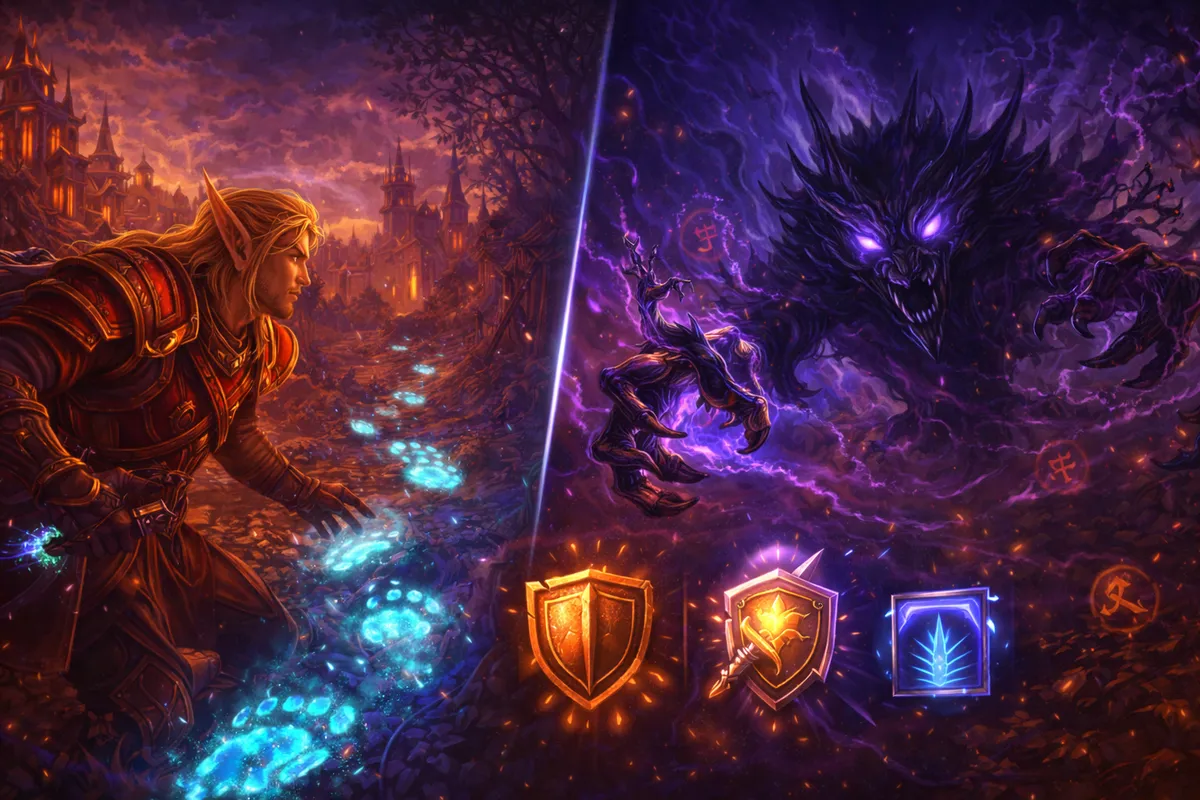
The Defensive Mindset That Makes Prey Feel “Fair”
Most deaths in Prey are not “one-shot mistakes.” They’re “I was already stressed, then the hunt started” moments. Defensive success is about eliminating those stacked-stress situations.
Adopt this mindset and you’ll immediately survive more:
- You are never fully “out of danger” during a hunt. Even if nothing has happened for 10 minutes, you still play like it can happen now.
- You don’t spend your best tools on trash. You keep at least one answer available for the ambush.
- You treat control as defense. Interrupts, stuns, roots, knockbacks, and disorients prevent damage before it happens.
- You fight in terrain that allows a reset. Wide space is a defensive resource.
- You choose consistency over ego. The best difficulty is the one you can finish cleanly, not the one that looks impressive on paper.
If you follow those rules, your hunts stop feeling random and start feeling like a system you can manage.
Normal vs Hard vs Nightmare: How Defense Priorities Change
Your defensive plan should change as you climb difficulty.
Normal difficulty defense priorities
- Keep the hunt fun and steady.
- Build habits: interrupt often, use a short defensive early, and don’t panic.
- If your target appears at a bad time, you can often survive because nearby players can help in the outdoor world.
Hard difficulty defense priorities
- Assume Torments will punish sloppy pulls and standing still.
- Your defensive plan needs structure: you can’t press everything at once.
- Practice “stabilize first, then burst” because Hard kills hunters who keep trying to DPS while losing control.
Nightmare difficulty defense priorities
- Treat the entire hunt like a dangerous challenge layer.
- You need a real reset plan: kite routes, terrain choices, and a disciplined cooldown budget.
- Don’t count on safety windows the way you do below Nightmare — Nightmare is where the system is allowed to be mean.
If you feel “Nightmare is impossible,” it usually means your defensive plan is missing one of the essentials: a short defensive cadence, a control cadence, or a reliable disengage.
Your Prey’s Three Most Dangerous “Kill Patterns”
Understanding how you die is the fastest way to stop dying. Most Prey wipes fit into one of these patterns:
Pattern 1: The Surprise Spike
You’re mid-fight, your health drops fast, and you don’t react quickly enough.
Fix: keep one short defensive available and press it early when pressure begins.
Pattern 2: The Free-Cast Punish
The Prey (or its mechanics) gets key casts off while you’re focused on damage.
Fix: treat interrupts and stops as mandatory. Use a focus interrupt habit.
Pattern 3: The Slow Spiral
You don’t die instantly — you slowly lose control. You burn cooldowns poorly, you panic heal, you can’t reset, and you die 20–40 seconds later.
Fix: learn to disengage earlier. Kiting and line-of-sight are defensive tools, not surrender.
When you recognize which pattern is killing you, you can tune your build and habits for that pattern instead of guessing.
The “Three-Second Rule” for Surviving Ambushes
When the Prey appears, your first three seconds decide the hunt.
Here’s the simple protocol that works for almost every class and role:
- Stop the biggest immediate threat.
- Interrupt, stun, knockback, root — whatever prevents the first dangerous cast or hit sequence.
- Stabilize your health and positioning.
- Hit a short defensive or quick self-heal. Move into open space. Turn away from cliff edges and tight choke points.
- Only then commit damage.
- Once you’re stable, you can burst. If you burst while unstable, you often die mid-cooldown and waste the entire attempt.
This is the single most important defensive lesson for Prey: control first, stabilize second, damage third.
Cooldown Budgeting: The System That Prevents “Empty Hands” Deaths
Prey punishes players who dump all cooldowns early and then have nothing for the next spike. The fix is a budget.
Think of your defensives in three tiers:
- Tier A (Short defensives): low cooldown, press early, keeps you stable (your “always available” tools).
- Tier B (Major defensives): longer cooldown, saved for the worst moment (your “I refuse to die” button).
- Tier C (Resets/escapes): movement or disengage tools that let you break the fight’s momentum.
A healthy Prey budget looks like this:
- Use Tier A early when pressure starts.
- Save Tier B for the moment you’d otherwise lose control.
- Use Tier C before you’re desperate, not after you’re nearly dead.
If your class has a “cheat death” style tool, treat it like Tier B. It’s not a license to play sloppy — it’s insurance for the moment the hunt gets unfair.
The Defensive Loop That Works in Every Hunt
If you want a repeatable rhythm, use this loop:
- Open with control (interrupt/stop)
- Apply steady damage while staying mobile
- Use a short defensive at the first real pressure
- Re-control the target when your short defensive ends
- Burst only when you’re stable
- Disengage when control tools are down
- Reset and re-engage
This loop is how you turn chaos into a predictable routine. It’s not flashy, but it’s extremely consistent — especially on Hard and Nightmare.
Torments: Why They Make “Trash Mobs” Dangerous
Hard and Nightmare introduce Torments that add extra pressure. The important defensive truth is that Torments don’t only matter in the final fight — they can change how the whole zone feels while you’re hunting.
That has two big consequences:
- Your normal open-world pulls become riskier. You can’t autopilot through packs the way you do without a hunt active.
- Your defensive plan must include “trash survival.” If you spend everything on a random pack and then the Prey appears, you’re done.
Torment-proofing your play means:
- pull smaller,
- fight in open terrain,
- keep at least one defensive ready,
- and always have an interrupt or stop available.
If you do that, Torments feel like an extra challenge layer — not a random death sentence.
The “Safe to AFK” Trap: Why Hunters Get Caught
Many players mentally treat outdoor content as “safe,” especially if nothing has happened for a while. Prey punishes that assumption.
The most common trap looks like this:
- You start doing normal objectives.
- You spend cooldowns on convenience.
- You start multitasking or relaxing.
- Then the ambush arrives when you’re distracted, low resources, or mid-pull.
To avoid it, keep one simple rule:
If you are hunting, you are on duty.
That doesn’t mean you must sweat constantly. It means you keep:
- one defensive available,
- one stop available,
- and your camera awareness active.
That’s enough to turn most ambushes into wins.
Terrain Defense: The Secret Weapon Most Hunters Ignore
In Prey, terrain is a defensive cooldown.
Here’s what to look for when choosing where to fight:
Good terrain
- wide open space for kiting,
- clean sight lines for casts and interrupts,
- gentle slopes rather than cliffs,
- low density of extra mobs.
Bad terrain
- narrow chokepoints that trap you,
- ledges that risk falling or pathing issues,
- tight camps where adds join accidentally,
- places with lots of “sticky” enemies that prevent a reset.
A simple hunting habit:
- If you’re about to engage something in terrible terrain, move 10–20 seconds to a better spot first.
- Those seconds save minutes of corpse-running later.
Interrupt and Stop Priority: Defensive Control That Saves Your Life
In Prey, the highest-value defensive buttons are often your stops, not your shields.
If you want a clean priority system:
- Interrupt the dangerous cast (if it can be interrupted).
- Use a stop (stun, incap, knockback) if the cast can’t be interrupted or you’re too late.
- Use a defensive if you can’t prevent the hit.
- Disengage if you’re losing control and your tools are down.
If you’re playing with friends, your survival improves massively when you coordinate:
- one player handles the first interrupt,
- one handles the second,
- and you keep a stop reserved for emergencies.
Control planning is defensive planning.
Defensive Tips for Melee Hunters: How Not to Get Deleted in Close Range
Melee builds often die because they refuse to give up uptime. Prey punishes that greed.
Melee defensive rules:
- Don’t trade your life for a damage window. If you need to disengage, disengage.
- Save mobility for defense, not only chase. Your dash/leap is a survival tool.
- Use your stop to create a heal window. Stun → self-heal → reposition is a winning pattern.
- Respect overlapping mechanics. If you’re mid-pack and the Prey appears, you’re allowed to peel away and reset the fight.
A strong melee habit:
- burst during your control window,
- then step out and stabilize,
- then re-enter for the next window.
That rhythm is what keeps melee alive in ambush-driven content.
Defensive Tips for Ranged Hunters: How to Avoid the “Cornered Caster” Death
Ranged players often die because they stand still too long and assume distance equals safety.
Ranged defensive rules:
- Kite early, not late. If you wait until you’re low health to move, you’ll die while moving.
- Use slows/roots proactively. Space is your best defensive resource.
- Never tunnel a long cast when danger is rising. Cancel and move.
- Use line-of-sight as a defensive tool if the prey has ranged pressure that punishes standing in the open.
A strong ranged habit:
- apply your core damage,
- move to keep safe distance,
- stop dangerous casts,
- then re-commit when stable.
Ranged is not “stand and turret.” Ranged is “control the fight’s geometry.”
Pet-Based Defense: The Easiest Way to Stabilize Ambushes
Pet classes and pet talents can be a huge defensive advantage because they reduce direct pressure on you and buy you decision time.
Pet-friendly survival advantages:
- the pet absorbs early hits,
- you can keep damage going while repositioning,
- you can use pet control to stabilize adds or chaos moments.
Pet defensive rules:
- Keep your pet healthy and treat pet management as survival, not convenience.
- Use pet positioning so the prey doesn’t drag into extra mobs.
- Don’t rely on the pet as a full tank in higher difficulties unless your kit supports it — you still need your own defensives.
If you struggle with Hard/Nightmare anxiety, pet-based play is one of the best “confidence builders” in Prey.
Tank and Hybrid Defense: The “Consistency First” Approach
Tanks and hybrids are often the most comfortable way to progress Prey because their kits naturally include:
- survivability,
- self-sustain,
- control tools.
But tanks still die in Prey when they overpull and get ambushed mid-chaos.
Tank/hybrid defensive rules:
- Pull smaller during hunts than you would normally.
- Don’t stack multiple dangers (big pack + ambush + terrain) unless you’re fully prepared.
- Use mitigation proactively so your heal windows stay clean.
- Save a major defensive for the moment the prey appears mid-pack.
A tank’s fastest path is not “big pulls.”
It’s “never dying while steadily progressing.”
The “Don’t Overpull” Rule That Saves More Hunts Than Any Talent
If you want the simplest survival rule that makes you instantly better at Prey:
While hunting, you do not take unnecessary multi-pulls.
Overpulling turns ambushes into unwinnable stacks:
- you’re already managing multiple enemies,
- your defensives are already being used,
- you’re already in messy terrain,
- and then the prey arrives.
You can still be efficient without large pulls:
- fight small and frequently,
- keep your combat uptime high,
- and keep your defensive budget intact.
You’ll finish more hunts faster by avoiding wipes than by chasing “speed pulls.”
Hard and Nightmare Final Encounters: Defensive Prep That Actually Works
Hard and Nightmare finals are where hunters fail because they treat them like normal open-world elites. The final encounter is meant to be a true skill check.
Before you start a final encounter, do this prep:
- Cooldown check: major defensive ready, movement tool ready, one stop ready.
- Resource check: high health and stable resources (mana/energy/rage).
- Terrain check: fight area is open enough to kite without pulling extras.
- Focus check: you’re not distracted, rushed, or multitasking.
During the final:
- Use your short defensive early when pressure begins, not when you’re nearly dead.
- Rotate stops to prevent dangerous casts and regain control.
- Disengage strategically if the fight is spiraling — a reset is often faster than dying.
The final encounter rewards calm execution far more than raw damage.
Astalor’s Demands: The Defensive Way to Handle Surprise Tasks
During hunts, Astalor Bloodsworn can appear and add pressure with spontaneous demands. This is where hunters waste time and die because they panic and try to do something flashy.
The safest approach:
- Treat Astalor’s interruptions as tempo moments, not emergencies.
- If the demand is “kill an enemy quickly,” remember the practical trick: tiny critters can satisfy it.
- Don’t sprint into a dangerous camp just to fulfill the demand — that’s how you stack danger on danger.
The defensive philosophy is simple:
Fulfill demands in the safest possible way, then return to your stable loop.
Defensive Build Tuning: What to Change When You Keep Dying
If you’re dying repeatedly, don’t just “try harder.” Make a build adjustment. The best defense tuning is small and targeted.
Here are high-impact changes that keep your damage respectable:
- Add one extra stop (stun/knock/disable) even if it costs a minor damage pick.
- Add one mobility upgrade so you can reposition without sacrificing your entire rotation.
- Add one sustain talent (self-heal, absorb, damage reduction) that works frequently.
- If you’re extremely glassy, shift a bit toward survivability stats so mistakes aren’t instantly fatal.
The rule is:
A small survivability upgrade that prevents deaths is a damage upgrade, because it prevents resets.
Solo Survival Checklist: What to Do Before You Leave Silvermoon
Before you start a hunt, run this checklist:
- One short defensive is on a comfortable key.
- One major defensive is on a panic key.
- Interrupt key is easy to hit on reaction.
- One stop is available (stun/knock/incap).
- Movement tool is ready (dash/blink/leap).
- Your UI shows enemy casts clearly.
- You have a plan for terrain (where you’ll fight if ambushed).
If you do nothing else, do this:
Decide your escape direction before the prey appears.
When the ambush happens, you’ll move instinctively instead of freezing.
Duo and Small Party Defense: How to Survive Together Without Chaos
A duo or small party becomes dramatically stronger in Prey if you coordinate defensives and control. Without coordination, parties often die because everyone overlaps the same buttons at the same time.
A clean party defensive plan:
- Assign interrupt order (Player A first, Player B second).
- Assign emergency stop (one person reserves a stun for “oh no” moments).
- Assign an external defensive window (if your comp has it, decide when it’s used).
- Agree on disengage rules (“If we lose control, we kite left and reset”).
The biggest party mistake:
- All defensives at once → then nothing → then wipe.
Staggering tools is what turns a party into a machine.
Nightmare Survival: The Habits That Separate Winners From Wipes
Nightmare hunts are designed to be punishing. You’re supposed to feel hunted. That means you must play with discipline.
Nightmare habits that win:
- You do not enter fights low health or low resources.
- You do not overpull, ever.
- You keep a defensive and a stop available at all times.
- You fight in open terrain and avoid cluttered camps.
- You commit burst only when stable, not as a panic reaction.
- You disengage earlier than your ego wants to.
Nightmare is less about hero moments and more about controlled, repeatable execution.
How to Turn Defense Into Speed: “No Deaths” Is the Fastest Farm
Hunters who want rewards quickly sometimes assume the fastest strategy is maximum damage. In Prey, the fastest strategy is usually:
- clean hunts,
- no corpse runs,
- no failed finals,
- and consistent weekly progress.
That requires defense.
If your goal is efficiency:
- Use the difficulty you can clear consistently.
- Build for control and mobility first, then add burst once you’re stable.
- Stop sessions when you’re tilted or tired — fatigue causes defensive mistakes.
A calm, consistent hunter farms faster than an aggressive hunter who dies twice per hour.
How BoostRoom Helps Hunters Survive Prey (and Finish Faster)
Prey is thrilling, but it can become frustrating if you keep failing finals, struggling with Torments, or losing hunts to “bad timing” ambushes. That’s where BoostRoom helps — especially for players who want rewards and progression without burning their limited playtime.
BoostRoom can help you:
- build a reliable defensive plan for your class and playstyle,
- learn the “three-second rule” so ambushes stop feeling random,
- coordinate duo or small-party control plans for Hard and Nightmare finals,
- reduce failed attempts so your weekly progress and reward chasing stays on track.
If you want the fun part of Prey (the hunt, the challenge, the rewards) without the repeated failure loop, BoostRoom is the practical shortcut: fewer wipes, more completions, faster results.
FAQ
Can my Prey really ambush me while I’m fighting other mobs?
Yes. Prey is designed to be unpredictable, and ambush timing often targets moments when you’re already occupied in combat.
Is defense more important than damage in Prey?
Defense is what makes your damage matter. A slightly lower-damage build that never dies will finish more hunts than a glassy build that resets often.
What’s the biggest defensive mistake hunters make?
Overpulling while a hunt is active, then getting ambushed with no cooldowns available. Smaller pulls and better cooldown budgeting solve most problems.
Do I need different defensives for Hard and Nightmare?
You need stricter habits and better budgeting. Torments add pressure, so you should keep control tools and a major defensive available more consistently.
What should I press first when the prey appears?
A stop or interrupt to prevent immediate danger, then a short defensive or quick self-heal to stabilize, then damage.
How do I avoid panic-casting and dying as a ranged class?
Move earlier, not later. Kiting and slows are proactive defenses. Don’t commit to long casts while danger is rising.
How do parties survive Hard and Nightmare finals more reliably?
Assign interrupts, reserve one emergency stop, stagger defensives, and agree on a disengage direction before the fight.
How does BoostRoom help with Prey survival?
BoostRoom helps you tune your defensive plan, improve ambush reactions, coordinate party strategy, and reduce failed attempts so you earn rewards faster.



