How Borderlands 4 Classes Work
In Borderlands 4, “class” is basically the complete package of how your Vault Hunter creates value in a fight. It’s not just a single Action Skill or a single skill tree. Your class power comes from four layers working together:
- Trait: a unique passive rule that shapes your identity all the time
- Action Skill: your signature ability that defines your combat loop
- Skill Tree investment: the passives and branch choices that decide how you scale
- Augment + Capstone selection: the “modifier layer” that can reshape your Action Skill without re-leveling
The big difference from older Borderlands habits is this: Borderlands 4 wants you to commit to an Action Skill identity and then make high-impact choices within that identity, rather than spreading points everywhere and hoping the math stacks.
That’s why fan discussions often sound like:
- “Which Action Skill actually feels best?”
- “Which capstone changes the playstyle, not just the numbers?”
- “Which tree has the least filler?”
- “How fast can I respec and test?”
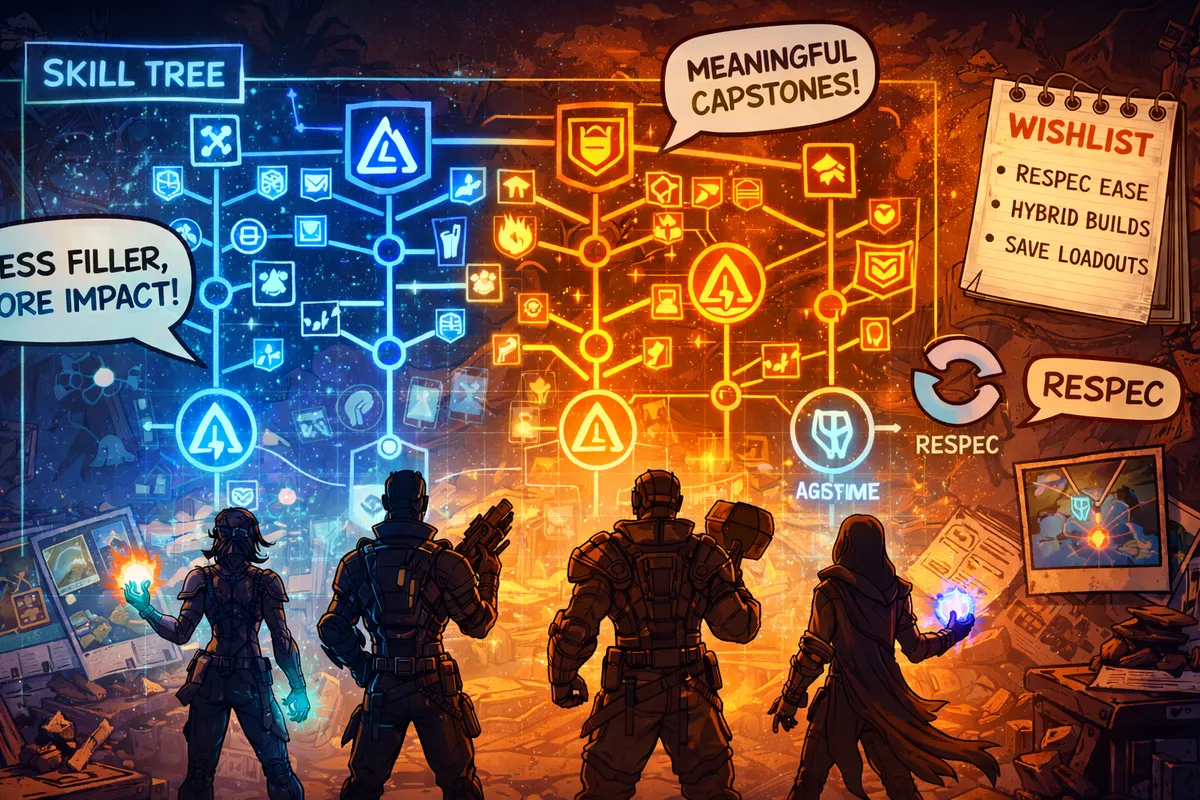
Traits, Action Skills, and the Three-Tree Structure
Each Vault Hunter in Borderlands 4 comes with:
- One Trait that shapes their playstyle
- Three Action Skills to choose from
- Three skill trees (each tied to one Action Skill)
This is the core promise: even if there are “only” four Vault Hunters at launch, the Action Skill + skill tree structure is designed to multiply builds dramatically.
Traits are important because they’re not tiny bonuses. They influence moment-to-moment decisions:
- Some Traits reward element matching and weapon swapping
- Some reward Action Skill uptime and momentum
- Some reward utility and survivability options that change co-op roles
- Some reward target linking and crowd control, which scales with team play
Action Skills matter because they determine your rhythm:
- Do you burst, then cooldown, then burst again?
- Do you maintain a long skill window and stay aggressive?
- Do you convert your skill into positioning, control, or survivability?
And skill trees matter because Borderlands 4’s trees are structured so you can’t just take “a little of everything” and reach all the best stuff easily. Your branching path choices determine what kind of Vault Hunter you become.
Augments and Capstones: The New Build Heart
Borderlands 4 makes augments and capstones a bigger deal than in some previous entries.
- Augments are enhancements that provide secondary bonuses or behavior changes to your Action Skill.
- Capstones are powerful enhancements that can modify or override specific Action Skill functionality, and they’re located at the bottoms of branches.
- In most cases, you’re limited to one Augment and one Capstone equipped at a time.
That last part is a huge reason fans are talking: if capstones can significantly transform how an Action Skill behaves, then choosing one capstone is no longer just “pick the obvious best.” It becomes a playstyle decision.
A good way to think about this layer:
- Skill points decide your engine (how you scale and what you specialize into)
- Augments and capstones decide your steering wheel (how you drive that engine)
Branching and Tiers: Why Your Path Choice Matters
Borderlands 4 skill trees use tiered progression:
- You unlock deeper tiers by investing points
- Later tiers split into branches, and branches require their own investment to access deeper nodes
This structure is one of the reasons Borderlands 4 build talk feels more “serious” than casual: your tree is not just a list of upgrades, it’s a map. If you commit to Branch A, you’re choosing what you won’t get from Branch B and Branch C—at least until future level cap increases add more points.
That branching design is also why fans care so much about “filler nodes.” If a branch forces you to spend points that don’t feel noticeable, it can make the branch feel like a tax rather than a path.
Swapping and Respeccing: How Flexible Builds Really Are
Borderlands 4 is more flexible than many players expect, but it’s not “anything goes.”
What you can typically do easily:
- Swap Action Skills on the fly
- Swap unlocked Augments and Capstones on the fly
What still requires a deliberate reset:
- A full skill tree reset (respec) usually needs a hub/respec station, and it costs in-game currency
This matters for fans because Borderlands has always been a theorycrafting game. Players don’t just want one build—they want the ability to test multiple builds without friction. A system that’s too restrictive discourages experimentation, while a system that’s too open can break balance.
The sweet spot most fans ask for is:
- Quick swapping for “build flavors” (Augment/Capstone variations)
- A straightforward respec loop for “build identities” (full tree changes)
- Clear UI that explains what changed and why your build feels different now
Skill Points and Level Cap: Why Fans Care So Much
At the time many players hit endgame, Borderlands 4’s level cap has been 50, providing 49 skill points to spend. That number matters because:
- It shapes how many branches you can realistically complete
- It determines whether “hybrid builds” are viable or feel underpowered
- It decides how much experimentation is possible without feeling like you’re missing key power milestones
The community almost always wants two things from skill points:
- Enough points to complete a satisfying “main” tree identity
- Enough leftover points to add a meaningful secondary flavor without becoming a weak generalist
Borderlands 4’s official roadmap messaging also points toward level cap increases in future updates, which is exactly what fans expect from a Borderlands lifecycle. More points generally means:
- More hybrid build options
- More capstone interactions
- More incentives to revisit older characters
- More demand for quality-of-life systems like shared progression and cross-save
What Fans Want Most: Less Filler, More Impact
If you combine years of Borderlands community feedback, one theme never dies:
Fans want skill points to feel like they matter.
That usually translates into:
- Fewer tiny stat bumps that are hard to feel in gameplay
- More nodes that change how you fight, not just what your damage number says
- Milestones that feel exciting (new interactions, new loops, new mechanics)
Examples of what “impactful” feels like in Borderlands:
- A node that changes how you reload, how you crit, or how you stack status effects
- A node that turns survivability into offense (or offense into survivability)
- A node that creates a new loop: “do X → get Y → explode Z”
Players don’t mind passive stats when they support a clear identity. What fans hate is passive stats that feel random, hyper-specific, or disconnected from the character fantasy.
A practical way to judge a tree (and what fans want trees to pass):
- If you remove five random nodes, does the tree still feel like the same character?
- If the answer is “yes,” fans will call it filler.
What Fans Want Most: Capstones That Change the Game
Capstones are where Borderlands builds become memorable—because capstones can turn “a build” into “a playstyle.”
Fans generally want capstones to do at least one of these:
- Transform the Action Skill into a new version (new behavior, new goal, new rhythm)
- Create a unique build endpoint (a reason to commit deeply)
- Enable a niche identity that’s still endgame-viable (melee, pets, DoT, support-DPS hybrids)
But fans also want capstones to avoid common traps:
- A capstone that’s mathematically mandatory (kills variety)
- A capstone that looks cool but isn’t strong enough to justify the investment (kills excitement)
- A capstone that only works with one specific piece of gear (kills accessibility)
The most important “fan expectation” for Borderlands 4 capstones is choice. If only one capstone per tree is truly good, the whole tree becomes less interesting.
What Fans Want Most: Better Cross-Tree Freedom Without Broken Balance
Borderlands 4 allows you to use Action Skills from other trees even if you haven’t invested points into that tree. That’s excellent for experimentation and for players who want to test “feel” before committing points.
However, the system also enforces a key limitation that many fans understand and even support:
- You generally can’t equip powerful Augments or Capstones from one tree onto an Action Skill from a different tree.
Why fans are split here:
- One side wants full “mix and match” freedom because it creates wild build creativity.
- The other side wants restrictions because it prevents every character from collapsing into one broken “best setup.”
What fans commonly ask for as a compromise:
- More meaningful cross-tree synergy through passives (not through “stealing” capstones)
- More “bridge nodes” that reward small investments into a secondary tree
- Better balance so hybrid builds are viable without outclassing specialized builds
In simple terms: fans want creative freedom, but they also want identity integrity.
What Fans Want Most: Build Loadouts, UI Clarity, and Planning Tools
Borderlands players love build crafting, but they hate fighting the interface.
The most common “quality-of-life wishlist” items around classes and skill trees:
- Saved build loadouts (swap between builds without manually re-slotting everything)
- Clearer explanations of what is additive vs multiplicative (so you know what matters)
- Better visual feedback for complex mechanics (stacks, timers, links, uptime windows)
- Fast comparisons (what changed if I swap this augment?)
- In-game build notes (let players write “boss build” and “mobbing build” notes)
Even when third-party planners exist, fans still want the game to support build planning in a clean, official way. The best UI makes experimentation feel fun rather than tedious.
What Fans Want Most: Class Mods That Drop for the Character You’re Playing
A classic Borderlands frustration is farming and getting class mods (or class-specific gear) for the wrong character. That’s not just annoying—it actively discourages experimenting with builds.
Fans consistently want:
- Higher chances for class mods to drop for the current character
- Clearer farming targets and dedicated drops
- Less “inventory heartbreak” where you see a perfect mod you can’t use
When class mods align with your current character more often, the build loop becomes healthier:
- You test more builds
- You respec more
- You stay engaged longer
- You feel rewarded instead of punished
What Fans Want Most: Endgame-Specific Skill Support
Borderlands builds often feel great in the campaign and then fall apart in endgame when enemy health spikes and mechanics demand more consistency.
Fans want skill trees to support endgame realities:
- Reliable survivability tools that don’t require perfect gear
- Damage scaling that rewards skillful play (crit, positioning, timing)
- Build paths that stay viable when mobs get tanky and bosses punish mistakes
- Clear roles in co-op (damage, control, support, frontline) that matter in harder modes
A big part of this is making sure endgame isn’t “one build wins.” Fans want multiple viable endgame archetypes:
- Gun DPS builds
- Element/status builds
- Melee builds that actually scale
- Pet/minion builds that aren’t just novelty
- Support-DPS hybrids that feel active, not passive
What Fans Want Most: Co-op Roles That Feel Different
Borderlands 4 leans heavily into co-op design: instanced loot, scaling, individual difficulty, easier fast travel to teammates. That makes class identity even more important because co-op players want to feel like they contribute in unique ways.
What co-op fans typically want from skill trees:
- A reason to coordinate (linked targets, debuffs, crowd control, aggro tools)
- Utility that feels exciting (not just invisible buffs)
- Builds that don’t require perfect aim to be useful (important for mixed-skill groups)
- Multiple “team value” endpoints, not just one support path
The dream scenario for most squads:
- Every Vault Hunter can be strong solo
- Every Vault Hunter can offer a distinct co-op advantage
- No one feels forced into a boring role
Class Identity Breakdown: What Each Archetype Adds to the Build Meta
Even without listing every skill node, Borderlands 4’s four launch Vault Hunters cover four major archetype lanes that fans typically want:
- Element + summoning lane (great for flexibility and solo stability)
- Momentum + uptime lane (great for players who love skill expression)
- Tank + utility lane (great for co-op reliability and frontline control)
- Crowd control + linked damage lane (great for turning team damage into efficiency)
Fans love this lineup because it supports different definitions of “fun,” but they still want the trees to deliver on the promise:
- The summoner shouldn’t feel like their minions fall off later
- The uptime character shouldn’t be forced into one “infinite skill” exploit to feel good
- The tank shouldn’t be strong only by becoming unkillable (and boring)
- The controller shouldn’t be useless against bosses or immune targets
How to Pick a Class Based on Your Playstyle
If you’re choosing a Vault Hunter mainly for build depth and long-term fun, use these filters:
- Do you enjoy swapping weapons often?
- If yes, you’ll love Traits and trees that reward elemental and manufacturer switching. If no, pick a class that gets value from consistency.
- Do you want your Action Skill to be your identity?
- If yes, choose the character whose Action Skill feels satisfying even at low level, because you’ll be pressing that button for months.
- Do you prefer “safe power” or “skill power”?
- Safe power feels good even when you’re tired. Skill power feels amazing when you’re locked in.
- Do you mostly play solo or co-op?
- Solo favors self-sufficiency. Co-op favors specialization and synergy. Pick the class that matches your real life, not your fantasy.
A simple rule fans often learn the hard way:
If the class is only fun when you have perfect gear, it isn’t your main—it’s your “later alt.”
Practical Build Planning: A Step-by-Step Method That Works
If you want a reliable method (the kind experienced players use), do this:
- Pick a primary Action Skill first
- Choose based on feel. If you don’t love pressing it, don’t build around it.
- Decide your primary job
- Mobbing, bossing, or co-op utility. You can eventually do all three, but your first build should have one priority.
- Commit to one branch path
- Branching matters. Pick the branch that supports your primary job, not the one with the coolest description.
- Choose your Augment to solve a problem
- Need survivability? Choose the augment that keeps you alive.
- Need uptime? Choose the augment that feeds cooldowns or duration.
- Need clear speed? Choose the augment that increases coverage or chaining.
- Choose your Capstone to define your identity
- Your capstone should make your build feel distinct. If it doesn’t change how you play, you may be chasing the wrong endpoint.
- Use your gear to reinforce, not replace, your build
- Gear should amplify your loop. If your build only works because one legendary carries it, it will feel unstable.
- Split your presets mentally
- Even if you don’t have saved loadouts, think in two setups:
- A “mobbing loop” setup
- A “boss loop” setup
- Then adjust augments/capstones accordingly if your class supports it.
Common Build Mistakes That Make Good Classes Feel Bad
Borderlands players often blame the class when the problem is the plan. These are the mistakes fans complain about most—because they feel like “my class is weak,” when it’s really “my build is unfocused.”
- Spreading points too thin
- Borderlands 4 rewards deep investment. If you spread points everywhere, you may never reach the real power milestones.
- Chasing damage before uptime
- A build that does big damage occasionally feels worse than a build that does solid damage constantly.
- Ignoring survivability tools
- Endgame punishes greed. If you can’t stay shooting, you can’t do damage.
- Equipping the “cool” augment instead of the “useful” one
- The best augment is the one that fixes your build’s biggest weakness.
- Building for bosses while leveling
- Campaign leveling rewards comfort and flexibility. Boss builds matter more later.
- Not adapting to co-op reality
- In co-op, enemies behave differently, fights get messier, and your role matters. A solo glass cannon can feel terrible in a four-player party.
BoostRoom: Faster Builds, Less Grind, More Testing
Classes and skill trees are the fun part—getting to the point where you can actually test them is the time sink.
BoostRoom helps Borderlands 4 players who want:
- Faster leveling to reach the point where builds “turn on”
- Less time stuck in gear droughts that make skill trees feel worse than they are
- A smoother path to endgame readiness so you can farm and experiment sooner
- Better momentum when you want to try a new build or a new Vault Hunter without restarting your life
The real value is simple: you spend more time doing what Borderlands is best at—build crafting, boss loops, and loot chasing—and less time doing low-value repetition.
FAQ
What’s the biggest difference between Borderlands 4 skill trees and older games?
Borderlands 4 emphasizes three Action Skills per Vault Hunter, each tied to a dedicated tree, with branching paths and a stronger augment/capstone layer that can significantly change how skills behave.
Can I use an Action Skill from a tree I didn’t invest in?
Yes, you can use Action Skills from other skill trees even without points invested, which is great for testing. But the strongest augments and capstones are usually tied to their specific tree and can’t be freely attached to other Action Skills.
Why do fans complain about “filler nodes”?
Because points are limited, and branching paths can force investments. If too many nodes don’t feel impactful, builds feel like they require “tax points” rather than rewarding choices.
What do fans want most from capstones in Borderlands 4?
Capstones that meaningfully change playstyle, create distinct build endpoints, and offer real choices—without one capstone becoming the only correct option.
Will the level cap increase?
Official messaging points toward future level cap increases, which usually means more skill points, more hybrid builds, and more reasons to revisit characters.
What’s the best way to plan a build without copying someone else?
Pick an Action Skill you enjoy, choose your primary job (mobs/boss/co-op), commit to a branch, select an augment to solve your biggest weakness, then select a capstone to define your identity.
How does BoostRoom help with classes and skill trees?
BoostRoom helps you reach the stage where builds feel complete—faster leveling, smoother build setup, and less grind—so you can spend your time testing playstyles and farming the content you enjoy.



