Why Midnight makes “reliable runs” more valuable than ever
Midnight isn’t just “new dungeons.” It’s also a shift in how groups coordinate, track mechanics, and keep pulls clean.
Here’s what that means for Mythic+:
- Low keys are getting a routing on-ramp. Midnight introduces a low-key affix designed to help players learn a basic route in early Mythic+ levels. If you’re pushing from +2 upward, this is a huge quality-of-life boost—but it also means the early ladder will be busy with players learning (and sometimes learning the hard way).
- UI and combat awareness are more standardized. Midnight leans harder into built-in tools like boss timelines, warnings, and better tracking, which should reduce the “you must have 12 addons or you’re griefing” vibe. The upside is smoother baseline play. The downside is that groups still need leadership, planning, and calm calls when pressure spikes.
- The early-season dungeon pool always creates friction. New mechanics + unfamiliar routes + different affixes = more wipes, more bricked keys, more wasted evenings—especially in random groups.
- Vault planning matters more than grinding. Most players don’t need to spam keys endlessly. They need a weekly plan that gives them strong options and a clear upgrade path without burning out.
So, the best Mythic+ carry in Midnight isn’t necessarily the one that sounds “fastest.” It’s the one that gives you clean completions, consistent weekly value, and predictable progress.
BoostRoom Mythic+ carry options for Midnight at a glance
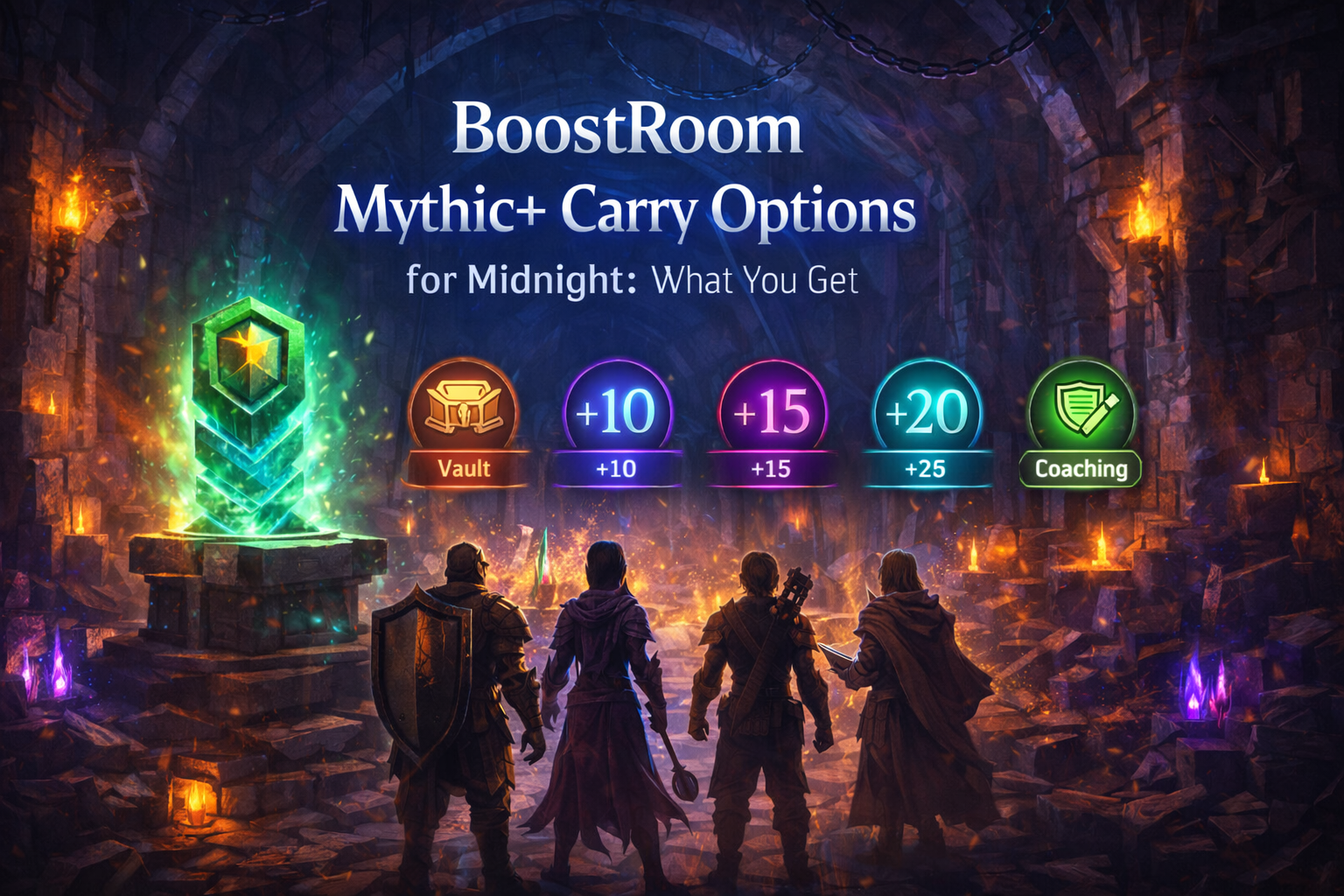
BoostRoom’s Mythic+ catalog is built to cover every stage of the keystone climb. Depending on your goal, you’ll usually look at options like:
- Mythic+ 0 (baseline Mythic)
- M+ Loot Runs (Lower Keys)
- Mythic +10 Carry
- Mythic +15 Boost
- Mythic +20 Carry
- Mythic +25 Boost (high keys)
- Mythic Keystone Upgrade (upgrade your key level)
- Great Vault Service (weekly reward planning)
- M+ Gear Boost (loot targeting / slot focus)
- Keystone Master package
- Keystone Hero package
- Keystone Legend package
- Resilient Keystone Carry (stability-focused option)
- Unbound Hero Boost (top-tier seasonal prestige goal, where applicable)
You don’t need to memorize the list. You need to match the option to your intent. The next sections explain exactly what each type is for—and what you get.
Option 1: Mythic+ 0 and lower-key runs (the “stable start” path)
If you’re new to Midnight’s dungeon pool, returning after a break, or gearing an alt that isn’t ready to sprint into double-digit keys, this is where you start.
What this option is best for:
- Learning dungeon layouts and boss mechanics without timer pressure.
- Building baseline gear so your first timed keys don’t feel like survival mode.
- Getting comfortable with your role responsibilities (kicks, stops, defensives, dispels).
- Creating a smooth ramp into +2–+5 keys, where early-season learning is common.
What you get from runs in this lane:
- Completion progress through the dungeon pool so you’re not blind later.
- A cleaner learning environment than random groups because pulls are planned.
- A real “how keys feel” experience without the chaos of “everyone is learning and nobody is leading.”
Why this matters in Midnight:
Midnight’s early key levels are designed to be a learning space, including route guidance in lower keys. That’s great—but only if the run is organized enough for you to actually learn. A calm, controlled group turns “learning keys” into “progress keys.”
Who should pick this:
- New Mythic+ players.
- Returning players who want a non-stress re-entry.
- Alt enjoyers who want to gear up without gambling their limited time.
Option 2: Mythic Keystone Upgrade (the “level my key” option)
Sometimes your goal isn’t “run a specific dungeon at a specific level.” It’s “I want my keystone higher so I can enter better keys all week.”
That’s what a keystone upgrade-focused service is for.
What this option is best for:
- Taking your key from low level to a higher level efficiently.
- Avoiding the common problem of bricking your key with random groups.
- Building momentum so your week starts strong (and stays strong).
What you get:
- A structured plan to complete keys successfully so your keystone upgrades instead of downgrading.
- A smoother keystone journey with fewer dead-end attempts.
- A more consistent path toward your preferred dungeon levels.
How to get the most value:
- Pick upgrade sessions early in the week so you benefit from the higher key for longer.
- Be clear about your comfort zone. A clean +10 you can repeat is often more valuable than a messy +12 that burns you out.
- Use the run to learn: ask about route logic, dangerous packs, and “where wipes usually happen.”
Option 3: +10 carries (the “weekly foundation” key level)
In modern Mythic+, +10 is a psychological milestone: it’s where players stop thinking “practice key” and start thinking “real key.” It’s also commonly tied to very practical rewards like portal/teleport unlock conditions in many seasons, plus meaningful score progression.
What +10 is best for:
- Starting a serious weekly routine.
- Building rating consistently.
- Creating a reliable baseline for Great Vault planning.
- Learning how the dungeon plays when mistakes actually matter.
What you get from a BoostRoom +10 carry-style run:
- A timed completion target (when you buy a timed service) or a clean completion (when you buy completion-first).
- Rating progress that actually moves your overall score meaningfully.
- A controlled run where interrupts, stops, and defensives are handled like a plan—not a wish.
Who should pick +10 carries:
- Players who are done “dabbling” and want a stable Mythic+ routine.
- Anyone who wants to start building score toward major milestones.
- Players who want consistency for weekly planning.
Option 4: +15 boosts (the “serious progress” lane)
A +15 is where the game starts demanding discipline. You can’t wing it. You need clean mechanics, correct stops, and a group that understands where the dungeon is dangerous.
What +15 is best for:
- Accelerating rating.
- Building confidence and skill in higher-pressure keys.
- Targeting stronger weekly-value outcomes through higher difficulty.
- Proving to yourself that you can handle the “real” Mythic+ cadence.
What you get:
- A run where pull pacing is controlled, not reckless.
- A clearer view of “what my role should be doing” at high intensity.
- Strong rating progress that compounds across the week.
The hidden benefit: skill transfer
A good +15 run teaches you more than ten messy low keys. You’ll notice patterns:
- Which casts must be interrupted.
- Which packs require defensives.
- Where line-of-sight and positioning matter most.
- How leaders call the minimum needed information so the team stays calm.
Option 5: +20 carries (the “high key reality check” lane)
High keys are where random groups often collapse. Not because players are bad, but because high keys punish small mistakes and weak coordination.
What +20 is best for:
- A big rating jump when done efficiently.
- High-end weekly planning (if your goal is “secure strong weekly outcomes”).
- Seeing what “real Mythic+ structure” looks like.
- Reducing the “I waste my whole night trying to find a capable group” problem.
What you get from a BoostRoom +20 carry:
- A stable group with role coverage that makes the dungeon feel manageable instead of chaotic.
- Clean execution around dangerous spikes.
- Calm calls that prevent panic play (panic is the #1 cause of high-key failures).
Who should buy this option:
- Players who want high-value progress with minimal time waste.
- Players pushing toward major rating milestones.
- Players who are tired of gambling on random leaders.
Option 6: +25 boosts and high keys (the “precision” lane)
Once you’re in the +25 zone, it’s not about “gear check.” It’s about precision: route control, cooldown mapping, pull planning, and clean mechanics under pressure.
What this option is best for:
- Top-end pushing.
- Personal achievement goals.
- Very high rating goals.
- Experiencing the true “competitive PvE” version of Mythic+.
What you get:
- A structured team environment where the run is planned like a script (but still adaptable).
- Correct use of stops and defensives so deaths don’t cascade into wipes.
- A clear look at how high-end groups manage risk: when to slow down, when to commit, when to use cooldowns aggressively.
Important mindset shift
At this level, speed is not “pull bigger.” Speed is pull smarter.
Option 7: Rating milestone packages (Keystone Master, Hero, Legend, and beyond)
If you want the cleanest “I know what I’m buying” result, milestone packages are the easiest to understand. Instead of purchasing one key level, you’re purchasing a rating goal.
Most seasons follow a familiar structure:
- Keystone Master is commonly tied to a 2,000 rating milestone and usually comes with a seasonal reward.
- Keystone Hero is commonly tied to a 2,500 rating milestone and is often associated with high-end seasonal prestige and dungeon convenience unlocks.
- Keystone Legend is commonly tied to a 3,000 rating milestone and is treated like a top-tier seasonal achievement.
What a milestone package typically includes:
- A planned spread of dungeons across the season’s rotation.
- A smart approach to both weekly affix types so your score grows efficiently.
- Keys at levels that maximize rating gain per run rather than wasting time on inefficient repeats.
- A completion plan that respects your schedule (you shouldn’t need to “live online” to finish).
What you get as the customer:
- A defined target (rating milestone).
- A mapped path (which dungeons, which weeks, which levels).
- Predictable progress without the “my week is ruined because pugs bricked my keys” stress.
Who should pick milestone packages:
- Players who care about seasonal rewards and prestige milestones.
- Players who want a clear “start to finish” plan rather than buying keys randomly.
- Players who want to stop guessing and start completing.
Option 8: Great Vault Service (the “weekly rewards secured” option)
If you’re busy, this is the smartest option to understand first.
A Great Vault-focused service isn’t about flexing your highest key. It’s about securing weekly reward options so your character progresses even when you can’t play much.
What this option is best for:
- Players with limited time who still want meaningful weekly upgrades.
- Players gearing multiple characters (alts love Vault planning).
- Players who want to avoid the “I played all week and got nothing useful” feeling.
What you get:
- A structured set of completions aimed at unlocking strong weekly reward choices.
- A “done for the week” feeling early—so the rest of your time can be for fun.
How to choose the right Vault plan
Ask yourself:
- Do I want one strong option, or several options to reduce bad luck?
- Do I want to secure my weekly value early, or gamble and hope I find time later?
Most players who feel stuck in Mythic+ aren’t stuck because they “can’t play.” They’re stuck because their week is unplanned. Vault services fix that.
Option 9: M+ Gear Boost (the “targeted loot” option)
Sometimes you don’t need “higher keys.” You need a specific slot upgrade—a trinket, a weapon, a ring, or a key stat piece that actually changes how your character plays.
A gear-focused Mythic+ service is designed to maximize:
- The number of relevant runs you complete.
- The chance you see the items you want.
- The efficiency of your time (no random dungeon spam if it doesn’t help your loot goals).
What you get:
- Runs selected for the loot you’re hunting (or run selection aligned with your objective).
- Cleaner completions so you actually reach the end and see rewards.
- A better “loot experience” because the group is stable and doesn’t disband.
The truth about targeted loot
Even the best plan can’t guarantee a specific drop every time. What a good gear boost does is remove the biggest enemy of loot farming: failed runs and wasted nights.
Option 10: M+ Loot Runs (Lower Keys) (the “fast reps” option)
Lower-key loot runs are about volume and comfort:
- Quick completions
- Less pressure
- Consistent repetition
What you get:
- A steady flow of completions that support gearing and familiarity.
- A lower-stress environment that’s perfect for alts and returning players.
- More chances to practice mechanics without the “one mistake ends the run” intensity.
This option pairs extremely well with a weekly routine:
- Use lower keys for volume and confidence.
- Use one or two higher keys for rating or weekly value.
- Stop when you hit your “done line.”
Option 11: Resilient Keystone Carry (the “stability-first” option)
Some players don’t want their run to be decided by a timer, a single wipe, or a bad pull. They want a completion that’s reliable, calm, and structured.
That’s the mindset behind a resilience-first carry option.
Who this is perfect for:
- Players learning tank routes or healing triage.
- Players returning from a break who don’t want timer pressure immediately.
- Players who prefer “finish cleanly” over “finish fast.”
What you get (in practical terms):
- A run that prioritizes stability and control.
- Clear guidance on dangerous moments and how to survive them.
- Fewer risky pulls, fewer ego decisions, fewer sudden collapses.
If you’ve ever said, “I don’t mind if it’s not timed—I just want it done,” this is your lane.
What you get inside a BoostRoom Mythic+ run (moment-by-moment)
People often ask, “Okay, but what does it feel like?”
A well-run BoostRoom key is structured, calm, and predictable:
Before pulls
- A quick route overview (“we’re starting here, then moving there”).
- A short reminder of key mechanics and danger packs.
- Role clarity: who’s kicking what, who’s stopping what, who’s using which utility.
During pulls
- Low-noise calls: short reminders like “kick X,” “defensive in 3,” “move left,” “stop that cast.”
- Smooth recovery if something goes wrong (minimal panic resets).
- Consistent pacing: no random “let’s yolo triple pull” moments unless it’s planned.
Between encounters
- Quick plan updates while moving.
- Short breaks only when needed.
- A focus on flow so the dungeon doesn’t become a stop-start mess.
At the end
- The objective is confirmed (timed, completed, milestone progress done).
- Optional micro-recap if coaching is included (what to improve, what worked).
This structure matters because Mythic+ is a rhythm game. The more consistent the rhythm, the more reliable your success becomes.
Scheduling and run structure: how BoostRoom protects your time
Most Mythic+ frustration isn’t “the dungeon is hard.” It’s “my time got wasted.”
BoostRoom’s run philosophy is designed around:
- Regions and scheduling windows that fit real life (common peak-time availability).
- On-time starts so your evening doesn’t disappear in prep chaos.
- Fixed session structure (clear start, clear endpoint, short breaks).
- Self-play as the standard approach so you stay in control of your character.
- Voice availability without pressure (helpful if you want it, not mandatory).
If you’re trying to build a weekly routine, those details are everything. A stable schedule turns Mythic+ into progress instead of gambling.
How to pick the right BoostRoom Mythic+ option (quick decision guide)
If you want the fastest way to choose, use this:
If you’re brand new or returning
- Start with Mythic 0 / lower-key loot runs
- Add a keystone upgrade chain once you feel stable
- Move into +10 when you can handle interrupts/defensives reliably
If you’re busy and want weekly value
- Prioritize Great Vault Service
- Add one +10 to +15 run if you want rating momentum
- Stop when your weekly options are secured
If you want rating milestones
- Choose Keystone Master / Hero / Legend packages
- Let the plan spread across dungeons and weeks (score grows faster when it’s mapped)
If you want high keys
- Pick +20 / +25 lanes
- Consider adding coaching if you want to turn the experience into personal improvement
If you want loot upgrades
- Choose M+ Gear Boost
- Pair it with one weekly-value key so your week stays efficient even if drops are rude
Practical rules to get maximum value from your Mythic+ carry
These are simple, but they change everything.
- Log in early
- Five minutes early beats a rushed start every time. Smooth starts create smooth runs.
- Tell the truth about your comfort level
- A good team can adjust. A surprised team loses time.
- Bring a “minimum kit”
- Even with strong players, you should show up prepared:
- A basic consumable setup (whatever is standard for your role)
- Your talents saved and ready
- Keybinds set for interrupt, defensives, and movement
- Keep your UI readable
- Midnight’s built-in tools are designed to help. Use them. Don’t overload your screen with noise.
- Don’t “hero panic”
- The fastest way to fail a key is panicking after one mistake. Calm play saves keys.
- Ask one smart question per dungeon
- Examples:
- “Which cast matters most here?”
- “Where do groups usually wipe?”
- “What defensive timing should I copy on this boss?”
- One good answer improves your future keys.
- Keep bags clean
- Loot flow matters more than people admit. Less clutter = faster pacing.
- Decide your goal before you buy
- Do you want:
- Completion?
- Timed?
- Vault options?
- Rating?
- A specific piece?
- Buying randomly is how people waste money and still feel stuck.
Sample plans: from +2 to high keys without burning out
You don’t need to no-life Mythic+ to climb. You need a plan that fits your week.
Plan A: The steady climb (new/returning player)
- Week structure: 1–3 sessions
- Focus: Mythic 0 → +2–+5 → +7–+10
- Add: one Vault-focused completion set
- Result: confidence, cleaner mechanics, and a real foundation
Plan B: The busy player plan
- Week structure: 1 session
- Focus: Great Vault completion support
- Add: one targeted key for rating
- Result: weekly upgrades without sacrificing your life schedule
Plan C: The milestone plan
- Week structure: mapped across the season
- Focus: Keystone Master → Keystone Hero → Keystone Legend
- Add: optional coaching in a few dungeons where you struggle
- Result: defined progress and a real “end of season” payoff
Plan D: The push plan
- Week structure: focused high-key sessions
- Focus: +20 and above
- Add: route refinement, cooldown mapping, consistency
- Result: high-key experience without the LFG headache
BoostRoom promo: why players choose BoostRoom for Midnight Mythic+
Mythic+ is supposed to be fun. The moment it becomes “group roulette,” it stops being fun.
BoostRoom is built for players who want:
- Stable rosters and calm leadership that prevent wipe spirals
- Fixed deliverables so you know what you’re getting
- On-time scheduling that respects your evening
- Self-play forward runs so you stay in control and improve
- A full catalog so you can choose the option that matches your exact goal
If your priority is progress without chaos, BoostRoom Mythic+ carries in Midnight are designed to feel like the opposite of random LFG: organized, predictable, and actually worth your time.
FAQ
Q: Do I need voice to do a BoostRoom Mythic+ carry?
A: No. Voice can help, but it shouldn’t be mandatory. The best runs keep calls short and clear either way.
Q: Is self-play the default for BoostRoom Mythic+ runs?
A: Yes—self-play is the cleanest way to stay in control of your character and learn while you progress.
Q: What’s the difference between a completion-first run and a timed run?
A: Completion-first prioritizes finishing cleanly; timed runs prioritize beating the clock for score and milestone value.
Q: Which option should I buy if I only have one night this week?
A: Great Vault-focused options are usually the best “one-session value” choice because they secure weekly progress.
Q: I’m starting from +2. What’s the smartest way to climb?
A: Start with lower keys for familiarity and clean mechanics, then use a keystone upgrade path and step into +10 when interrupts/defensives are consistent.
Q: What does “Keystone Master / Hero / Legend” mean in practice?
A: They’re rating milestone goals that typically require completing multiple dungeons across the seasonal pool at progressively higher difficulty.
Q: Can a Mythic+ carry help me improve, not just get rewards?
A: Yes—if you treat it like a live lesson. Ask about routes, dangerous packs, and defensive timing.
Q: What’s the best carry option for gearing an alt?
A: A mix of lower-key loot runs (for comfort and volume) plus weekly-value runs (for consistent upgrades) is usually the most efficient.
Q: How do I avoid wasting money on the wrong service?
A: Decide your primary goal first: weekly value, rating, specific gear, or high keys. Then buy the option built for that goal.
Q: Are low keys in Midnight good for learning routes?
A: Yes—Midnight introduces early-key features designed to help players learn a reliable route foundation.
Q: What’s the biggest mistake players make when buying Mythic+ carries?
A: Buying random key levels without a weekly plan. Progress comes from a routine, not isolated runs.
Q: If I want portals/teleports, what should I focus on?
A: In many seasons, dungeon convenience unlocks are tied to timing specific dungeons at a key threshold and/or reaching a rating milestone. A planned path gets you there faster than scattered runs.