Why Story Beats Make You Progress Faster
Story beats are essentially developer breadcrumbs. Blizzard uses them to funnel you toward the content that best matches your character’s current power level and your account’s current unlock state. If you treat story as optional, you tend to do three slow things:
You run activities before you’ve unlocked the most rewarding versions of them.
You queue into dungeons with zero context and miss the “why,” so you skip the clues that tell you what’s coming next.
You spread effort across too many systems at once and end up underpowered in all of them.
If you treat story as a progression tool, you do three fast things:
You unlock core systems early (so every minute after that is higher value).
You meet the “right enemies” in the intended order (so mechanics feel learnable, not random).
You align your gearing with upcoming difficulty spikes (so you don’t hit a wall right when the plot gets good).
Midnight is especially built for this because it’s a “second chapter” expansion. Second chapters don’t just introduce new zones—they reframe the world, introduce new rules, and force the player into higher-pressure content at a deliberate pace. The campaign is literally designed to prepare you.
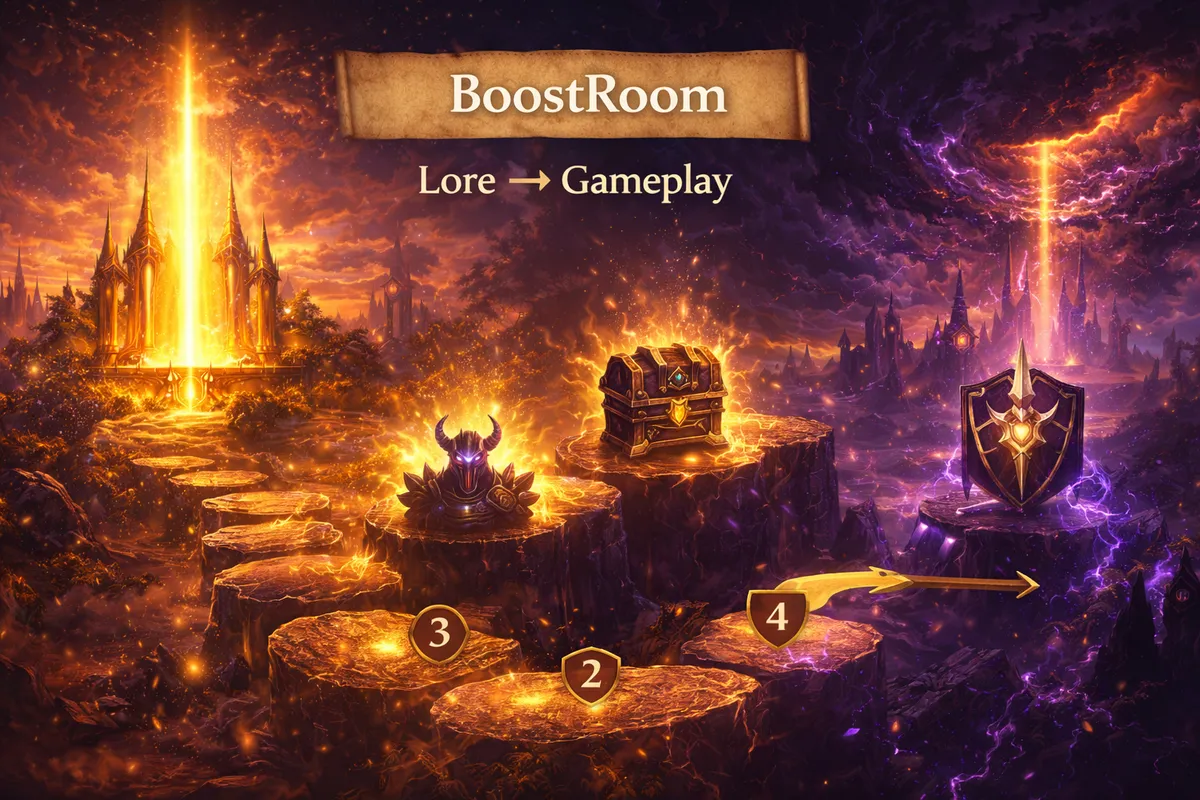
Midnight’s Big Twist: The Campaign Is a Progression Router
Midnight’s campaign structure is not a straight line. You begin in Eversong Woods, then you get a Choose Your Path moment where three major campaign routes open up and can be completed in any order: Zul’Aman, Harandar, and Arator’s Journey. That flexibility is great—until it makes players accidentally scramble their progression.
Here’s the truth: even when you can do things “in any order,” the story still signals a best order for efficiency based on what each route unlocks and what kind of gameplay it trains you for.
One path is best for unlocking a hub tool and getting a steady stream of narrative side quests.
One path is best for region-based gear and dungeon synergy.
One path is best for cosmic stakes and the lead-in to Voidstorm’s danger level.
When you read the campaign like a router instead of a movie, your entire week-one experience gets smoother.
The Lore-to-Gameplay Principle: Story Teaches Mechanics Before Mechanics Punish You
In good WoW design, story does at least one of these before a difficulty spike:
It introduces a new enemy type and shows you what they do in a safe environment.
It teaches you a counterplay concept (interrupts, movement, dispels, defensive timing) through story moments.
It gives you an ally, tool, or system that lowers friction (companions, hubs, activity unlocks).
Midnight leans hard into this. The expansion pitches the Void not only as corruption, but as predation—a world where everything is hungry, where the strong consume the weak, and where danger can find you even while you’re doing normal open-world tasks. That tone isn’t just flavor. It’s a warning: your autopilot habits will get punished later, so the campaign tries to break those habits early.
If you want to progress quickly without frustration, your job is to let story teach you the rules before you’re forced to learn them in a wipe.
Your Progression North Star: Silvermoon as a Hub You Should Actually Use
Silvermoon City is rebuilt as a major hub in Midnight, used by both factions. When an expansion chooses a hub like this, it’s not only to look pretty. Hubs are where Blizzard places:
system unlock NPCs
weekly and repeatable activity anchors
narrative gates (who you meet, who you’re sent to help)
“what matters right now” signals via quests and ambient story
Midnight’s Silvermoon hub is also structured for faction access, with part of the city being Horde-only and the rest accessible to both factions. That kind of design has a practical implication: your early progression loops are meant to pass through Silvermoon frequently, not just once at level cap.
Lore-to-gameplay rule: if the story keeps sending you back to the city, don’t fight it. That return rhythm is how you stay aligned with unlocks, weeklies, and the expansion’s intended pacing.
Checkpoint Thinking: The 6 Story Beats That Change Your Progression Options
Instead of thinking “levels,” think checkpoints. In Midnight, there are a handful of story beats that dramatically change your gameplay options. Hit them in a smart order and progression becomes smooth.
Checkpoint 1: Eversong Woods completion
You’re not just finishing a zone. You’re establishing the expansion’s baseline threat and unlocking the ability to branch.
Checkpoint 2: Choose Your Path unlocked
Your decision isn’t “which zone looks cool.” It’s “which progression benefits do I want first.”
Checkpoint 3: Arator’s Journey completed
This is the single biggest “quality-of-life” story payoff because it’s tied to Arcantina access.
Checkpoint 4: Arcantina unlocked (Arcantina Key)
Arcantina provides rotating visitor groups and story quests that send you across Azeroth—great for rewards, pacing breaks, and targeted progress.
Checkpoint 5: Prey system engaged
Prey is an opt-in hunting system with escalating difficulty and significant rewards, including outdoor Great Vault contribution and power rewards up to Hero track.
Checkpoint 6: Voidstorm entry
Voidstorm is where the expansion’s danger level escalates. Your build, habits, and gearing matter more here than in earlier zones.
The best part? You don’t need spoilers to use this. You just need to treat each checkpoint like a “new menu unlocked” moment.
The Best Story-First Progression Order (And Why It Works)
If your goal is to experience Midnight’s story cleanly and progress efficiently, this order is the strongest all-around route:
Silvermoon setup → Eversong Woods full campaign
Arator’s Journey (first path)
Unlock Arcantina and do one visitor rotation
Zul’Aman (second path)
Run the Zul’Aman-adjacent dungeon once for story synergy
Harandar (third path)
Do one Harandar-themed delve and one Harandar-adjacent dungeon
Enter Voidstorm and start treating your gameplay like it matters
Dungeons/Delves/Prey in a steady weekly loop
Season 1 raid story arc in intended order (Voidspire → Dreamrift → March on Quel’Danas)
Why this works:
You get the biggest unlock tool (Arcantina) early.
You keep regional storytelling coherent before cosmic weirdness ramps up.
You arrive in Voidstorm with better habits, better gear, and better context.
You naturally fold dungeons and delves in at moments where they feel meaningful instead of random.
Arator’s Journey: The Most “Gameplay Useful” Lore Path
Arator’s Journey is a continent-spanning campaign path alongside Arator, son of Turalyon and Alleria Windrunner. It’s framed around searching for relics of the Light—specifically relics used by priests and paladins at the Sunwell when their reserves run dry—and it’s also an internal journey where Arator grapples with family legacy and what it means to serve the Light.
That’s lore. Here’s why it’s also gameplay power:
It unlocks Arcantina access at the end.
It’s structured as a tour of iconic locations that function like “story workouts”—you get a fast education in Midnight’s themes: legacy, certainty, temptation, and what “Light” means when the Void is winning.
Arator’s Journey includes stops like:
Light’s Hope Chapel (and defending it)
Scarlet Monastery (dealing with hateful misuse of the Light)
Hammerfall (working with Sunwalker Dezco)
Blackrock Mountain (climactic identity/legacy pressure)
Even if you’re not a lore reader, this path is the best early pick because it gives you Arcantina—and Arcantina is a progression accelerant if you use it correctly.
Arcantina: A Story Hub That Also Functions Like a Progression Reset Button
Arcantina is presented as a warm, cross-faction refuge—“the opposite of the bleak and cold Void”—and it’s built around rotating groups of visitors who show up with quests and stories that send you across Azeroth. There are multiple visitor group rotations, and you never know who you’ll see next.
Lore-to-gameplay payoff:
Arcantina gives you structured side content that feels like mini-episodes.
It provides a reliable way to take breaks without losing direction.
It often becomes the safest place to pick up “what should I do right now?” content between heavy chapters.
Progression tip: don’t binge Arcantina and forget the campaign. Use it like an intermission.
The Arcantina rule: do one visitor rotation after a major campaign milestone, then go back to your main path. That keeps your story clean and your rewards steady.
Zul’Aman: The “Alliance and Tension” Path That Makes Group Content Easier
Zul’Aman is the Amani capital and a culturally loaded zone. In Midnight’s structure, this path tends to teach you:
how factions respond under pressure
what unity costs when history is ugly
why “helping” can be complicated
Gameplay payoff: zones like this often translate into dungeon storytelling and enemy design that emphasizes:
interrupts and control against organized packs
priority targeting (shamans, hexers, handlers)
dealing with environments that punish sloppy movement
Doing Zul’Aman after Arator’s Journey is efficient because you’ve already internalized the “values conflict” theme. You’re mentally prepared for politics and cultural friction, which makes the zone feel like a coherent episode—not a detour.
Harandar: The Lore Path That Prepares You for Voidstorm’s Rules
Harandar is described as a fungal jungle where the roots of all the world trees converge, home to the haranir, who travel through rootways and observe Azeroth in secret without openly intervening. Harandar also contains the Rift of Aln, a primordial wound where the barrier between dreams and reality grows thin.
That description is basically a gameplay warning: reality rules get weird here.
Gameplay payoff: Harandar is the best training ground for what the Void tends to do to players in difficult content:
distortion and disorientation mechanics
“thin barrier” themes (things appearing, phasing, shifting)
fights where positioning matters more than raw damage
If you do Harandar right before Voidstorm, the escalation feels natural: you go from “reality is thin” to “reality is hungry.”
Voidstorm: The Zone That Turns Story Into Survival
Voidstorm is framed as a hostile land suffused with Void, full of creatures that are hungry and eager to devour weaker beings for power. Xal’atath’s forces—described as a Devouring Host—rule over this world of cosmic predation, with powerful void creatures such as the domanaar highlighted as chief followers.
Lore-to-gameplay payoff: Voidstorm is where you stop playing “questing mode” and start playing “stay alive mode.” It’s the best place to apply the lore-to-gameplay mindset:
If the story frames the world as predation, expect ambush energy and “don’t stand still” punishment.
If the story emphasizes hunger and consumption, expect stacking danger—mobs that grow stronger, mechanics that escalate, and fights that punish slow execution.
Progression tip: don’t enter Voidstorm undergeared and impatient. Do your earlier story checkpoints first, pick up your key system unlocks, and arrive ready to play with intention.
Dungeons: Midnight’s “Story Episodes” That Also Teach Combat Skills
Midnight launches with eight new dungeons, each tied to different environments and storylines:
Windrunner Spire
Magister’s Terrace
Murder Row
Den of Nalorakk
Maisara Caverns
Blinding Vale
Nexus-Point Xenas
Voidscar Arena
These aren’t just eight places to farm loot. They’re mechanic classrooms that match Midnight’s themes.
Magister’s Terrace is reimagined and expanded, including areas previously inaccessible—like a balcony overlooking the Sunwell. Story-wise, that’s huge. Gameplay-wise, it means this dungeon likely sits close to major narrative stakes, and Blizzard typically uses those spaces to teach “high stakes” mechanics in a controlled setting.
Murder Row is described as an underbelly infiltration story involving exposing a hidden ring of blood elves practicing forbidden Fel magic, unmasking corrupt guards, and purging lingering corruption. Lore-to-gameplay implication: expect mechanics about:
Windrunner Spire is directly tied to the story of the Windrunner sisters and their tragic family history, described as a winged dungeon with mysteries. Lore-to-gameplay implication: this is the kind of dungeon Blizzard uses to deliver emotional beats and test movement awareness.
Voidscar Arena is set in Voidstorm and described as a place where combatants battle for the pleasure of the domanaar. Translation: it’s probably designed to feel brutal and performance-focused. Save it until you’ve felt Voidstorm’s tone.
Progression tip: do dungeons when you have context. The same dungeon feels easier when you understand the “rule” it’s teaching.
Delves: Why Doing Them With the Story Makes You Stronger
Midnight adds ten new delves plus one seasonal Nemesis delve, and swaps your companion from Brann to Valeera Sanguinar, who can fill all three support roles.
Delves listed for Midnight include:
The Shadow Enclave
Collegiate Calamity
Parhelion Plaza
The Darkway
Twilight Crypts
Atal’Aman
The Grudge Pit
The Gulf of Memory
Sunkiller Sanctum
Shadowguard Point
Torment’s Rise (Nemesis)
Two key lore-to-gameplay upgrades matter here:
1) Outdoor-style delves exist in Midnight.
Some delves are staged in outdoor spaces where you can use ground mounts. That changes pacing and makes delves feel less like “corridor content” and more like story vignettes.
2) Delves are used to interweave zone story.
Midnight explicitly frames delves as carrying story through new quests, meaning they aren’t “side content” in spirit—they’re part of the narrative ecosystem.
The progression trick is timing:
Do your first delves after you’ve finished a major zone chapter, as a “bonus episode.”
Use delves to practice role fundamentals (interrupts, defensives, target priority) before stepping into harder group content.
Treat the Nemesis delve like a weekly skill check, not a casual stroll.
When you do delves this way, you’re not just farming rewards—you’re training your gameplay brain with the story’s intended difficulty curve.
Prey: The System That Rewards Story-Driven Exploration
Prey is an opt-in hunting system accessed by speaking with Magister Astalor Bloodsworn in Murder Row in Silvermoon City. You pick a target, then continue doing your normal activities in the zones while the hunt unfolds unpredictably—your prey might find you before you find them.
Prey has three difficulty levels you unlock as you progress:
Hard and Nightmare add “Torments” (extra abilities) that make both the hunt and the final fight more challenging, and the final encounter becomes a “you and your friends” moment—not a raid group situation.
The key progression value:
Prey offers cosmetics, mounts, transmogs
It also offers power rewards up to the Hero track
It contributes to the Great Vault outdoor activity slot each week
Lore-to-gameplay implication: Prey is the perfect “story-aligned grind” because it matches Midnight’s theme of hunting and being hunted. If you use it as your weekly outdoor progression anchor, your open-world time stops being “filler” and becomes “progress.”
Raid Story Beats: Why Knowing the Order Makes You Raid Better
Midnight Season 1 is split across three raid zones with nine bosses total:
The Voidspire (six bosses, including showdowns with Dominus-Lord Averzian and Salhadaar)
The Dreamrift (single boss encounter hunting an undreamt god that never should have been, dealing with half-birthed abominations)
March on Quel’Danas (a thrilling climax as the united armies of the elven tribes march on the iconic Sunwell Plateau)
Midnight also emphasizes Story Mode access so that all players can experience key epic campaign moments within The Voidspire and March on Quel’Danas.
Lore-to-gameplay payoff:
If you understand why Voidspire happens, you’ll understand what kinds of enemies and mechanics the expansion wants you to master early.
If you treat Dreamrift as “weird one-off,” you’ll miss the warning that reality-rules and dream-boundary mechanics might show up elsewhere too.
If you do March on Quel’Danas early, you risk spoiling your own pacing and weakening your motivation—because the story is built to crescendo there.
Raid performance is partly psychological. When you know what the story is building toward, you take mechanics more seriously, you learn faster, and you don’t mentally check out.
The “Story Beat Signals” That Tell You What to Do Next
One of the biggest advantages of story-first progression is learning to read Blizzard’s signals. Here are the signals that reliably indicate “this is the next best step for progression”:
Signal 1: The hub gets new NPC clusters.
When Silvermoon suddenly has more quest markers in a concentrated area, you’ve hit a checkpoint that unlocked new loops (weeklies, repeatables, system progression).
Signal 2: The story introduces a new named enemy type repeatedly.
That’s a hint that your next dungeon or delve will heavily feature that enemy type, so you should practice their mechanics now.
Signal 3: The narrative shifts from “investigate” to “prepare.”
When quest text starts talking about gathering allies, fortifying, hunting targets, or retrieving relics, you’re being told to strengthen your character through the systems that support those actions.
Signal 4: A feature is introduced through a story contact.
Prey being anchored to an NPC in Murder Row is a perfect example. The system is framed as part of the world, not a UI button. That means doing the story puts you in the right place at the right time.
Signal 5: The story emphasizes unpredictability or danger.
That’s your reminder to stop autopiloting: adjust your build, carry consumables, plan defensives, and choose content timing wisely.
Practical Week-One Plan: Progress Fast Without Skipping the Lore
If you want a clean first week in Midnight that keeps story intact and still makes you stronger quickly, follow this structure:
Day 1–2: Campaign foundation
Lock in Silvermoon as your home base
Complete Eversong Woods’ main campaign arc
Avoid over-grinding side content until your first major checkpoint is done
Day 2–3: Unlock the best tool early
Choose Arator’s Journey as your first path
Finish it to unlock Arcantina access
Do one Arcantina visitor rotation as an intermission (don’t binge)
Day 3–4: Build your “region power”
Day 4–5: Train for cosmic escalation
Day 5–7: Turn on survival mode
Enter Voidstorm
Start Prey in Silvermoon (Normal difficulty first) and use it as your outdoor progression anchor
Add Voidstorm dungeons when you’re ready (Nexus-Point Xenas, Voidscar Arena)
This plan is simple, story-friendly, and efficient. You’ll finish week one with:
better system unlock coverage
better mechanical readiness
steady power gains from the right activities
a campaign experience that feels like a well-paced season, not scrambled scenes
The Biggest Mistakes That Slow Players Down (And How Story Prevents Them)
Mistake 1: Running every dungeon the moment it appears
You lose story context and you often run them before your build is ready for the intended lesson. Fix: run dungeons as “episode companions” to the zones you’ve just completed.
Mistake 2: Ignoring Silvermoon after the intro
You miss system anchors, unlock NPCs, and weekly loops. Fix: treat Silvermoon returns as part of the pacing, not backtracking.
Mistake 3: Delve-binging too early
Delves are great, but binging them before you hit key campaign checkpoints can leave you overleveled in side content and underprepared for the expansion’s main escalation. Fix: one delve after each major zone chapter.
Mistake 4: Jumping into Voidstorm before finishing your three paths
Voidstorm is built to feel oppressive and dangerous. Arriving early often feels like hitting a wall. Fix: finish at least two paths first (ideally all three) so you arrive ready.
Mistake 5: Treating Prey like a novelty instead of a weekly anchor
Prey contributes meaningful rewards and Great Vault outdoor progress. Fix: incorporate it into your weekly rhythm after you’ve stabilized your campaign progress.
BoostRoom: How We Turn Story Beats Into Real Progress
BoostRoom is built for players who want to experience Midnight’s story and keep their progression moving—without turning their free time into a stressful grind.
Here’s how BoostRoom fits the lore-to-gameplay approach:
Campaign-friendly support
When you’re deep in the story, the worst feeling is being forced to pause because your character isn’t strong enough for the next step. BoostRoom can help you bridge those gaps with efficient progression so the story stays continuous.
Dungeon and seasonal progression help
Midnight’s dungeons are story episodes with real power attached. BoostRoom can help you run the content you need cleanly—so you spend less time on chaotic group-finding and more time actually learning the mechanics the story is preparing you for.
Raid story access without burnout
Midnight’s raid arc is built like a season climax, with Story Mode support for major moments. If your goal is to experience the narrative beats on schedule, BoostRoom can help you get there faster and with fewer frustrating delays.
Delves and skill-building mindset
Delves are the perfect place to convert story knowledge into gameplay skill. BoostRoom coaching can help you translate “I understand what the Void is doing” into “I know exactly what button to press when it does it.”
Alt and Warband catch-up
Once you’ve done the full story on your main, alts become about efficiency. BoostRoom helps keep your Warband ready so you can replay Midnight’s campaign paths in different orders without time pressure.
BoostRoom is a third-party service and is not affiliated with Blizzard Entertainment.
Practical Rules: The BoostRoom Lore-to-Gameplay Playbook
Use these rules to progress faster while staying spoiler-light and story-first:
Rule 1: Finish Eversong before you judge the expansion’s pacing
Eversong sets the emotional baseline. Skipping ahead makes everything feel flatter.
Rule 2: Do Arator’s Journey early if you want smooth progression
Unlocking Arcantina early gives you better pacing breaks and structured side quests.
Rule 3: One path at a time—no branch hopping
Branch hopping is the fastest way to forget what you’re doing and slow your progress.
Rule 4: Dungeons are “chapter companions,” not random queues
Run a dungeon when the zone story that explains it is fresh.
Rule 5: One delve per chapter
Delves should reinforce the story, not replace it.
Rule 6: Start Prey when you’re ready to commit weekly time
Normal → Hard → Nightmare is a progression ladder. Treat it like one.
Rule 7: Voidstorm is not a casual tourist zone
Arrive prepared: better gear, better habits, and a plan.
Rule 8: Save climax content for climax energy
March on Quel’Danas is designed to feel like a peak. Don’t drain your own hype early.
Rule 9: Let the story teach your mechanics
If the narrative emphasizes predation, expect ambushes. If it emphasizes thin barriers, expect phasing and distortion. Prepare accordingly.
Rule 10: When life is busy, use support to protect your pacing
If you only have limited hours, your goal is not “do everything.” Your goal is “keep momentum.” That’s where BoostRoom fits best.
FAQ
Q: Do I really progress faster by doing story first?
A: Yes, because Midnight’s systems and activity loops are introduced and anchored through story checkpoints. Doing the campaign early unlocks the right tools and prevents you from wasting time on low-value detours.
Q: What’s the single most important story beat for progression?
A: Completing Arator’s Journey early is a huge quality-of-life win because it unlocks Arcantina access via the Arcantina Key, giving you structured narrative side content and a reliable pacing hub.
Q: When should I start the Prey system?
A: Start it after you’ve stabilized your campaign flow (usually after Eversong and at least one major path). Begin at Normal difficulty to learn how the hunts unfold, then climb to Hard and Nightmare as your character and confidence grow.
Q: Are delves worth doing while leveling, or should I save them for endgame?
A: Do them while leveling, but strategically. One delve after each major zone chapter is the best cadence: you get rewards and practice without losing the main plot.
Q: Which dungeons should I save until later?
A: Voidstorm dungeons (like Voidscar Arena and Nexus-Point Xenas) feel best after you’ve entered Voidstorm and absorbed its tone. Early hub-region dungeons (like Magister’s Terrace, Murder Row, and Windrunner Spire) are great once Eversong is complete.
Q: What’s the best order for raid story content?
A: For the cleanest narrative arc: The Voidspire first, then The Dreamrift, and save March on Quel’Danas for last so the “united armies” climax lands like it’s supposed to.
Q: How does BoostRoom help without ruining the story?
A: BoostRoom’s value is protecting your pacing—helping you handle power checks (dungeons, raid readiness, progression loops) so you can keep experiencing the story in order instead of stalling out or scrambling content.