Why Themes Win in WoW Midnight Housing
A “theme” isn’t a rule that limits you—it’s a shortcut that makes every choice easier. Once you pick a direction, you instantly know:
- What to buy first (anchors over clutter)
- What to skip (items that fight your palette or vibe)
- How to arrange rooms (flow and purpose instead of random placement)
- Which content to prioritize (Endeavors, vendors, crafting, achievements that match your look)
Themes also scale beautifully with your time. If you only play a little, you can still nail a strong theme with vendor staples, smart lighting, and one centerpiece. If you play a lot, you can turn your home into a museum of your adventures—without losing cohesion.
Practical Rules for Theme Building in Midnight Housing
Use these rules on every theme below (they’re the difference between “decorated” and “designed”).
- Rule 1: Pick 3 colors, then commit.
- Example: Light theme = white/gold/cyan. Void theme = black/indigo/blue. Nature theme = green/brown/amber. You can add small accents later, but keep the core consistent.
- Rule 2: Choose 2 materials that repeat.
- Stone + gold. Wood + linen. Iron + leather. Repetition is what makes mixed-expansion decor feel unified.
- Rule 3: Start with lighting before furniture.
- Lighting decides mood, highlights focal points, and hides “empty” space on purpose.
- Rule 4: Build one hero moment per room.
- A fountain, rotunda, portal, greenhouse, trophy wall, library nook—then decorate outward.
- Rule 5: Use “empty space” as decor.
- Real homes breathe. Leave pathways, corners, and sightlines. If everything is filled, nothing stands out.
- Rule 6: Use Basic mode for structure, Advanced mode for magic.
- Basic mode makes clean alignment easy. Advanced mode is where you do illusions: clipping, floating, scaling, and turning unrelated items into custom builds.
- Rule 7: Duplicate smart, not constantly.
- A set of matching lamps, 2–4 repeating plants, and consistent wall hangings look intentional. Twenty duplicates look like a warehouse.
How to Use Housing Tools to Make Any Theme Look “High-End”
Even if you don’t have rare decor yet, your build can still look premium by leaning into the system’s strongest tools:
- Grid + snapping for clean lines. Great for libraries, galleries, temples, and modern “showroom” looks.
- Parenting for practical staging. Place smaller items on a larger “parent” (like books on a bookcase) so you can move the whole scene without rebuilding.
- Advanced clipping for custom shapes. Push chairs into walls for built-in benches. Turn bushes into garlands. Combine pieces to form arches, rails, or platforms.
- Free rotation + scaling for signature builds. Scale a “small accent” up into a statue-like centerpiece, or scale a big piece down to become tabletop decor.
- Dye (where available) to unify mixed sets. If two chairs are different styles but can be dyed into the same palette, they suddenly belong together.
- Wallpaper, ceiling, and flooring as your “silent anchor.” Furniture can vary, but your surfaces keep the theme coherent. If you’re unsure, lock surfaces first.
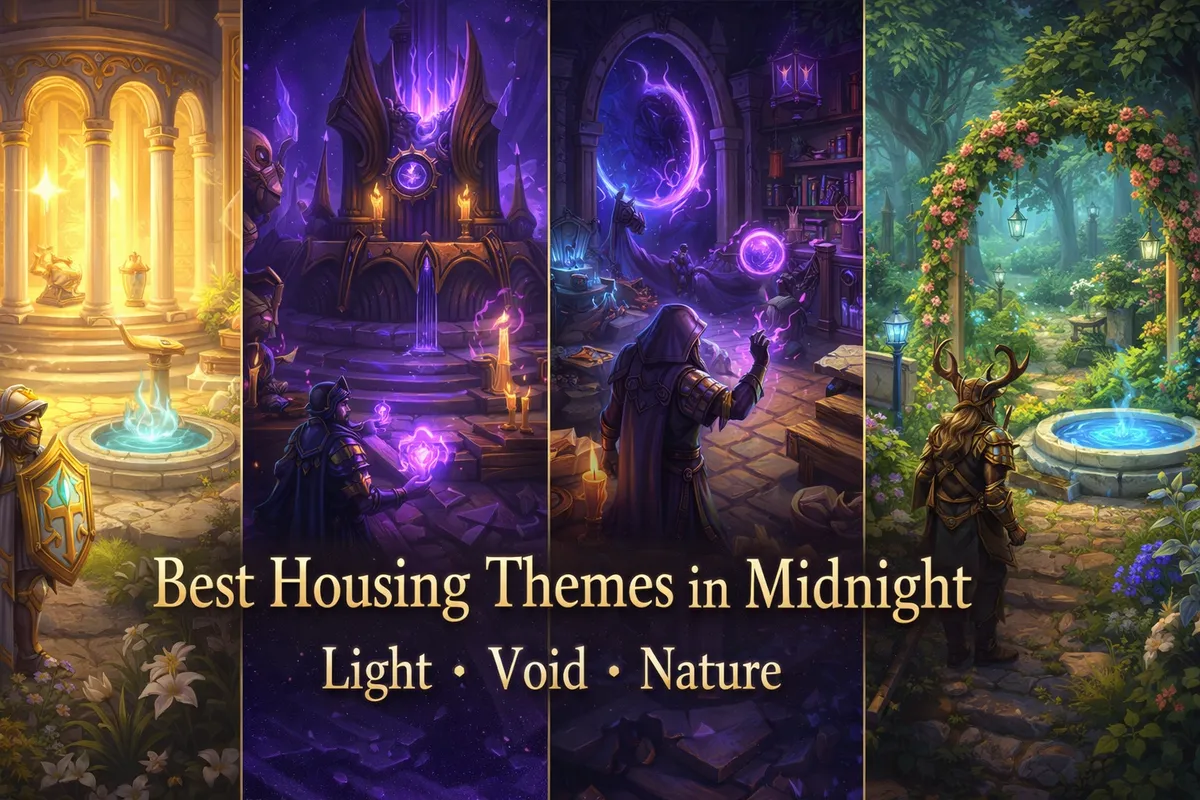
Light Theme: Sanctum Radiance and Silvermoon Glow
Best for: paladins, priests, draenei vibes, “holy library,” serene spas, elegant gardens
Core palette: white + gold + soft cyan
Signature mood: calm, clean, uplifting, “protected”
What makes the Light theme work: contrast control. Light builds don’t need to be bright everywhere—give your eyes rest with neutral stone, pale wood, and soft shadows. Then let your Light objects shine in key spots.
Anchor pieces to hunt or buy first (Light theme):
- A grand Light centerpiece (rotunda/fountain-style structural pieces are perfect as a lobby or courtyard hero moment).
- One iconic Light light source (a large candelabra or radiant lamp) to establish the tone.
- A symbol wall (banners, crystals, icons) to give the room “identity” without clutter.
Room ideas that always look good in Light builds:
- The Sanctuary Entry: a wide, open foyer with a single centerpiece and two symmetrical lights. Minimal furniture, maximum impact.
- The Hall of Oaths: a long corridor with banners and spaced wall lights. Add a central runner rug and keep the sides clean.
- The Healing Nook: one bed, one side table, one bookcase, one plant, soft light—done. Light themes shine when they’re not overfilled.
- The Radiant Courtyard: use structural decor outside (or in a large interior room) and frame it with trellises/hedges for a “garden chapel” vibe.
Advanced-mode tricks for Light builds:
- Floating “Naaru-like” displays: stack crystals and small lights at different heights to fake a hovering relic. Keep the cluster tight and centered.
- Gold trim illusion: clip thin wall hangings or decorative accents along edges of doorframes to mimic ornate gilding.
- Soft halo lighting: place small lights behind a banner or statue so the glow “leaks” around it.
Endeavor-friendly approach:
When your neighborhood’s monthly Endeavor theme leans toward uplifting, nature-adjacent, or faction-cultural aesthetics, treat it as your “Light season.” Farm the tasks you enjoy (crafting, questing, dungeons) and save the Endeavor currency for visiting decor vendors that fit your holy/elegant palette.
Void Theme: Whispering Studies, Ren’dorei Labs, and Cosmic Shrines
Best for: void elves, shadow priests, warlocks, “forbidden library,” cosmic laboratories, haunted manors
Core palette: black + deep blue + indigo (add small violet accents)
Signature mood: mysterious, arcane, unsettling—but stylish
Void builds are about controlled chaos. The trick is to make the space feel intentional: clean silhouettes, focused lighting, and a few “impossible” objects (floating orbs, corrupted fountains, strange containers).
Anchor pieces that define the Void theme:
- A corrupted structural centerpiece (a rotunda/fountain-style structure makes an instant ritual zone).
- One “cosmic object” cluster (orbs, caches, gravitational effects).
- A containment or research corner (storage crates, holding-cell vibes, experimental tables).
Room ideas that make Void builds feel like content, not clutter:
- The Whispering Study: bookcases, a desk, two chairs, a dim lamp, and a single void artifact on display. Add one wall of “forbidden” trophies.
- The Ritual Bath / Corruption Spa: surprisingly popular—use a corrupted fountain as a bath centerpiece, then surround with dark stone, candles, and minimal seating.
- The Observatory: a central orb “planetarium” with scaled objects floating at different heights.
- The Void Vault: a storage-and-trophy room where everything is symmetrical… except the one object that shouldn’t exist.
Advanced-mode tricks for Void builds:
- Gravity sculpture: float multiple orbs at different distances in a spiral shape. Rotate each slightly to avoid perfect alignment (it looks more “alive”).
- Portal framing: clip banners or arches into a circle to create a “gate outline,” then backlight it with small lights.
- Corrupted growth: hide small plants or organic shapes inside walls so they poke out like void tendrils—subtle, not messy.
Endeavor-friendly approach:
Void themes love Endeavors because visiting vendors and rotating monthly aesthetics can add that “this neighborhood is changing” atmosphere. Even if the Endeavor isn’t void-themed, you can still farm currency and spend it later when the right vendor set shows up.
Nature Theme: Druid Groves, Cottage Gardens, and Ardenweald-Inspired Calm
Best for: druids, hunters, shamans, “forest cottage,” alchemist gardens, cozy tea houses
Core palette: green + warm wood + stone (add amber or pale blue sparingly)
Signature mood: alive, cozy, fresh, grounded
Nature is one of the easiest themes to make gorgeous fast because plants instantly fill space in a believable way—just don’t overdo it. A nature build works best when it feels curated (like a garden you maintain), not like a jungle exploded indoors.
Anchor pieces for Nature builds:
- A trellis or plant arch to create “entrances” inside your home.
- Ground cover (grassy patches, leaf piles, garden clusters) to soften empty floors.
- One magical nature lamp to set the tone (Ardenweald-style lights are perfect).
- A greenhouse-style structure or a single “garden room” that becomes your home’s signature.
Room ideas that always land:
- The Garden Entry: trellis + two potted plants + one bench + warm lighting. Keep it simple and welcoming.
- The Indoor Courtyard: a “center garden” inside a big room, surrounded by seating and bookcases. Great for roleplay gatherings.
- The Herb Kitchen: shelves, jars, a worktable, hanging plants, and one small lantern. Looks amazing without needing rare items.
- The Moonwell Corner: stone + water centerpiece + a few flowers + soft blue lighting. Instantly feels like druidic Azeroth.
Advanced-mode tricks for Nature builds:
- Living walls: clip ivy into walls and ceilings to create a creeping canopy. Keep it focused on one wall so it reads as intentional.
- Fireplace garland: turn bushes into holiday garland (scale down and wrap around the mantle).
- Micro-gardens: scale plants down and place them in rows like a real herb bed (especially satisfying with grid snapping).
Endeavor-friendly approach:
Nature builds pair beautifully with Endeavors that bring in faction/culture decorations and seasonal-feeling neighborhood visuals. Treat each Endeavor as a “garden festival” month: earn currency, buy a handful of nature pieces, and update your home in small, satisfying waves.
Night Elf Moonlit Sanctuary: Purple Woods, Stonework, and Quiet Power
Best for: night elves, druids, sentinels, “moon temple,” tranquil libraries
Core palette: moonlit stone + muted purples + deep greens
Signature mood: serene, ancient, magical—like a secret place that’s always been there
Night Elf theming looks incredible when you emphasize silhouettes: arches, pillars, and long lines. Don’t fill every corner. Let moonlight, shadows, and a few carefully placed plants do the heavy lifting.
Anchor priorities:
- Moonlit lighting (soft, cool, indirect)
- One ceremonial focal point (an altar-like layout, a fountain, or a central rug + statue area)
- A “forest edge” transition (plants near entryways, less greenery deeper inside)
Room ideas:
- Sentinel Hall: weapon racks, banners, and a clean central path. Symmetry sells the authority.
- Moon Reading Room: bookcases, a curved seating nook, soft blue/purple lighting, and a single plant cluster.
- Temple Garden: a stone courtyard vibe with minimal furniture and a centerpiece.
Advanced-mode trick:
Create moonbeams by placing small lights behind partitions and clipping them so the glow appears to “spill” through cracks or archways.
Blood Elf Elegance: Gold Trim, Red Crystal Accents, and Grand Interiors
Best for: blood elves, paladins, magisters, “high society manor,” arcane salons
Core palette: gold + cream + deep red (add turquoise sparingly)
Signature mood: lavish, polished, confident
Blood Elf elegance works when everything looks expensive and intentional. Use fewer items, higher impact. Strong symmetry, repeated gold touches, and one “statement structure” will do more than dozens of small clutter pieces.
Anchor priorities:
- A grand centerpiece (fountain/rotunda/salon stage)
- Two matching large lights to frame the centerpiece
- A formal seating layout (chairs facing each other, not just shoved against walls)
- One “gallery wall” with paintings or banners spaced evenly
Room ideas:
- Arcane Salon: symmetrical chairs, a central table, soft lighting, one dramatic art wall.
- Crystal Atrium: open space, centerpiece fountain, minimal plants, reflective colors.
- Magister’s Study: desk, bookcases, one artifact display.
Advanced-mode trick:
Use scaling to create tiered displays—small items scaled up become “museum pieces,” and large furniture scaled down becomes ornate side decor.
Cozy Human Cottage: Inn Comfort, Books, and Warm Light
Best for: roleplayers, casual builders, “starter home that stays classy,” family tavern vibes
Core palette: warm wood + beige + brass
Signature mood: safe, familiar, lived-in
This theme is popular because it never looks wrong. Even mismatched items can work if the lighting is warm and the surfaces are consistent.
Anchor priorities:
- Warm lighting (lamps, candles, wall lights)
- Textiles (rugs, curtains, tapestries)
- Kitchen storytelling (a table set for guests, shelves with “supplies”)
- A fireplace moment (or the illusion of one)
Room ideas:
- Tavern Corner: table + benches + mugs/food props + warm wall lights.
- Guest Room: simple bed, one chair, one plant, one painting, one lamp.
- The Library Nook: bookcase, small chair, side table, soft lamp—instantly cozy.
Advanced-mode trick:
Make built-ins: clip shelves slightly into walls so they feel like they belong to the structure.
Orc Warlodge: Rugged Trophies, Iron, and Firelight
Best for: warriors, shamans, hunters, “raid trophies on display,” primal aesthetics
Core palette: dark wood + iron + orange firelight
Signature mood: powerful, practical, battle-earned
Orc themes should feel sturdy. Heavy furniture, visible materials, and trophies that tell your character’s story.
Anchor priorities:
- Firelight as your main mood tool
- Trophy wall (heads, gates, banners, weapons)
- Large table (the “war council” centerpiece)
- Rugs and hides to break up dark floors
Room ideas:
- War Council Hall: big table, chairs, torches, banners.
- Trophy Gallery: one corridor or wall dedicated to achievements—clean spacing, not clutter.
- Training Corner: a dummy or weapon racks, with simple lighting.
Advanced-mode trick:
Use clipping to create reinforced beams: stack wood and iron accents into thicker structural shapes.
Arcane Workshop and Observatory: Gears, Experiments, and Clean Geometry
Best for: mages, engineers, “mad inventor,” modern-looking builds
Core palette: steel + dark wood + teal/cyan
Signature mood: clever, bright, “things are happening here”
This theme shines with grid snapping and clean symmetry. It’s also perfect if you love custom builds, because Advanced mode turns basic objects into machinery.
Anchor priorities:
- A central experiment table
- Repeating lights (consistent “lab lighting” sells the look)
- Storage that looks intentional (crates, shelves, labeled corners)
- One spectacle piece (a floating orb display, a rotating “engine,” a portal frame)
Room ideas:
- Workshop Floor: benches, tools, crates, strong overhead lighting.
- Observatory Dome: a circular seating arrangement around a floating orb “planetarium.”
- Potion Lab: shelves, jars, a single bright lamp, clean surfaces.
Advanced-mode trick:
Build a mechanical armature by clipping rods/accents into a rotating-looking frame around your centerpiece.
Shadowlands Gothic: Torghast Chic, Dark Stone, and Dramatic Silhouettes
Best for: death knights, warlocks, “haunted manor,” villain lounges, dramatic trophy rooms
Core palette: dark stone + gray + cold blue (tiny red accents if you must)
Signature mood: intimidating, theatrical, ancient
Gothic themes look best when you lean into verticality: tall lights, towering arches, big wall hangings, and negative space. You want it to feel like a cathedral or fortress interior—grand, not cramped.
Anchor priorities:
- One portal-like statement (even a nonfunctional “gateway” prop can define the room)
- Tall lighting (chandeliers, wall lights spaced evenly)
- A throne or ceremonial seat (one seat, not ten)
- Minimal props (every prop should feel like it matters)
Room ideas:
- The Audience Chamber: throne seat, two torches, one centerpiece rug.
- The Vault: a trophy-and-art room with wide spacing and dramatic lighting angles.
- The Corridor of Echoes: long hallway, repeating lights, and a few evenly spaced relics.
Advanced-mode trick:
Create false alcoves using partitions and clipped wall decor. It makes interiors feel deeper and more complex.
Zandalari Temple and Trophy Hall: Gold, Stone, and Jungle Power
Best for: collectors, raiders, “museum of conquest,” jungle/empire vibes
Core palette: gold + stone + deep green
Signature mood: triumphant, ceremonial, larger-than-life
This theme is perfect if you love showing off achievements and raid memories, because it naturally supports display walls and statues.
Anchor priorities:
- Torches and sconces (repeating firelight makes everything feel sacred)
- A central ceremonial space (an altar-like layout or fountain)
- A trophy wall (heads, gates, banners, boss mementos)
- Plant accents (controlled jungle—don’t smother the temple)
Room ideas:
- Temple Steps Inside Your House: create “levels” using scaled objects and partitions so the room feels like it has elevation.
- Hall of Champions: symmetrical trophies along a corridor.
- Jungle Atrium: temple stone with carefully placed greenery.
Advanced-mode trick:
Make stone terraces by stacking and clipping large flat objects into a stepped platform.
Coastal Pirate Cove: Lanterns, Weathered Wood, and Treasure Corners
Best for: outlaw rogue vibes, relaxed hangout homes, “guild party house,” seaside cabins
Core palette: weathered wood + rope/beige + warm lantern light
Signature mood: adventurous, relaxed, a little chaotic—in a fun way
Pirate themes are storytelling gold: maps on walls, treasure corners, storage crates, and “we just got back from a run” staging.
Anchor priorities:
- Lantern lighting
- Crates and barrels (but grouped neatly)
- A map wall
- A “treasure display” (one corner that says “we’re rich,” even if it’s just clever staging)
Room ideas:
- Dockside Kitchen: table, stools, lanterns, stacked supplies.
- Captain’s Quarters: one good chair, one desk, one map wall, one trophy.
- Treasure Nook: chests, small lights, a rug, and a guard-like statue or weapon display.
Advanced-mode trick:
Create broken-ship architecture by turning beds/tables sideways and clipping them into walls as beams, rails, or hull shapes.
How to Keep Your Theme Fresh Across Monthly Endeavors
Endeavors happen about monthly and can change what vendors show up and how neighborhoods look. Instead of fighting that system, use it to evolve your home:
- Create a “seasonal wing.” One room that changes each Endeavor—your main theme stays stable, but you still enjoy the monthly refresh.
- Buy “transition items.” Neutral pieces that fit multiple themes (stone planters, simple rugs, basic lamps). These help you blend new decor without breaking your look.
- Upgrade in layers: lighting first, then one hero object, then accents. Don’t buy ten random things in one go.
- Treat Endeavor currency like a palette budget: only spend it on items that match your theme’s 3-color rule.
BoostRoom: Build Better, Collect Smarter, Finish Faster
If you love the idea of housing but don’t want to spend weeks figuring out what to farm, what to buy, and how to make it all look cohesive, BoostRoom is built for exactly that.
With BoostRoom, you can:
- Choose a theme (Light, Void, Nature, Night Elf, Blood Elf, Cozy Cottage, and more) and get a clear “what to prioritize first” plan.
- Get an Endeavor-friendly shopping route so you don’t waste currency on items you’ll regret later.
- Speed up your decor collection by focusing on the most impactful anchor pieces for your build.
- Get layout help for tricky rooms (entry flow, lighting placement, centerpiece design, and how to avoid clutter).
- Turn Advanced mode into your advantage with custom-build ideas that look like rare decor even when they’re just clever combinations.
Your home should feel like your character’s story—not like a storage room. BoostRoom helps you get there with less grind and better results.
FAQ
What’s the easiest theme to start with in WoW Midnight housing?
Nature and Cozy Human Cottage are the easiest because vendor plants, warm lights, and simple furniture create a complete look fast—even with common decor.
Which theme looks best with minimal decor?
Light themes and Blood Elf elegance. Both thrive on open space, symmetry, and one or two premium centerpiece moments.
How do I stop my Void theme from looking like random dark clutter?
Limit yourself to a few strong shapes (one centerpiece, one orb cluster, one research corner), then use controlled lighting. If everything is “spooky,” nothing stands out.
Can I mix themes without ruining the look?
Yes—pick one “main theme” and one “accent theme.” Example: Nature main + Light accent (a small sanctuary corner). Keep shared colors and repeat one material across both.
What should I buy first when I get new decor vendors from Endeavors?
Always start with anchors: lighting, a centerpiece structural piece, and one wall identity piece (banner/painting/icon). Accents come last.
How do Advanced mode builds help if I don’t have rare decor?
Advanced mode lets you clip, float, rotate on any axis, and scale objects—so you can build custom arches, altars, planetariums, and built-ins using common items.
Is it better to decorate room-by-room or buy everything first?
Room-by-room wins. Finish one room to “complete” quality, then move on. Buying everything first leads to mismatched pieces and budget waste.
How do I make my house feel bigger?
Use partitions to create corridors and alcoves, keep sightlines open, and place lighting to guide the eye toward one focal point per room.