The Artisan System in One Sentence 🔥
The Artisan system is a player-driven supply chain: you collect raw materials, refine them into usable components, then craft finished gear/items — and the game is designed so specialists matter (not one character doing everything).
That’s why the Artisan system feels “big” compared to most MMOs: it’s not a side menu. It’s a full progression path with its own goals, routes, tools, and money-making loops.
If combat is your main game, artisans still matter. Crafted gear, consumables, upgrades, trade goods — all of that can feed your leveling, PvP prep, and guild plans. And if you’re the chill grinder type? You can seriously build your whole identity around being an artisan 😄
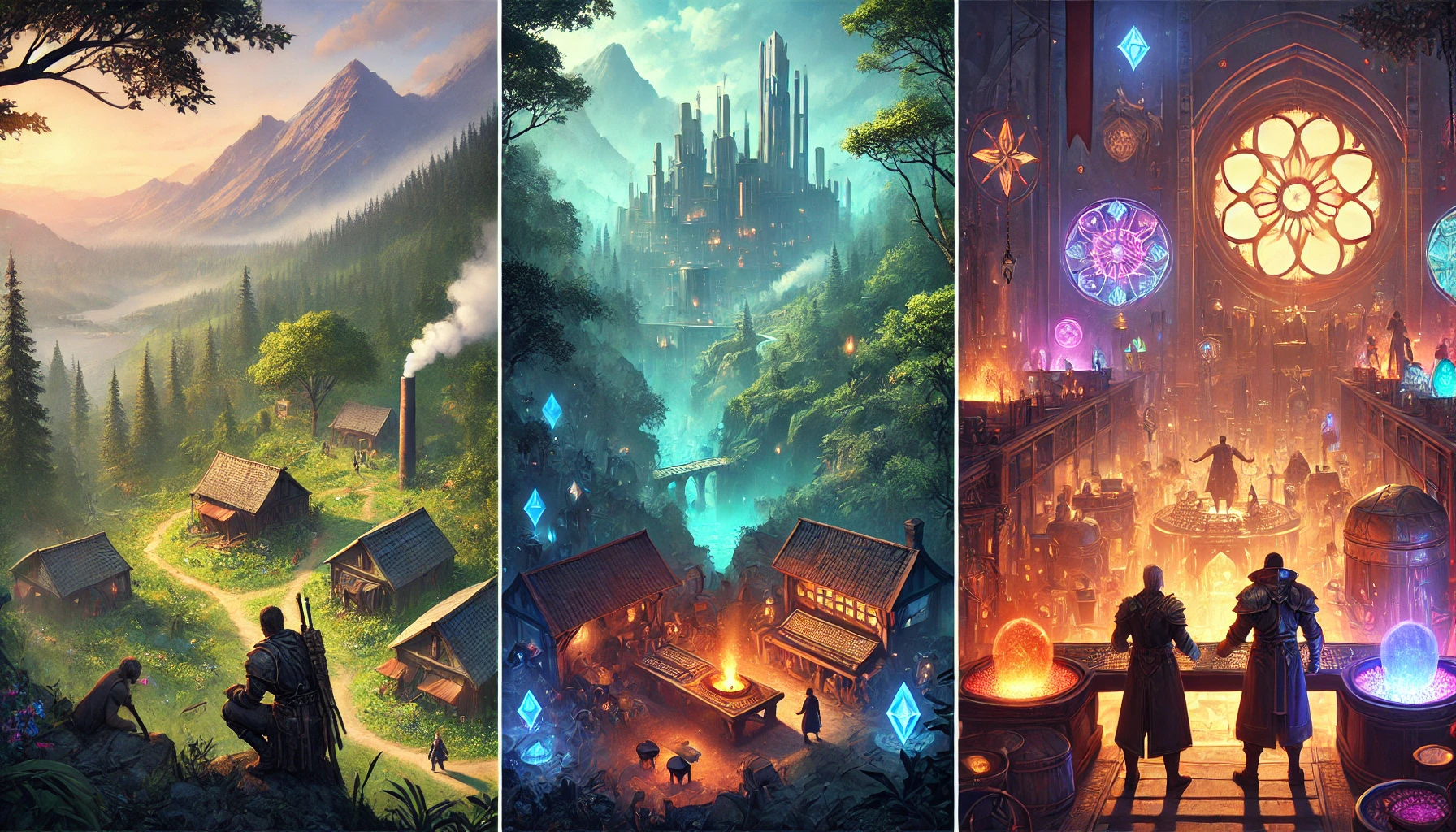
The Three Branches: Gathering → Processing → Crafting 🧩
Think of it like a triangle (because it basically is):
- Gathering: you grab raw stuff from the world 🌿⛏️🐟
- Processing: you refine that raw stuff into usable materials 🔧🧵🔥
- Crafting: you turn refined materials into finished items 🛡️⚔️📜
The key idea: each branch feeds the next, and most high-value crafts need multiple inputs. That’s why guild economies become a real thing — not just “everyone farms the same spot.”
The Big Rule: Why You Can’t Be Grandmaster in Everything 🚫👑
Here’s the “wake up early and plan” part:
You start as Novice in everything, but you can only push a limited number of professions into higher tiers.
A common way it’s explained:
- Up to 5 professions can be Apprentice+
- Up to 4 can be Journeyman+
- Up to 3 can be Master+
- Up to 2 can be Grandmaster ✅
This is the whole point of the system.
It forces specialization, keeps markets alive, and makes it impossible for one character to become a full economy by themselves.
Important detail: When you push a profession higher, it “uses” your slots at the lower tiers too. So if you go Grandmaster in something, that also counts as your Master/Journeyman/Apprentice in that same profession. In other words, your top picks lock in your whole plan.
Reality check (in a good way):
This is what makes artisans feel valuable. If anyone could max everything, crafted gear would be cheap junk, and gathering would be pointless after week one.
All Confirmed Professions (22 Total) 📚
You’ll see them grouped under the three branches.
Gathering Professions 🌲⛏️🐟
- Fishing
- Herbalism
- Hunting
- Lumberjacking
- Mining
Gathering is the “go out and touch grass” category 😄 — routes, nodes, tools, bags, and efficiency.
Processing Professions 🔥🧵🪵
- Alchemy
- Animal Husbandry
- Cooking
- Farming
- Lumber Milling
- Metalworking
- Stonemasonry
- Tanning
- Weaving
Processing is where raw mats become “real materials.” It’s also where most people underestimate time and storage needs.
Crafting Professions 🛡️⚔️📜
- Arcane Engineering
- Armor Smithing
- Carpentry
- Jeweler
- Leatherworking
- Scribe
- Tailoring
- Weapon Smithing
Crafting is the end of the chain: the part where your name matters, and your output becomes someone else’s power.
How the Supply Chain Actually Works (Simple Examples) 🔁
Let’s make it real:
Example 1: “I want to be a weapon crafter.”
- Mining (Gathering) → Metalworking (Processing) → Weapon Smithing (Crafting)
Example 2: “I want to make bags / utility gear.”
- Hunting (Gathering) → Tanning (Processing) → Leatherworking (Crafting)
Example 3: “I want to be a scroll/potion economy guy.”
- Herbalism (Gathering) → Alchemy (Processing) → Scribe (Crafting)
Now here’s the important part:
You don’t need to personally do every step.
You can:
- farm raw mats and sell them
- buy raw mats and focus only on processing
- buy processed mats and focus only on crafting
- do a “two-step” chain and trade for the missing piece
This is why guilds and long-term trade relationships matter. If you’re the only one doing everything, you’ll spend more time moving stacks than actually progressing.
Gathering: The “Routes and Rhythm” Game 🧭🌿
Gathering looks simple until you try to do it efficiently.
Here’s what separates casual gathering from serious gathering:
1) Tool quality matters
Higher tier tools generally mean better speed/quality/efficiency. Your tool is basically your weapon as a gatherer.
2) Inventory is a real limiter
If you’re gathering hard, you’ll hit “bags full” constantly. A good gatherer plays with:
- clean routes
- planned returns
- smart sorting
- minimal junk pickup
3) Time-of-day mindset (not literal time)
I mean your session style:
- “short session”: do tight loops, high-value spots, quick deposit
- “long session”: build a wide route with multiple resource types and reliable storage breaks
4) Don’t ignore ‘low tier’ mats
In a lot of MMOs, low tier mats die fast. In Verra-style economies, low tier mats can stay relevant because they’re still used in chains, upkeep, and bulk recipes. If you only chase the ‘best node,’ you’ll fight every other player doing the same thing.
Pro tip: If you’re solo, gathering is one of the safest, cleanest ways to build steady money early. You control your pace, your risk, and your time.
Processing: Where People Get Rich (Or Burn Out) 🏭💸
Processing is the “middle layer” that makes economies work… and it’s where a lot of players quit because they underestimate it.
What processing really is:
- converting raw mats into craft-ready materials
- turning “common stacks” into “useful inputs”
- being the glue between gatherers and crafters
Processing has two hidden costs:
- space (you will hoard materials like a dragon 🐉)
- planning (you don’t want to refine the wrong stuff and get stuck with dead inventory)
Processing is also where profit margins can spike.
Because plenty of players love gathering and plenty love crafting… but fewer people enjoy being the refinery worker in the middle.
If you enjoy “buy low → refine → sell high,” processing is your playground.
Crafting: The Endgame for Your Backpack 🛠️✨
Crafting is where Verra starts to feel “real” because your output impacts other players directly.
A good crafting mindset includes:
1) You’re building a reputation
Even without official “systems,” players naturally remember:
- who consistently makes good stuff
- who delivers fast
- who isn’t annoying to trade with 😄
2) Your bottleneck is usually NOT skill
It’s:
- materials
- rare components
- access to the right inputs
- having the right relationships (suppliers, gatherers, processors)
3) Crafting is about consistency
If you craft randomly, you get random progress.
If you craft with a plan, you become “the guy” for that category.
Certifications & Tier Milestones: Why Progress Feels “Chunky” 🎓
Your profession progression typically climbs through tiers (Novice → Apprentice → Journeyman → Master → Grandmaster).
What matters for your planning is that progress often comes with certification-style milestones (commonly talked about as unlocking every chunk of levels). These milestones are when you feel the real jump:
- better tools
- better access
- better outputs
- better efficiency
This is why “I’ll casually level everything” fails.
You don’t get the best results until you commit.
Rarity, Quality, and Why Specialization Wins 🌟
Let’s keep it simple:
- Gathering affects what quality of raw material you can reliably pull.
- Processing affects what quality of refined materials you can create.
- Crafting affects what quality of finished items you can produce.
So when someone says, “Why can’t I just do everything at mid tier?” — the answer is:
Because quality stacks.
If you want consistently strong results, you need deep specialization somewhere in the chain.
Also: the world matters.
Different regions/resources/biomes make gathering routes and supplier networks meaningful. That’s how you get real economy gameplay instead of one global “best spot.”
Picking Your Specialization Like a Smart Player 🧠✅
Here are strong “starter-friendly” paths. (Not the only paths — just reliable ones.)
Solo-Friendly Picks 🧍
If you play solo a lot, you want a path that:
- doesn’t require 10 suppliers
- has stable demand
- gives you control over your inputs
Good examples:
- Mining → Metalworking (steady demand chain)
- Hunting → Tanning (great for leather-based markets)
- Herbalism → Alchemy (consumables are always relevant)
Guild-Friendly Picks 🧑🤝🧑
If you have a guild or a consistent group, you can go deeper:
- Weapon Smithing or Armor Smithing (big inputs, big payoff)
- Scribe (feeds a lot of builds/playstyles)
- Carpentry (often ties into broader needs like tools/structures/utility)
Market Gamer Picks 🏪
If you love economy more than combat:
- processing professions are often underrated money printers
- focus on being the reliable middleman who always has stock
- win by consistency, not hype
Bold truth: The richest artisans aren’t always the best crafters — they’re the ones who control supply and timing.
How to Level Professions Faster Without Hating Your Life 😄⚡
Here’s the clean approach:
1) Pick your “core two” early
Since you can only Grandmaster two professions, decide your “final two” early — even if you don’t rush them yet.
2) Build a loop, not random chaos
A loop looks like:
- gather → deposit → process → craft → sell → repeat
- Random chaos looks like:
- gather 50 things → store forever → quit
3) Don’t oversplit your time across all 3 branches
You can, but it’s usually slower unless you have strong trading partners.
4) Track what you actually run out of
Your bottleneck tells you what to specialize:
- if you always lack raw mats, you need gatherers or better routes
- if you always lack refined materials, you need stronger processing
- if you always lack recipes/components, you need exploration/trading
5) Use the UI like a pro
There are artisan menus that help you track your recipes and progression. If you’re ignoring that and crafting “from memory,” you’ll waste time.
Gold & Profit: How Artisans Actually Make Money 💰
Here are realistic profit lanes:
Lane 1: Raw Mat Seller
- safest
- low setup
- wins by route efficiency and volume
Lane 2: Refiner (Processing Seller)
- higher margins
- higher storage needs
- wins by controlling bottlenecks
Lane 3: Finished Goods Crafter
- high prestige
- requires suppliers
- wins by reputation + consistent output
Lane 4: “Combo Specialist”
This is usually the best “normal player” setup:
- one gathering profession + one processing/crafting profession that matches
- you supply yourself enough to reduce costs
- you still trade for the rest
Comfortable truth: Most players don’t need to “own the whole chain.”
They need to own the most annoying part of the chain — because that’s where profit hides 😄
Common Mistakes That Waste Weeks ❌
Mistake 1: “I’ll level everything evenly.”
You’ll hit tier limits and end up mid in everything, great at nothing.
Mistake 2: Hoarding without a plan
Storage feels good until your inventory becomes a museum.
Mistake 3: Crafting without demand
If nobody wants it, it’s not profit — it’s cosplay 😄
Mistake 4: Ignoring processing
A lot of people think gathering is “free money,” but processing is often where the real margins live.
Mistake 5: No supplier friends
Even one consistent gatherer or processor friend can double your crafting progress. Markets are social, even if you play solo.
Quick Checklists You Can Actually Use ✅
Before a gathering session:
- empty bags
- decide your route
- know what you’re targeting
- plan your return point
Before a processing session:
- check storage space
- convert only what you need (or what sells)
- don’t refine “just because”
Before a crafting session:
- confirm you have all inputs
- craft in batches (reduces brain fatigue)
- track what sells and what doesn’t
FAQ (Fast Answers) ❓
Can I be a Grandmaster in more than two professions?
No — the system is designed around specialization, commonly capped at 2 Grandmaster.
Is it better to start with gathering or crafting?
Gathering is usually smoother early because it’s self-contained. Crafting becomes much easier once you have suppliers or reliable income.
Do I have to do all three branches to succeed?
No. You can specialize hard and trade for what you don’t do.
What’s the safest artisan path for solo players?
A matching pair like Herbalism → Alchemy or Hunting → Tanning tends to feel safe and consistent.
Why do people fight over artisan-related resources?
Because resources feed node growth, gear power, supply chains, and money — and money becomes control.
Conclusion 🏁
If you remember only one thing from this guide, make it this:
The Artisan system rewards commitment.
Pick a lane, build a supply chain plan, and lean into it. You’ll progress faster, make more gold, and actually feel like your character has a role in the world — not just “another guy farming random stuff.”
And once you have your “final two” professions planned? Everything becomes easier: your routes make sense, your inventory makes sense, and your economy game becomes real 😄🔥