The Economy in One Sentence 🧠💸
You don’t get rich by looting coins. You get rich by moving value.
Value can be:
time (saving players a grind),
location (bringing goods where they’re scarce),
specialization (turning raw junk into premium goods),
and safety (delivering cargo that others are too scared to run).
Bold truth: Your best “gold farm” is a system you can repeat daily without hating your life. 😄
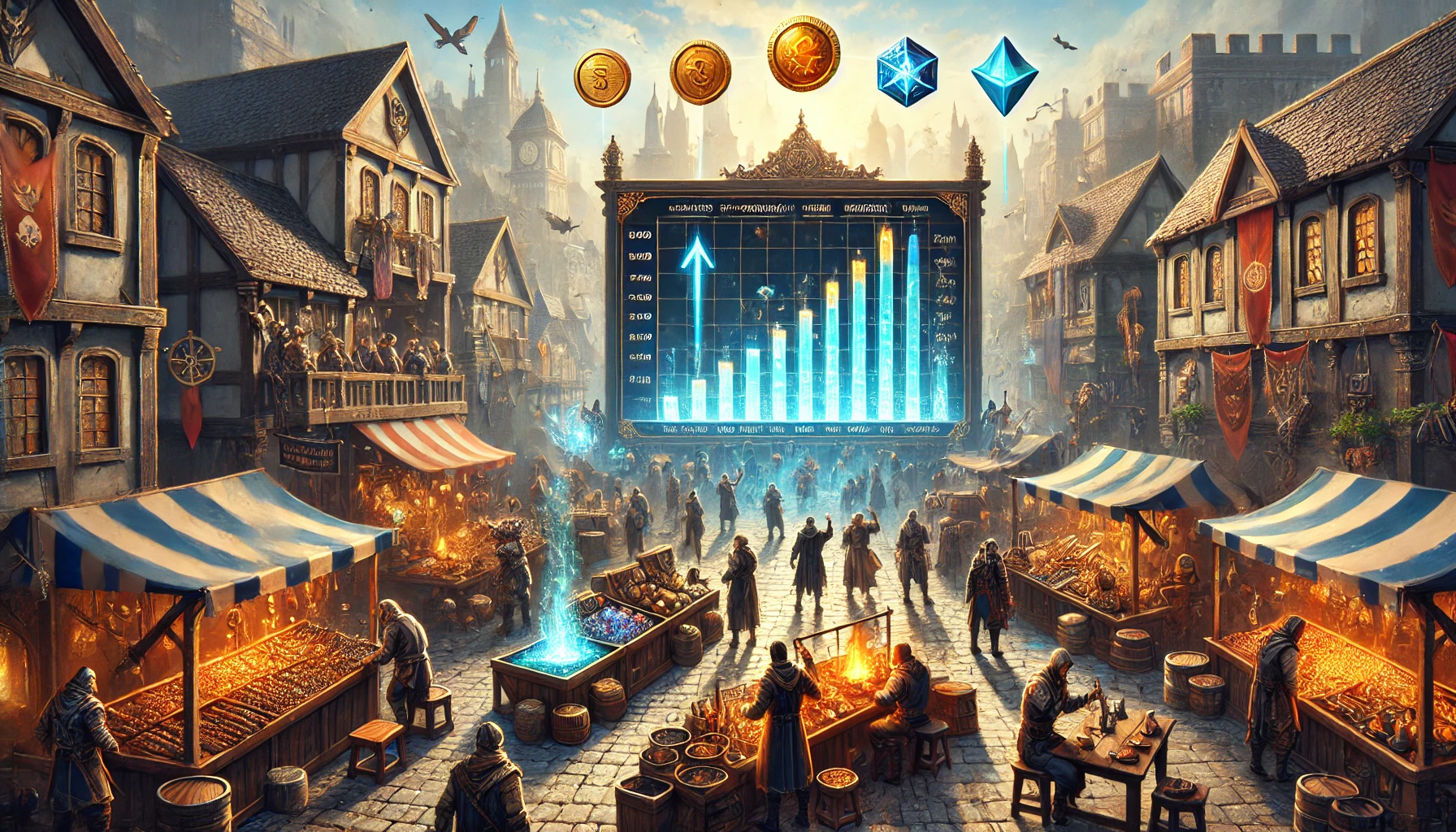
Why Nodes Control Everything 🏛️🌍
Nodes are literally designed to be the “heart of the world,” changing services and content based on player activity.
That matters for your wallet because a node’s growth affects:
which services exist nearby,
which NPCs and buildings show up,
where people gather to trade,
and where the next “economy hub” forms.
Bold line: In Ashes, the map isn’t just geography. It’s economics.
Economic node growth = bigger trade tools
Economic nodes have a unique trade building that evolves by stage, unlocking more trading features as the node advances.
This is the core reason prices can differ between regions: some places simply have more market power than others.
Markets Are Regional (And That’s Where The Profit Is) 🏪🗺️
In a regional economy, the same item can be:
cheap in a resource-heavy area,
expensive in a crowded hub,
or absurdly overpriced near a war zone where supply is risky.
That’s not “unfair.” That’s the whole game.
Ashes is built around nodes, regions, and vassal relationships that affect trade and taxes across a parent node’s zone of influence.
So you should expect:
local demand spikes (a node leveling fast needs materials),
local shortages (crafters drain one resource type),
and travel premiums (if it’s annoying to move, it costs more).
Bold truth: If everything is the same price everywhere, traders are useless. Ashes wants traders to matter.
The Economic Node “Trade Building Ladder” 🪜💼
This is one of the most important pieces of economy knowledge you can have, because it explains why certain settlements become rich.
Economic nodes unlock a unique building at the Village stage, and as the node grows, the building upgrades and adds more systems (Market → Exchange → Galleria → Emporium).
Market Stage: Your First Real Trading Hub 🏪🐴
At the Village stage, the economic node’s unique building is the Market, and it includes features like:
an auction house for raw resources and processed goods,
player shop areas and rental stalls,
and trade hauling options like Tier 1 mule training.
How you use this for profit
If you’re early, you sell basics fast (mats, processed stacks).
If you’re a grinder, you dump your loot here where buyers exist.
If you’re a crafter, you set up shop where foot traffic is nonstop.
Bold line: Your first economy win is simple: sell where the people are.
Exchange Stage: Where “Market Games” Begin 📊🧾
At the Town stage, the Exchange expands the Market with tools like:
an expanded auction house where all goods/items may be posted,
work orders (some tied to node government),
business licenses,
and information on average sale prices within the region.
This is huge for trading meta
Because once players can see more price data and list more item types, you get:
real undercutting wars,
real supply chain contracts,
and real “buy low, move, sell high” loops.
Bold truth: Price data is power. The best traders don’t guess—they compare.
Galleria Stage: Exchange Rates and Bigger Contracts 💱📦
At the City stage, the Galleria adds things like:
What changes here
Traders start thinking in “routes,” not “spots.”
Crafters start thinking in “pipelines,” not “single crafts.”
Guilds start treating materials like strategic resources.
Bold line: This is where the economy turns from “player hustle” into “regional industry.”
Emporium Stage: World Price Pressure 🌐💎
At the Metropolis stage, the Emporium adds major upgrades like:
worldwide sale prices for auction houses across Verra,
plus the “Linked Economy” superpower that shares auction house listings between linked economic nodes.
What this does to the meta
Rare goods become easier to locate and trade.
Big hubs can influence prices far beyond their borders.
“Local monopolies” become harder… but logistics and risk still matter.
Bold truth: Even with world price pressure, the best profits still live where supply is painful and risk is real.
Vassals, Influence, and Why “Small Nodes” Still Matter 🏘️🧷
Nodes can enslave nearby nodes into vassals starting at Stage 3, and vassals are subject to the parent’s taxes and trade rules.
Economy-wise, that means:
A strong parent node can shape the whole region’s trade flow.
A vassal can become a “resource feeder” for the parent’s market.
Traders can specialize in moving goods from vassal zones into the main hub.
Bold line: Big cities don’t run without small suppliers. If you live in the supplier zone, you can print money.
Taxes and Fees: The Invisible Hand That Changes Where You Sell 🧾💰
Taxes are not just flavor—they decide:
which market is worth listing in,
where crafting is profitable,
and where buyers actually want to shop.
Even in community discussion, one consistent idea is that mayors influence node life through decisions like tax rates and building decisions.
And nodes/vassals are explicitly tied into taxes and trade dynamics.
Practical rule
If taxes are high: prices might rise, but volume might drop.
If taxes are low: the hub becomes attractive and liquidity increases.
Bold truth: You don’t just sell an item. You sell an item inside a tax environment.
Crafting Profits: Where The Real Money Usually Lives 🛠️🔥
If you want consistent income, crafting loops tend to beat “lucky drops,” because you control the output.
The artisan supply chain is commonly framed as:
Here’s the key:
Processing is often where time and effort bottlenecks live—so processed materials can carry strong margins.
Bold line: Raw mats are volume. Processed mats are margin. Finished items are brand.
Three crafting business models that actually work
1) The “Stack Seller” (fast, low stress) 📦
You don’t craft final items. You:
This works because everyone needs inputs.
2) The “Commission Crafter” (social profit) 🤝
You become known for one lane (weapons, armor, consumables, tools).
People bring mats + tip you because they want reliability.
3) The “Niche King” (highest margins, harder work) 👑
You focus on items that:
That’s where people pay big.
Bold truth: Generalists survive. Specialists get rich.
Supply Chains: The Secret Skill Nobody Talks About 🧠🔗
A supply chain is just: how value moves from dirt → item → buyer.
In Ashes, supply chains matter more because:
nodes influence services and trade flow,
vassal zones feed parent hubs,
and the world is meant to react to player activity.
Build your supply chain like a real gamer
You don’t need spreadsheets (unless you like that). You need:
2–3 reliable gathering routes,
1–2 processing steps you can always do,
1 “final output” that sells consistently,
and one major hub where you list.
Bold line: If you ever log in and think “what do I do for money?” your system is missing.
Trading Meta: Arbitrage, Regional Prices, and “Why Caravans Exist” 🚚📈
Arbitrage is fancy talk for:
buy cheap here → move → sell expensive there.
Ashes supports this because markets are regional and nodes grow into more powerful trade centers.
But the real spice is caravans.
Caravans as an Economy Engine 🐴⚔️
Caravans are described as a major aspect of the economy, used to move commodities and other goods for reward.
A practical breakdown you’ll see in guides is that caravans are player-operated vehicles for moving trade goods, and they become available when a node reaches certain development (example: Village stage access mentioned in guide summaries).
Why caravans create “meta”
Because they add:
risk (ambush, PvP, loss),
coordination (escorts, routes),
and distance-based value.
Bold truth: Without risk, trade becomes boring. Caravans make trade a PvP story.
Commodities and Glint: The Trade Fuel 💠📦
Glint is commonly described as something you can trade with commodities vendors for market commodities, then transport those commodities elsewhere.
Commodities vendors can also trade glint directly for a smaller amount of gold compared to what you might get by exchanging commodities between nodes—meaning the “lazy cash-out” exists, but it’s weaker than doing the full trade loop.
What that means in plain English
Glint → quick gold (easy, lower profit)
Glint → commodities → caravan route → bigger gold (risk, higher profit)
Bold line: Caravans reward players who turn activity into logistics.
Regional Price Theory: Why One City Pays More 🏙️💸
A few real reasons a settlement pays more for the same item:
Demand spike: node leveling requires resources and services.
Crafting concentration: if many crafters live there, inputs get consumed fast.
Risk premium: dangerous routes reduce supply.
Tax pressure: sellers raise prices to compensate.
Time value: buyers pay more to skip travel.
Trader mindset: you’re not selling items—you’re selling convenience + safety + timing.
How to Calculate “Is This Route Worth It?” 🧮🚚
You don’t need perfect math. Use a simple gamer formula:
Profit = (sell price − buy price) − (fees + repairs + time cost) − (risk cost)
Where “risk cost” is:
Bold truth: A “lower profit” safe route often beats a “high profit” route that you fail half the time.
Escort Strategy: Turning PvP Into a Business 🤝⚔️
If caravans are profitable, then security becomes a job.
Great guilds will:
Solo/small groups can still win by:
running during low traffic,
using off routes,
traveling light and often,
and making your run boring to gankers.
Bold line: The safest caravan is the one nobody notices.
Market Roles: Pick Your “Economy Class” 🎭💰
If you want to dominate the economy, stop trying to do everything. Pick a role that fits your vibe.
Gatherer: The Reliable Earner 🌿⛏️
You always have something to sell. Your superpower is consistency.
Processor: The Margin Maker 🔥🧪
You turn cheap stacks into premium stacks. People underestimate you until you’re the one controlling supply.
Crafter: The Brand Builder 🛠️👑
You don’t just sell “an item.” You sell:
quality,
reliability,
repeat purchases,
and guild contracts.
Trader: The Route King 🗺️🚚
You know which settlements are hungry. You profit from distance and timing.
Broker/Flipper: The Market Predator 🦈📉
You watch listings, buy underpriced goods, resell at real value.
Harder, sweaty, but profitable.
Bold truth: Most rich players aren’t “better at combat.” They’re better at roles.
Early Server vs Mature Server Meta ⏳📈
Your strategy shifts as the server develops.
Early meta: scarcity rules everything 🥖💎
Mid meta: specialization wins 🧠🛠️
Late meta: logistics + influence wins 🏛️🚚
powerful nodes shape trade,
taxes and politics matter more,
and control of routes becomes a real strategic layer.
Bold line: If you keep using “early meta” methods forever, you’ll feel broke later. Adapt.
A Practical Daily Money Routine (Simple and Repeatable) ✅💸
Here’s a routine that fits most playstyles:
Gather for 20–30 minutes on a tight route
Process what you can (or sell raw if prices are hot)
Craft one consistent “seller” item (or stack type)
List in the busiest hub you can access
If you have time: run one trade route / caravan loop (or prep for one)
Bold truth: You get rich by repeating clean loops, not by chasing random jackpots.
Mistakes That Keep Players Poor ❌😂
Selling in dead markets with no buyers
Ignoring processing and wondering why mats “don’t pay”
Overcrafting niche items nobody wants yet
Running risky routes without a plan and calling it “bad luck”
Listing everything in one place forever, even when taxes and demand shift
Bold line: If the market changes, you change. That’s the whole meta.
BoostRoom Note: Why Economy Help Is Popular 🧠⚡
A lot of players love Ashes’ economy… but don’t have unlimited time.
So the most common “help needed” areas are:
speeding up artisan progress,
building consistent gold loops,
and getting key trade goods / crafted outputs faster.
Bold truth: The goal isn’t “skip the game.” It’s “skip the boring friction” and play the fun parts more.
Conclusion: Become a System Player 🏁💰
If you want to win the economy in Ashes of Creation, stop thinking like a looter and start thinking like a builder:
Nodes decide where trade power lives.
Economic node stages unlock stronger market tools, and top-tier economic nodes can enable linked auction access.
Supply chains (gather → process → craft → sell) create steady profit.
Caravans and commodities create distance-based value through risk and logistics.
Final bold line: Pick a lane, build a loop, and let the gold become automatic. 😈📈