Route: Draft Fundamentals That Win Before Loading Screen
Drafting isn’t about picking “strong heroes.” It’s about building a team that can do the job of winning: take objectives, survive engages, punish mistakes, and close games.
If you want to stop losing in draft, you need two upgrades:
- A draft checklist (so you don’t forget key tools)
- A win-condition mindset (so your picks all aim at the same plan)
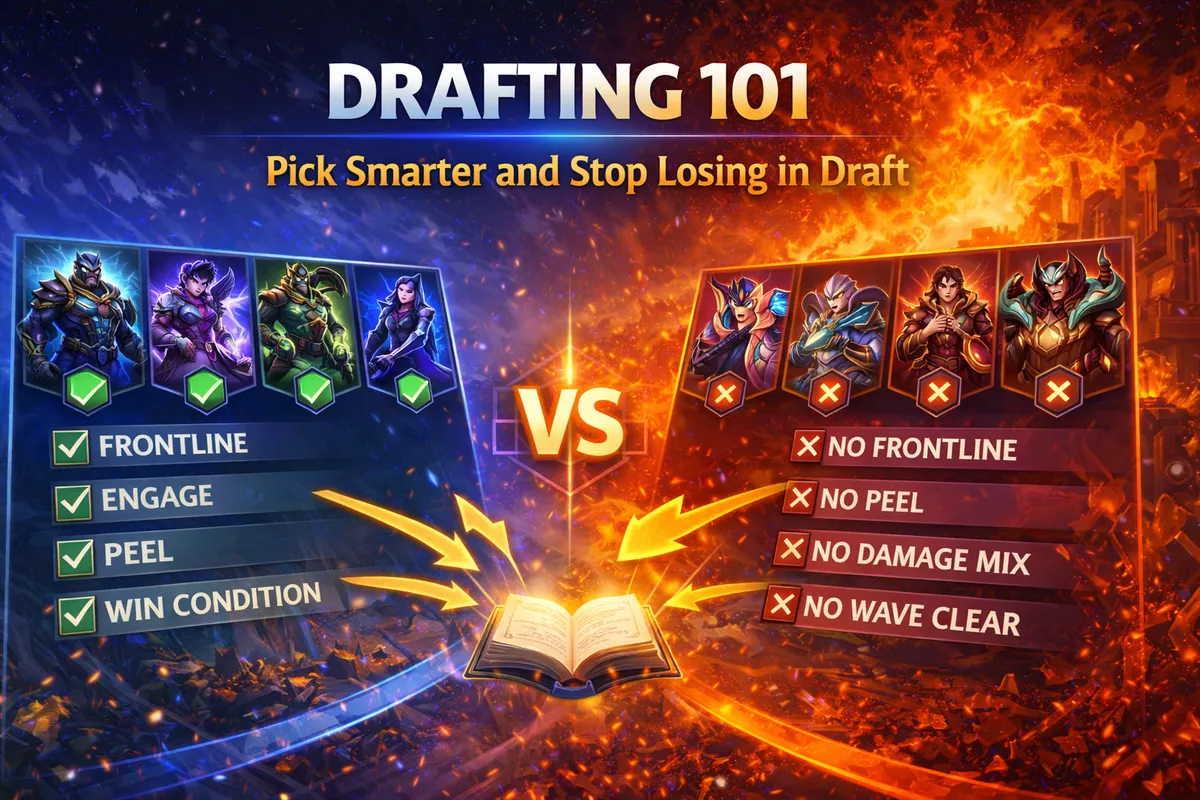
Your Draft Checklist (The 7 Boxes That Make Drafts Feel Easy)
Before the last pick locks in, quickly check these seven boxes. You don’t need perfection—you need coverage.
1) Frontline (Who stands first?)
If your team has zero heroes who can safely stand in front, you will lose control of bushes, lose objective entrances, and lose teamfights to one engage. One true frontline hero can make four squishy heroes playable.
2) Engage or Catch (How do we start fights?)
You need at least one reliable way to begin a fight on your terms: hard engage, pick tools, or a catch setup. If your team can’t start fights, you’ll only fight when the enemy wants to.
3) Peel (How do we protect the carry?)
In ranked, your gold laner or jungler often becomes the win condition. If your draft has no peel, assassins and dive comps farm you.
4) Damage Profile (Do we have physical + magic?)
A team with only one damage type becomes easy to itemize against. Mixed damage forces the enemy to spread their defenses and makes late game much easier.
5) Wave Clear (Can we defend and reset?)
Wave clear is the anti-throw tool of MLBB. It lets you stall when behind, defend base, and control tempo. Without it, one lost fight can end the game instantly.
6) Objective Control (Can we secure Turtle/Lord?)
Objective control comes from zoning + burst + secure timing. If your draft has no way to control entrances or threaten the enemy jungler, every Turtle/Lord becomes a stressful coin flip.
7) Tower Pressure (Can we end?)
Some teams win fights but can’t take towers. You need at least one hero who converts teamfight wins into structures—usually the gold laner, but not always.
If you check these seven boxes, your draft will already be better than most lobbies.
Route: Learn the Draft Flow (So You Stop Picking Blindly)
Draft Pick has three core phases: ban phase, pick phase, and last-change phase. The details vary by rank and updates, but the logic stays consistent: remove threats, pick a plan, then finalize builds and swaps.
Why Pick Order Matters More Than “Strong Heroes”
In standard pick order, one team picks a single hero first, then the other team picks two, and the pattern continues until the last pick. This creates a simple truth:
- Early picks should be safe and flexible.
- Late picks should be specific and punishing.
If you early-pick a hero that gets hard-countered, you hand the enemy an easy draft win. If you save your last pick for a counter or a “draft glue” hero that fixes your comp, you steal wins before the match starts.
The Golden Rule of Draft: “Draft for Game Plan, Not for Lane Ego”
A lot of drafts are lost because players treat draft like a 1v1 argument:
- “I want to win my lane.”
- “I need my hero.”
- “Pick what you want, I don’t care.”
But MLBB is a 5v5 objective game, not five separate duels. Lane wins matter, but only when your team comp can convert them into:
- Turtle control,
- towers,
- Lord pressure,
- and a clean finish.
You can win lane and still lose draft if your team has no frontline, no engage, and no answer to dive.
Route: Choose a Win Condition (The 5 Draft Plans That Actually Work in Ranked)
Most strong drafts fit one of these five win conditions. Pick one early (even silently), then draft around it.
1) Front-to-Back Teamfight (Most reliable for solo queue)
You draft a sturdy frontline, a consistent damage dealer, and support/control tools. You win by fighting as a unit, protecting your carry, and taking objectives after fights.
Best when: you want consistency and fewer coin flips.
2) Pick/Trap Composition (Win by catching one target)
You draft heroes that punish face-checking and force 4v5s. You win by controlling bushes near objectives and deleting anyone who walks alone.
Best when: enemies are likely to overextend and your team has burst + CC.
3) Dive/Backline Delete (Win by deleting their carry first)
You draft multiple heroes that can reach backline and remove the enemy marksman or mage instantly.
Best when: the enemy has weak peel and relies on one main carry.
4) Siege/Objective Melt (Win by taking structures fast)
You draft strong wave push, tower damage, and safe zoning. You win by taking mid turret early, pressuring lanes, and converting any small advantage into towers.
Best when: your team is disciplined and has wave control.
5) Split Push Pressure (Win by map stress)
You draft at least one strong side-laner who forces responses. You win by creating numbers advantage elsewhere when enemies answer the split push.
Best when: your side-laner is confident and your team can avoid getting wiped 4v5.
You don’t need to announce it in chat. You just need to draft like you have a plan.
Route: The Role Skeleton (What Each Slot Must Contribute)
A balanced MLBB draft usually includes these “jobs” across the five roles:
Jungler: tempo + secure + fight impact
Mid: wave clear + control + burst or poke
Roamer: vision control + engage/peel + map glue
EXP: frontline + disruption + early objective presence
Gold: scaling DPS + tower conversion
You can bend the rules (some metas allow weird setups), but if your team drafts five heroes that all want the same resources and none of them provide frontline or control, your match becomes hard for no reason.
Loot: Ban & Pick Tactics That Create Draft Advantage
Winning draft isn’t about memorizing “must bans.” Meta changes. What never changes is how you ban and pick.
Smart Bans: The 4 Ban Categories That Always Make Sense
In most ranked drafts, your bans should fall into one of these four categories:
1) Power Bans (Remove unfair heroes)
Some heroes are simply too efficient for the average ranked lobby to handle. If a hero is dominating your rank, banning it is often correct—especially if your team doesn’t first-pick it confidently.
2) Comfort/One-Trick Bans (Remove enemy’s best weapon)
If the enemy shows a favorite hero or your lobby recognizes a notorious specialist pick, one targeted ban can win the match before it starts.
3) Counter Bans (Protect your intended picks)
If you already know what you want to play, ban the heroes that hard-counter your win condition.
Example logic: if your plan is “protect-the-carry,” ban the worst diver/lockdown threats.
4) Draft-Structure Bans (Remove what breaks your comp)
Sometimes you ban not because a hero is “broken,” but because that hero ruins your team’s ability to function.
Example logic: if your team is drafting immobile backline, ban the best hard engage initiators.
The mistake most players make is banning randomly. The fix is simple: every ban should have a reason.
First-Pick vs Second-Pick Strategy (Stop Copying, Start Thinking)
Draft feels different depending on whether your team picks first or second.
If you have first pick
Your advantage is access to a “power pick” before the enemy can respond. Your job is to pick something that is:
- high value,
- difficult to counter,
- or flexible across roles.
If you have second pick
Your advantage is response. You get to pick two heroes after seeing the enemy’s first pick. Your job is to:
- deny synergy,
- take a strong two-hero pairing,
- or set up a counter lane.
A simple way to think about it:
- First pick = priority
- Second pick = punish
Early Picks: Pick Safe, Flexible, and “Draft-Helpful”
The best early picks usually share at least one of these traits:
- Flexible role or lane (harder to counter)
- Strong wave clear (protects your tempo)
- Reliable CC (always useful)
- Low dependence on perfect team coordination
- Doesn’t collapse to one counter item
If you pick a fragile, counterable hero early, you’re asking to get drafted into a wall.
Mid Draft: Secure Synergy and Cover Your Weaknesses
Mid draft is where good teams quietly win. Ask:
- Do we have frontline yet?
- Do we have engage or catch?
- Do we have peel?
- Do we have mixed damage?
- Do we have wave clear?
If the answer is “no” to multiple, you don’t need a flashy pick. You need a glue pick—a hero that makes the entire comp function.
A “glue pick” is often:
- a roamer with reliable engage or peel,
- a mid with control and wave clear,
- or an EXP hero that gives your team a real front line.
Last Picks: Counter Pick or Fix Pick (Choose One)
Your last pick has the highest strategic value. Use it correctly.
Counter pick
Pick a hero that directly punishes a key enemy pick or the enemy’s overall plan. This is strongest when you know:
- who you will lane against,
- what the enemy win condition is,
- and what your job will be.
Fix pick
Pick a hero that repairs your team’s missing tools. This is strongest when your team is about to draft something unplayable (no frontline, no wave clear, no engage). Fix picks win more ranked games than “ego counters” because they make your team functional.
Most ranked drafts are lost because the last pick is used for ego instead of structure.
Loot: Drafting for Solo Queue (The “Low Coordination” Advantage)
In solo queue, don’t draft like you’re playing a perfect tournament team. Draft like you’re playing with real humans who:
- might not rotate perfectly,
- might not peel perfectly,
- might chase kills,
- might forget objectives.
That means your draft should be:
- simple to execute
- forgiving when someone makes a mistake
- not dependent on one perfect combo
The 3 Solo Queue Draft Styles That Climb Fast
1) Front-to-back with a real frontline
Most consistent. Easy win condition. Fewer throws.
2) Pick comp with simple catch tools
Punishes enemy mistakes. Works even without perfect macro.
3) Split push with a safe map reader
Creates pressure even if teammates are messy—if the split pusher is disciplined.
The draft styles that often fail in solo queue:
- full dive with no follow-up,
- full squishy poke with no frontline,
- “five damage heroes” comps,
- and combo comps that require perfect timing every fight.
Loot: Counterpicking Without Overthinking (What Actually Matters)
Counterpicking is real—but many players do it wrong. They counter the lane and ignore the game.
Good counterpicks answer one of these:
- Can I survive their burst/engage?
- Can I deny their win condition?
- Can I punish their draft weakness?
The Counter Categories That Win Drafts
Anti-dive tools
If the enemy draft wants to jump your backline, you draft peel, control, and survival tools. This can be:
- roamer peel,
- mid zoning,
- EXP frontline disruption,
- and a carry with safer positioning options.
Anti-sustain tools
If the enemy relies on healing, shields, or regen-based fights, draft heroes that:
- apply anti-heal easily,
- burst through sustain windows,
- or control fights so enemies can’t free-heal.
Anti-poke tools
If the enemy drafts long-range poke, draft:
- hard engage to punish them,
- sustain/regen and wave clear to outlast,
- and flank threats that force them off angles.
Anti-split push tools
If the enemy has strong side pressure, draft:
- wave clear to defend lanes,
- fast rotation heroes,
- and at least one hero who can hold the side safely.
The biggest counterpick mistake:
Choosing a “lane counter” that makes your team comp worse overall.
Loot: Draft Communication That Actually Works (Without Toxicity)
In ranked, you don’t need long conversations. You need quick, clear signals.
Use simple messages like:
- “Need tank/frontline”
- “We have no engage”
- “We need magic damage”
- “Save last pick for roam/mid”
- “We scale, don’t fight early”
- “We have early, contest Turtle”
Draft communication works best when it’s:
- short,
- calm,
- and about the team’s plan.
If chat is toxic, don’t argue. Draft structure silently:
- pick glue,
- cover weaknesses,
- and make the comp playable.
Loot: The “Draft Trap” Mistakes That Lose Games Instantly
If you remember nothing else, avoid these draft traps:
Trap 1: Five squishies, no frontline
You will lose bushes, lose objectives, and get wiped by one engage.
Trap 2: No wave clear
One lost fight becomes base damage. Defending becomes impossible.
Trap 3: One damage type
Enemy stacks defense, your “lead” disappears, and fights become unwinnable late.
Trap 4: No objective control
Every Turtle/Lord becomes a steal risk or a forced fight you can’t start correctly.
Trap 5: No win condition
If your draft can’t answer “how do we win fights,” your match becomes random.
Fixing these five mistakes alone will raise your win rate.
Extraction: Turn Your Draft Into an Easy Game Plan
A smart draft only helps you if you play the draft. Extraction means translating picks into a simple plan.
Step 1: Identify Who Scales and Who Spikes
Every draft has timing windows.
- Early spike draft: wants early fights, early towers, early snowball.
- Scaling draft: wants safe farm, controlled fights, and late objective power.
- Mixed draft: wants to fight at item/level breakpoints, not randomly.
If you drafted scaling and you force messy early fights, you’re throwing your own draft. If you drafted early power and you AFK farm until late, you’re wasting your advantage.
Step 2: Decide Your Objective Behavior (Contest, Trade, or Trap)
For each Turtle/Lord window, decide in advance:
- Contest if you are stronger and set up early
- Trade if you can’t safely enter
- Trap if your comp is pick-based and you want a numbers advantage first
This one decision makes games feel controlled.
Step 3: Assign the Draft Jobs (So Everyone Knows Their Role)
Even without voice chat, you can mentally assign jobs:
- Who is the main damage carry?
- Who is the frontline that stands first?
- Who is the engager or catch starter?
- Who peels for the carry?
- Who clears waves and controls mid tempo?
- Who side pressures in mid-late?
When these jobs are clear, fights become structured instead of chaotic.
Step 4: Play the Draft in Teamfights (Front-to-Back Is the Ranked Default)
Most ranked fights are won by:
- protecting your damage,
- controlling space,
- and deleting whoever overextends.
If you drafted a solid frontline and peel, don’t throw it away by chasing the enemy backline alone. Let your comp do the work:
- frontline zones,
- control holds entrances,
- carry free-hits,
- then you take objectives.
Step 5: End With Your Draft’s Strength (Don’t Win Then Stall)
If you drafted siege:
- take towers after every win.
If you drafted pick:
- set traps near objectives and force 4v5s.
If you drafted dive:
- remove their carry first, then convert immediately.
If you drafted split push:
- pressure side during objective windows so enemies can’t defend everything.
Extraction is where “drafting smarter” becomes actual stars.
Practical Rules: 120 Draft Rules to Pick Smarter
- Draft for a win condition, not five comfort picks.
- Frontline makes drafts playable.
- If you have no frontline, your backline becomes free gold.
- One engager or catcher prevents “we can’t start fights.”
- One peel tool prevents “our carry can’t play.”
- Mixed damage prevents easy item stacking.
- Wave clear prevents instant base losses.
- Objective control prevents coin-flip Lords.
- Tower pressure prevents “we win fights but can’t end.”
- Early picks should be safe and flexible.
- Late picks should counter or fix the draft.
- Don’t early-pick fragile heroes that get hard-countered.
- Don’t last-pick ego if your team is missing key tools.
- If you see heavy dive, draft peel and control.
- If you see heavy sustain, draft anti-sustain tools.
- If you see heavy poke, draft engage or sustain + wave clear.
- If you see split push, draft wave clear and fast rotations.
- Ban with a reason every time.
- Power ban what your rank can’t handle.
- Comfort-ban obvious enemy specialist threats when possible.
- Counter-ban what ruins your intended plan.
- Structure-ban what breaks your team comp.
- First pick should be hard to counter or high value.
- Second pick should punish or deny synergy.
- A good draft has at least one “glue” hero.
- Glue heroes win more ranked games than flashy picks.
- Don’t draft five heroes that all need buffs and farm.
- Don’t draft five heroes that all want to dive with no follow-up.
- Don’t draft five squishies and hope to outplay every engage.
- Don’t draft no wave clear and pray you never lose a fight.
- Don’t draft only physical or only magic damage.
- Don’t draft without a reliable CC option.
- If your carry is immobile, draft peel and spacing tools.
- If your carry is short-range, draft frontline and engage.
- If your jungler is early, don’t draft four scaling lanes.
- If your jungler is scaling, don’t draft a full early-fight plan.
- EXP often provides the “second frontline” in objective fights.
- Roamer often provides the “draft glue” for engage/peel.
- Mid often provides wave control and objective zoning.
- Gold often provides tower conversion and late DPS.
- Draft with the minimap in mind: who checks bushes safely?
- Draft with Lord in mind: can we control entrances?
- Draft with defense in mind: can we clear waves when behind?
- Draft with ending in mind: can we take towers fast enough?
- Counterpicking is about the game plan, not just lane.
- Don’t counterpick lane if it breaks your team comp.
- Don’t pick “more damage” when your team needs structure.
- In solo queue, simple comps win more.
- Avoid drafts that require perfect combo timing.
- Avoid drafts that require perfect peel every fight.
- If chat is silent, draft glue instead of gambling.
- If chat is toxic, mute and draft structure anyway.
- If your team lacks CC, fix it before the match starts.
- If your team lacks frontline, fix it before the match starts.
- If your team lacks magic damage, fix it before the match starts.
- If your team lacks physical damage, fix it before the match starts.
- If your team lacks wave clear, fix it before the match starts.
- If your team lacks objective tools, fix it before the match starts.
- Draft should make the game easier, not harder.
- If you’re unsure, pick consistency over complexity.
- Pick heroes you can execute under pressure.
- A comfortable hero that fits the draft beats a meta hero you can’t play.
- But comfort that ruins the comp is still a draft loss.
- Always ask: “Who is our win condition?”
- Always ask: “Who protects the win condition?”
- Always ask: “Who starts fights?”
- Always ask: “Who clears waves?”
- Always ask: “Who takes towers?”
- Always ask: “Who controls objectives?”
- If you can’t answer, the draft is incomplete.
- Don’t reveal your entire plan with the first two picks.
- Save at least one pick to respond to enemy draft direction.
- Flex picks reduce counterpick value.
- If you have last pick, use it to punish.
- If you don’t have last pick, draft safer early.
- Don’t pick a hero that needs a babysitter if your roamer won’t babysit.
- Don’t pick a hero that needs perfect setup if your team lacks engage.
- Don’t pick “late only” comps and then fight early for no reason.
- Don’t pick “early only” comps and then stall until late.
- Draft and gameplay must match.
- If your draft is early, contest early objectives.
- If your draft is scaling, trade intelligently and farm.
- If your draft is pick, trap before objectives.
- If your draft is siege, take towers immediately after wins.
- If your draft is split, pressure during objective windows.
- Don’t draft a squishy roamer if your team already has no frontline.
- Don’t draft a damage EXP if your team needs a front body.
- Don’t draft a greedy mid if your team needs wave clear and control.
- Don’t draft a greedy gold if your team has no peel.
- Don’t draft a jungle pick that your team can’t support.
- If enemy has heavy CC, consider cleanse tools in draft mindset.
- If enemy has heavy burst, draft survival/peel and spacing tools.
- If enemy has heavy mobility, draft reliable catch/lockdown.
- If enemy outranges you, draft engage or flanks.
- If enemy out-engages you, draft disengage and punish tools.
- Draft should reduce the number of “must outplay” moments.
- Draft should create at least one “easy win” path.
- Easy win paths are: tower snowball, objective control, pick traps, or carry protection.
- One strong synergy pair is better than five unrelated picks.
- But synergy without structure still fails.
- Never ignore wave clear.
- Never ignore frontline.
- Never ignore your ability to start fights.
- Never ignore your ability to end fights into towers.
- Don’t ban randomly—ban intentionally.
- Don’t pick randomly—pick with a job.
- Don’t tilt-draft because you lost last game.
- Don’t revenge-ban; ban what matters now.
- If your teammate shows a hero, consider protecting it with bans.
- If your team is first pick, decide early if you want priority or safety.
- If your team is second pick, decide early if you want denial or counters.
- If your team is missing one tool, last pick can fix it.
- If your team is missing three tools, the draft is already in danger—pick glue earlier.
- Don’t rely on “we’ll just outplay.”
- Draft so average play can still win.
- The best draft is the one that is easiest for your team to execute.
- The best draft punishes common ranked mistakes.
- The best draft forces the enemy to make hard decisions.
- The best draft gives you a clear plan for Turtle, Lord, and siege.
- Pick smarter, and half your games stop feeling impossible.
BoostRoom: Draft Support That Turns Into More Stars
If you’re tired of losing matches in draft—before you even load in—BoostRoom is built for you. Most players grind mechanics but ignore drafting, even though draft is the fastest way to make games easier.
BoostRoom helps MLBB players improve drafting consistency by focusing on:
- simple draft checklists (frontline, engage, peel, wave clear, mixed damage)
- ban logic that matches your rank and hero pool
- pick order habits (safe early picks, high-impact late picks)
- win-condition drafting (teamfight, pick, siege, dive, split)
- turning draft into a clear in-game plan so you stop “winning lane, losing game”
If you want fewer coin flips and more controlled wins, learning to draft smarter is one of the highest-ROI upgrades in ranked—and BoostRoom is here to speed that up.
FAQ
What is the biggest mistake in MLBB draft?
Drafting without a win condition—usually five comfort picks with no frontline, no engage, and no peel.
How do I know what to ban in ranked?
Ban with a reason: remove power picks your rank struggles against, remove enemy comfort threats when obvious, and protect your intended win condition by banning hard counters.
Should I always pick meta heroes?
Meta helps, but execution matters more. A hero you play confidently that also fits the draft usually beats a meta hero you can’t execute—especially in solo queue.
What should be picked early in draft?
Safe, flexible, hard-to-counter picks that contribute to team structure (wave clear, CC, flexibility, or reliable value).
What should be picked last in draft?
Either a counter pick that punishes the enemy’s plan, or a fix pick that covers your team’s missing tools (frontline, wave clear, engage, peel).
How do I draft better in solo queue with no communication?
Draft for simplicity and structure: ensure frontline + reliable CC + wave clear + a clear carry plan. Avoid comps that require perfect coordination.
How do I stop getting destroyed by dive comps?
Draft peel and control. Make sure your team has at least one hero whose job is to protect the carry and punish divers.
Why does wave clear matter so much in draft?
Wave clear lets you reset tempo, defend base, and avoid losing instantly after one bad fight. It also helps you control objective setups.
Is mixed damage really important?
Yes. If your team is only physical or only magic, enemies can itemize efficiently and your damage falls off, especially in mid-late game.
How do I draft a teamfight composition that’s easy to win with?
Pick a real frontline, reliable engage or catch, consistent damage, and peel for the carry. Then play front-to-back and convert wins into objectives.



