Path of Exile 2 Crafting Guide: How to Make Better Gear Step by Step
Crafting is controlled gear improvement
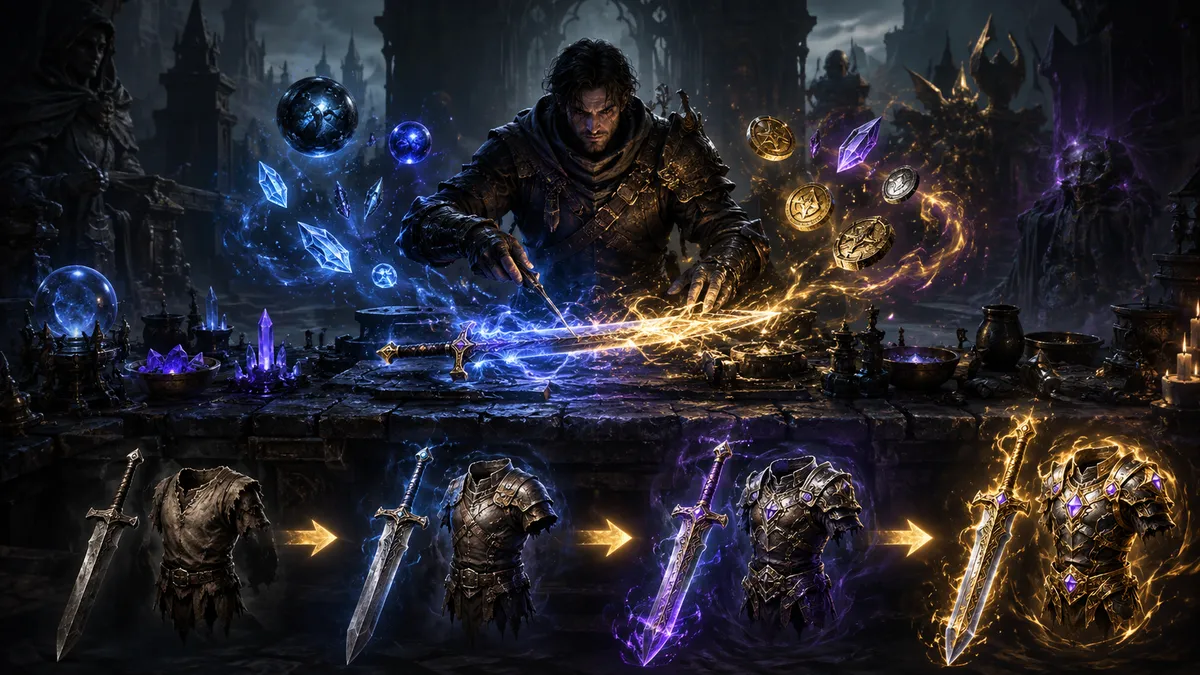
Crafting means using currency items, runes, essences, socketables, and special systems to improve gear. Instead of waiting for a perfect item, crafting lets you create better items from good bases or improve items that are already close to useful.
The best craft solves a real problem
A good craft has a purpose. It fixes low damage, missing resistances, weak life, slow movement, missing attributes, poor armor, low spell scaling, bad minion support, or another clear build issue. If you do not know what problem you are fixing, you should not craft yet.
Crafting starts before using currency
The first step is choosing the right item. A good crafting item begins with a good base, the correct level range, useful existing modifiers, and a real reason to invest. Currency cannot turn every bad item into a great item.
Not every item deserves investment
Some items are temporary. Some are weak bases. Some have the wrong stats. Some are missing too much. Good crafting also means knowing when to stop and move on.
Crafting and trading work together
You do not need to craft everything yourself. Sometimes crafting is best. Sometimes buying an upgrade is cheaper. Strong players use both methods depending on the item, cost, and risk.
Why Crafting Matters in Path of Exile 2
Drops will not always give exact upgrades
You may find many rare items, but most of them will not match your build. Crafting helps bridge the gap between random drops and the stats your character actually needs.
Crafting keeps leveling smooth
A weak weapon, slow boots, missing resistance, or outdated armor can slow the campaign. Simple crafting can keep your character strong enough to move forward without long farming sessions.
Crafting improves endgame power
Endgame gear needs better combinations of stats. Life, resistances, movement speed, damage, defenses, resource sustain, sockets, runes, and special modifiers become more important. Crafting helps refine these pieces.
Crafting teaches item value
When you craft, you learn which bases matter, which modifiers are valuable, and which items are not worth saving. This makes you better at looting, trading, and upgrading.
Crafting prevents wasted gear swaps
A good craft can fix one missing stat without forcing you to replace three other items. This is especially useful when your gear is balanced around resistances, attributes, or spirit.
The Main Crafting Rule
Always know the goal before crafting
Before using any orb, essence, rune, flux, alloy, or socketable, ask what you want from the craft. More damage, more life, better resistance, movement speed, attributes, armor, spell power, minion support, or Runic Ward are clear goals.
Use cheap currency for cheap problems
Early campaign problems can often be solved with simple currency. You do not need expensive endgame crafting to improve a leveling weapon or resistance ring.
Save rare currency for strong bases
High-value crafting items should be used on gear that can last. Spending rare currency on a weak low-level item usually gives poor value.
Stop when the item is good enough
One of the biggest crafting mistakes is overcrafting. If an item already solves the problem, stop. Chasing perfection can waste currency and sometimes ruin the upgrade path.
Do not craft emotionally
Crafting can feel exciting, but emotional crafting is expensive. Do not keep clicking because you are frustrated. If the item becomes bad, stop and start with a better base later.
Step 1: Identify What Your Build Needs
Damage problems need damage crafts
If enemies take too long to die, your first crafting target depends on your build. Attack builds usually need better weapons. Spell builds need spell or elemental scaling. Minion builds need minion-related stats. Ailment builds need correct ailment support.
Defense problems need survival crafts
If you die often, look for life, resistances, armor, evasion, energy shield, Runic Ward, recovery, block, or other defensive stats. Adding more damage may not fix a character that dies too fast.
Movement problems need boot upgrades
Slow boots make every zone worse. Movement speed is one of the best early crafting goals because it improves campaign speed, boss dodging, Trial movement, and mapping comfort.
Requirement problems need attributes
Strength, Dexterity, and Intelligence requirements can block skills and gear. If your item swap breaks a gem, you may need attribute crafting or jewelry fixes.
Resource problems need sustain
If your skill costs too much or your setup feels clunky, crafting for mana, spirit support, recovery, or related stats can be more valuable than more damage.
Step 2: Choose the Right Base
The base decides the item’s foundation
A base item controls weapon type, attack speed, damage range, armor type, evasion, energy shield, requirements, sockets, and what kind of build can use it well. Crafting on the wrong base starts the craft badly.
Attack builds need correct weapon bases
Bow builds need bow bases. Crossbow builds need crossbows. Melee builds need the right melee weapon type. Spear builds need spear bases. A strong modifier on the wrong weapon type does not help.
Spell builds need caster-friendly bases
Spell builds usually care about spell damage, cast speed, elemental or chaos bonuses, gem-related bonuses, mana support, and defenses. Raw weapon damage may not matter for many spells.
Armor bases should match your defense plan
Armor, evasion, energy shield, hybrid bases, and Runic Ward-related decisions should support your passive tree and gear plan. Random defenses are weaker than planned defenses.
Jewelry bases are flexible
Rings, amulets, and belts can fix resistances, attributes, life, mana, spirit needs, and damage. Jewelry is often the easiest place to solve missing stats.
Step 3: Check the Existing Modifiers
Good modifiers make crafting safer
An item with useful existing stats is a better crafting target. If a weapon already has strong damage, a ring already has good resistance, or boots already have movement speed, crafting can improve something that already works.
Bad modifiers lower the item’s value
If an item has several irrelevant stats, it may not deserve more investment. Adding one useful modifier to a mostly bad item rarely makes it great.
Open modifier space matters
Some currency adds modifiers. If an item has no useful room left or already has too many bad stats, adding more may not solve the problem.
Modifier combinations matter
One good stat is nice. Several useful stats together create real value. A ring with life, resistance, and attributes is much better than a ring with one good line and several wasted ones.
Do not ignore hidden value
An item may be valuable because it fixes attributes, sockets, resistance balance, or skill requirements. Always check what the item is doing before replacing or crafting over it.
Step 4: Start With Simple Currency
Transmutation Orbs are for normal bases
A Transmutation Orb turns a normal item into a magic item. This is useful when you find a good normal base and want to create a simple upgrade.
Augmentation Orbs improve magic items
An Augmentation Orb adds another modifier to a magic item if it has space. This is best when the first modifier is already useful.
Regal Orbs upgrade strong magic items
A Regal Orb turns a magic item into a rare item by adding another modifier. Use it on magic items that already have good stats, not on weak ones.
Alchemy-style crafting creates quick rares
Turning a normal item into a rare can be useful when the base is strong and you need a fast upgrade. The result is still random, so the base must be worth the attempt.
Exalted Orbs improve good rares
An Exalted Orb adds a modifier to a rare item. It is best used on items that are already good and have room for improvement. Do not use it to rescue bad rares.
Step 5: Use Essences for Direction
Essences make crafting less random
Essences are useful because they give more direction than basic random crafting. They can help guarantee or influence a certain modifier type, depending on the essence.
Use Essences when you need a specific stat
If your build needs a damage type, defensive stat, minion modifier, resistance, or other specific direction, an Essence can be better than blind orb crafting.
Essences still need good bases
An Essence does not make a bad base good. The base should still match your build, level range, and gear plan.
Essence crafting is strong during progression
Essences are useful while leveling because they can create items with at least one meaningful stat. This can save time when drops are unlucky.
Perfect Essence-style crafting needs more care
More advanced targeted crafting should be saved for stronger items. If an item is already close to good, targeted crafting can be powerful. If the item is bad, it may still stay bad.
Step 6: Use Runes and Socketables
Runes add controlled bonuses
Runes are socketable upgrades that can add predictable item bonuses. This makes them very useful for fixing stats without gambling on random modifiers.
Use runes to fix missing stats first
During the campaign, runes are great for resistances, attributes, damage, or simple defenses. These fixes can keep your character moving.
Endgame runes become stronger tools
Later, runes can support more specialized damage, defense, weapon identity, Runic Ward, or build mechanics. They become more than simple stat patches.
Socketables should match the item role
Weapon socketables should usually support damage or weapon function. Armor socketables should usually support defense, resistance, ward, or survival. Jewelry socketables should support the item’s job if available.
Do not waste valuable socketables on throwaway items
If an item will be replaced soon, use cheaper socketables or save your stronger ones for long-term gear.
Step 7: Add Sockets With Purpose
Sockets create room for extra power
Sockets allow runes and socketables to improve an item. If an item is already good but lacks a socket, adding one can make it much stronger.
Use socket currency on items worth keeping
Do not add sockets to every random item. Use socket-related currency on strong items, important leveling pieces, or gear that solves a key problem.
Boots, armor, and weapons can gain major value from sockets
A socketed weapon can gain damage. Socketed armor can gain defense or resistance. Socketed boots can help movement or survival depending on available options.
Sockets are not a reason to keep bad gear forever
An item with a socket is not automatically good. If the base and modifiers are weak, the socket may not save it.
Plan the socket and the rune together
Before adding a socket, know what you want to place inside. A socket without a plan may become wasted potential.
Step 8: Use Fluxes to Fix Resistances
Fluxes help change resistance types
Fluxes can transform item resistances from one element to another. This is useful when an item is good but has the wrong resistance for your current setup.
Use Fluxes on items that are already worth saving
If the item has good life, damage, movement speed, defense, or other useful stats, a Flux can make it fit better. If the item is bad, changing resistance will not save it.
Fluxes help avoid awkward gear swaps
Sometimes replacing one item breaks your resistance balance. Fluxes can help adjust an existing item instead of forcing a full gear reshuffle.
Resistance crafting is practical power
Fixing resistances can make bosses and maps much safer. This is often more valuable than adding a small damage modifier.
Use Fluxes before difficult content
If one elemental weakness keeps killing you, fixing it before campaign bosses, Trials, or endgame maps can save a lot of time.
Step 9: Understand Alloys
Alloys are advanced modifier tools
Alloys can add crafted modifiers by replacing an existing modifier. This makes them more advanced than simple add-a-mod crafting.
Use Alloys on items with one fixable weakness
An item with several good stats and one weak modifier can be a good Alloy target. An item with many bad modifiers is usually not worth it.
Know what you might lose
Because Alloys replace an existing modifier, you need to understand the risk. Do not use them casually on items that are holding your build together.
Alloys are better for planned upgrades
These are not beginner spam items. They are stronger when used on gear that already has long-term value.
Use Alloys after the item has a clear role
Before using an Alloy, know whether the item is meant for damage, defense, resistance fixing, minions, spell scaling, weapon power, or endgame optimization.
Step 10: Use Verisium Runeforging
Verisium Runeforging adds another crafting layer
Verisium Runeforging is a newer crafting system connected to campaign progression and the Runes of Aldur systems. It gives players another way to improve armor and interact with Runic Ward.
Runic Ward is a defensive layer
Runic Ward helps your character survive after reaching 1 life by taking damage while it regenerates separately from life. It is not a replacement for normal defenses, but it can be part of a layered survival plan.
Lower-level armor can gain Runic Ward without the same tradeoff
After unlocking the system, lower-level armor can gain Runic Ward without losing regular base defenses. Higher-level armor involves more tradeoff, so the decision becomes more strategic.
Unique Verisium Runeforging can upgrade old uniques
Some lower-level unique weapons and armor can have their base type upgraded, helping them stay more competitive later. This can make certain unique items more useful beyond their original level range.
Runeforging should support your defense plan
Do not add Runic Ward randomly and ignore everything else. Life, resistances, movement, recovery, armor, evasion, energy shield, and flasks still matter.
Step 11: Use Remnant Crafting Carefully
Remnants create item crafting encounters
In the Runes of Aldur system, Remnants can let players craft an item through runic recipes and then fight an encounter to claim the result. This connects crafting with combat performance.
More runeshapes can mean more danger
Using more slots can create stronger or rarer crafting outcomes, but it also increases the challenge of the encounter. Crafting reward and combat risk are connected.
Crafting encounters require build readiness
A good crafting opportunity can still fail if your character cannot handle the enemies. Before pushing harder Remnant crafts, make sure your damage, movement, and defenses are stable.
Remnants unlock important crafting features
Farrow’s quest progression unlocks several crafting systems over the campaign, including Verisium Runeforging, Alloys, unique upgrades, Ancient Runes, Fluxes, and more advanced rune options.
Do not overcommit when your character is weak
If your build is struggling, choose safer crafting encounters or improve gear first. Failing a dangerous encounter can waste time and momentum.
Step 12: Use Trade as a Crafting Tool
Trading can be cheaper than crafting
Sometimes the item you need already exists. Buying it can cost less than spending many orbs trying to make it yourself.
Trade is best for exact problems
If you need movement speed boots with resistance, a weapon with specific damage, or jewelry with exact attributes, trade can solve the problem quickly.
Crafting is best when you have a good base
If you find a strong base or an item that is already close to good, crafting may be better than buying.
Compare cost before expensive crafts
Before spending valuable currency, check whether a similar item is available through trade. If buying is cheaper, save your crafting items.
Strong progression uses both methods
Do not treat crafting and trading as enemies. Craft when the opportunity is good. Trade when the market gives better value.
Crafting Weapons Step by Step
Start with the correct weapon type
A weapon craft begins with weapon type. Bow skills need bows, crossbow skills need crossbows, melee skills need the correct melee base, and spear skills need spear bases. The wrong weapon type cannot become the right item.
Check base damage and speed
For attack builds, base damage and attack speed matter a lot. A newer base with better damage can outperform an older rare with attractive but weaker stats.
Use simple currency on strong leveling bases
If you find a strong weapon base during the campaign, basic crafting can be worth it. Transmutation, Augmentation, Regal, Alchemy-style crafting, or an Exalted Orb can create a useful weapon if the base deserves it.
Use runes for direct weapon improvements
Weapon runes can add controlled power. If the weapon will last for several levels or early maps, socketing and runing it can be worthwhile.
Stop investing when the weapon is outdated
A low-level weapon eventually becomes bad no matter how much you like it. Save serious crafting for better bases.
Crafting Spell Gear Step by Step
Do not chase raw weapon damage for spells
Most spell builds need spell-focused modifiers more than weapon physical damage. Read your skill tags and scaling before crafting.
Look for spell-friendly bases
Caster weapons, focus-style items, shields, jewelry, and armor pieces can support spell damage, cast speed, elemental scaling, chaos scaling, gem bonuses, mana, and defenses.
Use crafting to improve casting comfort
Cast speed, mana support, and defensive stats can be just as important as spell damage. A spell that is too slow or too expensive may feel bad even with good damage.
Match the spell’s element or mechanic
A fire spell, cold spell, lightning spell, chaos spell, and physical spell may all want different modifiers. Craft for the spell you actually use.
Do not ignore survival
Caster gear still needs life, energy shield, resistances, movement speed, recovery, and defensive planning. Damage-only caster gear can create fragile builds.
Crafting Armor Step by Step
Choose a defensive base that fits your build
Armor, evasion, energy shield, and hybrid bases should match your class, passive tree, and defensive plan. Random armor bases create scattered defenses.
Look for life and resistances early
Life and resistances are some of the best armor crafting goals during the campaign. They make bosses, Trials, and later acts much smoother.
Use sockets and runes for defensive fixes
Armor sockets can help with resistances, defenses, Runic Ward, or other survival needs. This is one of the more controlled ways to patch weaknesses.
Use Runeforging when it supports survival
Adding Runic Ward can be valuable when the item and build benefit from another survival layer. It works best as part of a complete defense plan.
Do not craft heavily on weak armor
If the base is low-level or the item has several bad modifiers, save your better crafting items for a stronger piece.
Crafting Boots Step by Step
Movement speed is the first goal
Boot crafting should usually start with movement speed. Slow boots make campaign, Trials, and maps worse.
Add life and resistances when possible
Good boots usually combine movement speed with survival stats. Movement speed alone is useful, but movement speed with life and resistance is much better.
Do not overcraft bad boots
A low-level pair of boots with movement speed may help for a while, but it should not receive expensive crafting unless it has strong long-term value.
Use trade when boots need exact stats
Movement speed plus specific resistances can be hard to craft randomly. Buying boots may be cheaper than forcing the craft.
Endgame boots need stronger combinations
Later, boots should support speed, defenses, resistance balance, attributes, and possibly build-specific modifiers. Simple campaign boots will eventually fall behind.
Crafting Jewelry Step by Step
Jewelry fixes many build problems
Rings, amulets, and belts can fix resistances, attributes, life, mana, spirit needs, damage, and other build stats. This makes jewelry one of the best crafting categories.
Start with the missing stat
If your build lacks Dexterity, craft or trade for Dexterity. If it lacks fire resistance, fix fire resistance. If it lacks mana sustain, look for mana support. Jewelry should solve clear problems.
Use Fluxes on good resistance jewelry
If a ring or belt is strong but has the wrong elemental resistance, Fluxes can help adjust it instead of replacing the item.
Use Catalysts only on strong jewelry
Catalyst-style improvements are better on items you plan to keep. Do not spend them on weak jewelry that will be replaced soon.
Be careful when replacing jewelry
Jewelry often holds important attributes and resistances. Before replacing it, check whether the old item was keeping gems or gear active.
Crafting Minion Gear Step by Step
Minion gear must say it helps minions
If your minions deal the damage, personal spell damage or attack damage may not help. Craft for minion damage, minion survival, spirit support, curses, utility, and player defenses.
Spirit planning matters
Minion and persistent setups can depend on spirit. Gear that supports spirit or reservation-style planning can be valuable when your build needs it.
Curses and debuffs can improve minion damage
Minion builds often become stronger when enemies are weakened. Crafting for curse support, utility, or related effects can indirectly improve minion performance.
Do not sacrifice all personal defenses
Even if minions fight for you, your character still needs life, resistances, movement speed, recovery, and defensive layers.
Craft around the minion plan
A temporary minion, main damage minion, utility minion, and spirit-based setup may need different gear. Know what your minions are meant to do.
Crafting Ailment Gear Step by Step
Ailments need focused support
Poison, bleed, ignite, shock, chill, and freeze are not all crafted the same way. Each ailment needs correct damage type, application chance, magnitude, duration, or related scaling.
Craft for the ailment your build actually uses
Do not collect random ailment stats. A poison build needs poison support. A bleed build needs bleed support. An ignite build needs ignite support. Mixing everything usually weakens the item.
Weapons matter for many ailment builds
If your ailment comes from attacks, the weapon may still matter heavily. A bad weapon can make the ailment weak.
Support gems and passive tree must match
A crafted ailment item is only strong if your supports and passive tree also scale that ailment. Gear alone cannot carry a confused build.
Ailment crafting is better after you know the build
Beginners should avoid complicated ailment crafting until they understand what applies the ailment and what increases its real damage or effect.
Crafting With Quality
Quality improves item performance
Quality can improve weapon damage, armor defenses, or other item values depending on item type and current systems. It is a simple way to strengthen an item that already matters.
Use quality on items worth keeping
Do not spend quality currency on every temporary item. Save it for weapons, armor, or gear that will stay equipped long enough.
Attack weapons benefit strongly from quality
For attack builds, weapon performance is important. Improving a strong weapon’s quality can be a meaningful damage upgrade.
Defensive gear can also benefit
Armor, evasion, energy shield, and other defensive values can become better when quality improves the item’s base performance.
Endgame quality is more important
During campaign, quality is nice. In endgame, quality becomes part of proper item optimization.
Crafting With Corruption
Corruption is powerful but risky
Vaal-style corruption can create special outcomes, but it can also make an item harder or impossible to change normally. This makes corruption a late or high-risk step.
Do not corrupt essential gear early
If an item is carrying your build and you have no replacement, corrupting it can be dangerous. Save corruption for items where you accept the risk.
Corrupt finished items, not half-finished items
Corruption is usually better after the item is already good. Corrupting before finishing the craft can lock you out of useful improvements.
Use backups when possible
If you have a spare unique or duplicate item, corruption becomes safer. Never risk your only important item unless you understand the consequence.
Corruption is not beginner crafting
Beginners should focus on bases, modifiers, runes, resistances, and simple upgrades before chasing risky corruption outcomes.
Crafting During the Campaign
Campaign crafting should be practical
The campaign is not the place to chase perfect items. The goal is to make gear good enough to keep moving.
Craft weapons for attack builds
A stronger weapon can make every fight faster. If you use attacks and damage feels low, weapon crafting is often the first fix.
Craft boots for movement speed
Movement speed saves time everywhere. Boots with movement speed are one of the best campaign upgrades.
Craft jewelry for resistances and attributes
Rings and amulets can quickly solve missing requirements or dangerous resistance gaps. This is often cheaper than replacing several armor pieces.
Use basic currency before rare currency
Campaign gear gets replaced often. Use lower-value currency and simple crafts before spending rare materials.
Crafting in Early Endgame
Early endgame needs stable gear
When you reach endgame, random campaign gear starts falling behind. You need more consistent damage, defenses, resistance balance, movement speed, and sustain.
Upgrade the weakest slot first
Do not replace everything at once. Find the item causing the biggest problem and improve that slot first.
Craft on better bases
Early endgame bases are more worth crafting than campaign bases. This is where stronger currency use begins to make sense.
Use trade to avoid wasting currency
If you need a specific upgrade, check trade before attempting a risky craft. Buying may be cheaper than gambling.
Start planning long-term item roles
Your weapon, boots, jewelry, armor, and socketables should all begin supporting your endgame plan instead of only fixing temporary campaign problems.
Crafting in Endgame
Endgame crafting needs exact goals
Endgame crafting should not be random. You should know the base, desired modifiers, acceptable outcomes, and maximum currency you are willing to spend.
Strong bases matter more
A great craft on the wrong base can still be disappointing. The deeper you go, the more important the item base becomes.
Use advanced tools on strong items
Fluxes, Alloys, higher-tier orbs, advanced runes, Soul Cores, Catalysts, and Runeforging tools should usually be used on items with long-term value.
Endgame crafting often improves good items
Do not try to force every bad rare into greatness. Start from strong bases or items with several useful stats, then improve them.
Know when to stop crafting
If the item becomes good enough for your current goal, stop. Currency saved can upgrade another slot.
Crafting Step-by-Step Example: Leveling Weapon
Step one: find a current weapon base
Look for a weapon base near your level that matches your main skill. The weapon type and base damage should already make sense.
Step two: use simple currency
Use basic crafting to create useful modifiers. A magic or rare weapon with improved damage can carry you for several zones.
Step three: add another modifier only if the item is good
If the early result is strong, consider improving it further. If the first result is bad, do not force the craft.
Step four: socket or rune only if it will last
If the weapon is strong enough to keep for a while, a socket and rune can add more value.
Step five: replace it when damage falls off
A leveling weapon is temporary. When monsters become too slow to kill, start the process again with a better base.
Crafting Step-by-Step Example: Resistance Ring
Step one: identify the missing resistance
Check which resistance is weak. Do not craft randomly. Know whether you need fire, cold, lightning, chaos, or another defensive fix.
Step two: choose a useful ring base
A ring should fit your level and build needs. If it already has life, attributes, or one good resistance, it may be worth improving.
Step three: add or improve modifiers carefully
Use basic currency or targeted tools if the ring has a good start. If the ring is bad, find another base.
Step four: use Fluxes if the resistance type is wrong
If the ring is strong but has the wrong elemental resistance, a Flux can help turn it into the resistance you need.
Step five: check requirements before replacing old jewelry
Make sure the old ring was not providing important attributes. A resistance upgrade is not good if it disables your skill gems.
Crafting Step-by-Step Example: Movement Boots
Step one: look for movement speed
Movement speed is the most important boot stat for leveling and mapping comfort. Boots without movement speed are usually not strong long-term.
Step two: keep boots with speed and another useful stat
Movement speed plus life, resistance, attributes, or defense creates a good crafting candidate.
Step three: improve only good boots
If boots have movement speed and a useful base, adding another modifier or socket can be worth it.
Step four: avoid heavy investment into low-level boots
Campaign boots will be replaced. Do not spend high-value crafting materials unless the item is unusually strong.
Step five: replace with stronger endgame boots later
Endgame boots need movement speed plus multiple useful stats. Do not keep early boots forever just because they helped once.
Crafting Step-by-Step Example: Defensive Armor
Step one: choose the right defensive base
Decide whether your build wants armor, evasion, energy shield, hybrid defense, or Runic Ward support.
Step two: look for life and resistance
These are strong early defensive stats. Armor that combines a good base with survival modifiers is worth improving.
Step three: use sockets or runes for missing defenses
If the armor is good but missing one defensive piece, runes can help patch it.
Step four: consider Runeforging when available
If your build benefits from Runic Ward, Verisium Runeforging can add another defensive layer.
Step five: do not ignore movement and recovery
Armor is only one part of survival. Defensive crafting should support the full build, not replace every other layer.
Crafting Step-by-Step Example: Endgame Rare Item
Step one: start with a strong base
Endgame crafting begins with the correct item type and item level. A weak base is not worth serious investment.
Step two: identify required modifiers
Know the stats that must be on the item. These may include life, resistances, weapon damage, spell scaling, minion stats, movement speed, attributes, or special build modifiers.
Step three: use targeted tools when possible
Essences, runes, Alloys, Fluxes, and higher-tier currency can reduce randomness when used correctly.
Step four: evaluate after every step
After each crafting action, decide whether the item is still worth improving. Do not continue just because you already spent currency.
Step five: compare with trade
Before spending more, check whether buying a similar item would be cheaper. If trade is better, stop crafting and buy.
When to Craft and When to Replace
Craft when the base is good
A good base with one or two useful stats is often worth improving. A bad base with bad stats is usually not.
Replace when too many things are wrong
If an item has the wrong base, wrong modifiers, no useful stats, and poor requirements, replacing it is better than crafting.
Craft when the problem is small
If an item is good but missing one resistance, attribute, socket, or modifier, crafting can be efficient.
Replace when the item is outdated
A low-level weapon or armor piece eventually falls behind. Do not spend serious currency trying to keep outdated gear alive.
Craft when trade is too expensive
If a perfect item costs too much, crafting a good-enough version may be smart.
Crafting Mistakes Beginners Should Avoid
Crafting on bad bases
Bad bases waste currency. Always start with an item that matches your build and level range.
Using expensive currency too early
Do not spend rare crafting items on gear you will replace soon. Use cheap currency for leveling and save rare tools for stronger items.
Ignoring item requirements
An item can look good but be unusable if you lack attributes. Always check Strength, Dexterity, and Intelligence requirements.
Trying to fix every item
Not every item deserves saving. Sometimes the correct move is to vendor, salvage, trade, or replace it.
Overcrafting a good-enough item
Once an item solves the problem, stop. Chasing perfect rolls can waste currency better spent elsewhere.
Corrupting too early
Do not corrupt important unfinished gear unless you understand the risk and accept the result.
Forgetting the whole character
A new item may improve one stat while breaking another. Always check total resistances, attributes, damage, defenses, and skill requirements after a craft.
How to Fix a Failed Craft
Stop immediately if the item becomes bad
Do not keep investing just because you already spent currency. That is how small losses become big losses.
Check whether the base is still worth saving
If the base is strong, you may try again later with better tools. If the base is weak, move on.
Use the failed item as temporary gear only if it helps
A failed craft may still be better than your current item. Use it temporarily if it solves a problem, but do not overinvest.
Recover value when possible
Some items can be sold, salvaged, disenchanted, traded, or used for other systems depending on their value. Do not automatically throw everything away.
Learn from the mistake
Every failed craft teaches something. Maybe the base was wrong, the currency was too valuable, the goal was unclear, or trade would have been cheaper.
Crafting for Different Build Types
Bow and projectile builds
These builds usually craft for weapon damage, attack speed, projectile scaling, critical stats if using crit, elemental damage, movement speed, evasion, life, and resistances.
Crossbow and Mercenary builds
Crossbow builds often craft for strong crossbow bases, attack damage, projectile behavior, burst damage, speed, useful utility, life, resistances, and movement.
Spell caster builds
Spell builds usually craft for spell damage, elemental or chaos scaling, cast speed, gem-related bonuses, mana support, energy shield or life, resistances, and movement speed.
Melee builds
Melee builds need strong weapons, armor, life, resistances, recovery, attack speed or heavy hit scaling, area support, and enough defense for close-range fights.
Minion builds
Minion builds craft for minion damage, minion survival, spirit support, curses, utility, life, resistance, movement, and personal defensive layers.
Ailment builds
Poison, bleed, ignite, shock, chill, and freeze builds need focused crafting around the ailment they actually use. Random ailment stats are not enough.
Shapeshift and primal builds
Druid and shapeshift setups should craft around the form, weapon, talisman, or primal mechanic that carries the build. Trying to craft for every form at once usually weakens the gear.
Crafting and Passive Tree Planning
Your crafted stats should match your passive tree
If your passive tree scales lightning spells, craft for lightning spells. If it scales physical melee, craft for physical melee. If it scales minions, craft minion gear.
Do not craft against your tree
A strong-looking item may still be wrong if your passive tree does not support it. Gear and passives should point in the same direction.
Crafting can free passive points
If gear fixes attributes or resistances, you may be able to refund temporary passive nodes and invest into stronger damage or defense.
Major crafts can change tree priorities
A powerful new weapon, unique, rune, or defensive layer can make certain passive nodes more valuable. Review your tree after big gear changes.
Build planning makes crafting cheaper
The clearer your build is, the less currency you waste. Random builds create random crafting decisions.
Crafting and Support Gems
Crafting should support your main skill
Your main skill decides what gear stats matter. A supported projectile attack wants different crafting than a supported cold spell or minion setup.
More support gems can change resource needs
If your main skill gains more supports, it may cost more or feel different. Crafting for sustain can become more important.
A support setup can reveal gear problems
If the skill is supported correctly but still feels weak, the issue may be gear. Attack builds may need a weapon. Spell builds may need spell scaling. Minion builds may need minion stats.
Crafting can improve skill comfort
Cast speed, attack speed, mana, movement speed, and defensive stats can all make your supported skills feel smoother.
Do not craft for skills you stopped using
If you change your main skill, your gear priorities may also change. Review old crafts after major skill swaps.
Crafting and Ascendancy
Ascendancy can change best crafting stats
If your Ascendancy improves poison, projectiles, minions, slams, spells, flasks, defense, spirit, or shapeshifting, your crafted gear should support that direction.
Subclass mechanics can make certain items stronger
A stat that was average before may become powerful after Ascendancy. This is why major subclass choices should influence crafting plans.
Do not craft for an Ascendancy you did not choose
Some players copy gear from a different subclass and wonder why it feels weak. Craft for your character, not someone else’s build.
Defensive Ascendancies still need gear support
Even if your Ascendancy gives defense, gear must still provide life, resistances, movement, recovery, and other layers.
Review crafting goals after Ascendancy upgrades
Every major Ascendancy point can change what your next best item should be.
Crafting and Endgame Farming
Farming creates crafting opportunities
Endgame content gives more currency, bases, runes, essences, socketables, and crafting materials. The more efficiently you farm, the more crafting options you get.
Choose content your build can clear well
The best crafting materials are not helpful if the content takes too long or kills you repeatedly. Farm content that your build handles consistently.
Sell items to fund crafting
Not every valuable drop is for your build. Selling useful items, runes, uniques, crafting materials, or bases can fund your own gear projects.
Upgrade gear to farm harder content
Crafting should create a cycle: farm content, improve gear, clear harder content, earn better materials, improve again.
Do not spend all farming profit randomly
Set upgrade goals. A stronger weapon, better boots, resistance jewelry, defensive armor, or advanced rune setup should come before random gambling.
Best Beginner Crafting Strategy
Start with simple goals
Do not try to craft perfect endgame gear immediately. Start by crafting weapons, boots, rings, and armor pieces that solve obvious problems.
Use cheap currency to learn
Basic crafting teaches how items change. Use cheap currency on good bases to understand the system without risking too much.
Save high-value materials
If you do not understand a rare crafting item, save it. Learn its use and value before spending it.
Craft one slot at a time
Fix your weakest item first. Then move to the next. Crafting every slot at once creates confusion and can break resistances or attributes.
Use BoostRoom when progress feels stuck
If you cannot tell whether your issue is gear, crafting, passive tree, support gems, or boss mechanics, BoostRoom can help make progression smoother.
Best Endgame Crafting Strategy
Start with the final item role
Before crafting, decide what the item is supposed to be. A boss weapon, mapping boots, resistance ring, minion amulet, defensive armor, or Runic Ward piece all need different stats.
Choose the base carefully
Endgame crafting depends heavily on base quality. Do not begin expensive crafting on the wrong item.
Use targeted tools first when possible
Essences, runes, Fluxes, Alloys, and other directed systems can help reduce randomness when used correctly.
Protect your strongest items
Do not use risky currency on important gear without a backup or a clear plan. Corruption and heavy rerolling can ruin progress.
Set a spending limit
Decide how much currency the item deserves before you begin. If the craft exceeds that limit, stop and consider trading instead.
When BoostRoom Helps With Crafting
BoostRoom helps when crafting feels overwhelming
Path of Exile 2 has many crafting systems, and it is easy to waste currency when you do not know what matters. BoostRoom helps players focus on practical progression.
Gear direction saves currency
The best way to save currency is knowing which slot to upgrade next. BoostRoom can help players avoid spending on the wrong item.
Boss help keeps progress moving
Sometimes your gear is not ready for a boss wall, or your crafting luck has been bad. BoostRoom can help with boss completion so you do not lose momentum.
Leveling support reduces early crafting pressure
If the campaign feels slow because of weak gear, BoostRoom can help with leveling and progression support while you improve your items.
Endgame support helps turn crafts into results
Crafting is only useful if it helps you clear content. BoostRoom can help with Atlas, Waystones, farming, bossing, and stronger endgame progression.
BoostRoom
BoostRoom helps Path of Exile 2 players save time, avoid frustrating mistakes, and progress through crafting, gearing, leveling, bossing, and endgame systems more smoothly.
Crafting direction
If you are unsure whether an item is worth crafting, BoostRoom can help you focus on better upgrade decisions.
Gear upgrade support
BoostRoom can help players understand which gear slots are holding the build back and what kind of stats matter most.
Campaign and leveling help
Weak gear can make leveling much slower. BoostRoom can help with smoother campaign progress and difficult campaign sections.
Boss completion help
If a boss is blocking progress before your gear is fully fixed, BoostRoom can help with completion so your character can keep moving forward.
Endgame farming support
BoostRoom can help with Atlas progress, Waystones, farming goals, and endgame content so your crafted gear turns into real progression.
Final Crafting Advice
Crafting should always have a purpose
Every orb, essence, rune, socketable, Flux, Alloy, or Runeforging choice should solve a real problem. Random crafting wastes value.
Good bases create good crafts
The base is the foundation. A strong base with useful existing stats is worth improving. A bad base is usually not.
Stop when the item does its job
An item does not need to be perfect to be useful. If it fixes your damage, resistance, movement, or defense problem, it has value.
Use expensive materials carefully
Rare crafting tools should be saved for items with long-term value. Do not spend them on gear that will disappear in a few levels.
Crafting is part of progression
Path of Exile 2 crafting is not only an endgame hobby. It is how you keep your character strong, fix weak gear, prepare for bosses, and build toward harder content step by step.
FAQ
What is crafting in Path of Exile 2?
Crafting is the process of using orbs, essences, runes, socketables, Fluxes, Alloys, Verisium Runeforging, and other crafting items to improve gear and solve character problems.
What should beginners craft first?
Beginners should usually craft weapons for attack builds, movement speed boots, resistance jewelry, life gear, and simple defensive upgrades. These give the most noticeable campaign improvement.
How do I know if an item is worth crafting?
An item is worth crafting if it has the right base, useful existing modifiers, enough potential to improve, and a clear purpose for your build.
Should I craft during the campaign?
Yes, but keep it simple. Use cheap currency to fix practical problems like low damage, missing resistances, slow boots, weak armor, or missing attributes.
Should I use expensive currency while leveling?
Usually not. Save rare and valuable crafting items for stronger bases, endgame items, or trade. Use cheaper currency for temporary leveling gear.
What are runes used for?
Runes are socketable crafting items that add controlled bonuses to gear. They are useful for fixing stats, adding damage, improving defense, or supporting build-specific needs.
What is Verisium Runeforging?
Verisium Runeforging is a crafting system that can add Runic Ward to armor and upgrade certain lower-level unique weapons and armor, depending on progression and item type.
What is Runic Ward?
Runic Ward is a defensive layer that helps your character survive after reaching 1 life by taking damage while regenerating separately from life.
Are Fluxes useful for crafting?
Yes. Fluxes are useful when an item is good but has the wrong elemental resistance. They can help adjust resistance balance without replacing the item.
Are Alloys beginner-friendly?
Alloys are more advanced because they can replace existing modifiers with crafted modifiers. Beginners should use them carefully and only on items with clear long-term value.
Is crafting better than trading?
Crafting is better when you have a strong base and clear goal. Trading is better when the item you need is cheaper to buy than to craft. Strong players use both.
Can BoostRoom help with crafting and gear?
Yes. BoostRoom can help with crafting direction, gear upgrades, leveling support, boss completion, farming goals, and smoother endgame progression.



