What Team-Up Abilities Are in Marvel Rivals
Team-Up abilities are special hero synergies that activate when specific heroes are on the same team. Instead of being a generic “team bonus,” Team-Ups usually do something concrete and noticeable, such as:
- granting a new active skill to one or more heroes
- upgrading or replacing an existing ability with a stronger version
- adding a passive effect that stays active as long as the pairing exists
- giving an anchor hero bonus so the synergy doesn’t feel one-sided
- creating unique “moment” plays that are strongest around objectives (where teams naturally group)
The reason Team-Ups matter is simple: Marvel Rivals is an objective shooter. Objective fights create predictable patterns—teams gather near a capture zone, stack near a checkpoint, or clump during overtime. Team-Ups are often designed to punish those patterns by adding burst healing, crowd control, sustain, anti-heal pressure, forced repositioning, or disruptive effects that make it harder for enemies to execute cleanly.
In Season 8, Team-Ups continue to rotate and evolve. Some are active, some become inactive (retired) to make room for new ones, and new heroes can introduce new Team-Ups that reshape the meta. The practical takeaway is: you don’t need to memorize every Team-Up ever made—just learn the ones that are active and strong right now, and understand the general rules that make any Team-Up valuable.
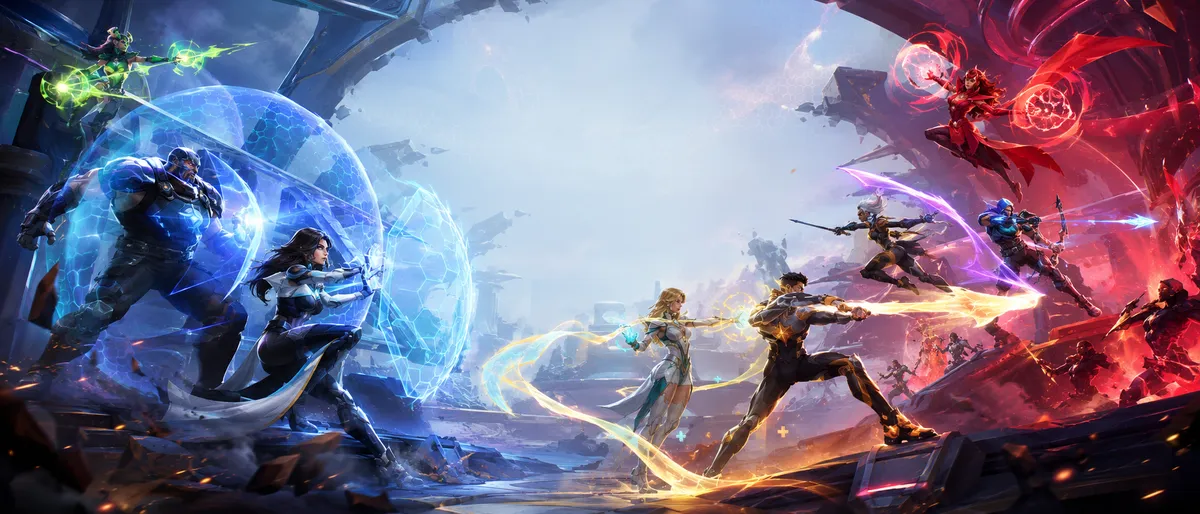
How Team-Ups Work
Team-Ups are built around a few consistent ideas. Once you understand these, everything else becomes easier.
Anchor hero vs secondary hero
Most Team-Ups have one anchor hero that “enables” the synergy. The anchor is the hero the Team-Up is built around, and that hero typically receives a passive bonus for being the anchor. One or more secondary heroes gain the “main benefit,” which is often a new ability or a major upgrade.
This matters for team building because anchors function like “keys.” If your team doesn’t have the anchor, the Team-Up does not exist. So if you’re trying to build around a specific synergy, you plan around the anchor first.
Active Team-Ups vs passive Team-UPs
Not every Team-Up requires a button press.
- Passive Team-Ups give an always-on benefit as long as the right heroes are selected. These are easy value and can be huge in long objective fights.
- Active Team-Ups add a skill with a cooldown, or transform a skill while the Team-Up is active. These require timing to get real value.
Season rotation and “inactive” Team-Ups
Marvel Rivals rotates Team-Ups over time. Some become inactive, either temporarily or as a “retirement,” and others are introduced to match new heroes, new seasons, or balance goals. That means you should treat Team-Ups like a living system, not a permanent list.
Where you see Team-Ups in-game
During hero selection, the game indicates which Team-Ups your current hero can access with teammates. This is one of the easiest ways to improve quickly: before locking your hero, look for compatible allies and decide whether a Team-Up is worth adjusting your pick.
The hidden rule: Team-Ups are strongest when the enemy cannot disengage
A lot of teams waste Team-Ups in open space where the enemy can simply back up. The most reliable Team-Up value happens when enemies must commit:
- contesting a capture zone
- defending or retaking a choke
- touching the payload in overtime
- pushing through a narrow entry
- When leaving is not an option, your Team-Up becomes a win condition.
Why Team-Ups Matter More in Ranked Than People Think
In casual matches, Team-Ups feel like “extra fun.” In Ranked, they become a comp advantage—especially if your team is already playing fundamentals well.
Ranked amplifies Team-Ups because:
- teams rotate more cleanly into objective fights
- supports survive longer, so utility value compounds
- players punish mistakes, so one Team-Up pick or one Team-Up mis-timing can decide the round
- coordinated teams convert Team-Up value into objective progress immediately (instead of wandering off for eliminations)
Casual still rewards Team-Ups, but for different reasons:
- stronger Team-Ups punish clumping and messy positioning
- easy-value passives become “free stats” that casual opponents don’t adapt to
- disruptive Team-Ups create confusion that uncoordinated teams struggle to recover from
If you’re playing solo queue, Team-Ups also help you “stabilize” unpredictable teammates. A well-timed Team-Up can cover for a teammate who overextends, save your frontline long enough to touch, or create a pressure window that forces the enemy to stop chasing and start surviving.
The Main Types of Team-Up Synergy
Team-Ups can look very different on the surface, but most fit into a few categories. Recognizing the category helps you use the Team-Up correctly.
1) Sustain and stabilizer Team-Ups
These Team-Ups add healing, bonus health, shielding, or regeneration patterns. They are strongest in long fights and overtime stalls because they keep your team “online” through multiple damage waves.
2) Objective control Team-Ups
These Team-Ups help you hold a location: blocking entries, punishing touches, controlling chokes, or forcing enemies off an area with pressure or crowd control.
3) Engage and chase Team-Ups
These Team-Ups add mobility or an engage tool. Their value comes from starting fights on your terms or catching a target that would normally escape.
4) Anti-heal and debuff Team-Ups
These Team-Ups change the “math” of a fight by reducing enemy sustain or increasing damage taken. They are strongest when your team is ready to focus one target immediately.
5) Disruption Team-Ups
These Team-Ups cause confusion, vision clutter, displacement, or fight-breaking chaos. Their purpose is to make it harder for enemies to execute cleanly—especially in clumped objective fights.
The best Team-Ups often combine two categories (for example: sustain + objective control, or disruption + sustain).
Best Team-Up Pairings in Season 8
Below are the most impactful Season 8 Team-Ups to build around, with practical advice for how to get value and what mistakes to avoid. These are written for real matches: objective fights, messy solo queue moments, and the “one fight decides the round” scenarios that happen constantly.
Lucky Loan (Black Cat + White Fox + Captain America)
What it does
Lucky Loan is a Team-Up where Black Cat is the anchor and shares her “luck” benefits with White Fox and Captain America. White Fox gains a new AoE skill that launches spectral tails around her that automatically seek nearby targets, healing and granting movement speed to allies while damaging and slowing enemies. Captain America gains a Team-Up activation that expands his shield’s protective radius for a short window and upgrades deflection so it becomes highly accurate to where he is aiming, letting him return incoming attacks precisely.
Why it’s one of the best Team-Ups
Lucky Loan is S-tier because it stacks value in the places that decide games:
- White Fox becomes stronger at saving allies in close fights because her AoE heal-and-hurt effect doesn’t rely on perfect aim.
- The movement speed boost helps your team reposition during objective chaos.
- Captain America’s upgraded deflection can flip “burst windows” back onto the enemy at chokes and during retakes.
How to use it in real matches
- Use White Fox’s Team-Up skill when you must fight in a tight area, especially during capture contests or choke holds. It’s at its best when multiple teammates and multiple enemies are inside the radius.
- Use Cap’s upgraded shield when the enemy is committing damage into your team, not during a calm poke phase. The goal is to punish the enemy for committing resources into a hold.
Best modes and moments
- Domination retakes (enemy must stand on point)
- Convoy checkpoint contests (predictable sightlines)
- Convergence capture fights (tight space, repeated pushes)
Common mistakes to avoid
- Popping the Team-Up while chasing a single target in open space (low value)
- Using the deflection window when enemies are not actively committing damage
- Standing too far from your team so White Fox’s AoE catches nobody important
Vibrant Vitality (Mantis + Loki + Groot)
What it does
Vibrant Vitality is a Team-Up where Mantis is the anchor and grants “Life Energy” benefits to Loki and Groot. Loki’s Regeneration Domain becomes stronger by not only healing and protecting, but also boosting ally stats inside the area, including a damage boost. Groot’s wall becomes stronger by gaining the ability to heal Groot and nearby allies.
Why it’s one of the best Team-Ups
This Team-Up is a direct answer to objective fights:
- Loki’s domain becomes a “fight permission zone”—you can push into contested space because your team is simultaneously safer and more threatening.
- Groot’s wall healing turns choke points into nightmares for the enemy: even if they damage your frontline, your team stabilizes behind cover and keeps pressure.
How to use it in real matches
- Treat Loki’s enhanced domain as a “we win this space now” button. Use it to hold a capture zone edge, stabilize an overtime touch, or win a choke.
- Use Groot’s wall healing to build a defensive shape: wall + heal + pressure, then rotate forward only after you’ve won the space.
Best modes and moments
- Domination holds and retakes (the domain changes the whole fight)
- Convoy defense at choke-heavy segments
- Convergence capture phase where standing on the point is risky
Common mistakes to avoid
- Dropping the domain after your team has already lost two players (too late)
- Placing walls that heal nobody because your team is scattered
- Trying to “solo play” as Loki instead of anchoring your team’s fight space
Arcane Order (Doctor Strange + Scarlet Witch + Magik)
What it does
Arcane Order is a Team-Up where Doctor Strange is the anchor and shares arcane power with Scarlet Witch and Magik. Scarlet Witch’s Chthonian Burst is replaced with Mystic Burst, letting her fire a rapid salvo of magical missiles. Magik gains Chain of Cyttorak, which links two enemies and slows them—stronger slow when the linked enemies separate.
Why it’s one of the best Team-Ups
Arcane Order is about securing kills on targets that normally escape.
- Magik’s chain tool turns slippery enemies into catchable enemies.
- Scarlet Witch gains a more structured, sustained damage option that can punish targets caught by chain or forced into predictable movement.
- Strange benefits from being the anchor of a Team-Up that creates real “pick windows.”
How to use it in real matches
- Think of Arcane Order as a “catch and finish” package. The ideal sequence is: your team pressures → Magik links targets to prevent clean escape → Scarlet Witch uses the upgraded pressure window to finish or force cooldowns.
- Use Chain of Cyttorak when enemies are trying to rotate through a choke or touch an objective. The more predictable the movement, the easier it is to get value.
Best modes and moments
- Overtime touches and choke entries
- Convergence capture retakes (tight, predictable movement)
- Domination perimeter fights where enemies attempt to rotate in pairs
Common mistakes to avoid
- Using chain on targets your team cannot see or follow up on
- Starting a fight with Arcane Order tools before your team is in position
- Forcing the Team-Up in comps that don’t benefit from “catch” (if your team is already full dive chaos, you may not convert the control)
Psionic Mayhem (Invisible Woman + Doctor Strange)
What it does
Psionic Mayhem is a Team-Up where Invisible Woman is the anchor, enhancing Doctor Strange’s Maelstrom of Madness into Psionic Vortex, which pulls enemies toward Strange and grants bonus health to Strange and nearby allies based on damage dealt.
Why it’s strong
This Team-Up is a classic objective-fight amplifier:
- Pull effects become more valuable the tighter the map area is (capture zones, payload corners, chokepoints).
- Bonus health based on damage dealt turns the ability into a “we survive while you get pulled” moment.
- It rewards coordination without requiring perfect aim: you pull enemies together, your team follows up.
How to use it in real matches
- Use Psionic Vortex when enemies are committed to a location (touching objective, holding a corner, or grouping for a push).
- Communicate a simple plan: “pull next fight” is enough. Your team doesn’t need a lecture—just a heads-up to follow up.
Best modes and moments
- Domination retakes (enemy must stand somewhere)
- Convoy contests at corners (forced grouping)
- Convergence capture fights (predictable entry routes)
Common mistakes to avoid
- Using the pull when the enemy team is spread wide (low value)
- Pulling enemies when your own team cannot follow up (you simply reposition them, then get punished)
- Trying to force this synergy while your comp lacks damage follow-up (pulls need conversion)
Mr. Pool’s Interdimensional Toy Box (Deadpool + Jeff the Land Shark + Elsa Bloodstone)
What it does
Mr. Pool’s Interdimensional Toy Box is a Team-Up where Deadpool is the anchor, and Jeff and Elsa Bloodstone gain special benefits. Jeff gains a new ability that creates an area effect that heals allies, while also visually disrupting enemies with absurd Deadpool-themed clutter on their screens. Elsa gains an upgrade where her special shots can distract enemies, and she can recall them to heal herself based on damage dealt.
Why it’s strong
This Team-Up is disruption + sustain—perfect for chaotic objective fights:
- Jeff’s area healing adds stability during team clashes on points.
- Visual disruption reduces enemy consistency right when precision matters most.
- Elsa’s self-heal through recall enables more aggressive positioning without instantly losing tempo.
How to use it in real matches
- Use it during full team clashes on capture points or payload contests. That’s where both healing and disruption matter.
- Use it defensively when flankers are pressuring your backline—disruption is often enough to force them off a clean finish.
Best modes and moments
- Domination team fights on point
- Convoy overtime contests (clustered fights)
- Convergence capture battles where everyone stacks and trades cooldowns
Common mistakes to avoid
- Using it while chasing a lone enemy (minimal value)
- Dropping it too early during poke (enemy waits it out)
- Standing in the open as Jeff to “get value” and getting eliminated first (dead support = no Team-Up value)
Explosive Entanglement (Gambit + Magneto + Rogue)
What it does
Explosive Entanglement is a Team-Up where Gambit shares kinetic energy with Magneto, granting Magneto the ability to form greatswords and launch them for added offensive pressure. Gambit also shares energy with Rogue, causing Rogue’s attacks to create explosions that damage nearby enemies and heal allies.
Why it’s strong
This Team-Up is powerful because it increases your team’s “fight density”:
- Magneto gains stronger offensive contribution while still functioning as a top-tier space controller.
- Rogue’s explosion-and-heal pattern makes brawls near objectives far more favorable for your team because each hit contributes to both damage and sustain.
How to use it in real matches
- Play this Team-Up around choke-heavy objectives. The more enemies cluster, the more the explosion-and-heal value multiplies.
- Use it when your team wants “slow power”: hold space, force contest, win long trades through combined pressure and sustain.
Best modes and moments
- Domination holds where enemies must enter through predictable paths
- Convoy defenses at checkpoints
- Convergence capture fights where teams repeatedly collide
Common mistakes to avoid
- Treating it like a burst combo and overcommitting (it’s often better as sustained fight advantage)
- Splitting Magneto and Rogue to opposite sides of the map (you lose layered value)
- Forgetting that objective presence matters more than hunting eliminations
Strong Team-Ups That Win Games When Used Correctly
Not every high-value Team-Up is “top tier” in every lobby. Some are extremely strong but require the right situations, the right map geometry, or the right team plan. These Team-Ups are still worth learning because they can hard-carry specific matchups.
Gamma Charge (Bruce Banner + Black Panther + The Thing)
What it does
Gamma Charge is a Team-Up where Bruce Banner is the anchor, granting enhanced effects to Black Panther and The Thing. Black Panther gains a defensive passive that automatically creates a Gamma-Charged shield when his health drops very low. The Thing receives Gamma Gauntlets that increase the damage and range of key strikes, and each hit grants bonus health.
Why it works
Gamma Charge helps your team survive the “commit moment”:
- Black Panther becomes harder to finish during deep flanks or dives.
- The Thing becomes scarier in brawls because he gains both damage consistency and survivability through bonus health.
How to use it
- Use it when your team wants to fight close and win by outlasting enemies in objective brawls.
- This Team-Up is best when your team commits together—if your frontline and dive are disconnected, you won’t convert the defensive value into wins.
Mistakes to avoid
- Playing spread-out poke comps with this Team-Up (it shines in close fights)
- Diving alone as Black Panther assuming the shield will “save you” every time
- Forgetting the objective and turning the match into endless side skirmishes
Sword of Duality (Cloak & Dagger + Hawkeye + Psylocke)
What it does
Sword of Duality is a Team-Up where Cloak & Dagger are the anchor, empowering Hawkeye and Psylocke with light-and-dark infused tools. Hawkeye’s Crescent Slash gains an energy wave that passes through allies and enemies, healing and buffing teammates while damaging enemies and applying anti-heal. Psylocke gains a Light Boomerang Dart that heals allies and harms enemies, plus dark darts that slow enemies while she briefly enters a phased state.
Why it works
Sword of Duality is one of the most practical Team-Ups in objective play because it mixes:
- sustain for your team
- anti-heal pressure against enemy supports
- defensive utility (slow + phased safety) that keeps carry heroes alive
How to use it
- Use it during objective contests where both teams are clumped. Anti-heal value spikes when enemies are trying to out-sustain you.
- Treat Hawkeye’s empowered slash as a “fight swing” tool: use it to stabilize allies while damaging the enemy frontline and denying healing windows.
Mistakes to avoid
- Using it in empty space where the wave hits nobody important
- Saving it too long and losing two teammates before you commit the utility
- Ignoring that anti-heal needs follow-up damage to matter
Primal Flame (Phoenix + Wolverine + Black Widow)
What it does
Primal Flame is a Team-Up where Phoenix is the anchor, infusing Wolverine and Black Widow with Phoenix Force effects. Wolverine’s leap triggers a burn effect around him and grants lifesteal. Black Widow can activate the Team-Up to enhance her primary attack so it can both heal teammates and damage enemies.
Why it works
Primal Flame is excellent when the enemy team relies on heavy frontline sustain:
- Wolverine’s empowered leap becomes a strong “tank breaker” moment in brawls.
- Black Widow gains team-support value that can stabilize a fight when your backline is under pressure.
How to use it
- Time Wolverine’s empowered leap for the moment the enemy Vanguard commits to the objective.
- Use Black Widow’s enhanced primary to stabilize teammates during a push or to keep your frontline alive while you finish a target.
Mistakes to avoid
- Using the leap when the enemy can easily disengage (save it for forced contests)
- Overcommitting Wolverine deep and getting isolated
- Treating the Team-Up as a “solo carry button” instead of a teamfight tool
Divine Armory (Angela + Thor)
What it does
Divine Armory is a Team-Up where Angela shares fragments of her Ichor with Thor, granting him a throwable Thunder Spear and a follow-up leap to it.
Why it works
This is a mobility-and-engage Team-Up. It matters because mobility decides:
- who starts the fight
- who reaches the backline
- who touches the objective first in overtime
- who can reposition after breaking a choke
How to use it
- Use the spear-leap to cross dangerous lanes safely and reach key objective positions faster.
- Save it for decisive moments: a retake, an overtime touch, or a chase that actually converts into objective progress.
Mistakes to avoid
- Burning the leap just to “move faster” when no fight is happening
- Diving without support sightlines and getting eliminated instantly
- Forgetting that Thor still needs follow-up damage to turn an engage into a won fight
Symbiote Shenanigans (Venom + Jeff the Land Shark + Hela)
What it does
Symbiote Shenanigans is a Team-Up where Venom is the anchor, gaining a maximum health increase as the Team-Up anchor. Jeff gains Healing Tendrils that link to allies in an area for a short duration to provide healing. Hela gains an enhancement to her Hel Sphere that pulls enemies and slows them, functioning as a strong setup tool (pull without a stun).
Why it works
This Team-Up is a complete “anti-dive + objective control” package:
- Venom becomes harder to remove as a frontline disruptor.
- Jeff gains a sustained healing option in the moments where teams collide.
- Hela gains a pull-and-slow setup that can drag enemies into danger zones or punish sloppy touches.
How to use it
- Jeff’s tendrils are best when your team is grouped during a point fight. Use it to stabilize the fight’s most dangerous seconds.
- Hela’s pull-and-slow is best as a follow-up: after an ally creates pressure, pull enemies into a kill zone or into ongoing area damage.
Mistakes to avoid
- Standing too far behind as Jeff and never being in range to link allies
- Standing too far forward as Jeff and becoming the first target
- Using Hela’s enhanced sphere when enemies are already spread and can simply step out
Primal Punishment (Devil Dinosaur + The Punisher)
What it does
Primal Punishment is Season 8’s new Team-Up where Devil Dinosaur is the anchor and The Punisher can ride on Devil Dinosaur’s back, gaining damage reduction while receiving shared healing interactions with the anchor.
Why it works
This Team-Up is about enabling a safer “close-to-frontline” damage presence:
- The rider becomes harder to remove during a push.
- Shared healing interactions can make the push feel sturdier if your supports are already stabilizing the anchor.
- It can create awkward targeting for enemies during objective fights, where attention is already split.
How to use it
- Use it for objective pushes and contests, not for chasing scattered enemies.
- Treat it as a “we are committing to this fight” signal: when the rider is on, your team should be taking space, not drifting.
Mistakes to avoid
- Using it when your team is not ready to push (you commit a resource with no follow-up)
- Riding during a losing fight and getting staggered afterward
- Forgetting that objectives still require touch and positioning—Team-Ups don’t replace fundamentals
How to Build Team Comps Around Team-Ups
A Team-Up is strongest when the rest of the team supports the same plan. You don’t need an ultra-specific composition—just avoid building a team that fights against itself.
Here’s the simplest way to think about Team-Up team building:
Step 1: Pick your Team-Up “win condition”
- Do you want to win by out-sustaining (Vibrant Vitality, Lucky Loan, Symbiote Shenanigans)?
- Do you want to win by catching and finishing (Arcane Order, Psionic Mayhem)?
- Do you want to win by disrupting fights (Mr. Pool’s Interdimensional Toy Box)?
- Do you want to win by engage mobility (Divine Armory)?
Step 2: Add what the Team-Up lacks
- Sustain Team-Ups still need damage conversion.
- Catch Team-Ups still need consistent follow-up.
- Disruption Team-Ups still need objective discipline.
- Engage Team-Ups still need survivability to avoid trading down.
Step 3: Keep your team’s fight distance consistent
A common Team-Up failure is mixing heroes that want opposite fight ranges:
- half the team wants long-range poke
- the other half wants close brawls
- If you do this, your Team-Up triggers in the wrong distance and becomes “wasted value.”
Team-Up Timing: A Simple Playbook That Works in Ranked and Casual
Most Team-Ups should be used in one of three windows:
Window 1: The engage window (first 5 seconds of a real fight)
Use a Team-Up to gain an immediate advantage: stabilize your frontline, catch a target, force enemies off an angle, or create a pick.
Window 2: The counter-engage window (enemy commits first)
This is where defensive and disruption Team-Ups shine. Let the enemy commit, then punish their commitment: pull them in, out-sustain the burst, or disrupt their focus so they can’t finish.
Window 3: The forced-touch window (overtime and objective desperation)
When enemies must touch, they become predictable. This is where “area value” Team-Ups become devastating: sustained healing zones, pull effects, anti-heal waves, and AoE pressure.
A simple rule you can follow every match:
- If the enemy can walk away, don’t Team-Up yet.
- If the enemy must stay and fight, Team-Up now.
Mistakes to Avoid With Team-Ups
Most teams “have” Team-Ups but don’t actually “use” them correctly. Avoid these common mistakes and your Team-Ups will start winning you games.
Mistake 1: Using Team-Ups during low-stakes poke
If both teams are just trading damage at range and nobody is committing, your Team-Up is usually wasted. Save it for when the fight is real: objective contest, push through choke, retake
attempt, or overtime touch.
Mistake 2: Pressing Team-Up as a panic button after losing players
If your team is already down two players and the enemy is full strength, most Team-Ups will not “save” the fight. Instead, you usually need a clean reset and a grouped retake.
Mistake 3: Triggering the Team-Up when your team cannot follow up
Catch-and-pull Team-Ups and anti-heal Team-Ups need follow-up. If your Duelists are respawning or your tank is not in position, don’t trigger a Team-Up that creates an opportunity nobody can use.
Mistake 4: Ignoring the objective because the Team-Up feels powerful
A Team-Up is not a win condition by itself. It’s a tool to win the objective fight. If you chase away from the objective and lose the capture or payload progress, you traded the real win condition for a highlight moment.
Mistake 5: Team-Up tunnel vision
Some players become so focused on “getting value” that they force the Team-Up every fight in the same way. Good opponents adapt. Good Team-Up players change patterns:
- sometimes you engage with it
- sometimes you counter-engage
- sometimes you save it for overtime
- Being unpredictable is a form of strength.
How to Counter Enemy Team-Ups
You don’t need a perfect counterpick. Most Team-Ups can be mitigated with simple discipline.
Spread when you know a pull or area Team-Up is coming
If the enemy’s Team-Up punishes clumping, don’t walk into the choke as six people stacked. Enter in layers, use cover, and avoid standing on top of your entire team.
Focus the “value source,” not the toughest target
Sometimes the anchor is hard to eliminate. That doesn’t mean they are always the correct focus. Often the correct counterplay is eliminating the secondary hero who is creating the Team-Up’s biggest value (the one enabling the sustain or disruption).
Wait out the window, then re-engage
Many Team-Ups are strongest for a short period. If you can survive and disengage for a moment, you can re-enter once the value window ends.
Force fights in open space when the enemy Team-Up needs tight geometry
Objective fights are naturally tight, but you can choose the angle and approach. If the enemy Team-Up is strongest in narrow chokes, rotate and force them to fight where their area control is weaker.
Punish predictable Team-Up timing
If a team uses the same Team-Up at the start of every fight, you can bait it. Show presence, let them press it, then back up. The moment it ends, you commit your own resources and win the real fight.
BoostRoom: Learn Team-Ups Faster and Turn Them Into Wins
Most players don’t lose because they “don’t know Team-Ups exist.” They lose because they:
- pick Team-Ups that don’t match their comp’s fight distance
- use Team-Ups at the wrong time (poke instead of objective)
- trigger catch tools without follow-up
- press sustain tools after the fight is already lost
- win a fight with a Team-Up and then fail to convert it into objective progress
BoostRoom helps you build a practical Team-Up mindset that translates directly into more wins:
- choosing a small hero pool that gives you access to multiple strong Team-Ups
- learning Season 8’s best pairings and when to build around them
- improving timing so your Team-Ups hit during forced-touch moments and decisive engages
- fixing objective decision-making so your Team-Up wins actually become captured points and escorted distance
- reviewing fight patterns so you stop repeating the same “Team-Up waste” mistakes every match
If you want your matches to feel more controlled—especially in Ranked—Team-Ups are one of the smartest systems to master, and BoostRoom is built to speed up that learning curve.
FAQ
Do I need Team-Ups to win in Marvel Rivals?
No, you can win without them. But Team-Ups are powerful advantages that can swing close fights, especially around objectives. If two teams are similar in skill, a well-used Team-Up often decides the round.
What is a Team-Up anchor hero?
The anchor is the hero required for the Team-Up to exist. The anchor typically receives a passive bonus for enabling the Team-Up, while secondary heroes often receive the “main” new ability or upgrade.
Are Team-Ups always active once we pick the heroes?
Some Team-Ups are passive and stay active automatically while the heroes are selected. Others add a bonus skill or ability modification that needs to be activated and has a cooldown.
Why does my Team-Up feel useless sometimes?
Usually because it’s being used in the wrong window—during poke, during a lost fight, or when your team can’t follow up. Team-Ups feel strongest when the enemy must commit to an objective space.
What’s the best way to learn Team-Ups quickly?
Pick one strong Team-Up and build a small hero pool around it. Practice using it only during objective fights (retakes, overtime touches, checkpoint contests). Then add a second Team-Up that covers a different situation (anti-dive, engage, sustain).
How do I counter a strong Team-Up like a pull or a big sustain zone?
Spread out, use cover, don’t clump in a doorway, and wait out the strongest window if possible. After the value window ends, re-engage with your own resources while the enemy Team-Up is unavailable.



