Why You Lose Gunfights Even When Your Aim Is “Fine”
Most players assume every death means “my aim is bad.” In reality, many deaths come from losing before the shots even start. Here are the most common hidden reasons:
- You peeked an angle that exposed you to two threats, so you couldn’t win even with perfect aim.
- You fought at the wrong time (they were ready, you were not).
- You took a duel with no escape plan, so missing one burst meant guaranteed death.
- You re-peeked instantly after being seen (predictable timing).
- You shot while moving, or you panicked into a long spray at medium range.
- You won a kill, then overheated and gave the enemy a free trade.
If you fix angle advantage + timing + discipline, your aim will “feel better” without changing sensitivity, crosshair, or hardware—because your fights become cleaner and more predictable.
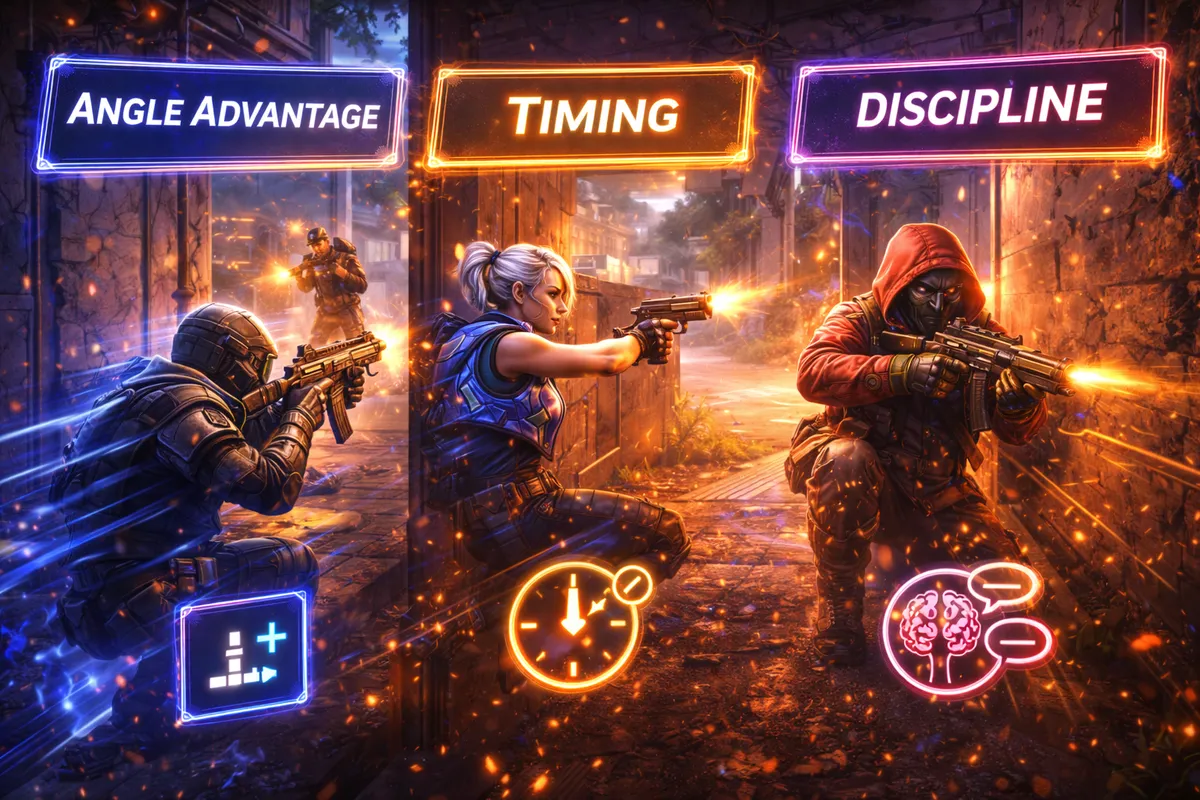
The Gunfight Triangle
To win more fights, don’t chase 100 tips. Master these three pillars:
Angle advantage:
You choose positions that reduce what the enemy can see, isolate threats, and force awkward flicks.
Timing:
You fight when the enemy’s attention, crosshair, or movement is compromised—during rotations, reloads, utility, or after a teammate makes contact.
Discipline:
You shoot accurately (stop–shoot rhythm), take the right burst lengths, avoid ego re-peeks, and play for trades/time instead of highlights.
When one pillar is missing, you get “randomly” deleted. When all three are present, gunfights start to feel unfair—in your favor.
Angle Advantage: The Geometry That Creates “Free” Kills
Angle advantage is the simplest way to win fights without being a better aimer. It’s about what your opponent sees first, what you expose first, and how predictable your position is.
Distance From the Corner
A practical rule that helps instantly:
- Standing very close to the corner often makes you easier to hit when you swing because your body appears quickly and you may expose more than you think.
- Standing slightly farther back can help you see more of the angle with less exposure and gives you more room to strafe back into cover.
This doesn’t mean “always stand far.” It means: be intentional. If you keep dying when you peek, experiment with taking one step back before you peek or hold.
The One-Angle Rule
If your peek exposes you to more than one likely enemy position at the same time, your duel becomes a coin flip (or worse).
Fix: Slice the area into parts.
- Clear the closest danger angle first.
- Then clear the next.
- Use utility to block or clear the side you can’t safely look at.
The number one way players lose “unwinnable” gunfights is peeking into two angles and hoping there’s only one enemy. Stop hoping.
Off-Angles: Make Their Crosshair Wrong
An off-angle is a position that isn’t the “default pre-aim” spot. When you hold an off-angle:
- the enemy’s crosshair is usually aimed at the common spot,
- so they must adjust,
- and that adjustment buys you time for your first burst.
How to use off-angles safely:
- Pick an off-angle that still gives you an escape route.
- Don’t repeat the same off-angle every round.
- Use it when you expect the enemy to clear lazily or fast.
Off-angles are especially powerful on defense and in post-plant holds because enemies often clear quickly under time pressure.
Head-Level Discipline: Angle Advantage’s Best Friend
Angle advantage is wasted if your crosshair isn’t ready. The simplest gunfight upgrade in Valorant is keeping your crosshair at head height before you see anyone.
Easy head-height check:
- Imagine a horizontal line across the map where heads would be.
- Keep your crosshair on that line while moving and clearing.
- Your goal is to reduce big vertical adjustments (flicking up/down).
When your crosshair starts at head level, you don’t need insane flicks. You need tiny micro-corrections.
Isolating Fights With Space
Good players “create 1v1s” even in 5v5 situations. They do it by choosing positions that limit how many enemies can swing them at once.
Examples of isolation thinking:
- Don’t swing deep into a site if you can instead hold an angle that only one defender can contest.
- Don’t push past your safe cover line without a reason.
- Don’t chase into open areas where multiple enemies can trade you.
Your goal: fight one person at a time whenever possible.
Vertical Angles and Elevation
Elevation changes crosshair placement and reaction speed. Many players aim at normal head height and forget that:
- enemies on boxes, stairs, or ramps change the head line,
- and you must pre-aim that adjusted height.
If you keep losing to elevated players:
- start pre-aiming common elevated spots,
- clear vertical threats early,
- and avoid wide swinging into high-low crossfires.
Angle Advantage on Attack vs Defense
On attack:
- Use angle advantage to take space safely.
- Favor peeks that can be traded.
- Don’t commit deep into open zones without utility.
On defense:
- Use angle advantage to get one kill and live.
- Play positions that let you fall back after first contact.
- Avoid early round “hero peeks” that throw a free 5v4.
Timing: The Moment You Choose Decides the Fight
Timing is about fighting when the enemy is least able to fight back cleanly. That could be because they’re moving, rotating, distracted, using utility, reloading, or reacting to another threat.
Timing Is Not Speed
New players think “timing” means “go fast.” Often, timing means:
- waiting one extra second,
- letting the enemy get impatient,
- then punishing them when they overextend.
Pro-level timing is controlled tempo, not constant rushing.
The Three Best Timing Windows
1) After contact elsewhere (distraction timing)
When your teammate fights or uses utility on one side, enemies often:
- turn,
- reposition,
- or stop holding their angle properly.
That’s your moment to swing a different angle, take space, or punish a rotate.
2) During transitions (movement timing)
Enemies are weakest when they are:
- rotating between sites,
- repositioning after being seen,
- crossing open space,
- or moving out of a smoke.
Catching someone mid-transition creates the easiest kills.
3) After a shot/ability (recovery timing)
If an enemy:
- fires an Operator shot,
- sprays a rifle,
- uses a major ability,
- or gets stunned/flashed,
- they often have a short recovery window where their crosshair is not perfectly set.
You don’t need to know exact milliseconds. You need to recognize patterns:
- “They shot, now they’re vulnerable.”
- “They used utility, now they’re adjusting.”
- “They’re reloading, now I can swing.”
Stop Re-Peeking on Autopilot
The most common timing mistake is instant re-peeking:
- you peek, miss, get seen,
- then you peek again immediately,
- and get pre-aimed or prefired.
Fix: Change at least one variable:
- timing (wait),
- angle (reposition),
- method (jiggle first),
- or resources (use utility).
If you never change variables, your opponent’s job becomes easy.
Tempo Changes: Be Unpredictable
Most players have one speed. They either:
- always swing instantly, or
- always play slow.
Good timing mixes both:
- one fast peek,
- then a pause,
- then a delayed swing,
- then a reposition.
This forces enemies to guess when you’ll appear, which causes panic shots and mis-aim.
Swinging Off Teammates (Trade Timing)
The easiest timing advantage in ranked is trading. When your teammate contacts an enemy:
- the enemy must shoot them,
- then reset aim,
- then possibly reload or adjust.
That’s your timing to swing and trade.
Rule: If you are close enough to trade, you should almost never “watch” your teammate die without swinging.
Timing in Post-Plant and Defuse Situations
Timing becomes everything after the spike is planted.
As attackers (post-plant):
- Don’t all peek at once.
- Hold crossfires.
- Peek when you hear the defuse tap or when utility forces the defender to move.
- Play time. The clock is your teammate.
As defenders (retake/defuse):
- Don’t trickle in one-by-one.
- Group, clear with utility, then swing together.
- If time is low, you must increase tempo—but do it as a unit, not as solo panic.
Audio Timing: Stop Giving Free Information
If you run everywhere, you give the enemy perfect timing info:
- where you are,
- when you’re close,
- whether you’re rotating.
Use sound intelligently:
- run when far away or when you must rotate fast,
- walk when near enemies or when you want surprise timing.
Many gunfights are lost before they start because the enemy heard you coming and pre-aimed your exact path.
Utility Timing: Fight When You Have an Advantage
A simple rule that wins more fights:
If you can use utility to make the duel unfair, do it.
Examples:
- flash then swing (instead of dry swinging),
- smoke then cross,
- recon then punish the revealed player,
- stun then wide swing.
Even basic utility usage improves timing because it forces opponents into reaction mode.
Discipline: The Difference Between Winning One Duel and Winning the Round
Discipline is the part people ignore because it’s not “cool.” But discipline wins ranked games because it prevents throws.
First-Bullet Discipline
A huge percentage of Valorant duels are decided by the first accurate burst.
Discipline rules that win fights:
- Stop briefly before firing.
- Burst 2–4 bullets at medium range.
- Reset between bursts instead of committing to a panic spray.
- Don’t crouch-spray out of fear every time you see a target.
When you focus on first-bullet discipline, your aim becomes consistent even under pressure.
Burst vs Spray Discipline
Tap (1 bullet):
- best at longer ranges,
- best when holding tight angles,
- great for Sheriff and precise rifles.
Burst (2–4 bullets):
- best for most rifle fights,
- keeps recoil manageable,
- gives you repeated “first shot” moments.
Spray:
- best at close range,
- best when you’re fully committing,
- dangerous at medium range if you don’t control recoil.
If you constantly spray at medium range, you’ll feel like your aim is “random.” It’s not random—it’s uncontrolled.
Movement Discipline: Don’t Shoot While Sliding
The fastest way to lose fights is firing while moving at medium or long distance. You need the rhythm:
- strafe → stop → burst → strafe
Discipline is the ability to pause for accuracy even when your brain screams “shoot now!”
Re-Peek Discipline
Ask yourself after every peek:
- Did they see me?
- Did I miss?
- Did I take damage?
If yes, don’t instantly re-peek. Reset the fight:
- reposition,
- change timing,
- or use utility.
Overheat Discipline (The #1 Throw Habit)
Overheating is when you:
- get a kill,
- then chase another kill,
- then die and give up your advantage.
Overheating loses rounds more than missing shots.
Discipline fix: After a kill, do one of these immediately:
- reposition,
- reload in safety,
- hold for a trade,
- or fall back to a stronger angle.
If you win a 5v4 and then donate a death, you just erased your advantage.
Discipline With Confidence (No Ego Fights)
Ego fights are duels taken for pride, not for value:
- dry swinging an Operator “to prove you can,”
- peeking when you have spike and could play time,
- re-peeking after being tagged,
- taking a 1v2 because you’re mad.
Discipline is choosing the play that wins the round, not the duel you want emotionally.
Discipline Under Pressure: Reset Your Hands
A simple in-round reset:
- exhale once,
- loosen your mouse grip,
- and commit to “first bullet calm.”
This reduces panic spraying and improves your next peek instantly.
Weapon Matchups: Win More Gunfights by Choosing the Right Distance
Gunfights become easier when you fight at the distance your weapon wants.
Rifles (Vandal/Phantom style fights)
Rifles reward:
- crosshair placement,
- burst discipline,
- stop–shoot rhythm,
- and clean peeks.
Best rifle fight distance: medium to long (with controlled bursts).
Avoid: close corner brawls against shotguns unless you have utility or a trade.
Pistols
Pistols reward:
- clean taps and bursts,
- patient peeks,
- and smart positioning.
Best pistol habit: aim first, then peek. Don’t flick after you see them.
SMGs
SMGs often reward:
- close to medium fights,
- higher mobility,
- fast timing hits.
But don’t confuse “SMG speed” with “run and gun forever.” You still want stop–shoot bursts for reliable kills.
Shotguns
Shotguns reward:
- close distance,
- corner traps,
- unexpected timing.
If you’re fighting against shotguns:
- clear close angles first,
- don’t walk into tight corners dry,
- use utility to force them off the corner,
- maintain distance whenever possible.
Snipers (Operator-style threats)
Against a sniper:
- prefer jiggle/shoulder peeks to bait the shot,
- then punish the reset timing with a team swing or utility,
- avoid dry wide swings into long sightlines.
Snipers turn bad timing into instant death. Respect them.
How to Take Better Gunfights on Attack
Attack gunfights should create space and secure the objective, not just chase kills.
Default First, Then Commit
If you rush every round, defenders pre-aim and stack. A smarter pattern:
- take early info,
- punish aggression,
- then commit with your team.
This creates gunfights that are:
- more tradable,
- more predictable,
- less chaotic.
Entry and Trade Discipline
If you’re entry:
- your job is to create space and enable trades,
- not necessarily to survive every time.
If you’re second:
- your job is to trade the entry immediately,
- not to hide and watch them die.
The fastest way to win more gunfights as a team is trading properly.
Plant and Stop Fighting the Clock Wrong
Once the spike is down, stop giving defenders free duels:
- hold crossfires,
- peek off sound,
- use utility to delay,
- play time.
Many players lose post-plant gunfights because they keep taking dry 1v1s instead of letting time win for them.
How to Take Better Gunfights on Defense
Defense gunfights are about denying space and surviving long enough to retake as a team.
Get One and Live
A high-value defensive round often looks like:
- get one kill,
- fall back,
- delay with utility,
- play retake with teammates.
Trying to get three alone is the fastest way to throw.
Don’t Over-Rotate Into Bad Gunfights
Over-rotating creates bad timing:
- you arrive late,
- you face set-up attackers,
- you peek into crossfires.
Better defense timing:
- confirm the hit,
- rotate with information,
- retake together.
Retake Discipline
Retakes are won by:
- grouping,
- clearing with utility,
- swinging together,
- and trading.
Retakes are lost by:
- one person peeking early,
- dying,
- then the next person peeking late,
- dying again.
If you want more gunfight wins on defense, stop taking solo retake fights.
The “Pro Fight” Checklist You Can Use Mid-Round
Before you commit to any duel, ask:
- Is this a 1v1 or could it be a 1v2?
- Can I be traded if I die?
- Do I have cover to fall back to after my burst?
- Am I accurate when I shoot (stop–shoot)?
- Is my timing good (are they distracted / moving / recovering)?
If you can’t answer those positively, don’t force the duel. Reposition or use utility.
Drills That Make Angle + Timing + Discipline Automatic
You don’t need a two-hour aim grind. You need short drills that build the exact habits that win ranked fights.
Drill 1: Strafe–Stop–Burst (5 minutes)
Goal: first-bullet accuracy while staying hard to hit.
- Strafe left, stop, burst 2–3 bullets.
- Strafe right, stop, burst 2–3 bullets.
- Keep crosshair at head height.
- Reset after each burst.
Drill 2: Angle Isolation (5 minutes)
Goal: stop exposing yourself to multiple threats.
- Choose a doorway-like angle.
- Practice clearing only one side first, then the other.
- Don’t move into positions where two angles can see you.
Drill 3: Timing Swings (5 minutes)
Goal: swing when the enemy is least ready.
- Simulate “enemy just fired” timing: wait a beat, then swing and burst.
- Simulate “trade timing”: swing right after an imaginary teammate contact.
- Focus on calm first bullets, not speed.
Drill 4: No-Overheat Rule (in one quick mode)
Goal: stop throwing advantages.
- Every time you get a kill, you must reposition before taking another duel.
- This trains the habit that wins real rounds: kill → reset → win.
A 10-Game Plan to Win More Gunfights in Ranked
If you want results you can feel, commit to this for your next 10 games.
Games 1–3: Angle Advantage Only
Your only goal: take fights from better positions.
- Off-angles once per round.
- Slice angles instead of wide swinging everything.
- Avoid peeking multiple angles.
Games 4–6: Timing Only
Your only goal: stop taking “ready enemy” fights.
- Swing off teammate contact.
- Bait shots before committing.
- Change timing after you’re seen.
Games 7–10: Discipline Only
Your only goal: stop throwing fights.
- Burst at medium range (no panic sprays).
- No instant re-peeks.
- No overheating after a kill.
Track one stat:
How many times did I die with no cover and no trade?
Lower that number and your win rate rises.
BoostRoom: Turn Gunfight Wins Into Rank Wins
Winning more gunfights is great—but what you really want is more match wins. BoostRoom helps you convert mechanics into consistent ranked results by focusing on what actually decides fights:
- Personal angle coaching: where to stand, how to hold, when to reposition
- Timing training: when to swing, when to wait, when to trade, when to stop peeking
- Discipline improvement: burst control, stop–shoot rhythm, anti-tilt habits, and decision-making
- VOD review: you’ll see exactly why you lost a duel (and how to fix it next time), instead of guessing
If you’re tired of feeling like gunfights are random, BoostRoom turns them into a repeatable system—so your performance becomes stable and your climb becomes real.
FAQ
What is angle advantage in Valorant?
Angle advantage is using geometry and positioning so you see the enemy sooner, expose less of yourself, or force them to adjust their crosshair instead of having an easy pre-aim shot.
Why do I feel like enemies kill me instantly?
Usually it’s because your peek is predictable, you’re exposing yourself to multiple angles, or your first bullets are inaccurate (shooting while moving or panic spraying). Fixing peeks and first-burst discipline makes fights feel slower.
Should I always wide swing to win duels?
No. Wide swings are a commitment peek. Use them when you have a trade, utility support, or a reason to disrupt a tight angle holder. Otherwise, gather info first and take a smarter fight.
How do I stop panic spraying?
Focus on short bursts (2–4 bullets), reset between bursts, and practice strafe–stop–burst rhythm daily. Panic spraying is often a stress response—breathing and grip relaxation help too.
How do I win more gunfights without better aim?
Improve your fight selection: better angles, better timing, and discipline. You’ll take easier duels, get traded less, and land cleaner first bursts.
What’s the fastest habit that improves gunfights?
Stop re-peeking instantly after you’ve been seen, and always fight near cover so you can reset after your burst. That one change alone reduces “free deaths.”



