How This Guide Works: One Bad Habit → One Clean Fix
You don’t need 50 tips at once. The fastest improvement comes from fixing one repeat mistake until it becomes automatic.
As you read, keep one question in your head:
“Which mistake do I do most often?”
That’s your first fix. Master that one, then move to the next.
You’ll also see a pattern throughout the guide: most mistakes are not mechanical. They’re decision mistakes—where you stand, when you fight, when you back up, and what you spend.
Mistake 1: Staggering (Feeding One by One)
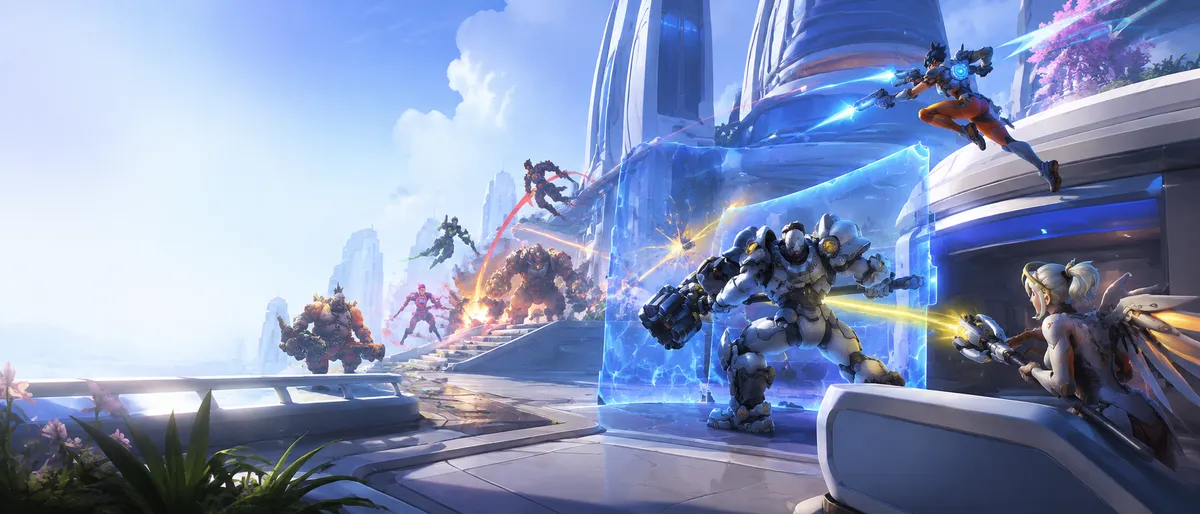
Staggering is when players re-enter fights alone or in small groups instead of waiting and fighting as five. It’s the #1 reason teams get steamrolled—even when both teams have similar skill.
What staggering looks like
- You die, respawn, sprint back in instantly, and die again before your team arrives.
- Your team “touches” one by one.
- The kill feed never stabilizes because people keep dying at different times.
Why it holds you back
Staggering does three awful things:
- You fight 3v5 or 4v5 repeatedly, so you lose “by math.”
- You feed the enemy ultimate charge.
- You waste time that should be spent taking one clean fight.
The fix: The 5-second regroup rule
After you respawn, wait 5 seconds and look:
- Who on your team is alive and close?
- Are you about to enter a real 5v5?
- Is your tank even there?
If the answer is “no,” don’t run in. Take a breath. Rotate to your team. Fight together.
The fix: Learn the “reset call” even if you don’t use voice
Use one of these every time you see a lost fight:
- “Back up, regroup.”
- “Wait for five.”
- “Down two, reset.”
Even typing or pinging “Group up” between fights changes outcomes because it interrupts the stagger chain.
Mistake 2: Fighting in the Open (No Cover Discipline)
A massive amount of “I didn’t get healed” deaths are actually “I stood in open space and got shot by five angles” deaths.
What it looks like
- You stand in the middle of a lane to shoot.
- You chase around corners without checking where you can retreat.
- You duel while exposed to multiple enemies.
Why it holds you back
Healing is not infinite. Supports can’t out-heal bad positioning when:
- multiple enemies can see you,
- burst damage hits at once,
- and you have no line-of-sight break.
The fix: The one-step-from-cover rule
Whenever possible, position so you can reach cover in one step.
This single habit:
- reduces your deaths immediately,
- makes your cooldowns last longer,
- and makes your Supports’ jobs 10x easier.
The fix: Peek-shoot-hide rhythm
Instead of standing exposed:
- peek from cover,
- shoot for 1–2 seconds,
- hide again,
- repeat.
It feels “slower,” but you actually deal more useful damage because you stay alive longer.
Mistake 3: Re-Peeking the Same Angle (The Ego Peek Loop)
A classic habit: you take damage, hide for half a second, then re-peek the exact same angle… and die.
What it looks like
- You get tagged by a sniper or burst hero.
- You re-peek instantly to “get them back.”
- You die because the enemy is already aiming there.
Why it holds you back
Overwatch rewards patience. Many enemies are waiting for your predictable re-peek.
The fix: The 1-second delay
After you take damage, wait one full second before peeking again.
During that second, do one thing:
- change position slightly,
- reload,
- or check your flank.
That one second breaks the enemy’s timing and saves you from countless deaths.
Mistake 4: Using Cooldowns on Poke, Not on the Commit
Cooldowns decide fights. Beginners spend them too early, then have nothing when the real push happens.
What it looks like
- Defensive abilities used “just in case.”
- Mobility used to go forward, not to escape.
- Healing tools burned before the enemy commits.
Why it holds you back
The enemy team is waiting for you to run out of resources. If you spend tools early, you lose the fight when the enemy finally commits.
The fix: Live tool vs win tool
Think of your abilities as two types:
- Live tool: keeps you alive during the enemy’s danger moment.
- Win tool: helps secure the pick or space after the enemy commits.
If you spend both early, you die later. If you save both forever, you lose space. Balance is mastery.
The fix: “If they haven’t committed, I don’t commit”
If the enemy is still poking and testing:
- play cover,
- hold your best cooldowns,
- wait for the moment they actually push.
Mistake 5: Over-Ulting (Winning One Fight and Losing the Next Two)
Ultimate economy is one of the biggest rank separators. Many players “press Q” out of fear, not logic.
What it looks like
- Your team uses 3 ultimates after already getting a pick.
- You use your ultimate in a fight that’s already lost.
- You ult just to feel useful.
Why it holds you back
If you spend too many ultimates in one fight, you lose the next fight with zero tools while the enemy has ults.
The fix: One ultimate per fight (most of the time)
In most fights, aim for:
- one ultimate to win,
- save the rest,
- then repeat.
The fix: Don’t ult when you’re down two
If your team is down two players early, it’s usually a reset.
Save your ultimate for a real 5v5 unless it clearly flips the fight and your team can follow.
The fix: Last fight is different
On the final fight of a round, you can spend more aggressively—because there may not be another fight. The mistake is spending like it’s last fight… when it isn’t.
Mistake 6: Healing the Wrong Thing (Support Priorities)
If you play Support, “more healing” is not always “better healing.”
What it looks like
- You tunnel on the tank while your other Support dies.
- You top off full-health teammates while someone is about to die.
- You heal when nobody is in danger and never pressure enemies.
Why it holds you back
Support value comes from stability and fight swings, not just numbers.
The fix: Save → Stabilize → Top off
- Save: prevent the next death (immediate danger).
- Stabilize: keep the team alive through the enemy’s commit.
- Top off: heal between fights so your team starts clean.
The fix: “If nobody dies in 1 second, look up”
If no one will die in the next second:
- pressure a target,
- help finish a kill,
- or reposition to safer cover.
Supports that never pressure often lose long fights because the enemy gets unlimited attempts.
Mistake 7: Shooting the Tank All Game (DPS Target Selection)
Yes, you sometimes must shoot the tank. But if you only shoot the tank, you often lose because the enemy supports stay comfortable and the fight never breaks.
What it looks like
- You farm tank damage while their supports free-heal.
- You ignore exposed squishies because the tank is big and easy.
Why it holds you back
Eliminations win fights. The tank often has the most resources and the most healing.
The fix: The “killable + valuable” rule
Shoot the target that is:
- killable right now (exposed, low, no escape, isolated)
- and
- valuable to remove (supports, key DPS angle, out-of-resources tank)
The fix: Re-evaluate every 10 seconds
Every 10 seconds in a fight, ask:
- “Who can I kill from my position?”
- “Who is exposed?”
- “Who has no escape?”
This prevents tunnel vision.
Mistake 8: No Off-Angles (Everyone Shoots the Same Doorway)
If your whole team shoots from one lane, the enemy defends with one shield, one corner, one plan.
What it looks like
- Both DPS stand behind tank and shoot main.
- Nobody takes high ground.
- Enemy supports never get pressured.
Why it holds you back
Off-angles force enemies to split attention. Split attention creates kills.
The fix: Small off-angles first
You don’t need deep flanks. Start with small off-angles:
- a few steps left or right,
- a nearby staircase,
- a safe high ground ledge.
If two enemies look at you, that’s still value—because your team gets freedom.
The fix: Off-angle safety rules
- Always have cover within one step.
- Always have an exit path back to your team.
- Don’t take angles so deep you can’t be helped.
Mistake 9: Trying to “Carry” by Over-Chasing
Chasing feels heroic. It’s often how teams throw.
What it looks like
- You win a fight, then chase kills into enemy territory.
- You die, stagger, and the enemy re-takes for free.
- You lose the next fight because you gave up positions.
Why it holds you back
Overwatch rewards position control, not kill chasing. Many kills are bait.
The fix: Stabilize first, chase second
After you win a fight:
- reload,
- heal,
- take the next corner/high ground,
- then clean up safely if it’s free.
The fix: The “two corners” rule
If you chase past two corners away from your team, you’re probably feeding unless you have a guaranteed safe exit.
Mistake 10: Playing Every Mode the Same Way
Push, Control, and Hybrid reward different decisions. Many players lose because their objective habits are wrong.
What it looks like
- You stack on point in Control and lose the ring around it.
- You stack on robot in Push and give up space.
- You push payload with five players and lose high ground.
Why it holds you back
Objective progress is often created by space, not by bodies on the objective.
The fix: “One pushes, four take space” mindset
On Push and Payload:
- 1–2 players can maintain objective contact,
- the rest should hold corners and angles to win the next fight.
On Control:
- hold positions around the point so enemies must walk into danger to touch.
The fix: Stop panic touching
Touch the objective alone only when it truly saves the round (overtime / last seconds). Otherwise, regroup and take a real fight.
Mistake 11: Swapping Like a Slot Machine (Panic Counter-Picking)
Counter-swapping is powerful when it’s purposeful. It’s a trap when it’s emotional.
What it looks like
- You swap every death.
- You lose ultimate charge repeatedly.
- You never learn matchups deeply.
Why it holds you back
You can’t build mastery while constantly resetting your rhythm.
The fix: The 3-question swap system
Before swapping, answer:
- What problem is stopping us? (sniper angle, flanker, brawl rush, etc.)
- Do we need survival, access, or finishing?
- Which hero I actually play well solves it with the lowest cost?
If you can’t name the problem, fix your positioning first.
The fix: Use your near-ready ult, then swap
If your ultimate is close and can win the next fight, use it first—then swap if needed. Don’t throw away a fight-winning ult out of frustration.
Mistake 12: Ignoring Your Role Job (Tank, DPS, Support)
Many players lose because they do the wrong job for their role.
Tank job mistakes
- Walking forward alone (no team behind you).
- Taking open space with no cover.
- Never peeling for supports when backline is collapsing.
Tank fix habit:
Take space in small bites. Fight at corners. Look back once before pushing. If your supports are being deleted, give 2 seconds of peel pressure so they can live.
DPS job mistakes
- Taking no angles.
- Chasing duels while objective is lost.
- Shooting only the tank.
DPS fix habit:
Take one safe off-angle per fight. Pressure supports when exposed. Finish low targets quickly.
Support job mistakes
- Dying first while healbotting.
- Using escape aggressively.
- Using defensive tools before the enemy commits.
Support fix habit:
Survive first. Play cover. Save your escape for danger. Help your other support when pressured.
Mistake 13: “I Need More Aim” (When the Real Problem Is Decision-Making)
Aim matters, but it’s rarely the first thing holding you back.
Signs your aim isn’t the main problem
- You die first often.
- You take fights in the open.
- You re-peek predictable angles.
- You stagger.
- You waste cooldowns and ults.
The fix: Build aim into safe fights
Your aim improves faster when you:
- take cover duels (peek-shoot-hide),
- use high ground,
- and choose fights you can actually win.
If you want a fast improvement order:
- survive more
- position better
- shoot calmer
- then refine sensitivity and crosshair
Mistake 14: Weak Communication Habits
You don’t need to talk a lot. You need to say the right thing at the right time.
What it looks like
- No one calls “regroup,” so people stagger.
- No one calls “flanker,” so supports die silently.
- Comms become blame, not solutions.
The fix: Three callouts that win games
Use these even with pings:
- “Back up, regroup.”
- “Flanker on supports.”
- “(Hero) one, focus.”
Short. Calm. Repeatable.
The fix: Ping first, then one sentence
Ping the target or danger area, then say one sentence if you use voice. This coordinates even in chaotic solo queue lobbies.
Mistake 15: Tilt Sessions (Playing While Your Brain Is Sloppy)
Tilt doesn’t just make you angry. It makes your decisions worse:
- you re-peek more,
- you chase more,
- you panic ult,
- you swap randomly,
- you type instead of playing.
The fix: Use a stop-loss rule
Examples:
- If you lose two in a row and feel emotional, take a break.
- If you start typing while alive, end the session.
- If your deaths spike, reset your goal to “survive first.”
The fix: One goal per session
Good goals:
- “No staggering.”
- “One step from cover.”
- “One safe off-angle per fight.”
- “One ult per fight.”
If you queue with “I must rank up today,” you’ll tilt faster. If you queue with one habit goal, you improve even in losses.
The 20-Minute “Fix My Habits” Practice Routine
If you want consistent improvement, do this before ranked or even during a Quick Play warmup.
5 minutes: survival rhythm
- Practice peek-shoot-hide from cover.
- Focus on calm crosshair control.
5 minutes: movement and positioning
- Walk through a few map areas mentally: “Where is my next cover? Where is my escape route?”
- Start fights from cover positions, not open lanes.
5 minutes: target switching
- Practice switching targets quickly and smoothly.
- Train your brain to finish low targets.
5 minutes: fight flow
- Simulate the pattern: poke → commit → reset.
- Remind yourself: “If down two, we reset.”
This routine trains the habits that win games—not just aim.
The “One Week Fix” Plan
If you want a simple plan you can actually follow, use this schedule:
Day 1: Stop staggering
Goal: fight 5v5 more often than the enemy.
Day 2: Cover discipline
Goal: one step from cover whenever possible.
Day 3: Cooldown discipline
Goal: save your best tool for the enemy commit moment.
Day 4: Off-angles
Goal: one safe off-angle every fight.
Day 5: Target selection
Goal: stop tunneling tank; pressure exposed supports and low targets.
Day 6: Ultimate economy
Goal: one ult per fight; no ults in lost fights.
Day 7: Replay check
Watch one loss and find:
- one stagger moment,
- one open-space death,
- one wasted ult.
- Fix those first next week.
Repeat this loop and your rank will follow your habits.
How BoostRoom Helps You Break Bad Habits Faster
Guides help, but the fastest improvement usually comes from identifying your specific repeat mistakes—because everyone’s “bad habit stack” is different.
BoostRoom helps you turn “I feel stuck” into a clear plan:
- VOD review: spot the 3–5 repeat mistakes that cost you the most fights (staggering, cover discipline, ult usage, target selection, rotations).
- Role coaching: learn what your job is in fights so you stop doing the wrong thing at the wrong time.
- Hero pool plan: reduce randomness by building a small pool you master (instead of swapping constantly).
- Session structure: stop tilt spirals and create steady progress with simple goals.
If you want to climb without guessing, the biggest upgrade is clarity: knowing exactly what to fix first. BoostRoom is built around that.
FAQ
Why do I feel like I play well but still lose?
Often because of invisible teamfight habits: staggering, over-ulting, chasing after wins, or dying first. Fixing these wins more close games than aim alone.
What is the fastest habit to fix for ranked climbing?
Stop staggering. Fight as five more often than the enemy. It’s a “hidden skill” that wins in every rank.
How do I stop dying first?
Play one step from cover, stop re-peeking the same angle, save your escape for danger, and don’t take open-space duels.
Should I swap heroes every time I die?
No. Swap when you can name the problem and your swap solves it. If you can’t name the problem, adjust positioning first.
How do I know if I’m over-ulting?
If your team uses multiple ults after already getting a pick, or if you win one fight hard and then lose the next fight with no ults, you’re over-ulting.
Why do my supports feel like they can’t heal me?
Because healing can’t out-heal multiple angles in open space. If you’re exposed to several enemies, you need cover first, healing second.
What’s the easiest way to improve DPS impact?
Take safe off-angles and improve target selection. Pressure exposed supports and finish low targets instead of farming the tank.
How can BoostRoom help if I’m not a high rank?
BoostRoom is especially useful early because fixing fundamentals (cover, regrouping, cooldown timing, ult economy) gives quick results and reduces frustration.



