


Genshin ImpactService Info
Genshin Impact Boosting Jobs
Buy Genshin Impact boosting jobs at BoostRoom Shop. Cheap, safe, fast boost & carry service for sale. Best results today.
Read more

Genshin Impact has one of the biggest lore worlds in modern open-world games. At first, it looks like a colorful adventure about exploring regions, unlocking characters, fighting monsters, and collecting rewards. But the deeper you go, the more you discover that Teyvat is full of hidden history, forgotten civilizations, gods, ancient wars, secret organizations, memory mysteries, and unanswered questions about the Traveler’s true place in the world. This guide explains the core Genshin Impact lore in a simple way: what Teyvat is, how the seven nations work, who the Archons are, why the Traveler is searching for their sibling, what Khaenri’ah and Celestia mean, and why factions like the Abyss Order and Fatui matter. BoostRoom helps players understand Genshin Impact beyond builds and farming, so every quest, region, character, and story reveal feels more connected.
Check out some of our most popular Genshin Impact services:
Genshin Impact takes place mainly in Teyvat, a fantasy world where elemental power, gods, nations, ancient history, and human ambition all shape the story. Teyvat is not just a map. It is the center of the game’s main mystery. Every region reveals a different part of the truth, and every Archon Quest pushes the Traveler closer to understanding what happened to their sibling, what happened 500 years ago, and what kind of world Teyvat really is.
The official world description presents Teyvat as a fantasy world where the seven elements flow and converge, and where people formed civilization with elemental abilities granted by the Archons. It also mentions that 500 years ago, the collapse of an ancient civilization changed the world, and that peace has still not fully returned.
This is the foundation of Genshin Impact lore. The world looks peaceful in many places, but underneath the beauty of Teyvat is a long history of conflict, divine rule, lost civilizations, and hidden truths. That is why Genshin lore is so interesting: the game does not reveal everything at once. It gives players pieces of the mystery through Archon Quests, World Quests, Story Quests, character stories, artifact descriptions, in-game weapon descriptions, books, events, and environmental details.
For new players, the easiest way to understand the story is to divide it into four major layers:
The Traveler’s personal journey.
The seven nations and their Archons.
The history of Teyvat, Khaenri’ah, Celestia, and the Cataclysm.
The modern conflict involving the Abyss Order, Fatui, gods, dragons, and hidden powers.
Once these layers make sense, the entire world becomes easier to follow.
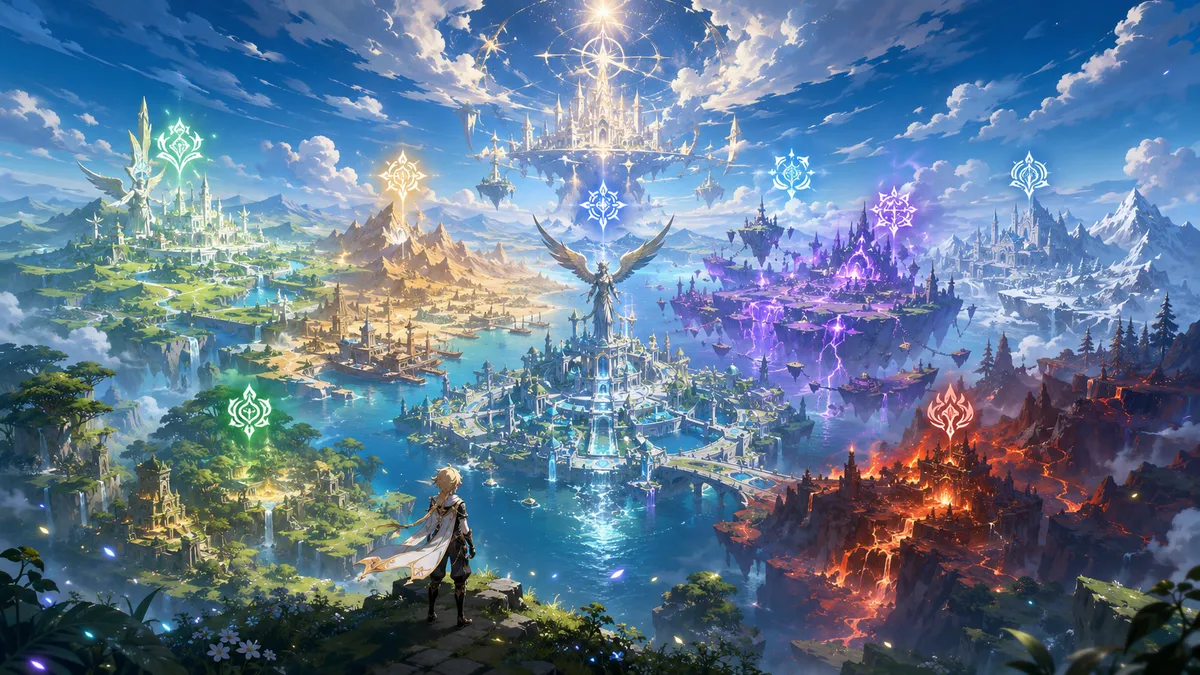
Teyvat is the main world and continent where most of Genshin Impact’s story takes place. It is divided into seven primary nations, each connected to an element, an Archon Quest chapter, and an Archon. The lore also includes other important regions and places such as Nod-Krai, Khaenri’ah, Celestia, and the Dark Sea.
Teyvat is designed around the idea that each nation has its own culture, government, element, ideal, and relationship with the divine. Mondstadt is not just a city with windmills. It represents freedom. Liyue is not just a harbor. It represents contracts. Inazuma explores eternity. Sumeru explores wisdom. Fontaine explores justice. Natlan explores war. Snezhnaya remains heavily tied to the Cryo Archon, the Fatui, and future story revelations.
This structure makes Teyvat feel like a living mythological world. Each region is a separate story, but all regions are connected by larger themes: gods and humans, fate and freedom, truth and memory, contracts and rebellion, law and judgment, life and loss, and the question of whether Teyvat’s divine order is truly fair.
The in-game map and region systems also support this structure. Regions are used for map tabs, expeditions, commissions, and Ley Line tracking, which means nations are not only lore divisions but gameplay divisions too.
The main story follows the Traveler and Paimon as they journey through Teyvat in search of the Traveler’s lost sibling. Archon Quests are the main questline that tells this story, and players need to reach certain Adventure Rank requirements to unlock different parts of it.
At the beginning of Genshin Impact, the player chooses one of two twins: Aether or Lumine. The chosen twin becomes the Traveler, while the other becomes the lost sibling. The Traveler is separated from their sibling after arriving in Teyvat, then wakes later and begins traveling across the world.
The Traveler’s first goal seems simple: find their sibling and leave Teyvat. But as the story continues, the goal becomes more complicated. The Traveler learns that their sibling has already traveled through Teyvat and has become deeply connected to the Abyss Order. The sibling’s role depends on the player’s choice at the beginning, and the sibling is described as the Prince or Princess of the Abyss Order.
This changes the story from a simple rescue mission into a larger mystery. The Traveler is not only searching for someone. They are trying to understand why their sibling changed, what truth they discovered, and why Teyvat’s gods, nations, and hidden powers are connected to their separation.
Paimon is the Traveler’s closest companion and guide. She helps the Traveler understand the world, speaks in many story scenes, reacts to important events, and acts as the emotional bridge between the player and Teyvat.
Paimon is often funny and lighthearted, but her role is more important than comic relief. She is present for nearly every major story moment. She helps the Traveler connect with people, asks questions the player may be thinking, and keeps the journey moving.
Because Genshin Impact is full of hidden lore, many players have theories about Paimon’s true nature. The game has not fully answered every question about her, which makes her one of the biggest ongoing mysteries. For now, the safest way to understand Paimon is as the Traveler’s guide, friend, and constant witness to the story of Teyvat.
Teyvat’s main political and divine structure is built around seven nations. Each nation is associated with one element, one Archon, one ideal, one main city, and one Archon Quest chapter. The known seven nations are Mondstadt, Liyue, Inazuma, Sumeru, Fontaine, Natlan, and Snezhnaya.
The seven nations are:
Mondstadt: Anemo, Freedom, Barbatos.
Liyue: Geo, Contracts, Morax.
Inazuma: Electro, Eternity, Baal and Beelzebul.
Sumeru: Dendro, Wisdom, Greater Lord Rukkhadevata and Buer.
Fontaine: Hydro, Justice, Egeria and Focalors.
Natlan: Pyro, War, Xbalanque and Mavuika.
Snezhnaya: Cryo, connected to the Tsaritsa.
The current official HoYoLAB interactive map includes Teyvat map regions such as Mondstadt, Liyue, Inazuma, Sumeru, Fontaine, Natlan, Nod-Krai, Enkanomiya, The Chasm: Underground Mines, Sea of Bygone Eras, and other map layers.
Each nation tells a different kind of story. Mondstadt introduces freedom and the relationship between people and a distant god. Liyue explores contracts, leadership, and what happens when a nation must move beyond its god. Inazuma explores eternity, isolation, and change. Sumeru explores knowledge, dreams, memory, and truth. Fontaine explores justice, prophecy, performance, and judgment. Natlan expands the story through war, inheritance, and survival. Snezhnaya continues to build toward the Fatui and Cryo Archon conflict.
The Seven Archons, usually called The Seven, are the gods who preside over the seven nations of Teyvat. They were established after they or their predecessors emerged as victors of the Archon War around 2,000 years ago. Each Archon is connected to an element and an ideal, and that ideal shapes their nation’s culture and governance.
The Archons are important because they are both rulers and symbols. They are not only powerful beings. They represent the values their nations are built around. Barbatos represents freedom. Morax represents contracts. Ei represents eternity. Nahida represents wisdom. Fontaine’s story is tied to justice. Natlan’s Archon story connects to war. Snezhnaya’s Tsaritsa remains one of the most important unresolved figures in the main plot.
Archons also possess Gnoses, special divine focuses connected to Celestia. The Seven page explains that each Archon has a Gnosis that allows them to resonate directly with Celestia, while Visions are described as more primitive by comparison.
This is one reason the Fatui’s actions matter so much. The Fatui are not simply collecting random magical objects. They are pursuing Gnoses, which are tied to Archon authority and the divine order of Teyvat.
Elemental power is central to Genshin Impact lore and gameplay. Most playable characters use Visions, which are elemental amulets that allow their users to channel one of the seven elements. Visions are associated with people who have strong desires and the potential to ascend to Celestia.
Archons use Gnoses instead of ordinary Visions. A Gnosis is not just a stronger Vision. It is tied to Archon status, Celestia, and the authority of The Seven. This is why the loss, exchange, or collection of a Gnosis is a major story event.
For players, elements may look like combat mechanics: Pyro, Hydro, Electro, Cryo, Anemo, Geo, Dendro. But in lore, elements represent deeper systems. Nations are organized around elements. Archons are defined by elements. Visions mark people chosen by divine systems. Reactions shape combat, but elemental power also shapes politics, culture, identity, and fate.
This is one of the strongest parts of Genshin Impact’s worldbuilding: the same elements you use in battle also explain how Teyvat’s societies work.
Mondstadt is the first major nation most players experience. It is the nation of Anemo and freedom, ruled in name by Barbatos, the Anemo Archon. In practice, Mondstadt is governed by the Knights of Favonius, while Barbatos is famously distant from direct rule. The Teyvat nation table lists Mondstadt’s element as Anemo, Archon as Barbatos, ideal as Freedom, and governing body as the Knights of Favonius.
Mondstadt introduces many of Genshin Impact’s core ideas. Players learn about the Seven, the role of Archons, the existence of the Fatui, the importance of dragons, and the idea that divine protection does not always mean direct divine control.
The Mondstadt story also shows that freedom can be complicated. Barbatos does not rule like a king. He allows people to govern themselves, which makes Mondstadt feel open and independent. But freedom also means people must protect their own home, face their own mistakes, and decide what kind of nation they want to be.
Mondstadt’s lore is beginner-friendly, but it is not simple. It introduces ancient Mondstadt history, Decarabian’s old city, the rise of Barbatos, Vennessa’s rebellion, Dvalin’s pain, and the idea that even legendary heroes and gods can be misunderstood over time.
Liyue is the nation of Geo, contracts, commerce, and ancient tradition. Its Archon is Morax, also known as Rex Lapis and Zhongli. The Teyvat nation table lists Liyue as the Geo nation, Chapter I region, with Morax as its Archon, Contracts as its ideal, and the Liyue Qixing as its governing body.
Liyue’s story is about trust, responsibility, and the transition from divine guidance to human leadership. Morax has guided Liyue for a very long time, but the nation must eventually prove that it can stand without constant divine control.
Contracts are more than business agreements in Liyue. They are a moral and social foundation. Liyue’s people believe in order, promises, trade, and responsibility. This makes Liyue very different from Mondstadt. Where Mondstadt celebrates freedom, Liyue asks what people owe to each other.
Liyue also expands the lore of adepti, ancient gods, the Archon War, divine contracts, and the long history of Teyvat before the Traveler arrived. It helps players understand that every nation has a long past filled with sacrifices, old agreements, and unresolved consequences.
Inazuma is the nation of Electro and eternity. The Teyvat nation table identifies Inazuma as the Electro nation of Chapter II, with Baal as the first Electro Archon and Beelzebul as the second, and Eternity as the nation’s ideal.
Inazuma’s story focuses on isolation, fear of change, loss, and the danger of trying to freeze a nation in one perfect moment. Unlike Mondstadt and Liyue, Inazuma begins as a closed nation under strict rule, with the Vision Hunt Decree and Sakoku Decree shaping its conflict.
The Electro Archon’s idea of eternity is not simply “living forever.” It is about resisting change, protecting what remains, and trying to prevent loss from repeating. But Genshin Impact shows that eternity can become harmful if it ignores the needs of living people.
Inazuma lore also expands the role of divine substitutes, puppets, war, resistance, ambition, and what it means for a god to lead while carrying personal grief. It is one of the first regions where the player sees how an Archon’s ideal can become dangerous when taken too far.
Sumeru is the nation of Dendro and wisdom. The Teyvat table lists Sumeru as the Dendro nation of Chapter III, with Greater Lord Rukkhadevata as the first Dendro Archon and Buer as the second, and Wisdom as its ideal.
Sumeru’s lore is one of the most important parts of Genshin Impact’s main story because it introduces deeper questions about memory, truth, dreams, and Irminsul. Irminsul is described as the repository of all information and memories of Teyvat, collected through the Ley Lines.
This changes how players understand the world. Genshin Impact is not only asking “What happened?” It is asking “Who remembers what happened?” and “Can history itself be changed if memory is changed?”
Sumeru also explores the divide between knowledge and wisdom. The Akademiya values research, information, and control, but the story challenges whether knowledge without compassion is truly wisdom. Nahida’s role is especially important because she represents a different kind of wisdom: curiosity, empathy, patience, and the courage to face painful truth.
Sumeru is one of the biggest lore turning points because it makes players question whether Teyvat’s history is reliable.
Fontaine is the nation of Hydro and justice. The Teyvat nation table lists Fontaine as the Hydro nation of Chapter IV, with Egeria as the first Hydro Archon and Focalors as the second and last, and Justice as its ideal.
Fontaine’s lore is built around law, performance, judgment, prophecy, and the difference between public truth and hidden truth. The nation is theatrical in style, but its story is not shallow. Fontaine asks whether justice is the same as punishment, whether a legal system can understand truth, and whether performance can hide sacrifice.
Fontaine also expands major lore about divine authority. The Seven page notes that after Chapter IV: Act V, only six divine thrones remain after the Hydro Archon’s throne was destroyed, returning Hydro authority to the Hydro Dragon Sovereign and breaking the established order of The Seven.
This is one of the most important developments in Genshin Impact lore. It suggests that the divine system of Teyvat is not permanent, and that the authority of the Archons has deeper origins connected to older powers.
Fontaine’s story is emotional because it combines national prophecy with personal identity. It is also lore-heavy because it connects Archons, dragons, divine thrones, judgment, and the limits of the system Celestia created.
Natlan is the nation of Pyro and war. The Teyvat table lists Natlan as the Pyro nation of Chapter V, with Xbalanque as the first Pyro Archon and Mavuika as the latest, and War as the nation’s ideal.
Natlan’s lore expands the story through themes of inheritance, battle, collective memory, survival, and what it means for a nation to continue fighting for its future. Unlike some earlier nations that focus heavily on government, contracts, wisdom, or law, Natlan’s identity is connected to conflict and endurance.
War in Natlan lore should not be understood only as fighting. It also represents struggle, protection, legacy, and the will to keep going when the nation faces danger. This makes Natlan important for the broader story because the world of Teyvat is moving closer to larger conflict involving gods, the Abyss, the Fatui, and truths hidden for centuries.
Natlan also deepens the connection between nations and their older histories. Like other regions, it shows that a nation’s current culture is shaped by what its people remember, what they inherit, and what they are willing to defend.
Snezhnaya is the Cryo nation and the homeland of the Fatui. The Teyvat table lists Snezhnaya as the Cryo nation of Chapter VI, with the Tsaritsa as the second Cryo Archon.
Snezhnaya is one of the most important future-facing parts of Genshin Impact lore because the Fatui have been involved across many nations. The Tsaritsa herself has not appeared directly in quests, but her Harbingers act in her name. The Tsaritsa page explains that her Harbingers enforce her will and her goal of rebelling against the divine, including obtaining the Gnoses of other Archons.
This makes Snezhnaya different from other nations. Before players even fully reach it, they already feel its influence. Fatui diplomats, agents, Harbingers, and political schemes appear throughout the story. They are not just random villains. They are part of a larger plan connected to divine authority.
The Tsaritsa remains mysterious because her full motivation is not completely explained. The Fatui’s actions often look harsh, but the story keeps hinting that their rebellion against the divine order may be tied to something bigger than ordinary conquest. This uncertainty is what makes Snezhnaya one of the most anticipated lore regions.
Nod-Krai is listed as a region on the official interactive map and is also described in lore as an autonomous region in the southernmost part of Snezhnaya, on the edge of Teyvat.
Nod-Krai matters because it expands the map and story beyond the traditional seven-nation path while still connecting to Snezhnaya and larger Teyvat mysteries. It is not one of the seven primary nations in the same way Mondstadt or Liyue are, but it is part of the broader world players need to understand.
Regions like Nod-Krai show that Genshin Impact lore is not only about the seven Archons. Teyvat includes borderlands, underground civilizations, destroyed nations, divine spaces, and places that do not fit neatly into the official order.
This is important for future story direction. The closer the Traveler gets to Snezhnaya, Khaenri’ah, and Celestia-related mysteries, the more the story moves beyond simple nation visits and into the hidden structure of the world
.
Khaenri’ah is one of the most important mysteries in Genshin Impact. It was an ancient civilization destroyed 500 years ago during the Cataclysm. The Teyvat page describes Khaenri’ah as an underground civilization located deep below Sumeru that relied on the Art of Khemia, a life-giving alchemy, to survive.
Khaenri’ah is important because it was not ruled by one of The Seven. It represents a civilization outside the normal divine order. Its destruction is tied to the biggest unanswered questions in the game: What exactly happened 500 years ago? Why did Celestia and the gods respond as they did? What role did Khaenri’ah’s technology, alchemy, and ambition play? Why is the Traveler’s sibling so connected to its aftermath?
The Abyss Order is also deeply connected to Khaenri’ah. The Traveler’s sibling is associated with the Abyss Order, and the story gradually reveals that the Abyss is not just a monster faction but part of the world’s broken history.
For lore fans, Khaenri’ah is one of the main keys to the final story. Understanding Khaenri’ah helps explain why the Traveler’s journey is not only about visiting nations, but about uncovering the truth behind Teyvat’s divine system.
Check out some of our most popular Genshin Impact services:
Celestia is a floating island in the sky where gods are said to reside. Teyvat’s people believe that mortals chosen to ascend to godhood will join the pantheon in Celestia.
Celestia is one of the most mysterious forces in the story. It is connected to the divine order, Archons, Visions, Gnoses, and the larger structure of Teyvat. Many characters talk about it indirectly, but the game has carefully limited how much players truly know.
Celestia matters because it represents authority above the Archons. The Seven rule nations, but they are not necessarily the highest power. Celestia appears to sit above the system, connected to divine judgment, ascension, and the rules that shape Teyvat.
This creates one of the central questions of Genshin Impact lore: Is the divine order protecting Teyvat, controlling Teyvat, or hiding the truth from Teyvat?
The game does not answer this fully early on. Instead, every region gives the player a different angle. Mondstadt shows a god who avoids direct control. Liyue shows a god stepping away. Inazuma shows a god trying to control change. Sumeru reveals memory systems. Fontaine challenges divine authority. Natlan and Snezhnaya continue pushing the story toward the larger conflict.
The Abyss Order is one of the major opposing forces in the story, but it is not a simple monster group. It is connected to the Traveler’s sibling, Khaenri’ah, and the hidden history of Teyvat.
The Traveler’s sibling is described as the leader of the Abyss Order after becoming separated from the Traveler and seeing the “truth” of the world. This makes the Abyss Order personal to the Traveler. The main enemy is not distant. It is connected to the Traveler’s family and the truth their sibling discovered.
The Abyss Order often opposes the gods and the current order of Teyvat. Its motives are tied to the aftermath of Khaenri’ah and the suffering caused by the Cataclysm. This does not mean every action by the Abyss Order is good, but it means the faction has a deeper story reason behind its hostility.
For players, the Abyss Order is one of the main reasons the story feels morally complex. The Traveler wants to stop dangerous actions, but also wants to understand why their sibling chose this path. This creates emotional tension that continues through the main story.
The Fatui are a powerful organization from Snezhnaya led by the Tsaritsa and represented by the Eleven Fatui Harbingers. They appear across multiple regions and often act as political, military, or diplomatic antagonists.
The Fatui’s larger goal is tied to the Tsaritsa’s plan to seize authority from the gods, with the Harbingers carrying out her plans and collecting Gnoses. This makes the Fatui one of the most important forces in the entire story.
What makes the Fatui interesting is that they are not only enemies in combat. They are diplomats, spies, soldiers, researchers, bankers, and political actors. Their influence is felt in Mondstadt, Liyue, Inazuma, Sumeru, Fontaine, Natlan, and beyond.
The Harbingers also make the Fatui more complex. Each Harbinger has their own personality, method, and priorities. Some are direct fighters. Some are planners. Some are scientists. Some are diplomats. Their differences make the Fatui feel like a full organization rather than a simple evil group.
In lore terms, the Fatui are the human rebellion side of the divine conflict. The Abyss Order rebels from a broken past. The Fatui rebel through power, politics, and collected divine authority.
Irminsul is one of the most important lore concepts in Genshin Impact. It is described as the repository for all information and memories of Teyvat, collected through the Ley Lines.
This means Teyvat’s history is not only written in books or remembered by people. It is connected to a world-level memory system. That makes the story much deeper because changing memory can affect how people understand reality.
Irminsul is especially important in Sumeru. It connects knowledge, dreams, memory, truth, and the question of whether history can be trusted. If records and memories can be changed or hidden, then players must be careful when interpreting lore. A story told by one character may be incomplete. A book may preserve a clue. A forgotten name may matter more than it first appears.
Irminsul also connects to the Traveler’s unusual nature. The Traveler’s relationship with Teyvat’s records is different from ordinary people, which is one of the reasons the Traveler is important beyond being a strong adventurer.
For lore readers, Irminsul means one thing: pay attention to memory, names, records, and what people forget.
Archon Quests are the main storyline of Genshin Impact. They follow the Traveler and Paimon through Teyvat as they search for the Traveler’s lost sibling.
Each nation’s Archon Quest usually introduces the nation’s central conflict and its Archon’s ideal. Mondstadt introduces freedom. Liyue introduces contracts. Inazuma introduces eternity. Sumeru introduces wisdom. Fontaine introduces justice. Natlan introduces war. Snezhnaya is expected to continue the larger conflict involving the Cryo Archon and Fatui.
Archon Quests matter most because they reveal the biggest story pieces. They explain the Traveler’s journey, introduce major characters, uncover regional conflicts, and slowly reveal the truth behind Khaenri’ah, the Abyss, Celestia, and the divine order.
For players who want to understand Genshin lore, Archon Quests should be the first priority. World Quests and character stories add depth, but Archon Quests are the main spine of the story.
Story Quests focus on individual characters. They show personal motivations, relationships, daily life, hidden struggles, and how each character fits into their nation.
These quests are important because Genshin Impact lore is not only about gods and ancient civilizations. It is also about people. A nation’s ideals become easier to understand when you see how ordinary citizens, leaders, fighters, scholars, artists, and outsiders live inside that nation.
For example, a character from Liyue may show what contracts mean in daily life. A character from Inazuma may show the emotional cost of eternity. A character from Sumeru may show the pressure of knowledge. A character from Fontaine may show the difference between justice as performance and justice as truth.
Story Quests also help players understand playable characters before building or pulling them. A character’s gameplay role is important, but their lore role can make them more meaningful.
World Quests are one of the best sources of hidden lore in Genshin Impact. Many of the deepest stories in the game are not only in Archon Quests. They are hidden in regional questlines, caves, ruins, books, ancient inscriptions, and long side stories.
World Quests often reveal:
Ancient civilizations.
Regional history.
Forgotten gods.
Lost families.
Old wars.
Hidden ruins.
Environmental mysteries.
Local legends.
Connections to Khaenri’ah or Celestia.
World Quests are especially important in regions like Sumeru, Fontaine, Inazuma, Chenyu Vale, The Chasm, Enkanomiya, Dragonspine, and Natlan. These areas often include lore that changes how players understand the main story.
BoostRoom recommends that lore-focused players do not skip World Quests. The main story gives the big picture, but World Quests often provide the details that make the world feel alive.
Genshin Impact lore can feel overwhelming because it is spread across many sources. A player may finish an Archon Quest and understand the main plot, but still miss details hidden in artifact sets, books, boss descriptions, world puzzles, and character voice lines.
The best way to understand lore is to follow a clean order:
Complete Archon Quests.
Complete major World Quests in each region.
Complete Story Quests for important characters.
Read character profiles and voice lines.
Read artifact and in-game weapon descriptions.
Pay attention to ruins, murals, and environmental clues.
Replay or review confusing story sections when needed.
Separate confirmed facts from theories.
This final point is very important. Genshin Impact has a huge theory community, but not every theory is confirmed. A good lore reader should enjoy theories while still knowing the difference between official story information and speculation.
If something is directly stated in-game or in official material, it is stronger evidence. If something is only a fan theory, it may be interesting but should not be treated as confirmed.
Genshin Impact lore is popular because it rewards curiosity. The game gives players beautiful regions and fun combat, but it also hides deep stories behind small details. A flower, ruin, book, artifact set, boss name, or world quest can connect to a huge mystery.
The lore also works because it has multiple scales. There is personal lore, like the Traveler and sibling. There is character lore, like playable characters and their struggles. There is national lore, like Mondstadt’s freedom or Fontaine’s justice. There is ancient lore, like Khaenri’ah and the Cataclysm. There is cosmic lore, like Celestia, the divine order, and powers beyond The Seven.
This creates a world where every player can enjoy lore at their own level. Casual players can follow the main story. Deep lore fans can read item descriptions and build theories. Character fans can focus on Story Quests. Exploration fans can find secrets in ruins.
That is why Genshin lore keeps players interested between updates. The world is not finished, and every new region can change how old information is understood.
New players should not try to understand everything at once. Genshin Impact lore is meant to unfold slowly.
Start with the Archon Quests. They introduce the Traveler’s journey and the seven nations in the intended order. Then do World Quests in each region before moving too far ahead. This helps you understand regional history while it is still fresh.
Do not worry if some names feel confusing at first. Genshin Impact uses many titles, alternate names, god names, human names, and historical names. For example, an Archon may have a divine name, a local title, and a playable identity. This is normal.
Pay attention to repeated words. Names like Celestia, Khaenri’ah, Abyss, Irminsul, Gnosis, Vision, Descender, Archon, Dragon Sovereign, and Heavenly Principles appear for a reason. When a term repeats across regions, it usually matters.
Most importantly, avoid spoiling yourself too quickly if you care about story surprises. Genshin lore is best when major reveals happen naturally through quests.
Check out some of our most popular Genshin Impact services:
BoostRoom helps Genshin Impact players enjoy the game with more context. Builds, teams, artifacts, and farming are important, but lore makes the world feel meaningful. When players understand the story behind Teyvat, nations, Archons, and factions, quests become more interesting and exploration feels more rewarding.
Many players skip dialogue because the lore feels too large or confusing. BoostRoom helps simplify the big picture: who the Archons are, why each nation matters, what the Traveler is searching for, how Khaenri’ah connects to the Abyss, why the Fatui collect Gnoses, and why Celestia remains such a major mystery.
A player who understands lore can enjoy Genshin Impact on a deeper level. They notice small hints, understand character motivations, connect regions together, and feel more invested in future updates.
BoostRoom is here to help players progress smarter and understand the world they are progressing through.
What is Teyvat in Genshin Impact?
Teyvat is the main world and continent where Genshin Impact takes place. It is divided into seven primary nations connected to elements, Archons, ideals, and Archon Quest chapters.
Who are the Seven Archons?
The Seven Archons are the gods who preside over Teyvat’s seven nations. Each Archon is connected to one element and one ideal, such as Freedom, Contracts, Eternity, Wisdom, Justice, War, or the Cryo nation’s still-developing story.
What are the seven nations of Teyvat?
The seven nations are Mondstadt, Liyue, Inazuma, Sumeru, Fontaine, Natlan, and Snezhnaya.
What is the Traveler’s main goal?
The Traveler’s main goal is to find their lost sibling while traveling through Teyvat with Paimon. Over time, this goal becomes connected to the larger truth of the world.
What is Khaenri’ah?
Khaenri’ah was an ancient underground civilization destroyed 500 years ago during the Cataclysm. It is one of the biggest mysteries in Genshin Impact lore.
What is Celestia?
Celestia is a floating island in the sky where gods are said to reside. It is connected to divine authority, Visions, Archons, and Teyvat’s larger order.
What is the Abyss Order?
The Abyss Order is a major faction connected to the Traveler’s sibling and the aftermath of Khaenri’ah. It opposes the current divine order of Teyvat.
What are the Fatui?
The Fatui are a powerful organization from Snezhnaya led by the Tsaritsa and her Harbingers. They are involved in collecting Archon Gnoses and challenging divine authority.
What is Irminsul?
Irminsul is the repository of Teyvat’s information and memories, collected through the Ley Lines. It is especially important in Sumeru’s lore and the mystery of history and memory.
Can BoostRoom help players understand Genshin Impact lore?
Yes, BoostRoom helps players understand Genshin Impact lore, story order, region meaning, Archon roles, faction conflicts, and how the main plot connects across Teyvat.
Genshin Impact lore is much bigger than one region, one Archon, or one questline. It is the story of Teyvat, the seven nations, the Traveler’s lost sibling, the Archons, Celestia, Khaenri’ah, the Abyss Order, the Fatui, Irminsul, and the hidden truth behind the world.
Mondstadt introduces freedom. Liyue explains contracts. Inazuma questions eternity. Sumeru explores wisdom and memory. Fontaine challenges justice and divine authority. Natlan expands the story through war and survival. Snezhnaya continues building toward the Tsaritsa, the Fatui, and the larger rebellion against the divine. Nod-Krai and other regions show that Teyvat’s world is even wider than the seven-nation structure.
The best way to enjoy Genshin lore is to take it step by step. Follow Archon Quests, complete World Quests, read character stories, explore ruins, pay attention to repeated names, and separate confirmed lore from theories. The more you understand, the more every region and character begins to connect.
BoostRoom is here to help players experience Genshin Impact with clearer story knowledge, smarter progression, and a deeper appreciation for the world of Teyvat.
More Reads
Buy Genshin Impact boosting jobs at BoostRoom Shop. Cheap, safe, fast boost & carry service for sale. Best results today.
Read more
Genshin Impact account progression is not only about reaching a higher Adventure Rank. A strong account grows through smart character building, better teams, efficient Resin spending, steady exploration, event rewards, good Primogem planning, stronger in-game weapons, upgraded talents, and better artifact farming at the right time. This guide explains how to progress from a brand-new player to endgame without wasting resources. You will learn what to focus on at each stage, when to farm materials, when to start artifact farming, how to build your first and second teams, how to prepare for Spiral Abyss and Imaginarium Theater, and how to avoid beginner mistakes that slow account growth. BoostRoom helps players turn every login, quest, event, and farming session into real Genshin Impact progress.
Read more
Genshin Impact is easy to start but difficult to understand fully at the beginning. New players often make mistakes with Primogems, Resin, artifacts, talents, in-game weapons, team building, exploration, bosses, events, and character upgrades without realizing how much those decisions affect long-term progress. This guide explains the most common Genshin Impact beginner mistakes and how to avoid them. You will learn why random pulling slows account growth, why early artifact farming can waste Resin, why supports matter, why talents and in-game weapons are important, and how to build a stronger account with fewer regrets. BoostRoom helps players avoid beginner errors, save valuable resources, and progress through Teyvat with a smarter plan.
Read more
Genshin Impact is one of the most beautiful open-world games on mobile, but it can also be demanding. Large regions, elemental effects, boss fights, character animations, co-op battles, underwater areas, city crowds, and high-quality environments can make phones heat up, drain battery, stutter, lag, or drop frames if the settings are too high. This guide explains the best Genshin Impact mobile settings for smooth gameplay on Android, iPhone, and iPad. You will learn how to choose graphics settings, FPS, render resolution, shadows, visual effects, controls, storage options, battery habits, and performance fixes. BoostRoom helps players enjoy smoother gameplay, better farming, easier combat, and more stable exploration without wasting time guessing which settings to change.
Read more