Dota 2 Farming Guide: How to Get More Gold and XP Efficiently
Farming is one of the most important skills in Dota 2 because gold and experience decide how quickly your hero becomes useful. A player who farms efficiently reaches items faster, gains levels earlier, joins fights with stronger spells, and creates more pressure on the map. A player who farms poorly may feel weak even after a good lane, miss important timings, and lose fights because the enemy reached items first.
Many players think farming means going to the jungle and killing neutral camps. That is only one part of farming. Real farming includes last hitting lane creeps, denying enemy experience, pushing waves, clearing jungle camps between waves, stacking camps, collecting runes or shrine rewards, taking safe farm when ahead, taking recovery farm when behind, and knowing which hero on the team should take which resources.
Dota 2 rewards players who farm with purpose. If you farm safely but never help your team take objectives, you may become rich and still lose. If you fight constantly and ignore creeps, you may fall behind and become useless. The best players understand the balance: farm when your hero needs items, fight when your timing is ready, and always turn farm into map pressure.
Valve has treated last hitting as a vital mechanic for improvement, even adding a Last Hit Trainer in the Learn tab so players can practice getting more creep gold and improving GPM. That alone shows how important farming fundamentals are in Dota 2.
This complete Dota 2 farming guide explains how to get more gold and XP efficiently. You will learn last hitting, lane creeps, jungle routes, stacking, wave pressure, role-based farming, support XP, carry farming patterns, mid recovery, offlane space creation, map safety, item timing, and common farming mistakes. BoostRoom can also help players improve faster through Dota 2 coaching, replay review, farming-route analysis, item-timing feedback, and role-specific improvement plans.
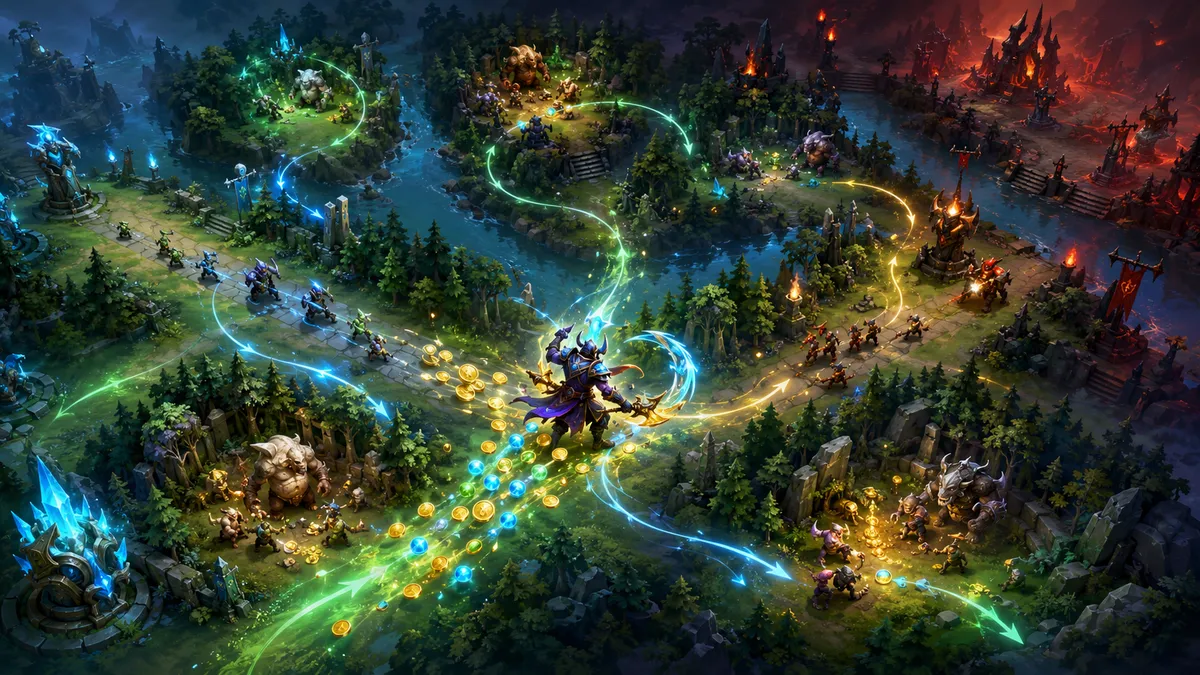
Why Farming Matters in Dota 2
Farming matters because Dota 2 is a resource game. Every creep, camp, rune, tower, and objective gives value. The team that collects resources more efficiently usually reaches stronger timings sooner. Stronger timings lead to better fights, better fights lead to towers and Roshan, and those objectives help close the game.
Gold gives items. Experience gives levels. Items and levels change what your hero can do. A carry with a fast farming item can accelerate into late game. A mid hero with level advantage can rotate and control fights. An offlaner with a fast Blink Dagger can start fights before enemies are ready. A support with level 6 can use a powerful ultimate and change the map.
Poor farming creates a chain reaction. If your carry misses too many lane creeps, their first item is late. If the first item is late, they farm slower. If they farm slower, the second item is late. If the second item is late, they may be too weak for the next fight. This is why small early mistakes can become large mid-game problems.
Good farming creates the opposite chain. You last hit well, reach an item earlier, farm faster, survive better, and join fights with confidence. The enemy must respond to your timing instead of playing their own game freely.
Farming is not only for cores. Supports also need experience and some gold. A support with boots, wards, detection, and a save item can decide fights. A position 5 stuck at level 4 for too long may not have enough impact. Efficient Dota means every role gets the resources they need without stealing from the heroes who need them more.
Gold and XP Are Different Resources
Gold and experience are connected, but they are not the same. Gold helps you buy items. Experience helps you level abilities and talents. Some heroes need gold more urgently. Others need levels more urgently. Understanding the difference helps you farm smarter.
A carry usually needs gold because carry impact often comes from items. A Juggernaut, Luna, Wraith King, Drow Ranger, Anti-Mage, or Sven becomes much stronger after item timings. These heroes want lane creeps, jungle camps, and safe farming routes.
A mid hero often needs both gold and experience. Levels give strong spells, while gold gives tempo items, damage, mana, mobility, or survival. A mid player who controls runes and waves can gain a level advantage that affects the whole map.
An offlaner often values levels early because many position 3 heroes become useful with level 6, strong spells, and one key item. Some offlaners need Blink Dagger. Others need aura items. Others need levels to defend towers or start fights.
Supports often need experience more than gold early. A support with level 6 can become much stronger even without expensive items. Supports also need small amounts of gold for boots, wards, detection, Smoke, and utility items. They should not take farm from cores randomly, but they should collect empty waves and participate in XP-based objectives when appropriate.
A good Dota player asks: who needs this farm most, and who can use it best right now?
Last Hitting: The First Farming Skill
Last hitting is the foundation of farming. A last hit is the final hit on an enemy creep that gives gold. If you are a core, missing last hits in the first ten minutes directly delays your items. If you are a support, understanding last hits helps you protect your core, secure important creeps when needed, and avoid ruining lane equilibrium.
Lane creep bounties go to the player who lands the killing blow, and denied lane creeps give reduced experience to enemies instead of full value. The Dota 2 Wiki notes that denied lane creeps grant 50% of their experience value to enemies, while gold bounty is only granted to the enemy player who gets the last hit.
To improve last hitting, practice with the heroes you actually play. Every hero has different attack damage, animation, projectile speed, and attack timing. Drow Ranger does not last hit like Wraith King. Zeus does not last hit like Dragon Knight. Crystal Maiden does not last hit like Jakiro. If you want better farming, practice your real hero pool.
Do not attack creeps randomly. Watch the creep’s health, prepare your attack, and use stop commands or movement to time the hit. If you auto-attack constantly, you may push the wave and make the lane harder.
A simple goal is to track your first ten-minute last hits. If you usually get 35 last hits by ten minutes, try to reach 40. Then 45. Then 50. Improvement does not need to happen instantly. Small gains every game become much faster item timings over time.
Denying: Farming Also Means Taking Resources Away
Denying is not farming for yourself, but it is part of resource control. When you deny your own creep, you reduce the enemy’s value from the lane. This can slow their level timing and make your lane stronger.
Denying is especially important in mid lane because small level advantages can decide the matchup. A mid player who secures their own ranged creep while denying the enemy ranged creep can create a level gap. Side lanes also benefit from denies, especially when the lane is stable and you can deny without missing your own last hits.
However, do not deny so much that you miss gold. For most cores, securing your own last hits comes first. Denying is excellent when you can do it safely and efficiently. Supports can deny when the core is not missing farm or when lane equilibrium needs help.
Denying also affects lane position. If you deny more creeps, your wave may push less, keeping the lane safer. A carry who denies well can keep the wave closer to their tower. An offlaner who denies well can reduce the enemy carry’s comfort. A mid player who denies well can force the enemy to play from behind.
Farming is not only about what you gain. It is also about what the enemy does not gain.
Creep Aggro: Farming Safely in Lane
Creep aggro is one of the most important farming mechanics in Dota 2. It lets you manipulate enemy creeps so they move closer to you. This helps you last hit more safely, control the lane, and avoid taking unnecessary harassment.
The lane creep system allows creeps to change targets when enemy units enter their acquisition range, and the Dota 2 Wiki explains that lane creeps can chase aggroed units before returning to their lane.
For a carry, creep aggro helps bring creeps closer to your safe area. For an offlaner, it helps you secure creeps in a difficult lane. For a mid player, it helps control the wave and secure ranged creeps. For supports, understanding aggro helps you avoid accidentally drawing creep damage during bad trades.
A simple way to practice is to right-click an enemy hero when enemy creeps are nearby, then walk backward. The enemy creeps may move toward you, changing their position. This makes the last hit safer.
Many low-rank players lose farm because they walk forward for every creep. Better players use creep aggro to make the creep come to them. This saves health, improves lane control, and reduces deaths.
Creep aggro is not flashy, but it can improve your gold and XP immediately.
Lane Creeps Are Usually Better Than Jungle Camps
One of the biggest farming mistakes is ignoring lane creeps. Jungle camps are useful, but lane creeps are often more important because they give resources and push the map. A hero who farms only jungle may collect gold but allow enemy waves to damage towers and reduce map space.
Lane creeps create pressure. If you push a wave into the enemy side, someone must respond. If nobody responds, the wave damages towers. If someone responds, you gain information about enemy location. This makes lane creeps valuable beyond gold and XP.
A good farming pattern often starts with the lane wave. Push the lane when safe, then farm nearby jungle camps while the next wave moves. This is much more efficient than sitting in jungle while lane creeps die to towers.
For example, a carry farming safe lane can clear the incoming lane wave, then farm the nearest camps, then return for the next wave. A mid hero can push mid, farm one camp, then return. An offlaner can push a dangerous wave to force enemy movement, then retreat to a safer camp.
Jungling without lane pressure often makes your team passive. Farming lanes safely creates pressure and money at the same time.
Jungle Farming: When and How to Use Neutral Camps
Neutral camps are an important source of gold and XP, especially after the laning stage. Neutral creeps start spawning at 1:00 and then spawn every minute if the camp is not blocked by units or wards.
Jungle farming is useful when the lane is dangerous, when your hero clears camps quickly, when your lane wave is already pushed, or when you are waiting for an item timing. But jungle farming should not replace lane farming completely unless the lane is truly unsafe.
The best jungle farming is route-based. Do not walk randomly from camp to camp. Clear camps in a path that connects with lane waves, runes, stacks, or objectives. Every second spent walking without farming is lost efficiency.
Good farming heroes clear camps quickly and move smoothly. Luna, Sven, Anti-Mage, Alchemist, Naga Siren, Phantom Lancer, Medusa, and similar farming heroes can accelerate through jungle patterns. But even slower heroes can farm better by planning routes and not wasting movement.
A support can also farm jungle when cores are not using it and when the support can clear safely. However, supports should not take camps needed by a core who is nearby and working toward a key item.
Jungle camps are valuable, but they are best when combined with wave pressure.
Creep Stacking: Creating Extra Gold and XP
Creep stacking is one of the best ways to increase total team farm. Stacking means pulling neutral creeps away from their camp before the minute mark so a new camp spawns. The Dota 2 Wiki explains that stacking increases the number of units in a camp, that new neutral camps spawn on each minute when the camp is clear, and that many camps are stacked around the 54–55 second mark depending on camp and unit movement.
Stacking is powerful because it creates extra resources. A carry or mid hero who clears stacks can get a burst of gold and XP. A support who stacks can help the team while moving between lane, warding, and rotations.
The same source notes that stackers can receive bonus bounty value when a teammate clears the stacked creeps, with stacking bonus values listed as part of the mechanic.
Supports should stack when their lane is stable. Do not leave your carry to die just to stack. But when the wave is safe, the enemy cannot dive, or your core is farming under tower, a stack can be very valuable.
Cores should also recognize stacks. If your support stacks for you, use the stack at the right timing. Do not ignore it until enemies steal it. If you are a hero who clears stacks well, communicate with supports early.
Stacking is one of the easiest ways for supports and cores to work together. It increases total team economy without stealing lane farm.
Farm Priority: Who Should Take Which Farm?
Farm priority explains which hero should get the safest and most valuable farm. Position 1 carry usually gets the highest priority. Position 2 mid gets high priority too. Position 3 offlane needs enough farm for key items. Position 4 soft support gets some farm when available. Position 5 hard support usually gets the least farm.
This does not mean supports should never farm. If a lane is empty and no core can take it, a support should push it safely. If a support is close to a key item like Force Staff, Glimmer Cape, Blink Dagger, or a save item, the team may benefit from letting them finish it. Wasted creeps help nobody.
However, supports should not take safe farm from a carry who is nearby and close to a major item. A position 5 clearing the safest jungle camp while the carry walks with no farm is usually bad resource use. An offlaner farming the safest triangle while the carry is forced into dangerous waves may also be bad.
The question is not “Can I take this?” The question is “Who benefits the team most by taking this?”
Good teams distribute farm by need and timing. If the carry is 500 gold from Black King Bar, protect that farm. If the offlaner is 300 gold from Blink Dagger, let them finish it. If the support needs 200 gold for detection and save utility, give them an empty wave. Efficient farming is team-based.
Farming Patterns: The Core Skill Behind High GPM
A farming pattern is the route you take to collect waves and camps. Strong players do not move randomly. They move in patterns that reduce walking time and maximize safe resources.
A basic pattern is lane wave into nearby camps into next lane wave. For example, push the lane, clear two jungle camps, return to lane. This creates both gold and pressure. Another pattern is triangle camp into ancient camp into lane wave. Another is mid wave into side camp into rune check.
The exact route depends on hero, map state, vision, enemies, and item timing. A Luna clears differently from a Wraith King. Anti-Mage farms differently from Drow Ranger. Storm Spirit farms differently from Shadow Fiend. Supports farm differently from cores.
Efficient farming has three goals:
Collect resources quickly.
Avoid dying.
Pressure the map when possible.
If your farming route is fast but unsafe, it may lead to deaths. If it is safe but slow, your item timings suffer. If it gives gold but no lane pressure, your team may lose map control. The best farming route balances all three.
BoostRoom replay review can help players see inefficient farming routes clearly. Many players do not realize how much time they waste walking between camps, skipping lane waves, or farming areas that do not pressure the enemy.
The Importance of Item Timings
Farming is not just about getting rich. It is about reaching item timings. An item timing is a moment when your hero becomes much stronger because of a completed item.
A carry may become ready to fight after Black King Bar. A farming hero may accelerate after Battle Fury, Maelstrom, Radiance-style items, or hero-specific farming tools. An offlaner may become active after Blink Dagger. A support may become fight-changing after Force Staff or Glimmer Cape. A mid hero may control the map after a mobility or damage item.
If you are close to a key item, avoid unnecessary fights unless the fight is extremely important. Dying 300 gold before your timing can delay the item by minutes. If you finish your key item, use it. Do not buy Blink Dagger and farm passively for five minutes. Do not finish BKB and avoid every objective. Farm creates timings, and timings should create pressure.
A useful question is: “What does my next item let me do?” If it lets you farm faster, use it to accelerate. If it lets you fight, fight around it. If it lets you survive, play more confidently but not recklessly. If it lets your team take Roshan, communicate.
Farming without timing awareness is just collecting gold. Farming with timing awareness wins games.
Safe Farm vs Dangerous Farm
Not all farm is equal. Safe farm is farm your hero can take with low risk. Dangerous farm is farm that may get you killed if enemies respond. Both types matter.
Safe farm is usually near your towers, wards, teammates, or controlled areas. Carries often need safe farm because their deaths are expensive. Dangerous farm is often deeper on the map, near enemy jungle, far from allies, or in lanes where enemies can smoke or teleport to kill you.
Offlaners and mobile heroes often take dangerous farm because they are harder to kill or because they can create pressure. Carries can take dangerous farm when enemies show elsewhere, when they have defensive items, or when their team is nearby. Supports can take dangerous waves only with caution, spells, or vision.
Before taking a dangerous wave, ask:
Do I see enemy heroes?
Can they kill me?
Do I have escape or defensive items?
Are teammates nearby?
Is this wave worth the risk?
Can I push it quickly and leave?
Many Dota 2 deaths happen because a player wants one more wave. That one wave may cost a tower, Roshan, or the game. Efficient farming includes knowing when not to farm.
Map Awareness Makes Farming Safer
Good farming requires map awareness. The minimap tells you where enemies are visible, where teammates are, which lanes are pushed, and which areas may be dangerous. If you farm without looking at the minimap, you will die to predictable ganks.
A simple farming habit is to check the minimap before every wave and camp. If enemies are missing, be careful. If multiple enemies show on the opposite side of the map, you can farm more aggressively. If your ward expires, adjust your route. If the enemy smoke timing is possible, avoid showing too far forward.
Map awareness also helps you choose the best farm. If the enemy carry shows top and three heroes show mid, bottom may be available. If the enemy team groups near Roshan, pushing side lanes may create pressure. If your team wants to fight around a tower, farming nearby may let you join quickly.
Good farming is not tunnel vision. You must collect resources while reading the map.
How to Farm as Carry
Carry farming is about efficiency, safety, and timing. As position 1, you usually need the most gold on the team. Your job is to farm quickly without dying and then use your items to win fights and objectives.
In lane, focus on last hits, denies when possible, creep aggro, and survival. Do not chase kills if it makes you miss multiple waves. Do not take bad trades for one creep. Buy enough regen. Ask your support to pull if the lane is too far forward. If the lane becomes impossible, move to jungle or another safer area when your hero can do so.
After the lane, use farming patterns. Push a lane wave when safe, clear nearby camps, return to wave. Do not jungle forever while lane creeps die under tower. Lane waves give gold, XP, and pressure.
Watch your item timings. If your farming item is close, avoid risky fights. If your BKB or major fighting item is ready, look for a useful fight or objective. Do not farm forever after becoming strong.
Carry farming also requires buyback awareness late game. Sometimes the best economic decision is not spending all your gold. If a late-game fight is about to happen, keeping buyback may be more important than finishing a luxury item.
A good carry farms fast, dies rarely, joins key fights, and turns items into towers and Roshan.
How to Farm as Mid
Mid farming is different from carry farming because mid often needs to control tempo. You usually get solo experience and can influence the map early. Your farming should support pressure, not replace it.
In lane, secure last hits and denies while controlling the wave. Use spells for important creeps, especially ranged creeps, if needed. Control runes. Water and Power Runes can keep you active, and rune control often decides mid resources. Bounty Runes now spawn every four minutes after the initial 0:00 set, while Water Runes spawn at 2:00 and 4:00 and Power Runes start at 6:00 then continue every two minutes.
After pushing mid wave, you can farm a nearby camp, check rune, or rotate. The key is to not leave mid randomly. If you rotate and fail while the enemy mid farms freely, you may lose tempo. If you cannot rotate, push the wave and pressure tower.
Some mid heroes farm fast and scale. Shadow Fiend, Lina, Leshrac, Storm Spirit, Arc Warden, and similar heroes can accelerate through waves and camps. Other mids want to fight earlier. Queen of Pain, Puck, Dragon Knight, and Viper-style heroes may use levels and runes to pressure.
Good mid farming means staying strong enough to affect the map. If you farm too passively, your side lanes may collapse. If you fight too much, your item timing may disappear.
How to Farm as Offlane
Offlane farming is about pressure and space creation. As position 3, you need enough farm to become useful, but you usually should not steal the safest farm from your carry. Your job is often to take dangerous farm, push difficult lanes, and force enemies to respond.
In lane, use creep aggro and smart trading to get farm without feeding. Sometimes experience is more important than gold. If the lane is hard, survive and reach your level timing. If the lane is good, pressure the enemy carry and take the tower.
After laning, farm areas that create space. Push the enemy safe lane. Farm a dangerous wave your carry cannot take. Stand near objectives with your team. Use your first item timing, such as Blink Dagger or an aura item, to create fights.
The mistake is playing like a second carry. If you farm the safest jungle while your carry has no space, your team may lose. Offlane farm should often come from pressure areas. You are the hero who can show on a risky wave, force a reaction, and survive or make enemies spend resources.
A good offlaner farms enough to hit timings, then uses those timings to make the map easier for teammates.
How to Farm as Soft Support
Soft support, or position 4, needs some gold but should not take core farm randomly. Your farm usually comes from empty waves, successful rotations, assists, dewarding, stacks, and camps nobody else is taking.
In lane, your job is to help the offlaner. Do not steal last hits unless securing a creep that would otherwise be missed or denied. Trade with enemies, contest pulls, secure runes, and rotate when useful.
After the lane, look for farm that does not hurt cores. If a side lane is empty and dangerous, you may clear it with spells. If your cores are elsewhere, take a camp. If you are close to a key item like Blink Dagger, Force Staff, Spirit Vessel, or Eul’s Scepter, communicate and collect safe leftover farm.
Soft supports should also stack. A stack can help your core and give you bonus value. It is one of the best ways for position 4 players to create economy without taking lane creeps.
A good position 4 farms through activity. You do not AFK jungle. You move, ward, fight, stack, and collect resources along the way.
How to Farm as Hard Support
Hard support, or position 5, usually has the lowest farm priority. But this does not mean you should stay poor forever. You need levels, boots, wards, detection, and eventually utility items. The challenge is getting farm without hurting your cores.
In lane, protect the carry first. Pull when needed, trade with enemies, bring regen, and secure lane control. Do not take carry last hits unless the carry cannot get them or the creep would be denied.
After lane, collect empty resources. If a wave is dying to tower and no core is nearby, take it. If a jungle camp is ignored and you can clear it safely, take it. If your team wins a fight, you may get assist gold. If you deward, you gain value. If you stack, you may receive bonus value when teammates clear it.
Hard supports should also care about XP objectives. Current Dota has Shrines of Wisdom instead of old Wisdom Runes; Valve’s Wandering Waters update explained that players now stand in the shrine area to gain experience for themselves and an ally, rather than picking up a rune.
A level-starved support can become useless. Look for safe experience, but do not steal core timings. Good position 5 farming is quiet, efficient, and team-focused.
Shrines, Runes, and Map Resources
Farming is not only creeps. Map resources matter too. Bounty Runes give team gold. Power Runes can create kills and tempo. Water Runes help mid sustain early. Shrines of Wisdom provide experience. Lotus-style healing resources can keep heroes on the map longer.
Bounty Runes are especially important because they are reliable team gold. They spawn at 0:00 at multiple rune locations and then at dedicated bounty spots every fourth minute after that.
Power Runes affect farming indirectly. A Haste rune may let a mid hero gank and then farm safely. A Regeneration rune can save a trip to base. An Illusion rune can push waves or scout. A good rune can turn into kills, towers, and map control.
Shrines of Wisdom affect XP. Supports and lower-level heroes should care about them because a level timing can change fights. Patch 7.41 also changed Wisdom Shrine and Lotus Pool contest behavior so countdowns reverse when opposing heroes enter the area instead of simply pausing.
Efficient players collect map resources while moving. Do not walk across the map only for a small resource if it is unsafe, but do not ignore free gold and XP when they fit your route.
Farming From Ahead
When your team is ahead, farming should help close the game. This means taking enemy resources, pushing lanes, controlling Roshan, and making the enemy map smaller. Do not simply retreat to your own jungle and let the enemy recover.
When ahead, push waves into enemy towers. Ward deeper with teammates. Farm enemy jungle camps when safe. Take Tormentor or Roshan when available and appropriate. Deny enemy farm by controlling their side of the map. A lead becomes stronger when the enemy has fewer safe places to farm.
Carry players ahead should farm aggressively but safely. Offlaners should stand in pressure areas. Supports should ward around the areas the team wants to control. Mid players should help convert item timings into towers and Roshan.
The biggest mistake from ahead is passive farming. If your team wins all lanes but everyone farms your own jungle, the enemy gets time to recover. Use the lead to take space.
Farming from ahead is about control, not greed.
Farming From Behind
When your team is behind, farming becomes more difficult. The enemy controls more of the map, your wards are harder to place, and dangerous waves may be bait. The goal is to recover without feeding.
Push waves safely from distance if possible. Defend towers. Farm near teammates. Use defensive vision. Avoid walking alone into enemy jungle. If the enemy is grouped, split the map carefully. If they are doing Roshan, push waves or prepare a contest only if realistic.
Cores behind should prioritize survival and key items. A carry who dies while farming a dangerous wave may lose the game. A mid hero behind should clear waves and recover with safe camps. An offlaner behind should get the item or level needed to fight. Supports behind should protect vision and collect safe XP.
Do not buy greedy items when behind unless your hero truly needs them and the game gives time. Sometimes a smaller defensive or utility item helps you survive the next fight and recover.
Farming from behind is about patience. You are waiting for enemy mistakes, defensive fights, and key timings.
Farming and Objectives
Farming should lead to objectives. If you farm for 30 minutes and never take towers, Roshan, or map control, your gold may not matter. Dota 2 is won by destroying the Ancient, not by having the highest GPM.
After farming a key item, ask what objective your team can take. Can you push a tower? Can you take Roshan? Can you invade enemy jungle? Can you smoke with a Blink timing? Can you defend a tower and win a fight?
Towers open the map. Roshan gives major fight and push potential. Enemy jungle control denies farm. Lane pressure forces enemy movement. Farming is the preparation. Objectives are the payoff.
A common mistake is farming after winning a fight instead of taking something. If enemies are dead, look for towers, Roshan, deep wards, or enemy camps. Do not automatically return to your jungle.
Good players farm with the next objective in mind.
How to Improve GPM
GPM, or gold per minute, improves when you reduce wasted time. The fastest way to improve GPM is not always killing more heroes. It is often missing fewer creeps, walking less, dying less, and farming better routes.
To improve GPM, start with last hits. Missing easy lane creeps is the most common early gold loss. Then improve farming patterns. Push waves before camps. Farm camps near your route. Avoid long walks with no purpose. Use teleport scrolls carefully. Stack when possible. Clear stacks efficiently. Farm safe areas based on enemy positions.
Deaths destroy GPM. A death costs time, gold opportunities, map pressure, and sometimes buyback. If you want more GPM, die less while farming.
Itemization also affects GPM. Some items help farm faster. Some heroes need a farming item. Others naturally farm with spells. Buy the item that fits your hero and game. Do not force a slow farming item if the enemy is ending early. Do not skip farming acceleration if your hero depends on it and the game allows it.
Review your replays and look for dead time. Every ten-second walk with no farm adds up. Every missed wave adds up. Every death adds up.
How to Improve XPM
XPM, or experience per minute, improves when you stay near valuable sources of experience and avoid unnecessary downtime. Lane creeps are important for XP. So are neutral camps, kills, assists, and experience objectives.
Supports often struggle with XPM because they leave lane, ward, stack, and protect cores. This is normal, but supports should still look for safe XP. Stand near waves when cores allow it. Take empty lanes. Participate in kills. Secure Shrines of Wisdom when safe. Do not wander aimlessly with no XP for several minutes.
Cores improve XPM by staying active. Dying lowers XPM heavily because you spend time off the map. Farming only small camps while missing lane waves may also lower XPM. Taking lane waves safely is often one of the best ways to stay leveled.
Level timing matters. A hero reaching level 6, 12, 18, or an important talent early can change fights. Sometimes the best farming decision is to take a safe wave for a level before fighting.
Gold buys items, but XP unlocks power. Do not ignore levels.
Common Farming Mistakes
One common farming mistake is ignoring lane waves. Jungle camps are useful, but lane waves create pressure and often give better map value.
Another mistake is farming without looking at the minimap. If enemies are missing and you farm far away from vision, you may die.
Another mistake is fighting before a key item. If your important timing is close, avoid random fights.
Another mistake is farming forever after your timing is ready. If your item is finished, use it to take fights or objectives.
Another mistake is supports taking core farm. Supports should farm empty resources, not delay carry or mid timings.
Another mistake is cores refusing to let supports get any XP. A level-starved support may not have the spells needed to save the team.
Another mistake is not stacking. Stacks increase total team resources when used correctly.
Another mistake is inefficient walking. Every second spent walking without farming or creating pressure slows your timing.
Another mistake is dying for one more wave. That wave is rarely worth a major death.
Another mistake is buying items that do not fit your farming plan. Some heroes need farming acceleration. Others need fighting items. Know your hero.
Replay Review: How to Analyze Your Farming
Replay review is one of the best ways to improve farming. During the game, farming mistakes feel normal. In replay, they become obvious.
Start with the first ten minutes. Count missed last hits. Look at your lane position. Did you use creep aggro? Did you miss ranged creeps? Did you take bad trades and lose farming access? Did you buy enough regen?
Next, review your first major item timing. Was it late? Why? Did you die? Did you miss waves? Did you walk too much? Did you join bad fights? Did you farm unsafe areas?
Then review your farming route after lane. Did you push waves before jungle? Did you farm near objectives? Did you take safe camps while a better lane wave died? Did you farm too far from your team when a fight was about to happen?
Finally, review deaths while farming. What information did you ignore? Were enemies missing? Was vision gone? Were teammates far away? Did you stay for one extra wave?
BoostRoom coaching can make this process much faster. A coach can show exactly where your farming route slowed down, which waves you missed, when you should have stacked, when you should have fought, and how your item timing could have been faster.
Farming Tips by Hero Type
Fast-farming carries should focus on route efficiency. Heroes like Luna, Sven, Anti-Mage, Medusa, Naga Siren, and similar farming cores must connect waves and camps smoothly. Their goal is to become richer than enemies while still pressuring the map.
Fighting carries should farm toward earlier combat timings. Heroes like Juggernaut, Lifestealer, Wraith King, Slark, and Ursa-style carries may farm, but they also look for fights when key items and ultimates are ready.
Mobile mids should push waves and farm camps while watching runes and side lanes. Storm Spirit, Queen of Pain, Puck, Ember Spirit, and Void Spirit-style heroes should not disappear into jungle forever; they should use mobility to create pressure.
Wave-clear mids should use spells efficiently. Shadow Fiend, Lina, Leshrac, Zeus, and similar heroes can clear waves and camps quickly, but they must manage mana and positioning.
Offlane initiators should farm toward key items, then use them. Axe, Centaur, Tidehunter, Mars, Sand King, Legion Commander, and similar heroes should not delay pressure after Blink or teamfight timing.
Supports should farm through movement. Stack, deward, collect empty waves, participate in fights, and take resources nobody else can take.
How BoostRoom Helps Players Farm Better
BoostRoom can help Dota 2 players improve farming by reviewing real matches and identifying where gold and XP are being lost. Many players think they need better mechanics, but their replays show bigger problems: missed waves, inefficient routes, unsafe farming, bad fight timing, poor item decisions, or lack of map awareness.
For carry players, BoostRoom can help with last hitting, farming routes, item timing, lane-to-jungle transitions, safe farming, and late-game buyback decisions. For mid players, BoostRoom can help with wave control, rune timing, camp farming, and tempo balance. For offlaners, BoostRoom can help with dangerous farm, space creation, and key item timing. For supports, BoostRoom can help with stacking, safe XP, warding routes, and utility item timing.
Farming improvement is measurable. You can track last hits at ten minutes, first item timing, GPM, XPM, deaths while farming, and how often you turn farm into objectives. When those numbers and habits improve, your games usually become easier.
BoostRoom helps players stop farming randomly and start farming with purpose.
FAQ
How do I farm better in Dota 2?
Farm better by improving last hitting, using creep aggro, pushing lane waves before jungle camps, following efficient farming routes, stacking camps, watching the minimap, dying less, and playing around item timings.
Is jungle farming better than lane farming?
Not usually. Lane creeps are often more valuable because they give resources and create map pressure. Jungle camps are best when combined with lane waves or when the lane is unsafe.
How do I get more gold as carry?
Get more gold as carry by last hitting well, farming lane waves and nearby camps, avoiding unnecessary deaths, clearing stacks, using efficient routes, and not joining bad fights before key items.
How do supports get gold in Dota 2?
Supports get gold through assists, dewarding, stacking bonuses, empty lane waves, unused camps, objective participation, and careful farming when cores are not taking those resources.
When should I stop farming and fight?
Fight when your hero has a key item, ultimate, level timing, or objective opportunity. Do not fight randomly before your timing, but do not keep farming forever after your hero is strong.
What is creep stacking in Dota 2?
Creep stacking is pulling neutral creeps out of their camp before the minute mark so a new camp spawns. This creates more creeps in one camp and increases available team farm.
Why do I have low GPM in Dota 2?
Low GPM often comes from missed last hits, inefficient routes, too much walking, dying while farming, ignoring lane waves, bad item choices, or joining too many low-value fights.
How do I improve XPM in Dota 2?
Improve XPM by staying near lane creeps when safe, farming camps efficiently, avoiding deaths, participating in fights, collecting safe map XP resources, and not wandering without purpose.
Should offlaners farm like carries?
No. Offlaners need farm for key items, but they should often take dangerous farm, pressure towers, and create space instead of taking the safest farm from the carry.
Can BoostRoom help me improve farming?
BoostRoom can help with Dota 2 farming coaching, replay review, last-hit analysis, farming routes, item timing, map awareness, role-based farming, and practical GPM improvement.
Final Thoughts: Efficient Farming Is Smart Farming
Farming is not only about killing more creeps. Efficient farming means collecting gold and XP while staying safe, pressuring the map, hitting item timings, and helping your team win objectives. A player who farms intelligently becomes strong faster and uses that strength better.
Start with the basics. Improve last hitting. Use creep aggro. Deny when possible. Push lane waves safely. Farm nearby camps. Stack when you can. Watch the minimap. Avoid dying for one extra wave. Track your item timings. Fight when your hero is ready. Take towers, Roshan, and map control after winning fights.
Every role farms differently. Carries need safe and efficient gold. Mids need farm that supports tempo. Offlaners need enough resources to create space and start fights. Soft supports need activity-based farm. Hard supports need safe XP, utility items, and map resources without stealing core timings.
BoostRoom can help players improve farming faster by showing exactly where time, gold, and XP are being lost. With coaching and replay review, you can turn random movement into clear farming patterns and late item timings into stronger power spikes.
The best farming is not selfish. The best farming helps your team become stronger at the right moment. Farm with purpose, use your timings, and your Dota 2 games will become much easier to control.



