CS2 Training Maps and Tools: Best Ways to Practice
Training in CS2 should not feel random. A good practice routine has a clear purpose. You practice aim to win more duels. You practice recoil to control longer fights. You practice prefire to clear common angles faster. You practice utility to take space safely. You practice movement to stop before shooting. You review demos to understand why you lost rounds. Every useful tool should connect back to real matches.
The biggest mistake players make is thinking that more hours automatically means more improvement. Playing ranked all day can help you gain experience, but it can also reinforce bad habits. If you keep taking the same bad fights, missing the same utility, and making the same economy mistakes, more matches will not fix the problem by themselves. Focused practice fixes specific weaknesses.
CS2 has many practice options. The Steam Workshop gives players access to community-made training maps. Popular maps such as Aim Botz, Recoil Master, Yprac-related tools, prefire maps, and utility maps can help players practice different parts of the game. Deathmatch can help with live duels. Demo review can help with decision-making. Analytics platforms can help identify repeated weaknesses. External aim trainers can help with raw mouse control, but they should not replace in-game CS2 practice.
The best training plan combines several tools without overcomplicating the process. A beginner may need Aim Botz, Recoil Master, and simple deathmatch. An intermediate player may add prefire maps, utility practice, and demo review. An advanced player may use map-specific routines, retake practice, analytics, and structured team drills. The right tool depends on the weakness you are trying to fix.
BoostRoom helps CS2 players improve by turning practice into a clear system. Instead of guessing what to train, players can focus on aim, recoil, utility, positioning, communication, economy, and map understanding in the right order. Better practice creates better ranked confidence, and better ranked confidence leads to more consistent performance.
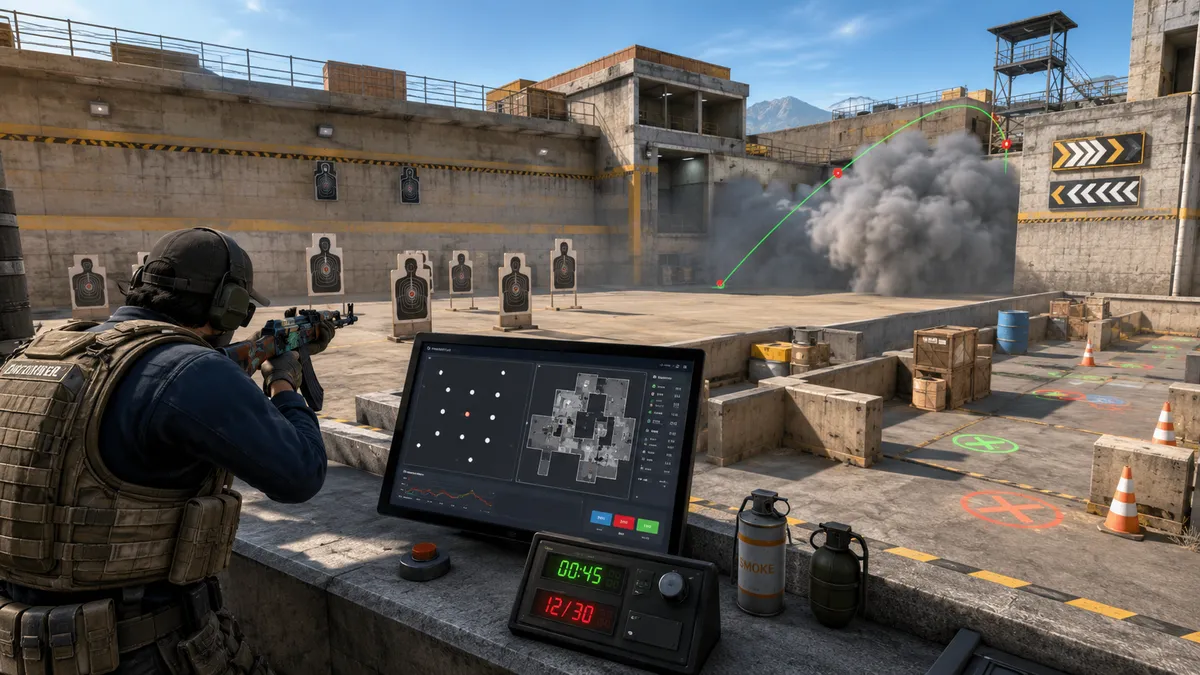
Why Training Maps Matter in CS2
Training maps matter because CS2 rewards precision. A small mistake can decide the round. If your crosshair is too low, you lose the opening duel. If your movement is inaccurate, your first bullet misses. If you do not know recoil, your spray becomes messy. If you do not clear the right angle, a defender gets a free elimination. If you do not know utility, your team enters through a dangerous chokepoint with no support.
Training maps let you isolate these problems. In a real ranked match, too many things happen at once. You have teammates talking, enemies moving, utility flying, economy decisions, rotations, and pressure. It can be hard to know exactly what went wrong. A training map removes some of that chaos so you can practice one skill at a time.
Training maps are also useful because they give repetition. In ranked, you may only take a certain duel once per match. On a prefire map, you can practice that angle many times in a row. In Recoil Master, you can repeat the same spray until your hand understands it better. In Aim Botz, you can take hundreds of simple aim reps quickly. Repetition builds comfort.
However, training maps are not magic. They only work when used correctly. If you shoot bots randomly for 30 minutes with no focus, you may warm up, but you may not improve much. If you use the same map with a clear goal, the value becomes much higher. Good practice means knowing what skill you are training and how it transfers into real matches.
Practice vs Warm-Up: The Difference Matters
Practice and warm-up are different. Many players mix them together, which makes both worse.
Warm-up is preparation:
A warm-up is short and familiar. It gets your aim, movement, and focus ready before you queue. A good warm-up should leave you feeling sharp, not tired.
Practice is improvement:
Practice is where you build new skills. It can be longer, harder, and more specific. You might spend time learning recoil, practicing utility, reviewing demos, or running prefire routes.
Do not learn too much right before ranked:
If you try to learn five new smokes, change sensitivity, practice a new movement habit, and then queue immediately, you may overthink in the match. Learn new things during practice sessions, then use warm-up to activate what you already know.
Do not judge your skill from warm-up:
Missing shots in warm-up does not mean you will play badly. Warm-up is not a test. It is a reset.
Do not replace practice with ranked grinding:
Ranked teaches experience, but practice fixes weaknesses. You need both.
A strong CS2 improvement plan has three parts: warm-up before queue, focused practice outside ranked, and review after matches.
The Best CS2 Training Categories
CS2 training should cover several categories. If you only train aim, you may still lose because of poor utility or bad positioning. If you only learn smokes, you may still lose duels. Balanced training is better.
Aim training:
Improves tapping, micro-adjustments, target switching, first-bullet accuracy, and visual focus.
Recoil training:
Improves control during longer in-game rifle fights, burst discipline, and spray reset timing.
Prefire training:
Improves angle clearing, crosshair placement, common position awareness, and timing.
Movement training:
Improves counter-strafing, stopping accuracy, peeking discipline, and movement confidence.
Utility training:
Improves smokes, flashes, in-game fire utility, HE usage, retakes, executes, and map control.
Deathmatch practice:
Improves live-duel speed, reaction timing, target switching, and confidence under pressure.
Demo review:
Improves decision-making, positioning, rotations, economy awareness, and round understanding.
Analytics tools:
Help identify patterns such as poor trading, weak utility, bad opening deaths, or low impact.
The best players do not train everything equally every day. They identify their current weakness and choose the right tool.
Aim Botz CS2: Best Map for Basic Aim
Aim Botz is one of the most popular aim training maps in Counter-Strike history, and its CS2 version remains one of the easiest ways to warm up and practice basic mechanics. It gives players a controlled environment with bots, weapon access, movement options, and configurable map sections.
Aim Botz is useful because it removes match pressure. You can focus on your crosshair, movement, stopping, and first bullet without worrying about teammates, economy, or rotations. This makes it especially good for beginners and intermediate players.
Best uses for Aim Botz:
Use Aim Botz for head-level aiming, target switching, taps, short bursts, basic movement shots, and warm-up before queue. It is also useful when your hand feels cold and you need simple, controlled reps.
How to practice in Aim Botz:
Start slowly. Aim at head level. Tap cleanly. Move between targets with control. Do not rush every shot. After a few minutes, add speed. Then add movement. Strafe, stop, shoot, reset. This connects aim and movement, which is essential in CS2.
Common Aim Botz mistake:
Many players stand still and shoot hundreds of bots as fast as possible. That may feel good, but it does not fully match ranked duels. Real fights include movement, peeking, stopping, and pressure. Add movement and discipline to make Aim Botz more useful.
Beginner routine:
Use 5 minutes of head-level taps, 5 minutes of movement shots, and 5 minutes of short bursts.
Intermediate routine:
Use 3 minutes of static precision, 5 minutes of counter-strafe shooting, 5 minutes of target switching, and 2 minutes of pistol taps.
Aim Botz is not the only training map you need, but it is one of the best starting points.
Recoil Master CS2: Best Map for Spray Control
Recoil Master is one of the best-known CS2 maps for learning recoil and spray control. It gives players a controlled way to practice in-game recoil patterns with visual guidance such as ghosthair and spray pattern references. It also includes options for different ranges, reset behavior, and common in-game weapons.
Recoil training matters because CS2 fights are not always decided by one tap. Sometimes you need to control a burst. Sometimes you need to finish a close-range duel with a longer spray. Sometimes you miss the first bullet and must recover. If your recoil control is weak, you may lose fights that should be winnable.
Best uses for Recoil Master:
Use it to learn spray patterns, practice burst control, understand reset timing, and build confidence with your main in-game rifles and common buys.
How to practice recoil correctly:
Do not only spray full magazines. Start with 5-bullet bursts. Then practice 10-bullet control. Then practice longer sprays. Real CS2 fights often require controlled bursts, not endless spraying. Learn when to stop shooting and reset.
Practice at different ranges:
A spray that feels good up close may not feel good at medium distance. Practice from more than one range so your control becomes practical.
Do not overtrain recoil before ranked:
Long recoil sessions are useful during practice, but before queueing, keep it short. Too much spraying can tire your hand and make your aim feel heavy.
Common Recoil Master mistake:
Players follow the pattern on the wall but forget to apply it in real fights. After using Recoil Master, spend a few minutes in deathmatch or bot practice to connect recoil control with movement and real target pressure.
Recoil Master is best when used as part of a balanced routine, not as the only thing you practice.
Yprac CS2 Tools: Best for All-Around Practice
Yprac has been known for structured practice tools, and CS2 versions continue the idea of combining aim, movement, utility, prefire, and map learning. Yprac-style practice is useful because it connects mechanics with real map scenarios.
Aim maps are good for raw mechanics, but CS2 is played on maps. You need to know where enemies usually stand, how to clear angles, how to move through routes, and how to use utility. Yprac-style tools are helpful because they make practice feel closer to real match situations.
Best uses for Yprac-style tools:
Use them for prefire routes, map-specific clearing, utility practice, movement drills, reaction speed, and structured training tasks.
Why Yprac helps ranked players:
Ranked mistakes are often map-based. You may have decent aim but still lose because you do not clear Sandbags, Triple, Donut, Connector, Heaven, Cave, Banana, Ramp, or other common positions. Map-specific practice fixes that.
How to use Yprac effectively:
Choose one map. Choose one route. Practice it slowly first. Focus on crosshair placement. Then add speed. Do not rush through the route just to finish it. The goal is clean angle clearing.
Common mistake:
Players run prefire routes like a speedrun and ignore why each angle matters. Slow practice first creates better habits. Speed comes later.
Yprac-style practice is especially good for players who want to improve from “decent aim but bad map awareness” into a smarter ranked player.
Prefire Maps: Best for Angle Clearing
Prefire maps are some of the best tools for improving real match duels. They place bots or targets in common positions on real maps, forcing you to clear angles correctly. This trains crosshair placement, route knowledge, and timing.
Prefire practice is important because many CS2 fights are not fair open duels. Enemies hold common angles. CT anchors play strong positions. T-side players clear chokepoints. If you do not know where to aim before you see the enemy, you will always be late.
Best uses for prefire maps:
Use prefire maps to learn common enemy positions, improve crosshair placement, practice entries, and reduce panic when clearing sites.
How to train prefire:
Start with one map route. For example, practice Mirage A entry, Inferno Banana, Ancient Mid, Anubis B, Nuke outside, or Overpass Bathrooms. Move slowly. Place the crosshair before each angle. Stop before shooting. Clear every position in order.
Why prefire helps solo queue:
Solo queue teammates may not clear everything. If you know the common angles, you become more reliable. You can entry, trade, or support with better awareness.
Common prefire mistake:
Do not memorize bot positions only. Understand the logic. Ask why someone would hold that angle, what teammate could support it, and what utility clears it.
Best routine:
Spend 10–15 minutes on one route per day. Rotate maps through the week. This builds map comfort without overwhelming you.
Prefire maps are one of the fastest ways to make aim feel more useful in real matches.
Utility Practice Maps: Best for Smokes and Flashes
Utility practice is one of the most underrated ways to improve in CS2. Many players spend hours on aim but never learn the smokes and flashes that make fights easier. A player with good utility can create safer entries, delay pushes, support teammates, and win retakes.
Utility maps and databases help players learn practical grenades for real maps. Some Workshop collections include utility maps for Ancient, Anubis, Dust2, Inferno, Mirage, Nuke, and other maps. These can help players practice smokes, flashes, and other in-game utility in a controlled environment.
Best uses for utility maps:
Use them to learn site execute smokes, defensive delay utility, retake utility, pop flashes, and map-control grenades.
Start with useful utility, not every lineup:
You do not need 50 smokes per map. Learn the utility you will actually use. For most players, this means one or two important smokes, one flash, one defensive delay grenade, and one retake tool per map.
Practice utility with timing:
A smoke is not useful only because it lands. It must land at the right time. Practice when to throw it, where your teammates should be, and what the next action is.
Do not learn lineups with no purpose:
Every grenade should answer a question. What space does this help take? What angle does this block? What defender does this move? What retake route does this support?
Common utility mistake:
Players learn a lineup once, then forget it in ranked. Repeat the same practical utility several times across days. Repetition creates confidence.
Utility practice gives immediate ranked value because teammates benefit from it too.
Deathmatch: Best for Live Duel Speed
Deathmatch is useful because it creates frequent fights. You see enemies quickly, react quickly, and practice target switching under pressure. It can be a good warm-up tool and a good aim practice tool, but only if used correctly.
Deathmatch is not ranked. The spawns are chaotic, the fights are constant, and many situations do not match real rounds. If you treat deathmatch like ranked, you may get frustrated. If you treat deathmatch like a mechanics lab, it becomes useful.
Best uses for deathmatch:
Use deathmatch for reaction speed, live aim duels, target switching, first-bullet accuracy, and confidence.
How to deathmatch properly:
Ignore the scoreboard. Focus on clean crosshair placement, stopping before shooting, and controlled first bullets. Do not run around spraying randomly. Do not tilt because someone spawned behind you. Deathmatch is not a real match.
Use focused deathmatch goals:
One session can focus on headshots. Another can focus on counter-strafing. Another can focus on rifle bursts. Another can focus on pistols. One goal per session is better than mindless chaos.
Short deathmatch before queue:
Use 5–10 minutes before ranked if it helps you feel sharp. Stop before you get tired or annoyed.
Longer deathmatch for practice:
Use 15–30 minutes during dedicated practice sessions if you can stay focused.
Deathmatch helps most when it is connected to real CS2 habits, not ego.
Community FFA Servers vs Official Deathmatch
Players often ask whether official deathmatch or community FFA-style servers are better. Both can help, but they feel different.
Official deathmatch:
Official deathmatch is easy to access from inside CS2. It is convenient and good enough for many players. It can be useful for warm-up, especially if you only need a few minutes before queueing.
Community FFA-style practice:
Community servers often create faster fights and more constant duels. They can be useful for intense practice, but the pace may also create bad habits if you forget ranked discipline.
Which one should you use?
Use official deathmatch if you want simple access and a lighter warm-up. Use community-style practice if you want more fights and can stay disciplined.
Important rule:
Do not let any deathmatch mode make you impatient. Ranked is slower, more tactical, and more utility-based. Deathmatch should sharpen mechanics, not turn you into a reckless player.
Movement Training: Best for Counter-Strafing and Peeking
Movement is one of the most important parts of CS2. You can have strong aim, but if you shoot before stopping, your bullets will feel inconsistent. Movement training helps you connect your aim with accurate shooting.
Best movement skills to practice:
Counter-strafing, stopping before shooting, shoulder peeking, jiggle peeking, wide swinging with purpose, jump-spotting in safe situations, and clean repositioning.
How to practice movement:
Use a bot map or empty map. Strafe left, stop, shoot. Strafe right, stop, shoot. Repeat until the timing feels natural. Then practice peeking from cover. Move out, stop, shoot, move back.
Do not overcomplicate movement training:
Beginners should focus on stopping accuracy. Intermediate players should add peek variety. Advanced players can practice map-specific movement routes and timing.
Common movement mistake:
Many players warm up aim while standing still, then lose ranked duels while moving. Always include movement in practice.
Why movement helps aim:
Good movement makes shots easier. If you stop cleanly and place your crosshair correctly, you need fewer difficult flicks.
Movement training may not look exciting, but it improves every duel.
Retake Practice: Best for Late-Round Impact
Retakes decide many ranked matches. CTs often lose not because they cannot aim, but because they retake one by one, use no utility, clear angles badly, or ignore the bomb timer.
Retake practice can be done on specific maps, in community servers, or through structured practice tools. The goal is to learn how to enter sites with teammates, clear common post-plant positions, use late utility, and protect the defuser.
Best uses for retake practice:
Use it to improve site clearing, timing, post-plant reads, utility usage, and clutch decision-making.
How to practice retakes:
Choose one site. Learn the common post-plant positions. Practice entering from different routes. Use flashes and smokes before crossing. Clear close angles first. Understand where the bomb is planted and what positions the attackers may hold.
Common retake mistake:
Players rush in alone because they feel time pressure. A calm two-player retake is usually better than three separate solo swings.
Retake rule:
Group first, use utility, clear in order, protect the defuser.
Retake practice makes you valuable even when your team loses the site.
Demo Review: Best Tool for Decision-Making
Demo review is one of the best tools for improving decision-making. Aim maps can show how you shoot, but demos show why you lost. Did you rotate too early? Did you die with utility? Did you ignore economy? Did you leave a teammate untraded? Did you over-peek after getting information? Demos reveal patterns.
Best uses for demo review:
Use demo review to study positioning, rotations, utility usage, opening deaths, trading, economy decisions, and post-plant mistakes.
How to review your own demo:
Do not watch the whole match randomly. Pick a focus. For example, review only your deaths. Ask whether each death was useful, tradeable, or avoidable. Then review your utility. Did your grenades help? Did you die with useful utility unused? Then review your rotations. Did you move based on information or fear?
Review losses and wins:
Losses show problems, but wins also contain mistakes. Reviewing wins prevents bad habits from hiding behind good results.
Keep notes short:
Write one or two repeated mistakes. Do not create a huge list you will never use. The next practice session should fix one main issue.
Common demo review mistake:
Do not review only to blame teammates. Watch your own choices first. You cannot control every teammate, but you can control your habits.
Demo review turns ranked into learning instead of only rating movement.
Analytics Tools: Best for Finding Weaknesses
Analytics tools can help players understand patterns that are hard to see during matches. They may track performance, utility, trading, openings, crosshair placement, and other useful data. Tools such as Leetify-style analysis are valuable because they give players feedback beyond the scoreboard.
The scoreboard is limited. It shows eliminations, deaths, assists, and damage, but it does not fully explain impact. You might have many low-impact eliminations and still lose important rounds. You might have fewer eliminations but strong trading and utility impact.
Best uses for analytics tools:
Use them to identify repeated weaknesses. Are you dying first too often? Are your trades weak? Is your utility underused? Are your opening duels poor? Are your retakes ineffective? Data can point you toward the right training tool.
Do not obsess over every number:
Analytics should guide practice, not create stress. If one number is bad for one match, it may not mean much. If the same problem appears across many matches, it matters.
Connect data to practice:
If analytics show poor crosshair placement, use prefire maps and Aim Botz. If they show poor utility, use utility maps. If they show bad opening deaths, review demos and practice safer peeking.
Analytics tools are most useful when they lead to action.
External Aim Trainers: Aimlabs and KovaaK’s
External aim trainers can help with raw mouse control, tracking, flicking, micro-corrections, and consistency. Aimlabs and KovaaK’s are two well-known options. They can be useful, but they should not replace CS2-specific practice.
CS2 has unique movement, recoil, utility, angles, timing, and map structure. An external aim trainer may improve general mouse control, but it cannot fully teach CS2 peeking, recoil, economy, utility, or map reads. That is why external aim trainers are best used as a supplement.
Best uses for external aim trainers:
Use them for micro-adjustments, flick control, reaction training, tracking basics, and consistent mouse control.
How to use them for CS2:
Keep sessions focused. Choose tasks that match CS2 needs: small target precision, micro-corrections, click timing, and strafing-style targets. Avoid spending all your time on scenarios that do not resemble CS2 fights.
Do not overtrain outside the game:
If you spend an hour in an external trainer but never practice CS2 movement or recoil, the transfer may be limited.
Best balance:
Use external aim training for raw mechanics, then use CS2 maps and deathmatch to transfer those mechanics into real game situations.
External trainers can help, but CS2 improvement still needs in-game practice.
Refrag and Premium Practice Tools
Some players use premium tools such as Refrag for more structured CS2 practice. These tools can include modes for aim duels, prefire, crossfire-style practice, routines, utility, and strategy training. They are not required to improve, but they can be useful for players who want more organized practice.
Best uses for premium tools:
Use them for realistic aim duels, map-based scenarios, structured routines, utility repetition, and high-quality training environments.
Who benefits most:
Intermediate and advanced players often benefit more because they already understand the basics and need more realistic practice. Beginners can still improve with free Workshop maps first.
Do you need paid tools to improve?
No. You can improve with free maps, deathmatch, demo review, and consistent routines. Paid tools may make practice easier to structure, but discipline matters more than the tool.
Best mindset:
A tool is only valuable if you use it consistently and connect it to match weaknesses.
BoostRoom-style structured improvement works with free or paid tools. The important part is knowing what to train and why.
Best Tools for Beginners
Beginners should not overwhelm themselves with too many maps and tools. The goal is to build fundamentals first.
Aim Botz:
Use it for head-level aim, slow target switching, taps, and short bursts.
Recoil Master:
Use it to understand basic recoil and spray reset timing.
Official deathmatch:
Use it for live aim experience, but do not care about score.
One utility map or offline practice:
Learn a few simple smokes and flashes for your favorite maps.
Demo review basics:
Watch your deaths and ask whether they were avoidable.
A beginner does not need advanced analytics, 100 utility lineups, or long practice sessions. The best beginner routine is simple: aim, movement, recoil, deathmatch, and one map skill.
Best Tools for Intermediate Players
Intermediate players usually have basic aim but lose because of inconsistency, poor map control, weak utility, and bad decisions.
Prefire maps:
Use them to improve angle clearing and map-specific crosshair placement.
Utility trainers:
Learn practical smokes, flashes, and retake grenades.
Deathmatch with focus:
Train first-bullet accuracy, counter-strafing, and target switching.
Demo review:
Study opening deaths, rotations, and post-plant mistakes.
Analytics tools:
Find repeated weaknesses and choose practice accordingly.
Intermediate players should build practice around ranked mistakes. If you keep losing A site entries, practice that route. If you keep losing retakes, practice retakes. If you keep dying first, review those deaths.
Best Tools for Advanced Players
Advanced players need sharper, more specific practice. General aim training is still useful, but the biggest gains often come from details.
Map-specific prefire:
Practice important routes on maps you play in Premier or team matches.
Advanced utility practice:
Learn timing, not just lineups. Practice how utility connects to executes, defaults, and retakes.
Structured deathmatch:
Use it for precise goals: pistol duels, entry speed, rifle bursts, or movement shots.
Demo review with round themes:
Study mid-round decisions, utility trading, rotations, and economy conversion rounds.
Team drills:
Practice site executes, retakes, flashes, and trading with friends or teammates.
Analytics review:
Track whether weaknesses are improving over multiple matches.
Advanced players should avoid random grinding. Their practice should be intentional and measurable.
Best Daily CS2 Practice Routine
A daily practice routine should be realistic. If it is too long, you will skip it. A good daily routine can take 30–45 minutes.
5 minutes: Warm-up aim
Use Aim Botz or a similar map. Focus on head-level taps and target switching.
5 minutes: Movement shots
Practice counter-strafing, stopping, and shooting accurately.
5 minutes: Recoil control
Use Recoil Master. Practice short bursts, 10-bullet control, and reset timing.
10 minutes: Prefire or map route
Choose one route on one map. Practice clean angle clearing.
10 minutes: Deathmatch
Focus on real match habits: crosshair placement, stopping before shooting, and controlled first bullets.
5 minutes: Utility or demo note
Refresh one grenade or review one repeated mistake from a recent match.
This routine is simple enough to repeat and strong enough to improve multiple skills.
Best Weekly CS2 Practice Plan
A weekly plan helps you avoid training the same thing every day while ignoring other weaknesses.
Day 1: Aim and movement
Aim Botz, counter-strafing, and deathmatch.
Day 2: Recoil and spray discipline
Recoil Master, burst practice, and rifle deathmatch.
Day 3: Prefire map practice
One or two routes on maps you play often.
Day 4: Utility practice
Learn or refresh smokes, flashes, and retake utility.
Day 5: Demo review and decision-making
Watch your deaths, rotations, and post-plant rounds.
Day 6: Ranked application
Play ranked with one focus goal from the week.
Day 7: Light warm-up and rest
Do a short routine or take a break. Improvement also needs recovery.
A weekly plan helps because CS2 skill has many parts. You cannot train everything perfectly in one day.
How to Practice Aim the Right Way
Aim practice should train useful match skills. Do not only flick wildly. CS2 aim includes crosshair placement, micro-corrections, stopping accuracy, burst control, and calm first bullets.
Start slow:
Build precision before speed.
Keep crosshair at head level:
This reduces the distance your aim needs to travel.
Add movement:
Standstill aim is not enough. Practice stopping and shooting.
Use taps and bursts:
Not every fight should become a long spray.
Train target switching:
CS2 often has multi-player fights. Switching targets cleanly matters.
End with live pressure:
Use deathmatch or fast bot routines to transfer aim into more realistic situations.
Aim practice is best when it creates cleaner first bullets in real matches.
How to Practice Recoil the Right Way
Recoil practice should build control and discipline. The goal is not to spray every fight. The goal is to know when you can spray and when you should reset.
Start with short bursts:
Practice 3–5 bullets first.
Practice 10-bullet control:
Many real fights are decided before a full magazine is used.
Practice longer sprays sometimes:
Long sprays are useful in close fights and multi-player situations.
Practice reset timing:
Know when to stop shooting and let accuracy recover.
Use real targets after wall practice:
Recoil on a wall is helpful, but you also need to spray at moving or placed targets.
Do not overdo it:
Too much recoil practice before ranked can make your hand tired.
Recoil training should make you calmer, not more spray-happy.
How to Practice Utility the Right Way
Utility practice is not only memorizing lineups. It is understanding purpose and timing.
Learn utility for your actual maps:
Do not learn random lineups for maps you rarely play. Start with your Premier or Competitive map pool.
Learn one execute smoke per site:
This helps your team enter sites with less risk.
Learn one defensive smoke or delay grenade:
This helps CT holds and slows rushes.
Learn one flash for teammates:
Support flashes win ranked rounds.
Learn one retake tool:
Retakes happen constantly, especially in solo queue.
Practice the follow-up:
After throwing utility, know what you do next. Move, flash, clear, plant, retake, or hold. A grenade without follow-up is incomplete.
Utility practice gives some of the fastest ranked improvement because it helps the whole team.
How to Practice Map Knowledge
Map knowledge is more than callouts. It means knowing where fights happen, where rotations go, where utility lands, and which areas matter.
Use prefire maps:
Learn common angles and clear routes.
Walk through maps offline:
Look at choke points, bombsites, rotation routes, and post-plant positions.
Learn callouts:
Good callouts make solo queue easier.
Study defaults:
Know basic T and CT setups for each map.
Practice retakes:
Understand where enemies hold after planting.
Review pro or high-level play carefully:
Do not copy everything blindly. Look for why players take certain space.
Map knowledge makes ranked feel less random.
How to Practice Movement
Movement training should focus on accuracy and control. The most important movement skill for most players is stopping before shooting.
Counter-strafe practice:
Move left, stop, shoot. Move right, stop, shoot. Repeat until it feels natural.
Peek practice:
Move from behind cover, stop, shoot, return.
Shoulder peek practice:
Use small peeks to gather information without fully committing.
Wide swing practice:
Learn when to swing wider to punish a close angle, but do not overuse it.
Movement with crosshair placement:
Do not let your crosshair drop while moving.
Movement practice makes aim more reliable because you shoot from accurate positions.
How to Practice Decision-Making
Decision-making is harder to practice than aim, but it is just as important.
Review your deaths:
Ask whether each death helped the round or gave the enemy an advantage.
Review rotations:
Did you rotate because of confirmed information or because you panicked?
Review utility usage:
Did you die with useful grenades? Did your utility help teammates?
Review economy decisions:
Did your team buy together? Did you force when saving was better?
Review post-plants:
Did you hold the bomb properly or chase unnecessary fights?
Decision-making improves when you connect mistakes to future rules. For example: “I will not rotate from B until bomb or multiple enemies are confirmed.” One rule can fix many rounds.
How BoostRoom Helps With CS2 Practice
BoostRoom helps CS2 players improve by making training more focused. Many players already spend time in the game, but they do not always know what to do with that time. BoostRoom helps turn practice into progress.
BoostRoom helps identify priorities:
Some players need aim. Others need utility. Others need map knowledge, economy, or mental discipline. BoostRoom helps players focus on what matters most.
BoostRoom helps build routines:
A consistent routine is easier to follow than random training. Aim, recoil, prefire, utility, deathmatch, and demo review all fit into a structured improvement plan.
BoostRoom helps connect practice to ranked:
The point of training is not only better scores on practice maps. The point is winning more CS2 rounds. BoostRoom helps players translate training into ranked impact.
BoostRoom helps reduce wasted time:
Instead of grinding without direction, players can practice the habits that create real improvement.
BoostRoom supports long-term progress:
CS2 improvement takes consistency. BoostRoom helps players stay organized, confident, and focused on the skills that matter.
Common CS2 Training Mistakes
Mistake 1: Only practicing aim
Aim matters, but CS2 also requires movement, utility, map knowledge, economy, communication, and decisions.
Mistake 2: Practicing too long before ranked
A long session can make you tired. Warm up before queue, practice separately.
Mistake 3: Ignoring movement
Many missed shots come from bad stopping timing, not bad aim.
Mistake 4: Learning too many lineups at once
A few useful grenades are better than many forgotten ones.
Mistake 5: Deathmatching with no focus
Deathmatch should train specific habits, not just scoreboard chasing.
Mistake 6: Never reviewing demos
If you never watch your mistakes, you may repeat them for months.
Mistake 7: Copying advanced routines too early
Beginners need fundamentals before advanced practice.
Mistake 8: Changing settings too often
Constant sensitivity and crosshair changes slow consistency.
Mistake 9: Not connecting training to matches
Every drill should help a real ranked situation.
Mistake 10: Quitting after a bad practice day
Some days feel worse. Consistency matters more than one session.
Practical Rules for CS2 Training
Rule 1: Practice one weakness at a time.
Focused improvement beats random grinding.
Rule 2: Use Aim Botz for controlled aim.
Head-level precision and movement shots are the priority.
Rule 3: Use Recoil Master for recoil confidence.
Practice bursts, sprays, and reset timing.
Rule 4: Use prefire maps for real angle clearing.
Map-based aim transfers better into ranked.
Rule 5: Use utility maps for practical grenades.
Learn smokes and flashes you will actually use.
Rule 6: Use deathmatch for live pressure.
Ignore score and focus on match habits.
Rule 7: Review demos for decision-making.
Your deaths usually reveal your biggest problems.
Rule 8: Use analytics to spot patterns.
Data is useful when it leads to better practice.
Rule 9: Keep routines realistic.
A routine you follow consistently is better than a perfect routine you skip.
Rule 10: Train for ranked impact.
Practice should help you win rounds, not only feel good in training maps.
FAQ
What are the best CS2 training maps?
The best CS2 training maps depend on your goal. Aim Botz is great for basic aim, Recoil Master is great for spray control, Yprac-style tools are useful for structured practice, prefire maps help angle clearing, and utility maps help smokes and flashes.
Is Aim Botz good for CS2 practice?
Yes. Aim Botz is one of the best maps for controlled aim practice, warm-up, target switching, head-level shots, movement shots, and basic mechanics.
Is Recoil Master useful in CS2?
Yes. Recoil Master is useful for learning in-game recoil patterns, practicing bursts, testing longer sprays, and understanding reset timing.
What is the best way to practice utility in CS2?
Start with practical utility for maps you actually play. Learn one or two execute smokes, one support flash, one defensive delay grenade, and one retake tool per map.
Should I use deathmatch to improve in CS2?
Yes, deathmatch can help with live duel speed and confidence. Use it with focus. Ignore the scoreboard and practice crosshair placement, stopping before shooting, and controlled first bullets.
Are external aim trainers useful for CS2?
External aim trainers can help raw mouse control, micro-corrections, and flicking. They should supplement CS2 practice, not replace in-game training maps, recoil practice, utility, and map work.
How long should I practice CS2 each day?
A realistic daily practice session can be 30–45 minutes. Include aim, movement, recoil, prefire or utility, and a short deathmatch or demo review focus.
What should beginners practice first in CS2?
Beginners should practice crosshair placement, movement stopping, basic recoil, simple utility, and common map callouts. Aim Botz, Recoil Master, and short deathmatch sessions are good starting tools.
How do I know what to practice in CS2?
Review your matches and look for repeated mistakes. If you die first too much, practice safer peeking and demo review. If your aim is inconsistent, practice aim and movement. If your site takes fail, practice utility and prefire routes.
Can BoostRoom help me practice CS2 better?
Yes. BoostRoom can help CS2 players build structured practice routines, improve aim, utility, map knowledge, recoil control, decision-making, and ranked consistency.



