Common Dota 2 Mistakes That Keep Players Stuck in Low MMR
Many Dota 2 players feel stuck in low MMR for months or even years. They win a few games, lose a few games, change heroes, blame teammates, follow new builds, watch high-level players, and still end up in the same bracket. This can be frustrating, but it is also fixable. Most low MMR problems come from repeated habits, not one unlucky teammate or one bad draft.
Dota 2 is a deep and constantly evolving game, with many heroes, roles, item choices, lane matchups, and strategies. Valve describes Dota as a game where there is always a new strategy or tactic to discover, which is exactly why players can get stuck when they learn only small pieces of the game instead of building consistent fundamentals.
Low MMR does not mean a player is hopeless. It usually means the player is inconsistent. One game they farm well, the next game they fight too early. One game they ward properly, the next game they walk into darkness. One game they buy the right item, the next game they copy a build that does not fit the match. Climbing MMR is about removing these repeated mistakes one by one.
Valve’s ranked system uses Rank and Rank Confidence as part of how it estimates player skill, so long-term improvement matters more than one lucky win streak. If you want to climb, the goal is not to play perfectly. The goal is to become more reliable than other players in your bracket. If you make fewer obvious mistakes, die less, farm better, communicate calmly, and take objectives more consistently, you will naturally give your team more chances to win.
This guide explains the most common Dota 2 mistakes that keep players stuck in low MMR and how to fix them with practical ranked habits.
Mistake 1: Blaming Teammates Instead of Finding Patterns
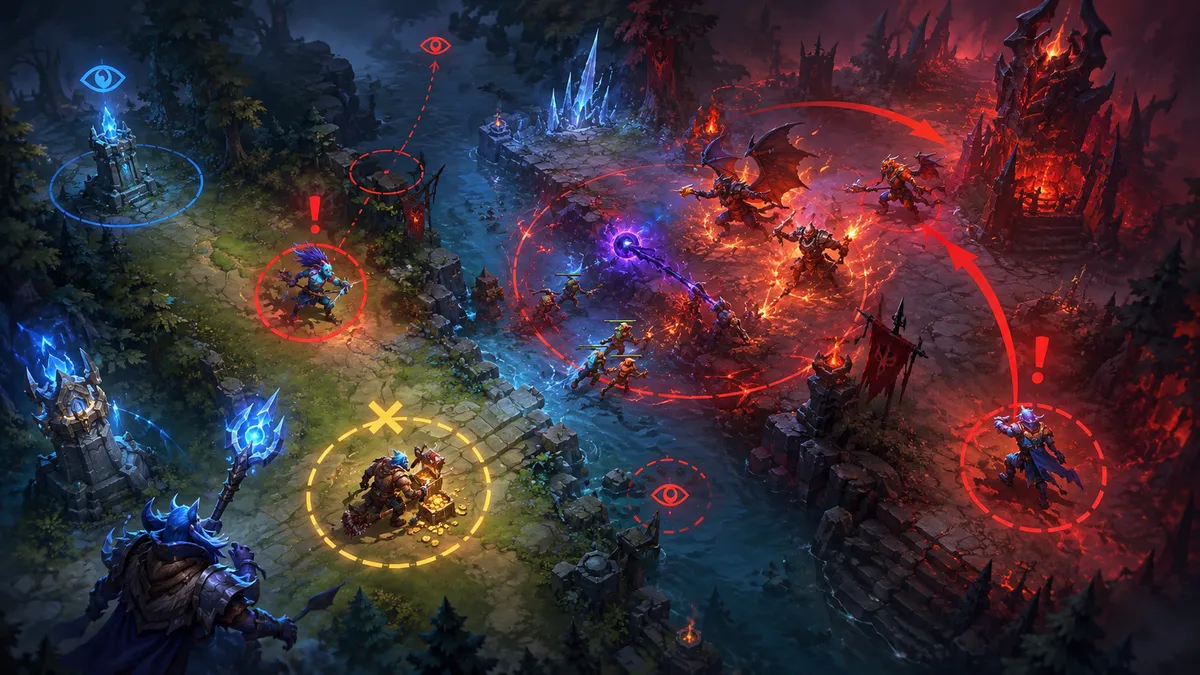
The most common low MMR mistake is blaming teammates after every loss. Teammates do make mistakes. Supports miss spells. Carries farm badly. Offlaners feed. Mids lose lane. But if you only focus on teammates, you miss the only thing you can control: your own repeated decisions.
Every player has patterns. Maybe you die too often before your first big item. Maybe you ignore the minimap while farming. Maybe you fight without Black King Bar. Maybe you pick heroes you do not understand. Maybe you win lane but never take objectives. Maybe you flame teammates and lose focus. These patterns matter more than one bad ally.
A useful mindset is to ask one question after every loss: “What mistake did I repeat that I can fix next game?” This keeps your improvement focused. You do not need to solve every problem at once. Fix one habit, then the next.
Low MMR players often think climbing requires carrying every game. That is not true. Climbing usually requires making fewer game-losing mistakes than the enemy. If you are consistently safer, calmer, and more objective-focused than other players at your rank, your win rate improves over time.
BoostRoom coaching can help players see these patterns clearly. Many mistakes are hard to notice during the match, but replay review can show whether your deaths, item choices, farming routes, or teamfight positions are the real reason you stay stuck.
Mistake 2: Playing Too Many Heroes
Many players stay in low MMR because they play too many heroes. One day they play carry, the next day mid, then offlane, then support, then a hero they saw in a video. This makes every game feel new, but it slows improvement.
Dota 2 has many heroes and roles, and Valve’s own Dota Plus page highlights that players can compare hero performance metrics like kills, deaths, GPM, and XPM against other skill brackets, which shows how measurable hero performance can be. If you constantly change heroes, it becomes harder to understand what you are actually improving.
A small hero pool is much better for ranked climbing. Pick three to five heroes for your main role. Learn their lanes, item timings, counters, farming patterns, teamfight jobs, and power spikes. When you repeat heroes, you stop wasting energy on basic mechanics and start learning real Dota decisions.
For carry, this might mean Wraith King, Juggernaut, Luna, Lifestealer, and Drow Ranger. For mid, it might mean Dragon Knight, Queen of Pain, Zeus, Lina, and Viper. For offlane, it might mean Centaur Warrunner, Axe, Tidehunter, Underlord, and Legion Commander. For support, it might mean Lich, Jakiro, Lion, Shadow Shaman, Crystal Maiden, Treant Protector, or Clockwerk.
The exact heroes matter less than consistency. A simple hero played well is better than a complicated hero played badly. Low MMR players often lose because they pick heroes they do not understand, then blame the draft. Do not make ranked games your testing ground for random picks.
Mistake 3: Weak Last Hitting and Poor CS
Poor last hitting is one of the biggest reasons players stay stuck in low MMR. Gold matters in Dota 2, and lane creeps are one of the most important early resources. Lane creeps give experience to nearby enemies when killed and gold to the hero who lands the last hit, while denied creeps reduce the enemy’s experience gain.
Many low MMR cores miss free creeps in lane, then wonder why their item timings are late. Missing ten creeps in the first ten minutes can delay Boots, Bottle, Magic Wand, Falcon Blade, Maelstrom, Battle Fury, Blink Dagger, or Black King Bar. That delay affects the whole game.
Last hitting is not only a carry skill. Mid players need last hits and denies to control the lane. Offlaners need last hits to reach key items. Supports need to understand last hitting so they do not ruin their core’s CS or lane equilibrium.
To fix this, track your CS at 10 minutes. Do not compare every game to professional players. Compare yourself to your own average. If you usually get 35 last hits at 10 minutes, aim for 45. Then 55. Then 65 in free lanes. Improvement does not need to be instant; it needs to be consistent.
Practice your main heroes. Every hero has different attack damage, animation, and projectile speed. If you keep switching heroes, your last hitting stays inconsistent. If you practice the same heroes, your timing becomes automatic.
Mistake 4: Ignoring Denies and Lane Control
Many low MMR players focus only on last hits and ignore denies, creep aggro, pulls, and lane equilibrium. This makes their lanes harder than they need to be.
Denying does not give the same reward structure as last hitting, but it reduces enemy value. Liquipedia notes that denying allied non-player-controlled lane creeps gives enemies 50% of their experience bounty instead of 100%. That means denying can slow enemy level timings and help control the wave.
Lane control is just as important. If you auto-attack every creep, the wave pushes forward and becomes dangerous. If you never deny, the enemy may get easier experience. If you do not use creep aggro, you may take unnecessary harassment for simple last hits. If you ignore pulls, the enemy support may reset the lane again and again.
Good lane control means understanding where the wave should be. Safe lane carries often want the wave close to their tower but not directly under it. Offlaners may want to drag or aggro creeps to survive. Mid players often use aggro to secure ranged creeps and control rune timing. Supports should pull when the lane is too far forward and avoid randomly hitting creeps.
Low MMR players often think losing lane is only about hero matchups. Sometimes it is. But often, the real reason is poor wave control.
Mistake 5: Farming Jungle While Lane Creeps Die
A very common low MMR mistake is farming jungle while lane creeps die for free. Jungle camps are useful, but lane creeps create pressure and usually matter more for map control.
If you farm only jungle, the enemy can push lanes into your towers. Your team loses map space. Your supports cannot ward safely. Your towers take damage. Your team has less information. Meanwhile, the enemy sees that nobody is pushing waves and can move freely.
Good farming usually connects lane waves and jungle camps. Push the lane when it is safe, then farm nearby camps while the next wave arrives. This creates gold, experience, and pressure. If enemies respond to the wave, you gain information. If they ignore it, their tower takes damage.
Carries should not disappear into jungle forever unless the lane is truly impossible. Mid heroes should push mid wave before rotating or farming nearby camps. Offlaners should take dangerous waves that carries cannot safely farm. Supports should collect empty waves only when no core can take them.
Low MMR players often ask how to increase GPM. One of the fastest answers is simple: stop ignoring lane waves.
Mistake 6: Dying for One More Wave
Greed kills many low MMR games. A player sees one more creep wave, walks too far forward, ignores missing enemies, and dies. That death may delay an item, give the enemy a tower, open Roshan, or lose the game.
The problem is not taking farm. The problem is taking farm without reading the map. Before showing on a dangerous wave, ask: where are the enemy heroes? Do I have vision? Can they kill me? Are teammates nearby? Do I have TP, BKB, Manta, Blink, or another escape? Is this wave worth dying for?
A carry death is especially expensive. If the carry dies before a key item, the team loses timing. If the carry dies late without buyback, the game may end. But supports and offlaners also throw games by dying alone while warding, pushing, or farming unsafe areas.
Good players still take dangerous farm, but they do it with purpose. Offlaners may push risky waves to create space. Mobile heroes may shove lanes and escape. Supports may clear waves from range. The difference is that good players understand the risk.
Low MMR players often die first and then say, “I was creating space.” Real space creation gives your team something useful. Random deaths do not create space; they create pressure for the enemy.
Mistake 7: Fighting Without Item Timings
Many low MMR games are filled with random fights. Players fight because they see enemies, because someone pinged, or because they are bored. They do not check items, cooldowns, lane pressure, or objectives.
This is a huge mistake. Dota 2 is built around timings. A carry with Black King Bar is different from a carry 800 gold away from Black King Bar. An offlaner with Blink Dagger is different from an offlaner still farming it. A support with Glimmer Cape or Force Staff is different from a support with only Boots. A mid hero with ultimate ready is different from a mid hero without it.
Before fighting, ask: what are we fighting for? Do we have our key spells? Do we have our key items? Can we take a tower or Roshan after? Is our carry ready? Are lanes pushed? Do we have vision?
If your team is 300 gold away from a major item, waiting one wave can be better than forcing a bad fight. If your team just completed two big items, that is the time to smoke, push, or take Roshan.
Low MMR players often fight constantly and then complain that they cannot farm. In reality, they are choosing low-value fights instead of using farm to hit stronger timings.
Mistake 8: Farming Forever After Hitting a Timing
The opposite mistake is farming forever after becoming strong. Some players finally finish BKB, Blink, Orchid, Desolator, Maelstrom, Aghanim’s Scepter, or another key item, then continue farming jungle for five more minutes while the enemy recovers.
Items are not trophies. Items are tools. If your item lets you fight, use it. If your item lets you take Roshan, call Roshan. If your item lets you pressure towers, group with your team. If your item lets you survive disables, stop hiding from every fight.
Many low MMR carries lose because they farm well but never convert their farm into objectives. A rich carry who avoids every fight can still lose if the enemy takes towers, Roshan, and map control. A mid hero with a strong timing who never rotates is wasting the advantage. An offlaner who buys Blink and keeps farming jungle is delaying the team’s playmaking.
Good Dota is a cycle: farm, hit timing, pressure, take objective, reset, farm again. Bad Dota is either fighting with no timing or farming with no purpose.
Mistake 9: No Objective Focus After Kills
Low MMR players often chase kills instead of taking objectives. They win a fight, then chase one support into the jungle while towers, Roshan, and lanes are ignored. This is one of the biggest reasons games become unnecessarily long.
Kills are temporary. Objectives are permanent. A tower changes the map. Roshan changes the next fight. Barracks change lane pressure. Enemy jungle vision changes where enemies can farm. If you get kills but take nothing afterward, the enemy respawns and the game resets.
After every won fight, ask what the team can take. Can you take a tower? Can you take Roshan? Can you ward enemy jungle? Can you push lanes? Can you force buyback? Can you take Tormentor or another map objective? Can you steal enemy camps?
Not every fight leads to a huge objective, but every fight should lead to something. Even placing vision or pushing waves is better than doing nothing.
Low MMR players often think they need more kills to win. What they usually need is better conversion.
Mistake 10: Poor Map Awareness
Map awareness is one of the biggest differences between stuck players and climbing players. Many low MMR players stare at their hero and ignore the minimap. They do not notice missing enemies, lane pressure, warded areas, or teammates’ positions.
Good map awareness does not mean knowing everything. It means checking the minimap often enough to avoid obvious danger and recognize opportunities. If four enemies show top, maybe bottom is safe to push. If all enemies disappear, maybe your team should back. If your support places a ward, farm near it. If your ward expires, stop farming like it is still there.
Map awareness also helps you communicate. If enemy mid is missing, warn side lanes. If enemy supports move toward Roshan, ping it. If your carry is farming without vision, ask for defensive wards or tell them to back.
Low MMR players often die and say, “How was I supposed to know?” The answer is usually that enemies were missing, the area had no vision, and the player ignored the map.
Build the habit of glancing at the minimap every few seconds. This one habit can save hundreds of deaths over time.
Mistake 11: Bad Warding and No Detection
Vision wins games, especially in low MMR where players often walk into unsafe areas. But many players either do not ward, ward randomly, or ignore enemy vision.
Supports usually place most wards, but vision is a team responsibility. Cores must understand where they can safely farm. Offlaners should help supports ward aggressive areas. Mids should ask for rune or river vision when needed. Carries should not farm outside vision and blame supports after dying.
Bad warding means placing wards in areas the team does not use. Good warding means placing wards for the next move. If your carry wants to farm triangle, ward triangle entrances. If your team wants Roshan, ward Roshan approaches and remove enemy vision. If your team is behind, ward defensively. If your team is ahead, ward deeper with teammates nearby.
Detection is also critical. If enemies have invisible heroes or Glimmer Cape-style saves and your team has no Sentries, Dust, or reveal, fights become much harder. Low MMR players often complain about invisible heroes but still refuse to buy detection. Do not lose games to a problem that costs little gold to solve.
Mistake 12: Bad Itemization
Item mistakes keep many players stuck in low MMR. They copy the same build every game, buy damage when they need survivability, skip detection, delay BKB too long, or buy greedy items when the team needs utility.
Items in Dota 2 provide attributes and active or passive effects, and many items combine into stronger items through recipes or components. This means itemization is not only about increasing damage. It is about solving the match.
Ask what is stopping you from doing your job. Are you dying to magic burst? You may need BKB, magic resistance, or positioning help. Are you getting silenced or rooted? You may need a dispel. Are enemies escaping? You may need catch. Are you unable to hit because of evasion? You may need accuracy. Are your teammates dying before fights start? Maybe a support save item matters more than more damage.
Low MMR carries often buy too many damage items and die before attacking. Low MMR supports often rush greedy items while the team needs Force Staff, Glimmer Cape, Sentries, or Smoke. Low MMR offlaners often buy carry items when the team needs initiation or auras. Low MMR mids often ignore defensive items and throw away early leads.
A correct item at the right time can win a game. A greedy item at the wrong time can lose it.
Mistake 13: Bad Teamfight Positioning
Teamfights decide many ranked games, and positioning decides many teamfights. Low MMR players often stand too far forward, group too closely, chase too deep, or enter fights at the wrong time.
Carries should usually deal damage from the safest possible position. They do not always need to jump the enemy carry. Often, hitting the closest safe target is better than walking past three enemies and dying. Mids should know whether they are a burst hero, control hero, scaling damage hero, or backline jumper. Offlaners should initiate only when teammates can follow. Supports should stay alive long enough to use spells and items.
A common mistake is supports dying first. If a support dies before casting disables, saves, wards, or items, the team loses huge value. Another mistake is carries entering before enemy disables are used. Another mistake is offlaners jumping alone and blaming teammates for not following.
Before a fight, ask: where should I stand? Who can kill me? What spell must I avoid? What is my job? Which target matters? Do we have vision? Can this fight lead to an objective?
Better teamfighting does not require perfect mechanics. It requires better patience and positioning.
Mistake 14: Using Spells Too Quickly or on the Wrong Target
Low MMR players often press spells as soon as they see an enemy. This feels active, but it can be wasteful. A stun used on a tanky offlaner may leave your team helpless against the enemy carry. A save used too early may not protect the real target. A big ultimate used on one support may make the next fight impossible.
Spell usage should have purpose. Are you starting the fight? Saving an ally? Stopping a channel? Forcing BKB? Killing a support? Controlling the carry? Protecting your backline? If you do not know why you are casting, you may be wasting the spell.
Cooldowns matter. If your team uses all major spells for one small kill, the enemy may fight back while your spells are down. If the enemy uses big spells and gets nothing, your team may have a window to fight.
Low MMR players often lose fights because they use spells quickly instead of correctly. Strong players are patient. They wait for the right target and the right moment.
Mistake 15: Ignoring Roshan
Roshan is one of the most important objectives in Dota 2, but many low MMR teams ignore it. They win a fight and farm jungle instead. They let the enemy take Roshan for free. They start Roshan without vision. They fight near Roshan with lanes pushed into their own base.
Roshan gives a major advantage because it helps teams fight, siege, and control the map. Aegis can allow a carry or mid to play aggressively. Roshan control also forces enemies to respond, creating fights on your terms.
The mistake is not only ignoring Roshan. It is failing to prepare Roshan. Your team needs lanes pushed, vision around approaches, Sentries to remove enemy wards, and enough health and damage to take it safely. Supports should ward. Cores should push lanes. Offlaners should stand ready to zone enemies. Mids should watch for enemy movement. Carries should know whether they can hit Roshan safely.
After winning a fight, ask “Can we Rosh?” This simple question wins many games.
Mistake 16: Throwing High Ground
Many low MMR teams throw games by forcing high ground too early. They win a fight, feel strong, walk uphill with no vision, dive behind towers, and die to buybacks. The game suddenly becomes hard again.
High ground is dangerous because the defending team has vision advantage, tower protection, buyback access, and easier spell setup. If your team does not have Aegis, strong lane pressure, or a clear advantage, forcing high ground can be risky.
When pushing high ground, hit buildings first. Do not dive for support kills unless the fight is clearly won. Keep lanes pushed. Respect buybacks. Save important spells. Protect the carry. Use Aegis properly. If the enemy uses Glyph and your wave dies, back up and reset.
When defending high ground, stay calm. Clear waves, hold big spells, force enemies to overextend, and communicate buybacks. Many comeback wins happen because the enemy team gets impatient.
Low MMR games often last longer than they should because teams do not know when to high ground and when to take Roshan first.
Mistake 17: Poor Communication and Tilt
Communication can win games, but bad communication loses them. Flaming, spam pinging, sarcasm, and blaming make teammates play worse. Even if you are right, toxic communication can make the team stop listening.
Valve’s communication system separates behavior score from communication score, and the Summer 2023 update explained that communication score affects access to tools such as pinging ally abilities, text chat, and voice chat. This reflects a simple truth: communication quality matters in Dota.
Good communication is short and useful. Say “wait BKB,” “Rosh after wave,” “enemy mid missing,” “no Ravage,” “ward triangle,” or “back, no vision.” Bad communication is emotional and useless. Saying “you are bad” does not help the next fight.
If a teammate is toxic, mute them. Do not argue. Protect your focus. If you are tilted, communicate less. Use pings and simple calls. Do not type while angry and dead.
Low MMR players often throw winnable games because chat becomes more important than gameplay. Do not let communication become another enemy.
Mistake 18: Not Buying Back Correctly
Buyback mistakes are very common in low MMR. Some players never save buyback late game. Others buy back too early for fights that do not matter. Some buy back and then farm instead of joining the fight. Others die without buyback before Roshan or high ground.
Late game, buyback status is one of the most important resources. A carry dying without buyback can lose the game instantly. A support buyback can save high ground. A mid buyback can turn a Roshan fight. But a wasted buyback can also leave you vulnerable for the next fight.
Before spending all your gold late game, ask if buyback is needed. If Roshan is about to happen, if enemies are pushing high ground, or if death timers are long, buyback may be more important than a luxury item.
Communicate buyback. Say “I have buyback” or “no buyback.” This helps the team decide whether to fight, defend, or back.
Mistake 19: Ignoring Replay Review
Many players play hundreds of games without reviewing any of them. This makes improvement slow. During a match, everything feels emotional and fast. In replay, mistakes become obvious.
Review your first ten minutes. Did you miss free creeps? Did you use creep aggro? Did you die for a bad trade? Did you buy enough regen? Did you rotate at the right time?
Review your deaths. Were enemies missing? Did you have vision? Were teammates nearby? Did you die before a key item? Did you use spells or items?
Review teamfights. Where were you standing? Did you use BKB correctly? Did you focus the right target? Did you cast your spells? Did you chase instead of taking objectives?
Dota Plus includes post-game and comparative analytics that let players compare performance metrics such as GPM and XPM across skill brackets, showing how useful measured review can be for improvement. Even without advanced tools, simple replay review can show why you are stuck.
BoostRoom replay review can speed this up because a coach can identify mistakes faster and explain what to fix next.
Mistake 20: Chasing the Meta Without Understanding It
Meta matters, but blindly chasing meta is a mistake. Patches change Dota. For example, Patch 7.41 removed Facets from the game and changed how innate abilities scale, so older assumptions can become outdated. But following the patch does not mean picking every popular hero without understanding it.
A meta hero is strong for a reason. Maybe it wins lane. Maybe it farms quickly. Maybe it counters common heroes. Maybe it abuses current items. Maybe it fits the map. If you do not understand why the hero is good, you may not use its strength.
Comfort still matters. A simple comfort hero with a clear plan is often better than a meta hero you cannot play. Low MMR players often pick heroes because they saw them in a high-level game, then lose because they do not understand lane matchups, item timings, or teamfight role.
Use meta as guidance, not as a replacement for skill. Your best ranked heroes should be both playable for you and useful in the current patch.
Mistake 21: Weak Role Discipline
Low MMR players often misunderstand their role. Carries fight too much before items. Mids farm passively when the team needs tempo. Offlaners pick greedy heroes and never start fights. Supports farm like cores while ignoring wards and saves.
Role discipline means knowing what your position should provide. Position 1 usually needs safe farm, scaling, and objective damage. Position 2 often needs tempo, damage, control, or scaling from levels. Position 3 usually needs space creation, initiation, durability, or team utility. Position 4 often needs movement, setup, and aggression. Position 5 usually needs lane protection, vision, saves, and low-farm impact.
You can break role rules when you understand why. But many low MMR players break them by accident. A support taking safe farm from a carry is not creativity. An offlaner farming triangle while the carry farms dangerous waves is not efficient. A mid refusing to rotate with a strong rune is not patience.
To climb, play your role clearly. Do the job your team needs.
Mistake 22: Drafting With No Plan
Many low MMR drafts fail before the game starts. Teams pick no stuns, no tower damage, no saves, no wave clear, no initiation, or too much greed. Then players act surprised when the match is hard.
A good ranked pick should solve a problem. If your team lacks disables, pick a hero with control. If your team lacks tower pressure, pick objective damage. If your team has no frontliner, pick a durable hero. If your team is too greedy, pick a hero that can fight earlier. If the enemy has mobile heroes, pick lockdown.
Do not pick only your favorite hero every game. Do not counter-pick with a hero you cannot play. Do not pick another farming core when your team already has two greedy heroes. Do not pick a support with no lane impact if your carry needs protection.
Drafting in low MMR does not need to be perfect. It just needs to avoid obvious holes.
Mistake 23: Taking Every Fight Your Team Starts
Another common mistake is following every bad fight. Teamwork is important, but joining a terrible fight does not make it good. If three teammates dive enemy jungle with no vision while your BKB is 400 gold away, joining may only turn three deaths into four.
You need judgment. Can you arrive in time? Do you have spells? Do you have items? Is the fight near an objective? Are enemies stronger? Is your carry ready? Are lanes pushed?
Sometimes the correct play is to ping back, push a wave, farm your timing, or defend the next objective. This is especially true for carries and scaling mids. However, do not use this as an excuse to avoid every fight. If your team is fighting around Roshan, tower defense, or a major timing, you may need to be there.
Low MMR improvement means learning the difference between important fights and random fights.
Mistake 24: Not Respecting Enemy Timings
Players often think only about their own items and ignore enemy timings. This causes bad fights. The enemy carry just finished BKB, but your team still tries to burst them. The enemy offlaner just got Blink, but your supports stand forward. The enemy mid just hit level 6 with a rune, but side lanes play aggressively.
Respecting enemy timings means adjusting before the punishment happens. If enemy Axe is close to Blink, stop standing together. If enemy Storm has Orchid, carry detection or defensive items. If enemy Faceless Void has Chronosphere ready, spread out. If enemy push lineup just hit its first timing, defend towers with numbers or trade properly.
Low MMR players often die to things they could predict. They do not track items or levels, then call the enemy lucky. Better players expect danger before it appears.
Mistake 25: Thinking Improvement Means Only Mechanics
Mechanics matter, but Dota 2 is not only mechanics. A player can have good spell combos and still be stuck because they farm badly, tilt, draft poorly, ignore vision, take bad fights, or never review games.
Low MMR players often look for one mechanical trick to climb. They want a broken hero, a secret build, or a flashy combo. But the biggest improvements usually come from simple habits:
Last hit better.
Die less before key items.
Push waves safely.
Buy the right defensive item.
Ward the area your team wants to play.
Stop fighting without timings.
Take towers after kills.
Use Roshan advantage.
Communicate calmly.
Review your deaths.
These habits may sound basic, but they win games. Low MMR is full of players who know advanced ideas but ignore fundamentals. Master the fundamentals first.
Role-Specific Low MMR Mistakes
Carry Mistakes
Carries in low MMR often miss too many lane creeps, jungle too early, ignore lane waves, fight before items, farm unsafe areas, delay BKB, and refuse to take objectives after winning fights.
A good carry should focus on early CS, safe farming routes, item timing, map awareness, Roshan, and late-game buyback. Do not chase every fight. Do not farm forever. Hit your timing and use it.
Mid Mistakes
Mids often lose because they ignore runes, fail to communicate missing heroes, rotate at bad times, never pressure towers, or pick difficult heroes without enough practice.
A good mid should control lane, secure runes, pressure side lanes when useful, and use level or item timings. If you win mid and do nothing, you waste the role’s advantage.
Offlane Mistakes
Offlaners often play like second carries. They take safe farm, skip initiation, buy greedy items, and do not create space. Others feed repeatedly and call it space.
A good offlaner pressures the enemy carry, reaches key timings, starts fights, builds team items when needed, and plays dangerous areas with purpose.
Soft Support Mistakes
Position 4 players often roam randomly, leave offlane too early, take too much farm, ignore runes, or initiate without follow-up.
A good soft support moves with purpose. Help lanes, secure runes, ward aggressive areas, smoke with timings, and set up kills that lead to objectives.
Hard Support Mistakes
Position 5 players often stand too passively in lane, fail to pull, ignore detection, ward randomly, or die first in every fight.
A good hard support protects the carry, controls lane equilibrium, buys detection, wards for the next objective, and stays alive long enough to use spells and items.
How to Actually Escape Low MMR
Escaping low MMR is not about one magic trick. It is about building a repeatable improvement system.
Start with one role. Pick a small hero pool. Practice last hitting if you play core. Learn lane control if you play any role. Watch your first ten minutes in replays. Track deaths before key items. Stop playing when tilted. Use short communication. Buy items for the actual match. Focus on objectives after kills.
Choose one mistake per week. For example, one week focus only on dying less while farming. The next week focus on CS. The next week focus on item timings. The next week focus on Roshan calls. This is much better than trying to fix everything at once.
MMR climbing is usually slow because players keep repeating the same mistakes. When the mistakes stop repeating, the climb becomes much more realistic.
How BoostRoom Helps Low MMR Players Improve
BoostRoom can help Dota 2 players identify the exact mistakes keeping them stuck in low MMR. Many players know they are struggling, but they do not know whether the real problem is farming, laning, drafting, itemization, map awareness, communication, teamfighting, or tilt.
BoostRoom coaching and replay review can break games down into clear lessons. A coach can show where you missed free CS, why your lane became hard, which death was avoidable, when you should have taken Roshan, why your item build failed, or how your positioning lost a fight.
For carry players, BoostRoom can focus on last hitting, farming routes, BKB timing, Roshan, and objective conversion. For mid players, it can focus on lane control, rune timing, rotations, and tempo. For offlaners, it can focus on space creation, initiation, and item choices. For supports, it can focus on warding, pulling, detection, smoke movement, and teamfight positioning.
Low MMR improvement becomes much easier when you stop guessing. BoostRoom helps players turn ranked losses into clear steps for climbing.
FAQ
Why am I stuck in low MMR in Dota 2?
Most players stay stuck because they repeat the same mistakes: poor farming, bad map awareness, random fights, weak itemization, poor objective focus, tilt, and playing too many heroes without mastering them.
What is the biggest mistake low MMR players make?
The biggest mistake is blaming teammates instead of reviewing personal patterns. Teammates matter, but you climb by fixing the decisions you repeat every game.
How do I climb out of low MMR in Dota 2?
Pick one main role, use a small hero pool, improve last hitting, die less, farm lane waves, buy correct items, fight around timings, take objectives after kills, and review your replays.
Should I play carry to escape low MMR?
Carry can climb low MMR, but only if you farm efficiently, avoid unnecessary deaths, join fights at the right timings, and convert items into objectives. Every role can climb if played well.
Are supports able to climb low MMR?
Yes. Supports can climb by winning lanes, warding useful areas, buying detection, pulling correctly, saving cores, starting good fights, and making objective calls.
Should I follow the meta in low MMR?
Meta helps, but comfort and execution matter more. A simple hero you play well is usually better than a meta hero you do not understand.
How many heroes should I play in ranked?
Most players should focus on three to five heroes in their main role. A small hero pool helps you learn matchups, item timings, and teamfight habits faster.
Why do I win lane but still lose games?
You may not be converting your lane advantage into objectives. After winning lane, pressure towers, control enemy jungle, take Roshan, and use your item timings.
How do I stop dying so much in low MMR?
Check the minimap more often, farm near vision, avoid dangerous waves when enemies are missing, buy defensive items, and stop walking alone into dark areas.
Can BoostRoom help me get out of low MMR?
BoostRoom can help with Dota 2 coaching, replay review, hero pool planning, farming improvement, itemization, map awareness, teamfight positioning, and ranked climbing strategy.
Final Thoughts: Low MMR Is Escaped by Fixing Repeat Mistakes
Low MMR is not escaped by blaming teammates, chasing every new hero, or hoping for easier games. It is escaped by fixing repeat mistakes. If you last hit better, die less, farm smarter, communicate calmly, buy better items, fight around timings, ward useful areas, and take objectives after kills, you will become much more reliable than the average player in your bracket.
The mistakes that keep players stuck are usually simple but repeated often. Missing free creeps. Ignoring lane waves. Dying for one more camp. Fighting before BKB. Farming forever after BKB. Chasing kills instead of towers. Warding random areas. Ignoring Roshan. Flaming teammates. Refusing to review replays. These mistakes add up over hundreds of games.
You do not need to become perfect overnight. Pick one problem and fix it. Then fix the next one. Build a smaller hero pool. Review your deaths. Track your item timings. Communicate with short useful calls. Focus on objectives. Stay calm when games are messy.
BoostRoom can help players speed up this process through structured coaching and replay review. If you feel stuck and do not know why, a clear outside review can show exactly what is holding you back.
Dota 2 is a difficult game, but low MMR is full of avoidable mistakes. Reduce your mistakes, improve your habits, and your ranked games will become easier to control.



