Why Team Comps Matter in Every Rank
In Marvel Rivals, you can win a few games with raw mechanics and chaos… but consistent win streaks come from structure. A good comp does three things:
- Survives first contact: Your team doesn’t collapse instantly when the enemy engages.
- Creates a reliable fight shape: Everyone knows where to stand, who to protect, and which angle matters.
- Turns wins into objective progress: After a teamfight, your comp can actually capture, escort, or hold.
Even in messy Casual matches, a strong comp reduces randomness. In Ranked, it’s even more important because stronger opponents punish bad structure instantly: they pick off your supports, isolate your tank, and stall objectives until you panic.
The goal isn’t “perfect drafting.” The goal is a lineup that still works when people make mistakes.
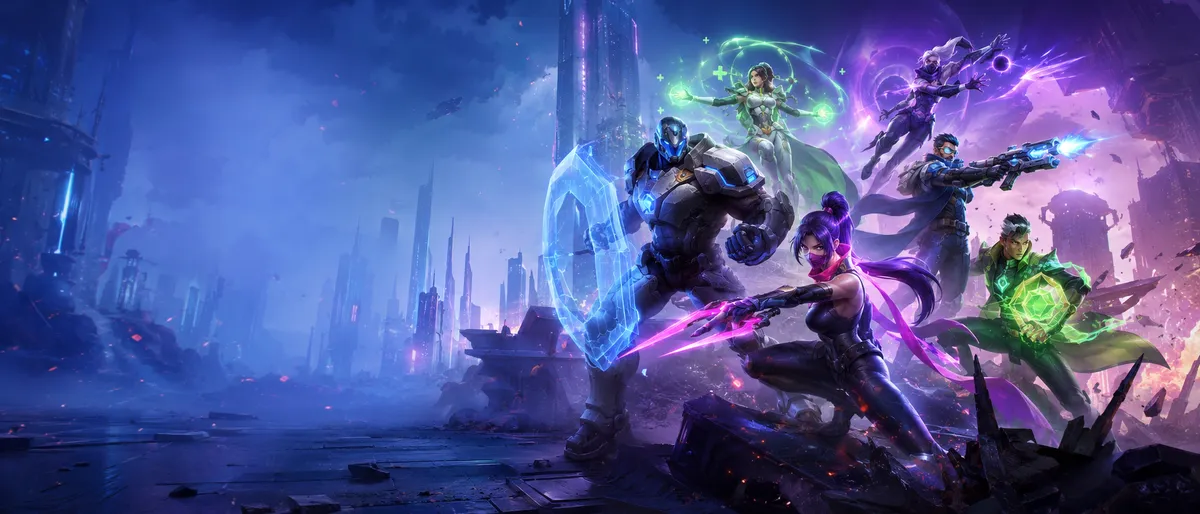
The One Comp That Works Everywhere: 2 Vanguard / 2 Duelist / 2 Strategist
If you want the easiest lineup that works in any rank, start here:
- 2 Vanguard
- 2 Duelist
- 2 Strategist
Why it works:
- You have enough frontline to touch objectives and survive dives.
- You have enough damage to actually finish targets.
- You have enough healing/utility to stabilize after mistakes.
It’s also flexible: if one player underperforms, the team still has backups in each role. That’s why it’s the best default structure for solo queue, stacks, and mixed-skill lobbies.
The “Easy Comp” Rule: Your Team Needs These 6 Jobs Covered
Before we list comps, here’s the simplest way to build lineups that don’t fall apart. Every good team covers these jobs:
- Anchor Tank (frontline holder)
- Stands on objectives, holds corners, doesn’t explode instantly.
- Disrupt Tank (space maker / peeler)
- Creates chaos for enemy supports, or peels divers off your own supports.
- Main Sustain Support (steady healing)
- Keeps your frontline alive through the first burst window.
- Utility Support (tempo / anti-dive / fight swing)
- Provides shields, speed, anti-heal pressure, crowd control, or huge objective tools.
- Consistent DPS (front-to-back pressure)
- Reliable damage into the enemy frontline and objective space.
- Pick/Angle DPS (off-angle threat)
- Creates crossfires, punishes exposed supports, finishes low targets.
If your comp has these six jobs, it will feel stable even if your team is imperfect.
Comp 1: The Balanced “Win Any Lobby” Core (2-2-2)
This is the safest, most universal lineup in the game. It doesn’t depend on one gimmick, one Team-Up, or one hero.
Best for: any rank, any mode, especially if your team isn’t coordinated.
Core idea: hold the objective with two tanks, stabilize with two supports, and win fights through crossfires from two Duelists.
Simple hero slot options (mix and match):
- Anchor Vanguard: Groot, Magneto, Doctor Strange, Peni Parker, Emma Frost
- Disrupt Vanguard: Hulk, Venom, Rogue, Captain America, Devil Dinosaur
- Main Sustain Strategist: Rocket Raccoon, Invisible Woman, Cloak & Dagger, Adam Warlock, White Fox
- Utility Strategist: Loki, Mantis, Gambit, Jeff the Land Shark, Cloak & Dagger
- Consistent Duelist: Phoenix, Namor, Hela, Moon Knight, Elsa Bloodstone
- Angle/Finish Duelist: Magik, Star-Lord, Psylocke, Black Cat, Winter Soldier
How it wins (simple plan):
- Tanks take the objective corner and protect supports.
- Supports keep tanks alive through the enemy’s first engage.
- Duelists take two different angles (main lane + side lane) and focus the same target when someone is exposed.
- After a fight win: touch/escort immediately, then set up the next corner.
Beginner-friendly rule:
If your team is losing, don’t change everything. Change one slot:
- Dying too fast → swap a support to a safer sustain pick.
- No damage conversion → swap one Duelist to a more consistent DPS.
- Supports getting dove → swap the second Vanguard to a better peeler/disruptor.
Comp 2: The “Safer Than Safe” Sustain Stack (1 Vanguard / 2 Duelist / 3 Strategist)
This lineup is popular in mixed ranks because it forgives mistakes and keeps teams alive long enough to learn objectives.
Best for: solo queue, low-to-mid ranks, chaotic lobbies, teams that keep dying first.
Core idea: outlast the enemy’s burst, win long fights, and convert slowly but safely.
Slots:
- 1 Vanguard (anchor): Groot, Doctor Strange, Magneto, Peni Parker
- 2 Duelist (consistent + angle): Phoenix/Namor/Hela + Moon Knight/Magik/Star-Lord
- 3 Strategist (2 sustain + 1 utility): Rocket/Invisible Woman/Cloak & Dagger + White Fox/Adam Warlock + Loki/Mantis/Gambit/Jeff
How it wins:
- You don’t need perfect engage timing. You win because your team stays alive long enough for enemies to run out of cooldowns.
- You control objectives through survival and repeatable retakes.
- You punish enemy teams that overchase, because your supports keep people alive while the enemy splits.
Big warning (so you don’t throw):
This comp can stall forever and still lose if nobody finishes targets. To fix that:
- Make sure at least one Duelist is a reliable finisher (someone who can confirm eliminations when a target is low).
- Use utility windows (speed, shields, anti-heal pressure) to create a short “kill window” every fight.
Comp 3: The “Break Their Tanks” DPS Pressure Comp (1 Vanguard / 3 Duelist / 2 Strategist)
Sometimes your team is stable… but you can’t actually kill anything. This is the comp that fixes that.
Best for: when the enemy frontline feels unkillable, or your team keeps losing because fights take too long.
Core idea: add damage so the enemy can’t out-sustain you, while still keeping enough support to survive.
Slots:
- 1 Vanguard (anchor or disrupt depending on map): Magneto/Groot/Doctor Strange or Hulk/Venom
- 3 Duelist:1 consistent DPS (Phoenix/Namor/Hela)
- 1 angle DPS (Star-Lord/Moon Knight/Elsa)
- 1 brawl/pick Duelist (Magik/Iron Fist/Wolverine)
- 2 Strategist: one sustain + one utility (Rocket/Invisible Woman/Cloak & Dagger + Loki/Mantis/Gambit/Jeff)
How it wins:
- Your Duelists create constant pressure from multiple angles, so defenders can’t comfortably hold corners.
- The enemy tank can’t stand on objectives forever because they’re getting burned down faster.
- Your Vanguard’s job becomes “hold space long enough for DPS to work,” not “be immortal.”
Most common mistake:
Overextending because you “feel strong.” This comp wins by controlled pressure, not by six people sprinting forward.
Comp 4: The Deathball Brawl Comp (2 Vanguard / 1 Duelist / 3 Strategist)
If your team likes fighting together in one tight group, this comp is made for you.
Best for: Domination holds, tight corridors, overtime fights, teams that struggle with split positioning.
Core idea: move as a single unit, take space with two tanks, and use layered healing/utility to win close fights.
Slots:
- 2 Vanguard (brawl + control): Devil Dinosaur/Hulk/The Thing + Groot/Doctor Strange/Magneto
- 1 Duelist (objective DPS): Phoenix/Moon Knight/Namor
- 3 Strategist (stacked sustain + fight swing): Cloak & Dagger + Rocket/Invisible Woman + Mantis/Loki/Gambit/Jeff
How it wins:
- You force fights where enemies must face your entire team at once.
- You dominate objectives because you always have bodies to touch, peel, and stabilize.
- Your supports’ big tools become harder to waste because everyone is actually inside them.
How to play it (simple):
- Stay grouped.
- Push corners together.
- Don’t chase far kills.
- When the enemy splits, you punish them by collapsing as six.
Comp 5: The Poke & Angle Control Comp (2-2-2 “Keep Distance, Win Slowly”)
This is the “we aim better and we’re not letting you touch” comp. It’s extremely strong on open maps and payload lanes with long sightlines.
Best for: Convoy maps with long lanes, teams with strong ranged players, matches where brawl comps keep running at you.
Core idea: hold space with ranged tanks and ranged damage, force the enemy to cross open space, and delete them before they reach you.
Slots:
- Anchor Vanguard: Magneto or Doctor Strange
- Second Vanguard (peel/control): Groot or Emma Frost
- Ranged Duelists: Phoenix + Hela/Namor (or another reliable ranged pressure Duelist)
- Strategists that can support at range: Mantis/Luna Snow-style spacing supports + Rocket/Invisible Woman/Cloak & Dagger
How it wins:
- You take a lane, punish anyone crossing it, and rotate early to keep distance.
- You don’t need constant eliminations. You need enough pressure that the enemy can’t enter safely.
- When the enemy finally commits, you kite backward while still shooting, then re-take the corner.
The rule that makes poke comps unstoppable:
Never let the fight become “everyone standing on the objective.” You want objective-adjacent control, forcing the enemy to touch under pressure.
Comp 6: The Dive & Collapse Comp (2-2-2 “Hit Backline, End Fight Fast”)
Dive comps are the fastest way to snowball when your team has coordination—even light coordination like “go in when I go in.”
Best for: teams with confident mobile players, matches where the enemy supports keep carrying, maps with multiple flank routes.
Core idea: your frontline and mobile Duelist pressure the backline at the same time, forcing supports to panic. Once one support falls, the fight collapses.
Slots:
- Dive Vanguard: Hulk or Venom (or another strong disruptor)
- Anchor Vanguard: Groot/Doctor Strange/Magneto (to keep your own backline safe)
- Dive/finish Duelist: Magik/Star-Lord/Psylocke/Black Cat
- Consistent Duelist: Phoenix/Moon Knight/Elsa/Namor
- Strategists (survival + tempo): Invisible Woman/Cloak & Dagger + Loki/Mantis/Rocket (depending on what keeps you alive)
How it wins:
- You don’t “poke forever.” You create one hard engage window.
- Your dive hits at the same time your anchor holds the main lane.
- The enemy either turns to stop the dive (and loses the frontline fight), or ignores the dive (and loses supports).
The mistake that ruins dive comps:
Going one-by-one. Dive must be layered:
- Vanguard pressures first.
- Duelist commits when enemy cooldowns are spent.
- Supports follow with utility that keeps divers alive just long enough.
Comp 7: The Anti-Dive “Protect the Backline” Comp (2-2-2)
Some games feel impossible because your supports die first every fight. This comp exists to delete divers and keep your team stable.
Best for: when the enemy runs constant backline pressure, or your team is losing because supports can’t breathe.
Core idea: build a comp that punishes anyone who jumps your supports.
Slots:
- Anchor Vanguard: Groot/Magneto/Doctor Strange
- Peel Vanguard: The Thing/Emma Frost/Captain America (or any tank that can respond quickly)
- Punish Duelist: Moon Knight/Phoenix/Elsa (consistent damage into divers)
- Control Duelist: Namor (zone control), or another Duelist that discourages diving
- Strategists (survivable + defensive utility): Invisible Woman/Cloak & Dagger + Rocket/White Fox/Loki
How it wins:
- You make diving expensive: divers enter, get slowed/stopped, get focused, and get eliminated.
- Once the enemy’s dive fails, their comp often has no plan B.
- Your team wins by staying alive and taking objectives in stable, repeatable fights.
Play tip:
Your supports should position so they can be peeled without your tanks leaving the objective completely. If you stand a mile away from your frontline, peel becomes impossible.
Comp 8: The Sky Control Comp and the Simple Anti-Sky Answer
Some matches become “air wars” where vertical space is everything. If the enemy controls the sky, your supports get pressured from angles they can’t see.
Best for: maps with lots of verticality, teams that struggle to handle airborne pressure.
Sky control version (if your team likes vertical play):
- Use heroes that can contest high ground consistently.
- Keep one support positioned to heal safely while your vertical players take angles.
Anti-sky answer (if the enemy is dominating from above):
- Run a Vanguard that can protect your damage dealers and force aerial threats into uncomfortable positions.
- Add at least one Duelist whose job is “deny sky angles,” not “chase kills.”
- Play tighter around cover so aerial pressure doesn’t get free sightlines.
The key concept:
You don’t counter sky comps by panicking. You counter them by controlling the safe ground space where your team can fight without being exposed from above.
How to Swap Mid-Match Without Destroying Your Team Comp
Marvel Rivals is built around adaptation. The biggest mistake is swapping randomly until your team has no structure.
Use this swap system instead:
Step 1: Identify the problem
- Are supports dying first?
- Is your tank exploding instantly?
- Are fights lasting too long?
- Are you winning fights but not converting objective progress?
Step 2: Swap one slot to fix one problem
Examples:
- Supports dying first → swap a support to a more survivable pick or swap second Vanguard to a better peeler.
- Tank exploding → swap to an anchor tank or add a second sustain support.
- Fights last forever → swap one Duelist to a consistent finisher or swap utility support to something that helps secure eliminations.
- No objective conversion → swap one Duelist to an “area owner” style that controls the objective space.
Step 3: Keep the 6 jobs covered
Even after swaps, your comp should still have:
- an anchor
- a peeler/disruptor
- a main sustain support
- a utility support
- consistent DPS
- angle/pick DPS
Objective Tweaks: Domination Team Comp Tips
Domination rewards two things more than anything:
- the ability to touch and survive
- the ability to hold corners around the point
Best comp styles for Domination:
- Balanced 2-2-2
- Deathball brawl
- Anti-dive protect backline
Domination comp rules that win games:
- Have at least one tank whose job is “touch responsibility.”
- Have at least one support with a strong defensive tool for retakes.
- Have at least one Duelist who excels at punishing predictable touches (overtime pressure is real).
Objective Tweaks: Convoy Team Comp Tips
Convoy rewards:
- forward space control
- survivability on corners
- pressure that denies easy contests
Best comp styles for Convoy:
- Poke & angle control (especially on open lanes)
- Balanced 2-2-2
- DPS pressure comp (when defenders are over-sustaining)
Convoy comp rules that win games:
- Don’t build a comp that needs close-range brawls if the map is wide open and long-range pressure dominates the lane.
- Keep at least one tank that can contest safely and at least one Duelist that can punish contests from an angle.
- Supports should prioritize survival and rotation; Convoy fights shift constantly.
Objective Tweaks: Convergence Team Comp Tips
Convergence is two games:
- a capture-style fight (tight, explosive)
- an escort-style fight (stretched, rotational)
Best comp styles for Convergence:
- Balanced 2-2-2 (best overall)
- Dive & collapse (great on capture chaos)
- Poke (great on escort lanes with strong sightlines)
Convergence comp rules that win games:
- If you win capture, don’t “auto-win” escort. Reset positions like it’s a fresh round.
- Build at least one tool for retakes (defensive support utility or tank control).
- Keep your comp’s fight distance consistent (don’t mix half poke and half brawl unless your team really understands timing).
Easy Team-Up Synergy: The Shortlist That’s Actually Worth Building Around
Team-Ups can make a comp feel unfair, but only if you treat them as part of your plan—not a random bonus.
A simple approach:
- Pick one strong Team-Up your team can access naturally.
- Build the comp’s playstyle around it (brawl, poke, dive, sustain).
- Use the Team-Up during objective fights, not during low-stakes poke.
If you’re trying to keep things easy, prioritize Team-Ups that:
- help your team survive on the objective
- help your team secure eliminations during forced touches
- don’t require perfect coordination to get value
The biggest Team-Up mistake is forcing a “cool pairing” while your comp’s fight distance doesn’t match. A brawl Team-Up won’t carry you if your team is spread across three rooftops.
The Biggest Team Comp Mistakes That Lose Games
Avoid these and your win rate improves immediately:
- No real healing: one support is rarely enough for long objective fights.
- All damage, no space: you get eliminations but can’t stand on objectives.
- All tanks, no conversion: you never die, but you also never finish anyone.
- Everyone picks their favorite hero with zero synergy: your team has no shared fight plan.
- Split fight distances: half your team wants long-range angles, half wants close brawls, so nobody is in range to help anyone.
- No peel plan: supports die first, the fight ends before it starts.
- Winning fights and not converting objectives: the most painful throw in Marvel Rivals.
Solo Queue Fixes: What to Do When Your Team Won’t “Run a Comp”
You can’t control teammates, but you can choose picks that create structure anyway.
If your team has no supports
- Pick a safer hero and play tighter around cover.
- Avoid deep flanks.
- Focus on fast fights and objective touches, not long brawls.
If your team has no tanks
- Pick a survivable hero that can touch objectives in emergencies.
- Play corners and force fights near cover.
- Don’t take open-lane duels unless you have a clear advantage.
If your team has too many tanks
- Pick damage that converts space into eliminations.
- Focus enemy supports and low targets.
- Stay near objective so your tanks’ space actually matters.
If your team has too many Duelists
- Pick one Duelist who can play “objective owner” and stop chasing.
- Use soft angles near your team instead of deep solo flanks.
The solo queue rule that wins games:
Pick the hero that fills the biggest missing job, not the hero you wish your teammates picked.
BoostRoom: The Fastest Way to Make Team Comps Feel “Easy”
Most players don’t lose because they chose a “bad comp.” They lose because their comp has no clear plan:
- nobody knows who touches
- supports aren’t protected
- damage happens away from the objective
- swaps happen randomly
- ultimates and Team-Ups are used in low-value moments
BoostRoom helps teams and solo players turn comps into consistent wins by focusing on:
- building a small set of easy comps you can run on any map
- learning role jobs so tanks create space, Duelists convert, and supports control tempo
- teaching objective-first conversions (win fight → capture/escort → set up next corner)
- improving mid-match swaps so you fix the problem without breaking your structure
- helping you recognize comp win conditions quickly (brawl vs poke vs dive vs anti-dive)
If you want fewer “coin flip” matches and more controlled wins, learning simple comps (and how to pilot them) is one of the highest-impact upgrades you can make—and BoostRoom is built around that kind of practical improvement.
FAQ
What is the best beginner team comp in Marvel Rivals?
The easiest beginner comp is 2 Vanguard / 2 Duelist / 2 Strategist. It’s balanced, forgiving, and works on every mode.
Do we always need two Strategists?
For most teams, yes—especially in objective modes where fights last longer. Two supports give you stable healing plus utility for retakes and anti-dive defense.
When should we run three Strategists?
When your team keeps dying first, when fights are chaotic, or when you want a safer “learn the game” lineup that outlasts opponents.
When should we run three Duelists?
When you’re stable but can’t finish targets—especially if the enemy is over-sustaining their frontline. More DPS helps break stalemates.
What’s the biggest sign our comp is broken?
Your supports die first every fight or your team can’t touch objectives without instantly collapsing. Fix those two problems first.
How do we know if we should play dive or poke?
If the map has long open lanes and your team has strong ranged pressure, poke is easier. If the map has many flank routes and you can reach supports reliably, dive can win faster.
Do “meta” comps matter in low ranks?
Not as much as structure. In low ranks, the team that stays together, touches objectives correctly, and avoids stagger deaths usually wins—even with non-meta heroes.



