What a Battle Pass Is (Simple Definition)
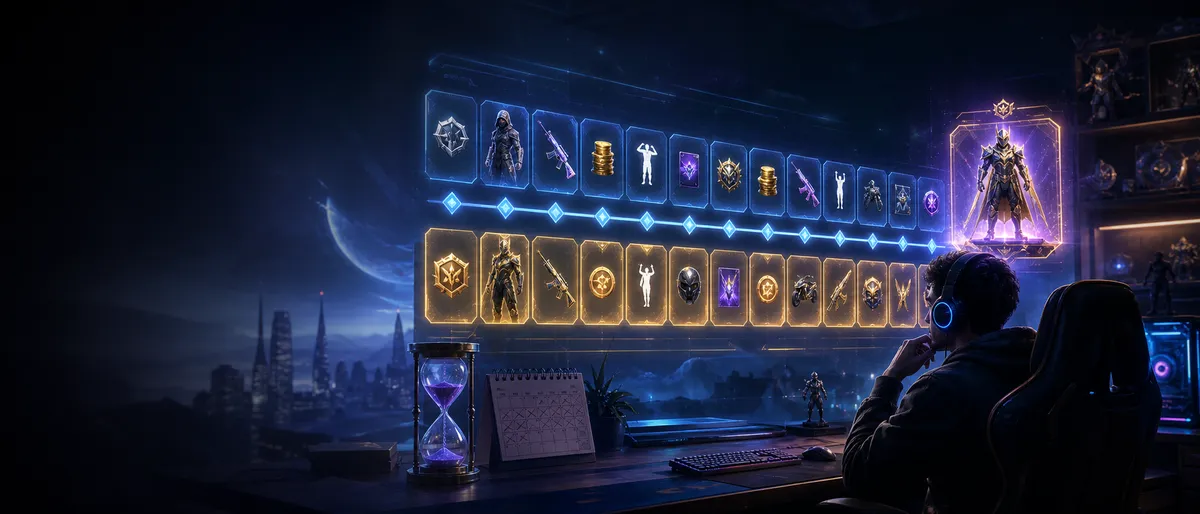
A battle pass (sometimes called a “rewards track”) is a seasonal progression system where you earn rewards by playing the game and completing tasks. Most battle passes have two layers:
- Free track: rewards anyone can earn without paying
- Premium track: extra rewards you unlock after buying the pass
The pass usually lasts for a limited season. You earn experience (XP) or progress points by playing matches and completing challenges. As you level up the pass, you unlock cosmetics and other items—often with the most desirable rewards near the end.
The key idea: battle passes are designed to reward consistent play during a limited time window.
Why Battle Passes Became So Popular
Battle passes exploded because they solved two problems for online games:
- Players wanted predictable rewards (instead of gambling-style randomness)
- Games needed steady revenue to fund servers, updates, and new content
A battle pass is “predictable monetization”: you can see what you’ll get before you buy, and your progress is tied to playing the game rather than luck.
But “predictable” doesn’t automatically mean “healthy.” Battle passes can still create pressure through time limits and challenges.
What Battle Passes Usually Contain
Battle pass rewards vary by game, but most include combinations of:
- Character skins and outfits
- Weapon skins / item skins
- Emotes, sprays, banners, profile frames
- Music packs or lobby themes
- In-game currency (sometimes enough to buy the next pass if you complete it)
- Crafting materials or cosmetic currency
- Boosters (XP boosts, sometimes limited)
- Special “tier 100” or “final tier” reward (often the most desired cosmetic)
Some games also sell:
- Pass bundles that include tier skips
- Premium+ versions that add instant rewards and extra cosmetics
The Real Cost of a Battle Pass (It’s Not Just Money)
When people ask “Is it worth it?” they usually mean price. But a battle pass costs four things:
- Money (or in-game currency you bought with money)
- Time (hours needed to complete it)
- Attention (daily/weekly planning, checking quests, decision fatigue)
- Mood (stress, FOMO, burnout, “I have to play” feeling)
A pass can be a great deal in money terms and still be “not worth it” if it:
- makes you play modes you hate
- pressures you into daily logins
- causes burnout
- leads to regret spending
So the best question isn’t “Is the pass cheap?” It’s:
“Will I enjoy the process of earning it?”
The Three Types of Battle Pass Players
Most people fall into one of these groups. Your group determines whether the pass is worth it.
1) The Natural Player
You already play regularly. You don’t need the pass to “force” you to log in.
Battle passes often feel worth it for you because you progress naturally.
2) The Seasonal Player
You play hard for 1–3 weeks, then disappear.
Battle passes can be worth it only if there’s catch-up or you buy late after you see your progress.
3) The Casual Drop-In Player
You play a few times a week or only with friends.
Battle passes are often NOT worth it unless the game has very flexible progression and you’re okay skipping most rewards.
Knowing which one you are is the fastest way to avoid regret.
How Battle Passes “Hook” You (Without You Noticing)
Battle passes are designed around human psychology. Understanding that design helps you stay in control.
FOMO timers
A season ends, the track resets, and some rewards may not return for a long time (or ever). That creates urgency.
Progress bars
A visible bar that’s “almost done” is extremely motivating—even if the reward isn’t that important to you.
Daily/weekly checklists
Checklists feel satisfying. But they also turn play into chores if the tasks aren’t fun.
Artificial scarcity
Limited skins, limited styles, and limited challenges create “must-do” pressure.
Sunk cost
After you buy, you feel like you must finish—even if you stop enjoying it.
A healthy approach is not to hate the system—it’s to use it intentionally.
The Big Question: Are Battle Passes Worth It?
Battle passes are worth it when all three of these are true:
- You want the rewards (not just “I might want them”)
- You will play enough anyway (without forcing yourself)
- You enjoy the activities that earn XP (modes and challenges feel fun)
They are usually not worth it when:
- you’re buying “just in case”
- you’re already busy or burned out
- you only want one or two rewards far into the track
- you don’t like the challenges but feel pressured
- you’re spending money you’ll regret later
A pass doesn’t become worth it because it has “100 tiers.” It becomes worth it when it matches your life.
A Practical “Worth It” Calculator (No Math Needed)
Use this step-by-step checklist before buying any battle pass.
Step 1: Pick your top 3 rewards
Look through the track and choose the only three rewards you truly care about.
- If you can’t name 3, you’re buying out of habit—not value.
Step 2: Check how deep they are
Are your top rewards early, mid, or near the end?
- If your favorite reward is at the end and you’re not a consistent player, risk of regret is high.
Step 3: Estimate your realistic playtime
Ask yourself honestly: “How many sessions per week can I play?”
- 1–2 sessions/week = most passes are hard to finish
- 3–5 sessions/week = finishing becomes realistic
- daily play = most passes are easy to finish
Step 4: Ask the most important question
“Would I play this game this month if there were no battle pass?”
- If no, the pass is probably a trap for your time and money.
Step 5: Decide your “finish level”
Instead of “I must complete it,” decide:
- “I’m happy if I reach my reward #1 and #2.”
This removes pressure and instantly reduces burnout.
The “Earn Back Currency” Trap (And How to Think About It)
Some games design battle passes to return enough in-game currency to buy the next pass—if you complete it. This can be a great value feature, but it can also create a trap:
- You feel like you “must finish” or you “lose value.”
- You treat the pass like a job to “pay for itself.”
A healthy mindset:
Currency return is a bonus—not a reason to buy.
If you enjoy the game, it’s great. If you don’t, it becomes pressure.
Also note: games can change their pass economics over time (price, reward amounts, bonus currency, additional pass types). Never assume “it always works the same.” Always check the current season details before buying.
Tier Skips and “Bundle” Versions: When They’re Worth It
Many games sell:
- Battle pass bundle (pass + tier skips)
- Premium+ versions with extra instant items
These can be worth it only if one of these is true:
- You have limited time but want late-tier cosmetics
- You’re joining late in the season and want to catch up
- You’re buying for cosmetics you truly love and will use
They are usually not worth it if:
- you’re buying skips because you’re stressed
- you’re trying to “save the pass” after missing weeks
- you don’t even like most rewards
A good rule:
Never buy tier skips while tilted or panicking about time.
That’s when regret spending happens.
Battle Pass vs Season Pass vs Subscription (Don’t Confuse Them)
These terms sound similar but work differently:
Battle pass
You pay for a seasonal reward track. You still need to earn XP to unlock rewards.
Season pass (classic)
Historically, a season pass meant you pay for future downloadable content (DLC packs). In modern games, “season pass” sometimes means a seasonal bundle of content access, not a reward track.
Subscription
You pay monthly for ongoing access or benefits (game library access, monthly currency, premium perks).
Battle passes are usually the “lightest commitment” because they’re seasonal, but they can still create pressure because of the time limit.
Battle Passes and Pay-to-Win: What’s Safe and What’s Not
A battle pass feels fair when:
- rewards are mostly cosmetic
- gameplay power isn’t locked behind money
- premium rewards don’t give competitive advantages
A battle pass feels unfair when:
- premium track gives meaningful gameplay power
- pass-only items dominate the meta
- progression affects competitive integrity
For competitive online video games, most players prefer passes that are cosmetics-only or cosmetics-heavy. Even casual players tend to quit games that feel like spending is required to keep up.
Battle Pass Fatigue: Why Players Burn Out
“Battle pass fatigue” is real. It happens when:
- too many games demand daily logins
- seasons are too short
- challenges feel repetitive
- there are multiple passes at once (main pass + event pass + side pass)
- your friend group pushes you to keep up
Symptoms of battle pass fatigue:
- you log in, stare at menus, and feel tired
- you play modes you don’t enjoy just for XP
- you start skipping friends because you’re grinding tasks
- you feel relief when a season ends (instead of excitement)
If you feel this, the solution is not “push harder.” The solution is better boundaries.
The No-Burnout Battle Pass Strategy
This is the simplest plan to enjoy battle passes without letting them control you.
Rule 1: Buy late, not early (when possible)
If the game lets you buy the pass at any time and still claim earlier rewards, consider waiting until:
- you’ve already progressed far enough to feel confident
- you know you’re still enjoying the season
This is one of the best ways to avoid regret spending.
Rule 2: Choose a “main game”
If you try to complete passes in 3 games at once, you create guaranteed burnout. Pick one main pass per season.
Rule 3: Make XP feel natural
Play modes you actually enjoy. If challenges force modes you hate, skip them unless the reward truly matters.
Rule 4: Make a weekly plan, not a daily plan
- One or two focused sessions for weekly challenges
- The rest of the week: play for fun
Rule 5: Stop at your target reward
You don’t need 100% completion for the pass to be worth it.
Best Practices for Casual Players
If you play a few times a week, battle passes can still be worth it—but only with a casual-friendly approach.
- Only buy after you’ve progressed far enough naturally
- Pick 1–2 rewards you truly care about
- Ignore the rest without guilt
- Avoid daily login pressure
- Don’t chase “perfect completion”
- If you miss a week, accept it and keep playing for fun
Casual truth: If a pass makes you feel stressed, it’s not worth it for you.
Best Practices for Competitive and Ranked Players
Ranked players often get trapped because they already play a lot—and passes are layered on top.
- Don’t let pass challenges ruin your ranked focus
- Use battle pass grind sessions in casual modes, not ranked
- Keep your ranked routine stable (warm-up, focus goal, stop-loss rule)
- Avoid changing your playstyle just for XP if it hurts your performance
- If the pass requires a time sink, decide if that time is better spent improving skill
A great ranked mindset:
Skill improves your results forever. Pass rewards are temporary.
Best Practices for Teens and Families (Safe Spending and Healthy Gaming)
If you’re under 18, battle passes need one extra layer: safe spending rules.
- Always follow family rules for purchases
- Ask before buying if your family payment method is connected
- Use platform spending controls if available
- Set a monthly limit (even if it’s $0)
- Never buy while frustrated or emotional
- Never share account passwords or verification codes with anyone
- If you feel pressured by FOMO, pause and wait 24 hours
A battle pass is never worth stress at home or regret spending.
How to Finish a Battle Pass Faster Without Playing All Day
You don’t need to grind endlessly. Most passes reward efficient XP, not maximum hours.
Here are safe, general strategies that work in many games:
- Focus on weekly challenges first (they often give the most progress)
- Combine objectives in one match/session (multi-goal efficiency)
- Play modes that naturally produce consistent XP (often longer modes or objective-focused modes)
- Play with friends if the game rewards party play or team success
- Avoid wasting time in menus—queue and play with a plan
- Keep sessions short enough to avoid tilt and sloppy play
The “secret” is structure. Random grinding is slower than planned play.
The “Buy Late” Method (The Safest Way to Avoid Regret)
If you’re unsure, do this:
- Play the season without buying the pass
- Track your progress for 1–2 weeks
- If you’re naturally reaching the rewards you want, then buy
- Claim all premium rewards instantly for levels you already earned
This method works because it reverses the usual trap. You’re not paying to hope you’ll play—you’re paying because you already did.
When a Battle Pass Is Definitely Worth It
A battle pass is almost always worth it when:
- you love the game and would play anyway
- you like most of the cosmetics
- you consistently finish seasons
- you enjoy the challenge style
- you want predictable rewards instead of random drops
It’s also often worth it if:
- the pass replaces other spending you’d do anyway (like buying multiple skins separately), as long as you truly want the rewards.
When a Battle Pass Is Definitely NOT Worth It
Skip the pass when:
- you’re busy and won’t play enough
- you’re burned out or tilted with the game
- you only want one reward at the very end
- you’re buying because friends pressured you
- you’re spending money you might regret
- the pass feels like chores instead of fun
A strong personal rule:
If buying the pass creates anxiety, don’t buy.
BoostRoom: A Smarter Alternative to Grinding
Battle passes often push you to spend either:
- money (tier skips)
- or time (grind)
BoostRoom gives a third option: spend on skill, so your playtime becomes more efficient and more fun.
How BoostRoom helps battle-pass seasons feel easier:
- Coaching: learn smarter strategies so challenges and matches take fewer attempts
- VOD reviews: stop repeating mistakes that waste time and cause tilt
- Team sessions: coordinate with friends so objectives and wins come faster
- Improvement routines: build a weekly plan that fits your schedule without burnout
Instead of “grind more,” BoostRoom supports “play better.” That often means:
- you finish objectives faster
- you win more without stress
- you enjoy your sessions more
- you stop feeling controlled by timers
If the pass is making you play in ways you hate, improving your fundamentals can make the entire season feel lighter.
BoostRoom Tips for Sellers: Ethical Services That Fit Battle Pass Seasons
If you offer services, battle pass seasons create huge demand—but the best sellers stay skill-first and safe.
High-value, ethical service ideas:
- “Battle pass efficiency coaching” (how to progress faster through smarter play)
- “Weekly challenge planning session” (help buyers plan what to do, not do it for them)
- “VOD review focused on pass objectives” (why objectives fail and how to fix it)
- “Duo/squad coordination for faster wins”
- “Beginner coaching to reduce frustration”
Best seller rule:
Offer help that improves a player’s skill and experience—avoid risky shortcuts that require account access.
FAQ
Are battle passes worth it in online video games?
They’re worth it when you want the rewards, you’d play anyway, and the challenges fit your playstyle. They’re not worth it when they create stress or force boring chores.
Is it better to buy a battle pass at the start or later?
If you’re unsure, buying later is safer. Play first, see your natural progress, then buy if you’re on track for the rewards you want.
Do battle passes make games pay-to-win?
Not always. Many are mostly cosmetic. A pass becomes problematic when premium rewards provide meaningful gameplay power that affects competitive fairness.
What if I can’t finish the battle pass?
That’s okay. Choose a target reward level so you still get value without forcing completion. Buying a pass only makes sense if you’re comfortable with the progress you’ll realistically reach.
Are tier skips worth it?
Only when you truly value late-tier rewards and your time is limited. Avoid buying skips out of panic, frustration, or FOMO.
How can I finish a battle pass faster without grinding all day?
Focus on high-value weekly challenges, combine objectives efficiently, avoid menu time, and play with a plan. Skill improvement also makes objectives easier.
How does BoostRoom help with battle pass seasons?
BoostRoom helps you improve skill and efficiency, so you complete challenges faster, win more smoothly, and avoid burnout from grinding.



